Untouched for 10 Years – We Finally Opened This Abandoned Hive and Saved the Colony
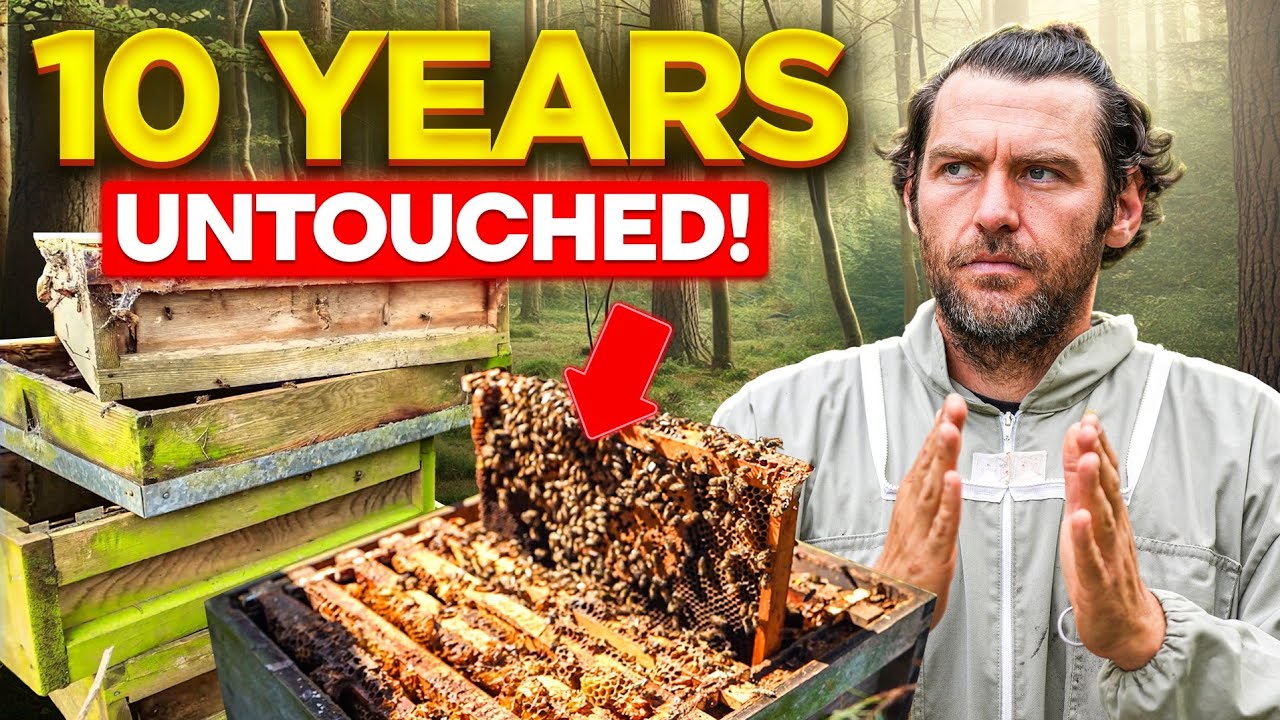
In this video, the Black Mountain Honey beekeeper opens a long‑abandoned beehive that appears to have been untouched for at least a decade. He documents the hive’s unusual three‑layer frames, extreme propolis buildup, and irregular frame spacing that makes inspection difficult. While extracting frames, he discovers a strong ling‑heather honey, multiple Apiguard (thymol) treatment trays, and heavily granulated, capped stores that were initially mistaken for brood. The presenter identifies clear signs of a severe varroa mite infestation, including dead bees with protruding tongues, spotty brood, and deformed wing virus symptoms, and notes the presence of dark‑coloured bees likely representing a local Apis mellifera mellifera mongrel. He evaluates the risk of contagious diseases such as American or European foulbrood, concluding that the colony’s health is too compromised to relocate. Instead, he leaves the equipment on site, offers the hive to interested parties, and invites viewers to follow future updates on the colony’s fate.
Chapters
Very strange. You don't often see that frame there. It's crazy, isn't it? You think that was brewed. It's definitely not though. The bees do not like it, but there's no real other way of doing it. Three layer frame, really, really deep. Oh, the frame spacing is just wild here. Proper, proper wild. Probably my favorite type of video doing this, and that patio slab is ridiculously heavy. Wow! That's probably the heaviest patio slab I think I've ever picked up. We'll toss that to the side. Look at that crown board. That is. About as old as you're gonna get. So we'll just crumple that up. Right, so next step, castellated supers. Always find it interesting with stuff like this, the kind of last beekeeper who came here, what was his reasoning? Why is frame number 2 and frame number 10 missing in here? Got one bee, that's the first bee coming up. But let's have a look at these combs, see how old they are. Obviously struggling for food here, there's not much food in there. Right, first few bees you can see are starting to jump up. Look at how they've propolised that queen excluder. That is absolutely wild. But we have got bees in here. There's definitely bees. You can see them flying up. This is the super. So there's a queen excluder, they're on brood and a half, and then there's a super underneath and a brood box. So I'm guessing that there's gonna be a relatively good-sized colony in here. So you can see just how old that is, flimsy and fragile, but in perfectly usable condition, covered in propolis. I love that. And then we're into the brood and a half super. And again, look at this incredible Incredible wax and propolis structure that you've got here. You can see all of that detritus over the years and then all of the wax that they've built up and all of the really cool propolis and propolizing structures that they've put together. You can see how wet it is over in that corner as well, the darkness that's happened as a result of damp. The bees are kind of covering just this section here, although we do have some bees in this corner here, so this could be a reasonable-sized colony. Right, so first thing I'm going to do is I'm going to try and take this super And that is glued shut like I've never felt anything glued shut before. I might need to get like a makeshift hive tool. Right, I've just got in there. I've cracked the seals. As I suspected, all of the frames underneath are sticking to the top box as well, so we're going to need to twist it round. The, the good news is there's lots and lots of bees in there. Huge, huge amount of bees. You can see there now bees coming in and out of the entrance, and I have to say they do look quite dark, these bees. So these are probably some sort of Welsh Black local mongrel. But the majority of the bees are relatively dark. These will be kind of like a high percentage of Apis mellifera mellifera, but with some kind of local mongrelization as well. Okay, it's not a hive tool, but I've got my Leatherman Raptor here, which is for cutting people out of seat belts. You know, I've got one in the car. You gotta have everything. But this will work as a really good hive tool. So what I'm gonna do is I'm gonna use this as a hive tool, starting to pull some of these frames out now. And I'll show you each frame one by one before I put it back in. So frame number 1, honey and an unmistakable smell of ling heather. Oh, that is absolutely delightful. Really, really nice. A big, strong, gelatinous ling heather. I am going home, taking a frame of that home. We are gonna taste that. That looks amazing. There we go, got that one out. But another beautiful frame of honey or stores there. You can see down there we've got an Apiguard treatment, so none of this honey's gonna be good to eat, unfortunately. Right, next frame. Interesting, that frame has just completely broken away. Ah, this is what happens when you have frames that are like fully propolised together like this. It is an absolute pain. You just get bits keep on breaking off. I'm not going to break all of the frames here though. I'd prefer to leave the bees to it, and if we can get access to that bottom brood box just to do a brood check, that will make it a bit easier. I'm not gonna lie, that fooled me a bit. I thought just kind of At first that was brood. It's not, it's just capped stores. Really looked like brood because if you can look kind of in the middle there, you'll see that there is granulated stores as well. So the granulated stores was white, thought that was larva and capped stores, but it's not. Closer inspection is quite clear that that is just capped stores of a different color and then granulated stores, open granulated stores in the middle. But look at that for a frame, completely wild. I reckon what's happened here is some of this foundation has kind of come out or it's been eaten, probably eaten away by a mouse or something, and then the bees are trying to build it all back together as best as they possibly can. And you can see it's making a little bit of a mess down there, which is— well, again, similar thing on that frame there. It's crazy, isn't it? You'd think that was brood. It's definitely not though. I am going to uncap a bit of it just to see what's kind of on the inside of it. But very strange, you don't often see that color differentiation like that there, where you've got like— that's capped stores. Looks to me like this is capped stores as well, but From afar, it really does look like brood. So let's just open it up and just kind of confirm that. Yep, so it's definitely capped stores, and the reason it's gone such a strange color is that it's just so incredibly granulated. Look at that. I know you're thinking, it's lava, it's lava. It's not, it's definitely not. It's something very hard. Yeah, it's sweet as well. It smells sweet. So confident that that is just really dried, old, granulated stores that they've capped over in a very strange way. So while we've got access to this, let's get this Apiguard tray out. That is going to be main reason I think that they're gluing stuff together down there. So that there, for anyone that doesn't know, is just a tray that you have some thymolated gel and then you use that to try and kill varroa. So what would be really, really good is if there was some sort of date on here, but I don't think there is. Look at all that propolis in there. Brilliant amount of propolis. I love that. That is super, super cool. Oh, I just love the smell of propolis as well. It's one of my favorite things. That is pure propolis there. But how cool is that? This is a proper, proper abandoned beehive full of bees, not been touched for 10 years at least, I would say. Could be 20, could be 30, could be 5, but I reckon by the state of the frames, the fact of how old and propolized everything is together, we're looking at double digits here for you. Bees all the way down there on that bottom surface. Top box is full to the brim with honey. Lots of stores, even though it's granulated, the bees will be working that consistently. This is a really cool find. So we will persevere. Remember the reason that we're doing this, we want to try and find some brood and we want to assess that brood to see if the brood is healthy. We're looking for signs of EFB, which is European foulbrood, and AFB, both incredibly contagious diseases that will spread across all of the bees in the local area if not kept in check. So very, very similar frame, that one. We won't go messing around with that one. But how good do those frames of honey look? Look at that. We're going to have to have a taste at some point, even though that thymol has been in there. I'll be able to detect if there's kind of any taste going in. Those trays could have been in there and emptied way before they collected this honey, so it might be okay. Right, so let's lean in. Oh, they're so stuck in. Right, there you go. There's another Apiguard tray. Right, so there we go. That is every frame out. I'm just going to take that top box, which you can see comes off really easily now. And I'm going to pop it directly down there. Look at this. That is a quality, quality brood box of bees. Very interesting spacing though. And this is why everything's gone a little bit crazy here. They're using wide spacers in the brood nest, which is just like the worst thing in the world that you want to do. You want to use standard DM4s in there. Basically all of the frames should be nudged up a bit closer together and you wouldn't have this wild comb everywhere. But let's get into the brood box. see if we can find some brood, and more importantly, see if we can find that queen. Right, so this is always the fun bit. This is the bit where they go for you if they're gonna go for you, because I'm going into their brood nest and they do not like people going into their brood nest. Look how much everything is stuck together there. That is wild how much it's stuck together. You can see as I go like that, look, everything's just moving kind of all at once. The bees do not like it, but there's no real other way of doing it. I need to break these frames apart in order to start getting them out. Because the spacing is just not right in this box, the bees are gonna get really angry with me. You can see here All of the combs are kind of extended out within the other combs, so they just become like one homogenous piece of bee comb. Very, very difficult to take apart. Once I've got the first one out, should, I'm hoping, make it just a little bit easier to work. All right, let's get that first one out. No, it's exactly what I thought. We're gonna have to do this in sections. So we're just gonna have to take out that whole section there. Can't see any brood in here. That's really, really annoying. I wanted some brood down here. Because brood means that I can move them today. See what I mean about the spacing's wrong, so everything's just kind of like falling apart. You're really, really careful. I don't want to drop the queen anywhere here. But you can see as I'm opening that up, it's incredibly sticky. Oh, the frame spacing is just wild here. Proper, proper wild. You know, if I was a queen, I'd be going underneath here. That would just be the easy place to hide. And I'm reluctant to start breaking everything up just at the moment. What would be very, very nice is if we just Found the queen quite early on, so I'm just going to rest that there. Give myself a little bit of space to work, and we're just going to kind of carry on, persevere, and just hope that the queen is over there somewhere. So you can see very, very old dark frames there. No sign of any brood. Oh no! Tell a lie. There is a sign of brood, and there is a sign that those apivar strips, apigard strips I should say, have not been effective. Right. So look over here. That is not a good sign. So what we're seeing there is. Signs of capped brood, bees with their tongues out, spotty brood. To me, very, very clear indication there. Heavy, heavy varroa load, and I'm talking severe heavy varroa load there. Let's get that to focus. Deformed wing virus there. Quite a lot of bees with deformed wing virus I'm seeing now. Again, that's another sign of a virus that is carried by the varroa that is causing all of this damage over here, but they are not in a good state at all. So as I said, look at that brood there. You can see the tongues coming out. Patches of brood like that, not a good indicator. Not thinking it's AFB or EFB, but it could be. Just because we're not seeing the obvious signs of that doesn't mean it's not here. But what we 100% can see is varroa. Dead bees inside with their tongues hanging out, that is classic varroa. And then deformed wing virus, that is another classic varroa sign. So without a doubt, we've got super, super high varroa loads. Look, if we turn that over, we're seeing Exactly the same thing again. High mortality rate in that brood. Very, very unhealthy bees here. There's no way that I'm taking these home. There's just way, way too much risk involved here. Way too much varroa for my liking. Let's try and separate it a bit. Let's get these ones out. There's not much in these ones over here, even though they're completely stuck together. Wow, it's just carnage. Look, you can see we've got old ones like that, and this is what almost certainly would have happened. That frame there Good indication of what this is probably like 6 months ago, because the bees swarm in, the varroa gets too much, they abscond, leaving behind everything, the brood, the honey, anything that's left. The mice come in, they rip everything down, they leave it like this, and then the bees come back in and they draw everything back out again. But it's not neat, the spacing's wrong, you've got these random kind of wired frames like that, and the bees just do what they want. And you end up with— perfect example here, look at this frame. And you end up with a frame like that, which is just impossible to inspect. Kind of, could you get a frame that was more all over the place than that? I don't think you could. Like a 3-layer frame, really, really deep. Cool, but a nightmare. Right, so it looks like we're out from where the majority of that brood is. I'm just going to move that frame. We'll just open up these last 2 just to see. Oh, again, they're stuck badly together. All right, there we go. Again, look at that. Wild. Absolutely wild. You can see in there crystallized stores in there. Again, more crystallized stores. They're doing okay for food. That's something that they definitely thrived on. And they've gone out. There's ling heather up here. They've obviously taken the ling heather and they're doing very, very well on it. So they're not going to die through starvation, but I'm almost certain that they are going to die through absconding due to a high varroa load. Potential AFB, potential EFB. So I'm not touching this colony of bees. There's no way this is coming back with me. I'll leave all of the boxes here and I will give them to someone. I'll put a little advert out there and say, who wants to come and get these bees? An abandoned colony of bees, not looking good. Hive varroa, lots of stores, potential disease risk. If you enjoyed that and you want to know the next update on this colony, definitely hit the subscribe button. We've got loads more content at Black Mountain Honey.










