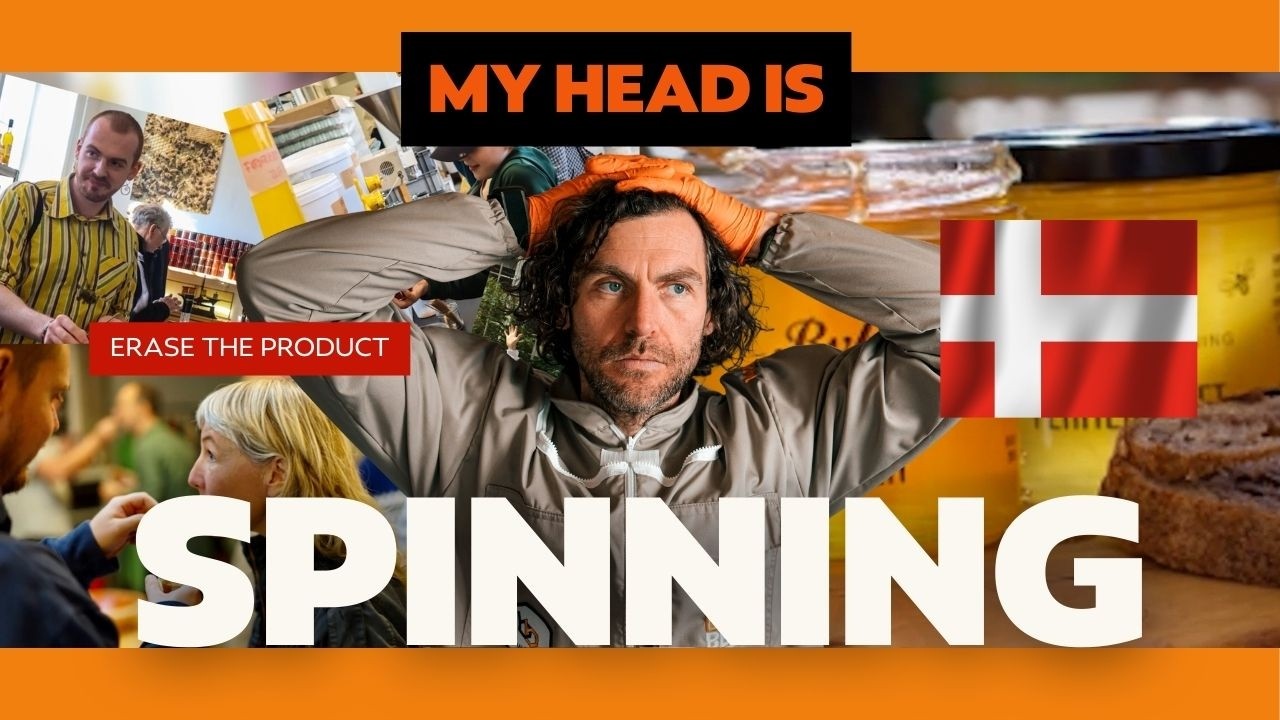
Bubi, a Copenhagen social enterprise, runs rooftop beekeeping as a regenerative network of bees, plants, and people rather than a product business. They frame honey as an invitation to build relationships, not a commodity, and work with artists, researchers, and schools to center the bee's perspective first.
Chapters
We have to answer that question with a yes. Of course we do. We never use the word— So, Bubi is a social enterprise. We work with bees on rooftops across Copenhagen. But what we are really is a community of animals and plants and people, bees, flowers, and people. We're interested in what would it take for this community to thrive. We follow a philosophy called regeneration, and what this is really about for us is a question. That question is, do we believe that we have as much potential to do good for the living world as we have to destroy it? We have to answer that question with a yes, of course we do. But if we believe that, then really our responsibility and yours, every living being on the Earth today, is to activate that potential in ourselves, in each other, but also in the other animals and plants around us. And that's really what we're trying to do. We have a very special language in what we do here at Bubi. We're not interested in consumers, we're interested in co-creators. Everybody we meet needs to be invited needs to be a part of this community and contributing to it in some kind of way. We never use the word product. For us, honey is an invitation. It wants something. We need to make sure that that invitation really sings and really demonstrates what a currency it can become when it connects people with each other, but also people with the bees and people with the plants that surround us in these landscapes. For us, the question isn't really about how to make More honey. What's a much more interesting question is, what is it like to be a bee? Are they happy? How do we know? How do we come into their world? And that's why when we work here in the city, we don't really work with kind of businesses or supermarkets. We work with artists, with researchers, with dancers, with theatres. We work with schools. And when we work with children, we don't teach them about how to make honey. We run out into the gardens and parks. We tickle each other with grass. We try and understand what it's like to be a bee first, and then all of the questions about where honey comes from, how it's made, emerge from that. We work with a network of different companies and organizations. Each one is a little different. We work with each one on its own terms, and we always try to insist with the people that we work on, this is not a question of honey production, it's not a question of us delivering a product, it's a question of building a relationship. We try and find ways together to make the honey circulate in such a way that everything it touches encourages people to contribute to the plants and animals of the city, but also to share with each other. What we say is that there's 2 really rules that are associated with honey. This is kind of our dogma. The first is that you have to say thank you to the bees. You do that, of course, by planting a flower. The second is that honey should be shared with someone you care for. In that way, together we can create connections not just between people but also between people and bees, people and flowers, and the other kinds of pollinators, the other kinds of bees that also share this environment. In our organisation, we work with people from all sorts of different backgrounds. Our main beekeeper, Arif, he comes from Syria. So he came around 10 years ago to Copenhagen, across Europe, and he brings a perspective that is completely fascinating. The thing I really love about this work that we do here is that every problem, every crisis, every dilemma in the world crosses our path in some way eventually. So we have both colleagues and friends who are connected to conflicts, people who have backgrounds as refugees. We've had volunteers coming from Ukraine to help us. look after the bees here in Copenhagen. I feel so lucky and so privileged. I think we all do in the organization to have this opportunity to really reflect on where we are in the world and have a space in which we can move. We can respond to these problems and do things differently. Maybe the most important thing that we believe in the project is that we have a choice. The choices we make, the technologies we use, the people we choose to work with, the culture we're reproducing are things that we can choose ourselves. And that's something that we can carry in this container of bees and flowers and people. So if there's one takeaway that I think people should really think about after meeting our project, it's this: what happens when we stop thinking about products? What happens when we erase that word and that concept? What happens if we see the honey as a material that wants something, that's asking us something? It has so many different possibilities in it, and actually you can apply the same question to almost anything. What I want people to understand is that this chain that connects a producer to a product to a consumer is a choice and one that's gone too far, that we can deconstruct, that we can unwind that and find a different way of being together with animals and plants and people in our communities today.