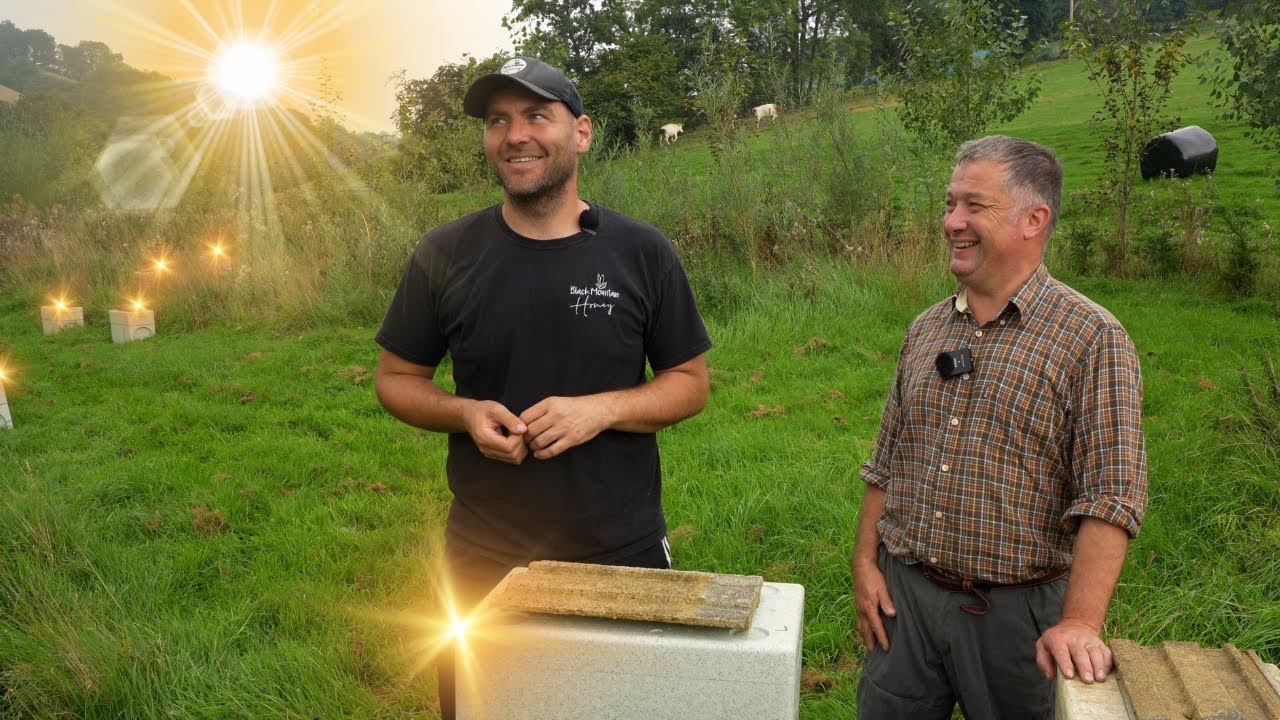
In this conversational video, Laurence Edwards and fellow beekeeper Richard discuss the unusually wet and cool 2023 season in the UK and its effects on their apiaries. They note that while early spring offered a brief period of good weather and strong nectar flow, from mid‑June onward rain and low temperatures severely limited late‑summer honey production. Richard describes how he adapted by feeding colonies earlier, removing supers sooner, and relying on stored honey, which allowed him to finish the season a month ahead of schedule. Despite the poor late season, spring nectar yields were strong and nuc production remained viable, especially because they diversified their operation and harvested the spring crop early. The pair also reflect on a brief warm spell at the end of the season, concluding that it was too late for a significant ivy nectar flow but may provide pollen for the next spring. Remarkably, queen mating success was high despite the weather, which they attribute to the secluded, drone‑rich environment of the Welsh hills. The discussion ends with a forward‑looking note on preparing for 2024, emphasizing flexibility, diversification, and local conditions as key to weather resilience.
Chapters
So 2023, I think, has been the wettest and most miserable year in terms of weather. It's been absolutely shocking, and it has had a huge impact on my bees, and I'm guessing it's had an impact on Richard's bees as well. So in today's video, we're going to talk to Richard about 2023, the weather, the impact on bees, and how you can set up your colonies to cope with the poor weather that we get in the summer. So 2023, was it a good season for the weather, average, or was it absolutely rubbish?
I think it was an average season. The early part was very good, but for definite from mid-June right through till now, it has been dire for any nectar flow, which has caused some problems.
So how does that impact kind of like your honey production and how does it impact your nucs? Like, does it cause you big issues?
Well, nuc production you can substitute with feeding. Honey production has been poor. The intervention to actually feed them hives, get supers off, has been sooner, and I probably wrapped the whole job up probably a month earlier than I would normally do. You just have to be able to adapt to the seasons really. I mean, this, this could be the other way around next year and a whole set of different ideas and ways you do things really. I mean, just be prepared to adapt to the circumstances really.
So you mentioned the spring was quite good early in the year, and it was, like early May was quite nice. We had a good 4 or 5 weeks of nice weather, didn't we? What was your spring and your summer harvest like in terms of percentage up and down? Like, just roughly, do you think it was like an average year for spring, average year for summer, or was there any kind of differentiation?
Well, I would say it was a good year for spring, but absolute wipeout for late. That would be how I'd describe it.
Okay, so overall pretty average, but good spring and overall—
So the early part of the late honey they produced, and then the rest of the year they ate that, and then they're back into your stores, which you're feeding.
And we've had this late flurry of sunshine, haven't we? So the last week has been really, really nice, and I booked the nicest day to come down to Richard and not where I live today, So beautiful sunshine and it's cloudy here, so they've kept the weather here for us today. What do you think the impact's going to be of this kind of like last maybe 10 days of really nice warm weather? Good for the bees?
I don't— I think it's too soon for the ivy flow, which if it would have been another 10 days on, it would have been good, but most other things have finished. So, and if there is a bit of pollen to be had, that's obviously a gain for next spring, but nectar flow is definitely finished.
It's so interesting, like, the different variations across the country, because I think the further south you go, the ivy probably is in flower now. But you look at this apiary here today, and it's like 25, 26 degrees here today. It's warm, it's about midday. Okay, there's not a huge amount of sun there, but there's no activity, is there? You think if it was a flow-on, the sky would be black with the amount of bees that are here.
But they are— but saying that, they are about fed down for winter, so I wouldn't expect— they're just collecting what they need.
Yeah.
They're reserving their strength for next spring, which is exactly what I want.
So overall then, it's not had too much of an impact, a bit of a reduction in the late summer crop, but the nukes have been unaffected, spring crop was good.
Yeah.
And as you say, it's about kind of diversifying your operation to make sure that one poor summer is not going to wipe out absolutely everything, and you've mitigated that by doing some nukes on the side and then taking off your spring crop. And I guess that's the big one, isn't it? If you didn't take that spring crop off, And I know you've taken it off because of the oilseed rape, then they probably would have eaten that as well, wouldn't they?
Yeah, probably, yeah. I mean, matings I thought would be poor and they actually weren't. They were not bad in the end, so I'm happy enough.
It's surprising that, because the last time we were here we were going through and looking at grafts and then had some cells on the go as well, and then it just rained. Like, it just rained for like 6 weeks solid and we were thinking we're going to need to get some more grafts out there now. And like, we're going through some of these colonies today Some of the exact ones that we looked at that had 6 weeks of rain before the queens had emerged. And they're beautiful, aren't they? Absolutely, like, completely packed into the colonies. 3 or 4 massive frames of brood, beautiful pattern, no issues whatsoever. So they're obviously getting out and getting mated here.
Yeah, yeah.
What do you put that down to then? Even like with the really poor weather, what's so special around here that gives you the good mating, do you think?
I think it's the Welsh hills.
It's true. It's very secluded here, isn't it? And it is very protected. On all, on all sides, and you're throwing so many drones up. Do you think they're getting mated close to here, the queens?
Yeah, for sure. Yeah, there's not a particularly high percentage of beekeepers in this area. There might be the one or two rogue, but most of them would be our own.
So there we go, 2023. It seemed like it was an absolute washout, but Richard's managed to cope with that poor weather that we've got throughout the season. And then there's always 2024 to look forward to.