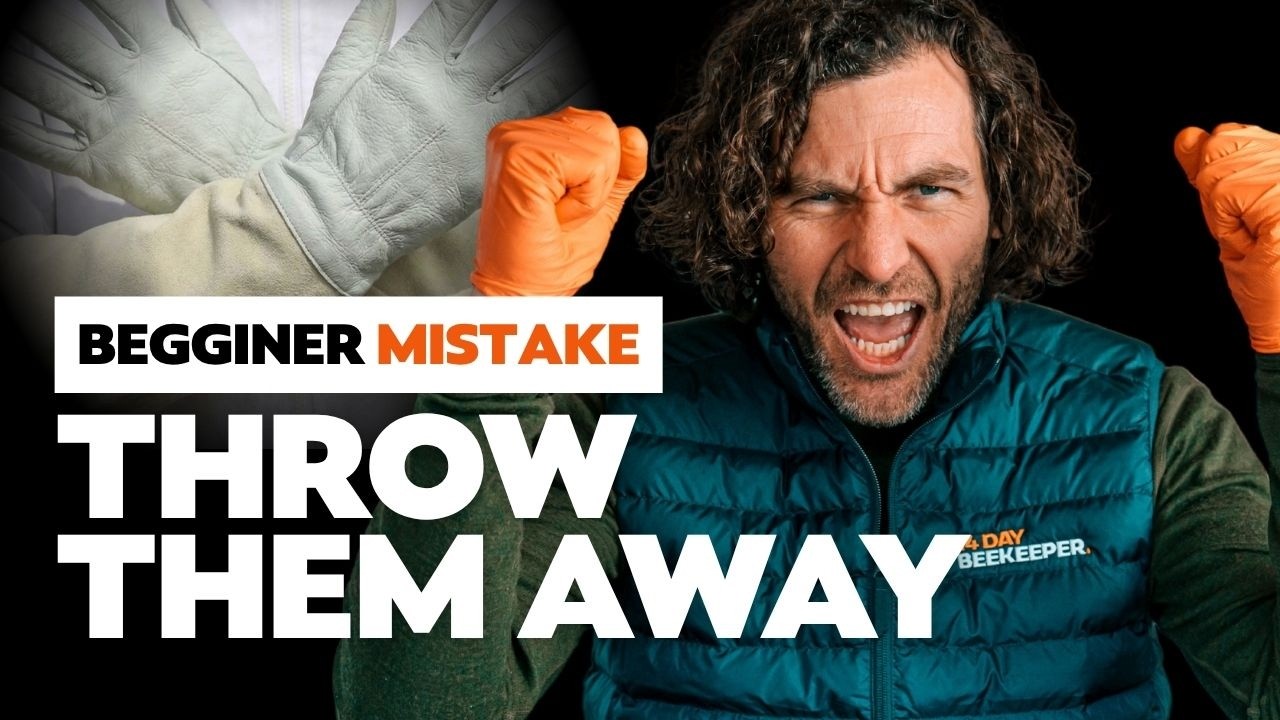
In this video Laurence Edwards explains why he no longer uses reusable leather gauntlet gloves for beekeeping and instead relies on disposable nitrile gloves. He describes how reusable gloves retain sting pheromones and can spread diseases between hives, and how they limit dexterity, causing more bee aggression. He then recommends two disposable options: a long‑cuffed XL nitrile glove that offers good wrist protection, low cost, and minimal bee reaction, and a thicker, Marigold‑style disposable glove (sourced from Viking Direct) for handling particularly aggressive or diseased colonies, noting its higher price, longer cuff, and better resistance to washing. Edwards also outlines his disease‑prevention workflow—using one glove per apiary, treating each apiary as a separate disease site, and washing hands between hives—to minimise pathogen transfer. The video concludes with links to the gloves and a reference to a previous gauntlet review.
Chapters
In this video, we're talking about gloves, the best gloves for beekeeping. It's amazing the amount of times I've been asked this question, which are the best gloves for beekeeping? I've tried pretty much every single glove there is on the market, and I started off like many people will start off, using some of the gloves that come in the kit form. So what I'm going to do in this video is I'm going to tell you why I don't like reusable gloves, and then I'm going to give you my top 2 picks for my best disposable gloves that you can use for beekeeping. So you'll see it on lots of the beekeeping kits, goatskin gloves, calfskin gloves. There are loads of different types of gloves that you can reuse again and again and again. I started off with these gloves and I think when you first put them on you think these are really good. They've got nice gauntlets that go all the way up your arm. You feel that you've got a lot of protection against the bees because the goat's leather or the calf's leather is really nice and thick and it gives you that sense of confidence to go into your bees And not get stung. The logic is a little bit twisted though, because you've got big, thick, heavy gloves that you're going to reuse again and again and again. They need to be well made, they need to be thick, they need to be durable, and it does— it instills this false sense of security in that the bees aren't going to sting you through them. And I say it's a false sense of security, it's not strictly true. The bees generally won't sting you through those gloves. However, what does happen is the bees attempt to sting you through those gloves, and often they leave the stinger in those gloves. Either on the gauntlets or on the fingers or somewhere on the leather. Now even with repeated washing, that attack pheromone stays on the gloves. And I remember the first time I ever moved over to like new disposable gloves. I just couldn't believe the difference in terms of the way that the bees responded to my hands going near them. With the reusable gloves that used to get stung all the time, I'd literally open up the beehive and they would attack my hands instantly. They knew where to go for, And I always kind of thought, well, they're just going for the closest thing, which is my hands. But it definitely wasn't that. They were sensing the smell, sensing that attack and the sting pheromone that was embedded in my reusable gloves. So I moved away from them. It's the best thing I ever did. And then looking back at it as well, thinking reusable gloves, unless you're really sterilizing those gloves each time, there's a massive disease risk in play there as well. So you're going from hive to hive, from apiary to apiary, You're using the same gloves, they're getting sticky, you're getting honey on them. If you've got EFB, if you've got AFB, you could easily transfer that from hive to hive or from apiary to apiary. So now we only use disposable gloves. The gloves that I'm showing you here, these are standard long cuff nitrile gloves. You can get these from anywhere. I really struggle with gloves, got very big hands, so I'm kind of like somewhere between like a size 10 and a size 11. in hands. And when I was going through and looking for different sets of gloves, I always struggled. If I just go for a standard size nitrile, they don't fit my hands very well, but the cuff's really not very long. And then I found that I was getting pinged all the time on the wrists. Very, very painful. And it's this leap of faith from going from a very thick reusable glove that does offer you protection but makes your bees very angry because they can sense that attack pheromone, moving over to a very thin, a very flimsy glove that offers you little to no protection but doesn't trigger the bees in the same way. So for me, 9 times out of 10, this is the glove that I end up with now. It's a long-cuffed nitrile glove in an extra large size, and as you can see from it there, it really is a nice long cuff like that. Gives you a lot more protection down on your wrists, and especially if your bee suit's got a thumb pull as well, you can get that long cuff, you can get it right over the top like that. Gives you good protection on your wrists, gives you good protection on your hands, and it's amazing, you kind of end up getting less stings. The big benefit is that the bees are just not triggered. They're really not triggered because you've got a new glove for every single hive that you go to. Or for us, we don't do it at every single hive. We treat each apiary as a separate disease site, so we use a single pair of gloves per apiary. That means that if there's a colony that's diseased within a single apiary, we can transfer around diseases within that apiary. But if we were to find a case of EFB or AFB within an apiary, just a single case, we would actually treat the whole apiary. For EFB, for example, we do a shook swarm and we'd shook swarm every single colony in that apiary. So in the video description, I'll put a little link up where we get our gloves. There's no affiliate fees on it. And I have to say, pretty much any nitrile glove that I've tried that's in the correct size and a long-cuffed variant has been absolutely fine. They don't last very long, easily enough to get around kind of like 20 or 30 colonies in a single apiary though. These genuinely have transformed my beekeeping, much better for disease prevention as well. And it just gives you that dexterity to not crush your bees. And this is the other point that I kind of missed out as well. When you've got these big, thick leather gloves on, your feeling and your level of dexterity about what's going on on those frames is really very blinkered. You kind of go in, especially for me, big fat sausage fingers smashing all the bees, crushing them up. It just adds another complete level of aggression for the bees because you're going in and you're doing so much damage. When you have really nice tight-fitting nitrile gloves like this that are thin, and it gives you that touch and the feel and the dexterity that's available through them. It means that you can feel what's going on, and it means that if you come up close to a bee, you can actually feel that bee start to buzz before you crush it with a leather-covered finger. So you get this whole host of benefits. However, I do have another glove that I want to show you, and the reason that I'm going to show you that other glove as well is that sometimes when you're using this glove, you will get stung through it. If you've got a really, really horrible colony, or a colony that you're not too sure about as well, sometimes you do need a little bit of extra protection on that glove. That's why I've got another variant as well, and that's the glove I'm going to show you next. So these gloves here, they are essentially a copy of a Marigold. They're much, much cheaper than a Marigold though, and I've found that they're of a similar quality. I wouldn't say they're any better, I wouldn't say they're any worse, but they're a lot cheaper. They come in a pack of 12. They come in a big size as well, so if you're struggling for different sizes, I think they come in 4 different sizes. You can get them from Viking Direct, and they're really, really good. You'll see me wearing these a lot when I'm kind of dealing with nasty colonies. I'll open them up now and I'll show you how good they So there we go, got my left-handed glove on as well, and it's really noticeable when you have these on next to a nitrile glove as well, just how much thicker they are on this side. I do not get stung through these gloves, never get stung through them at all. I often get stung through these, not much, but like maybe 1 or 2 stings per hive. This gives you the additional protection, but these cost quite a lot more as well. These work out, I think, about 70 or 80p per pair, whereas these ones here, I think they're working out about kind of like 10p per pair. So these are a lot more expensive, but I'd definitely keep a good store of these within the van just to deal with the horrible colonies as and when they come up. What I like about these ones as well is that you get a really, really long cuff, and I do mean it is a very, very long cuff. And what's great about these ones as well is that you can actually wash them. So if you want to go from hive to hive and then wash your hands in like a soda solution, something to clean it up and to disinfect your hands between hives so that you've not got that disease risk from hive to hive, I find these are a lot better at actually kind of coping with that moisture, whereas these ones, they start to rip, they start to tear, they don't cope with moisture very well at all. So there you go. I'm not going to bore you anymore about gloves. They're my top 2 picks: a long-cuffed nitrile glove, size XL for me, and then I've also got a long-cuffed marigold copy from Viking Direct. If you want to see a previous video about a pair of gloves that I used to own that I thought they were amazing at that time that proved to not be very durable in the long run, check out my BB Wear Gauntlet video. The gauntlets, still absolutely fantastic. I really do like my BB Wear gauntlets. Don't need them anymore now that I've got the Ultra Suit, but the actual gloves that were extended onto the end of them, when you start off using them, they're fine, but I never got a single pair through a single season.