What Every Beekeeper Needs to Know in April
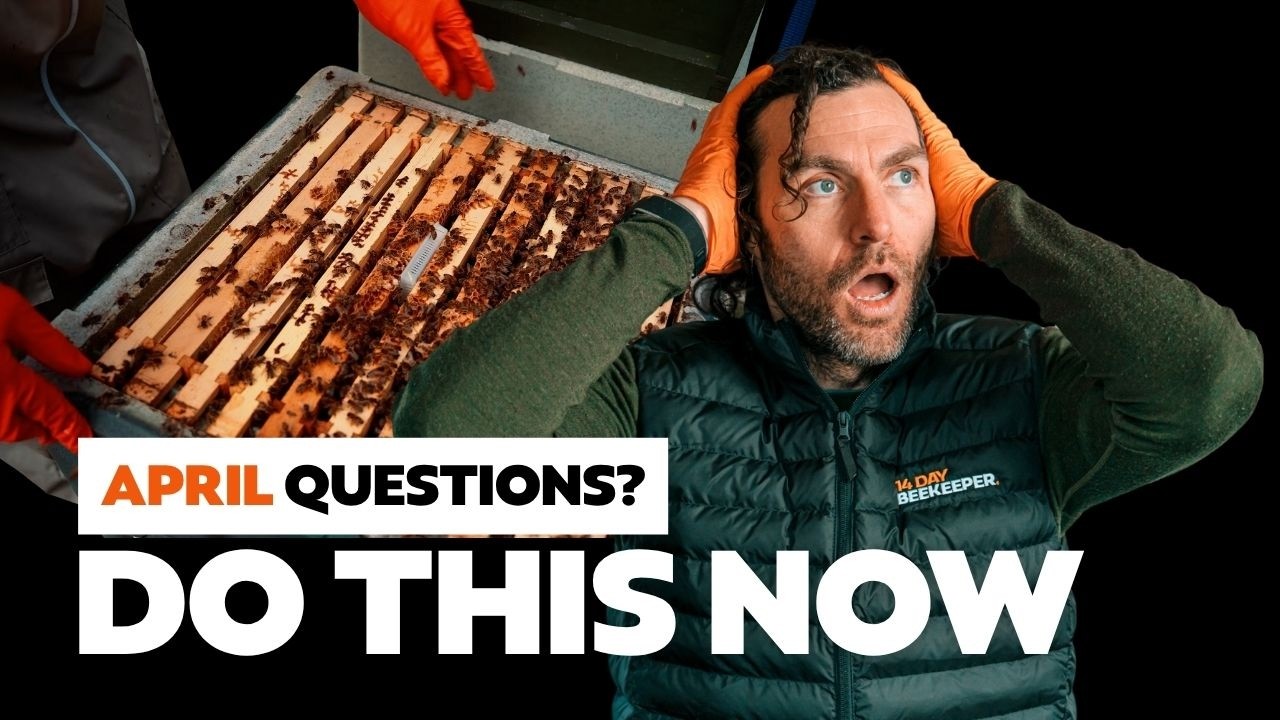
Laurence Edwards covers April beekeeping essentials: timing your first spring inspection, the 80% rule for adding boxes, and swarm prevention through queen clipping and splits. He explains how to read colony signals like congestion and play cups, manage weak colonies, and balance feeding with space to avoid starvation or swarming.
Chapters
These are all the questions that you should be asking yourself if you're a beekeeper in April. Now the first question is, should you be out inspecting your bees? I see people do inspections in February, I see people waiting until the first middle weeks of May before doing their inspections. Which one is right? Now it's definitely not as simple as that. There is no defined first week that you go out and do your first inspection, and as you start to develop as a beekeeper, you'll start to understand roughly where that might be for you. Now for me in North Wales, it's always around the first or second week of April, occasionally the last week in March. I know from my own experience that if I was to go in in first or second or third week in Feb and start doing manipulations for where I am in North Wales, it would come back and bite me in the bottom come March and April, and it would really set my bees back. We'll talk about some of those different mistakes that you can make later on in this video, but as you progress as a beekeeper, you'll start to understand roughly where that ballpark figure It's then up to you to determine, based upon your bees, based upon the weather, based upon how the season is progressing, when to actually go in and do your first inspection. Now for me, my baseline is always first week of April, and I came in and it was the middle, in between the first and the second week, around the 6th or the 7th. That's when I went out and did my first inspections this year, and I was happily surprised to see huge amounts of brood in there, nothing really close to starvation. If anything, some of them a little bit overfed, but I am now in there doing my inspections on a weekly basis. So it's up to you. You need to determine when is the right time for you to go in. Now, I'll give you a few tips later on in this video, which means that you can lengthen out that time where it's a little bit risky. You're not sure if the bees are going to swarm, you're not sure if they've got enough space, and I'll give you some strategies to mitigate that without doing an inspection. It's quite a handy little tip. But in terms of going in and actually doing your first inspections, what are you looking for? What are the things that you're going in to to actually look for? And the correct answer here definitely isn't, well, I'm just going in to do my first inspection, because if you've not got a plan, if you're not inspecting with intent, if you've not got a reason to go in, then how do you know what you're actually going to be looking for? So that is my first thing that I recommend to people, which is, what are you doing on your first inspection? What do you need to see to make you a happy beekeeper? And what do you need to give them to make sure that they've got everything to make it through until the next week? So when I'm going in to do my first inspections, I'm going in with intent. I'm thinking if there's any drone layers, I'm going to shake them out here. I'm going to remove all of the boxes. If they need any feeding, I've got feed on hand to give them feed. If they need additional space in the form of a super or a brood box or anything, a queen excluder or a crown board, I've got it with me. So I'm going there with the very specific idea of doing a certain thing. I'm planning for success. I'm thinking, well, I'm going to go into this colony here and they're going to be across 6 or 7 frames of brood. There's going to be a few frames of stores in there as well. And I'm going to look at it and say, needs a queen excluder, needs a couple of supers, and I'll walk away happy. So I don't go there to work that out. I don't go in and say, right, what's going on, bees? Okay, you need a super. I'll be back next week with a super. I assume that I'm going to need the super, and I bring it along to build the beehive preemptively. Now, of course, I'm looking for other things in there as well. As I said, I'm looking for drone-laying queens. I'm looking for poor spotty brood. We'll cover that later on in the video. I've always got an eye out on disease. I've always got an eye out on stores. I've always got an eye out on space. So I know what I need to look for. We'll break it all down in this video so you've got no illusion whatsoever what you should be doing in your first inspection, and more importantly, the questions that you should be asking yourself during April. So April for me is the start of the beekeeping season. For the majority of beekeepers in the UK, it will signal the start of the inspection regime. As soon as I do my first inspection, that's it, I'm in every single week doing further inspections, and I try and do as much as I possibly can on that first inspection. I'll clear away any burr comb, I'll give them additional space, I'll give them feed, I'll give them supers, I'll do whatever I need to do But I go there with the intention of having as many options available with what I'm bringing out to the apiary. So what does a good colony of bees look like in April? As I said, when I'm going out and trying to prepare for this success, I've got a vision in my mind. I've got an image of what good looks like. I've got my bees on a single brood box. They're on 6 or 7 frames of brood, brood in all stages, really nice brood pattern, plenty of pollen coming in, open nectar stores in the hive, only 2 or 3 frames of stores overall. Hopefully I don't want to see too much of that crystallized or any part within the hive where it shouldn't be. It should be out on the edges. Now the difficulty in beekeeping, I would say, is knowing when to put more boxes on. And the thing that we teach in 14-Day Beekeeper, and I've taught all the way throughout my YouTube videos, is the 80% rule. So when the box below is 80% full of bees— so if you've got a 10-frame box, if they're covering 8 frames, then it's good for another box to go on top. But there is an exception to that rule. That rule only works in the season when the colony is going up and it's expanding in that way. They don't start expanding as soon as they hit that 80% trigger, and a lot of bees will just overwinter in that configuration. So do not confuse that advice with opening them up middle of February and saying they're on 8 frames, they need another box. In the spring, it is about sitting on your hands, and it's about understanding that they're going to stay on that for a long, long time, on that 8-frame, 80% configuration maybe, without the requirement for an additional box. And if you add an additional box in above earlier on, you do huge, huge amounts of damage to your bees. I really wouldn't recommend doing that one. But you get used to the idea in a similar way that you get used to the idea of compressing bees down late on in the summer and they don't swarm when normally they would swarm. Compressing bees or keeping them compressed early on in the spring, it's not without risk. There is risk that the bees will swarm if you backfill that brood nest and they've just got nowhere else to go. And I've seen colonies go ahead and swarm now, but it just gives you that scale. Do we want to do this early Feb? No. Do we want to do it back end of April? No. It's going to be somewhere in the middle where you just need to commit and make that decision to give the bees additional space. Time will help you with this one. As you start to go through the beekeeping seasons, you'll start to see the similarities between them, and you'll understand when it's a sensible time to put stuff on whilst keeping the risk as small as it can possibly be. So that's what I'm looking for at this time of the year. I'm looking for good quality queen, good quality brood, brood in all stages, 6 or 7 frames of brood, 2 or 3 frames of stores, a box that is ready to go up. And if you see little bits of burr comb on the top of the frames or any mesh on the nucs that you're buying, that means that the colony is ready to go. And you can use these little signals, these little cues, to help you get the best out of your bees and to fine-tune that timing. So what should concern you if you're opening up a colony and thinking, wow, this does not look good? You're opening up your beehive in April, what can go wrong? Now, I like to train people to fix a lot of the problems later on in the previous season. So if a queen's turned drone laying, she gets shaken out and the colony gets merged up. If the colony's gone laying workers, they all get shaken out. Even if the queen doesn't look that great and you kind of think, well, they can maybe limp through. No, you kill the queen, you shake the bees out, you compress them down, and you only take the nice healthy winter stock into winter. But if you haven't done all of that, April is quite a miserable time as well going through all of the colonies where there are issues. So if you've got colonies that have failed over winter or failed late into the autumn, turned into drone-laying queens, maybe they've been robbed out, maybe you've got mice coming in, vermin attacks. My recommendation for people is you should be monitoring this all the way throughout the winter. and fixing things as and when they arise. That's not to say going in and fixing drone laying queens. You want to do that nice and late on in the season the previous year. But if you're noticing a colony getting robbed out, you're noticing a colony that's got vermin inside or outside, then you should take action there and then seal the colony up, stop it being robbed out, and you'll avoid any disease spread that way. So when you're doing your inspection, the next question you need to ask is, is my queen performing correctly? Is my queen doing exactly what I need her to do within And it does help about thinking, what should the queen be doing at this time of the year in April inside the beehive? She should be laying lots of eggs. That is what she should be doing now. She should be laying eggs like it's going out of fashion, and the longer days and the warmer temperatures will help trigger that. Now spring in the UK is very much a yo-yo. One day it's beautifully warm, it's 21, 22 degrees, and that triggers the colony to signal to the queen to lay lots of eggs. And then 2 days later, it's like -2 overnight and everything goes back into cluster. And all of those eggs might transition into larva and capped brood, but it sends another signal to the queen to stop. So don't worry if you're not seeing eggs at this time of the year. As long as you saw eggs previously or you're seeing good amounts of capped brood, you will get these fluctuations where you'll get eggs one day and eggs not the other day, or a few days later once they've cleared them out. But you want your queens to be laying lots and lots of eggs at this time of the year. You want to see a nice brood pattern. You want it to be a nice biscuity color. You don't want to see any chalk brood, you don't want to see any sac brood, definitely don't want to see any signs of any foul brood whatsoever. And when you're doing your first inspections, you should really be checking on all of this. Now I would say when you're doing your first inspection, it's much less likely to see a queen where you're like, meh, that doesn't look that great. It's generally a bit more clear-cut than that. So it's either, wow, she's failed, she's a drone layer, or yep, she's absolutely fine. You do occasionally get some that limp through winter, especially if they've not had a sufficient mite treatment the previous year. But I find it's very much one's a failure, one is good. Shake out all of the drone layers, take away all of the equipment, seal it up, quarantine it, and get it ready for use again the following season. So is your queen performing properly? Is she laying all of those eggs? Is she able to repeat the amount of eggs that she's laying? Is the temperament of the colony good if you requeened previously last season? Is the brood spread evenly? Is the brood in the correct place? Again, you'll start to see all of these things as you do more and more inspections. But as I go in for that first inspection, I said inspect within 10 I'm looking to give them space, I'm looking to make sure they've got enough food, but one of the things that I really do focus on on that first inspection is making sure, is the queen there, is she not damaged, is she correctly marked, is she laying properly, is she too old? I'm asking myself all of these questions and I'm making notes, I'm making adjustments as I go, but the question for you is, do you need to take action now? It might be a case that you've got a box full to the brim of bees and the queen is only laying drone brood because she turned into a drone layer over winter. It's a really simple fix. You kill the queen, you wait 8 days, you knock down any emergency cells if there are any, if there was any viable worker larva before, and then you add in a new queen and that colony can be saved. Every single bee there can be saved. And if you do nothing, every single bee there can potentially die. So there's a lot of pressure that rests on your shoulders as a beekeeper, a lot of decisions that you have to make. And as I always say, try and make those decisions with conviction. You are much better off saying, this is the route that I'm going down. I understand the implications of what I'm doing here. I understand the biology, I understand the technicalities, and this is the outcome that I want. A lot of beekeepers just say, I'm not really sure what to do, I'm just going to put it all back together again and hope for the best. And I would say 9 times out of 10, that is not the best way to manage your bees. You need to try and understand what is going on and try and give them both the resources that they need, but also work to any of the timings that the bees have got to ensure that the bees get through. So as I'm looking at the queen and I'm working out what the brood's looking like, I'm thinking, what is the brood telling me here? Is there anything that I need to know? Is it spotty or poorly spaced brood all over the place? Is it worker brood or is it drone brood? Does it look like the queen is just laying thousands and thousands of eggs like it's going out of fashion and there's no space anywhere else? Is the worker to drone ratio of brood correct for this time of year? We should start to see drone brood increasing and really ramping up at this point in the season. Now all of those things tell you something different. All of those things give you an action as a beekeeper. So if you're seeing sparse brood and spotty brood and not that much worker brood but lots of drone brood, there's something wrong and there's something that needs drastic attention. The queen has failed. You need to kill the queen and replace the queen. If you're seeing eggs everywhere like it's going out of fashion, I'm thinking, well, okay, let's fast forward 3 weeks here. What's going to happen once all of this brood emerges? I use that rule that a single frame of capped brood will emerge into roughly 3 frames of bees. Now you need to take off a few of those bees to account for the mortality of the colony, but even if you said it was 2 frames of bees and I'm looking inside a brood box that's got 10 frames of brood, I know that in 3 weeks' time there's going to be 20 additional frames of bees in there. And if I don't take action now, then the colony is definitely going to swarm. So that brood signals something to you. It tells you about the status of the queen. It tells you about the status of the colony. It tells you about the risk that's inside the colony if it goes cold again because they've got all of those mouths to feed, but it also gives you a clue to the future. It tells you in 3 weeks' time, this is how many bees you're going to have, and you can do this mental equation in your head. So the worst thing to do, what you definitely shouldn't do in spring, what you shouldn't do in April, is go and do an inspection on your bees, find that there's 8 frames of brood, 2 frames of stores, and then think, okay, yeah, the bees are looking really, really good, I'll just put everything back together again and come back next week. And they'll almost certainly swarm because you've not taken into account what that eight frames of brood is going to turn into. So it's all about just thinking ahead. Try and think ahead. Have the bees got what they need to get through until the next week? Can I look even further ahead than that? Is the brood going to turn into something else? Is it going to turn into a number of bees that I need to account for? You're always trying to look ahead and stay ahead of the bees because if you don't stay ahead of them, they will swarm. So whenever I'm doing my first inspections, and I do like to get a handle on this one in April because it's much easier to do it in April before things start kicking off later on in the season. But is Is everything okay? Is there any disease in any of my bees? Are any of them really limping through? Is there cause for concern? When you start pulling out the frames, are you seeing chalk brood that is a little bit more likely to show up at this point in the year just to the humid conditions? Are you seeing bald brood? Are you seeing any sort of sac brood? Now, these things are different from the pattern that the queen is laying. These are very specific diseases and brood disorders that come up in a beehive that can reduce the efficiency of that machine. Now, it's not to say that you need to take any immediate action if you spot them at this time of the year, but I would definitely raise it for concern, raise it for monitoring. And if it doesn't clear up on its own, or you think it's really starting to ramp down any efficiency within that hive, then you do need to take action, and we'll cover that in separate videos. So the next question that you need to ask yourself, and really dive into this one, is do the bees have enough food to get them through until the next inspection? Is there enough stores in my beehive in April? Now, throughout the entire year up until the first inspection, we've assessed that by hefting or by weighing the beehives. I've got my HiveWatch monitoring system, which is brilliant for that one beehive. I wish I had it on every single one, even if there are a few wires that you need to get in there. But it's great for benchmarking and baselining. But up until that point, to assess the food that's in the colony, you're kind of assessing it blind because you're going in and hefting and weighing. And although you might know roughly what weight you're looking for, you don't know, is that bees? Is it Brood. And even with hefting, you're kind of just roughly assessing that anyway, and you can get it wrong. But on the first inspection, you actually get the chance to look in and see. Did you feed them any fondant? Did you feed them any syrup? Have they taken all of that food down into the beehive? Is it still there? This is a problem that a lot of people face in the spring, which is they go into their beehives, they do their first inspection, and instead of finding 7 or 8 frames of brood and 2 frames of stores, they find 7 or 8 frames of stores and 2 frames of brood. Now, this is a really big issue. What people might think there is that, okay, we'll take out the frames of stores and we'll just build up that 2-frame split. Now, that 2-frame split would have been massively restricted in the way that it can grow and the way that it can develop throughout the winter. So not only has the number of bees been drastically reduced by the amount of space that's in the beehive because it's restricted by all of those stores, but the other problem that you've got there is that because it's been so heavily restricted, the bees that you see are going to be so much older than they should be for this point in the year. That means when you get to crossover day, which is the day where the colony can continue to grow without the assistance of all of the old winter bees, that crossover day is going to be way further to the right or the left, I forget, but way further into the future. It sets your colonies back massively by overfeeding them, and these are problems that would have built up over the late autumn going into the winter and then the early spring as well. So overfeeding is a huge, huge problem. What does good look like at this time of the year? I would say 7 or 8 frames of brood and then maybe 2 or 3 frames of stores. That is optimum. As soon as you start getting into 5 or 6 or 7 frames of stores, there really is an issue. But take it as good learning. You can build those colonies back up. It will take a little bit longer, but make sure that you don't make the same mistakes again in the following season. Now, the biggest problem that people are going to have in April is this stores and space conundrum, and it really is a conundrum. Because if you don't give your bees enough food to survive, they are going to die, which obviously we don't want. And if you don't give your bees enough space in the spring, then they are going to swarm, which is not quite as bad but still pretty bad for the beekeeper. So you're trying to balance these 2 things the whole way through. Now you might go in to your bees in the back end of March and say they are on 8 frames of brood and 2 frames of stores, and I'm going to go ahead and put a super on because I think that's my trigger. So you go ahead, you put your super on, Double up the supers maybe, which is what I recommend that most people do once you reach that period, just to give you that additional space. But then what happens if the first or second week of April we get another beast from the east and all of that cold weather comes back in and the bees cluster up? And hmm, what do we do now? Because we've kind of gambled on putting the supers on, and we gambled that the bees had enough nectar coming in, added to the 2 or 3 frames of stores that they've got, to get them through this period. And now, like I did a few years ago, you have to go back around and take all of the supers back off if you want to feed them. You can't feed the bees once you put the supers on. So do you need to add additional space to your beehive? Maybe yes, but it does then restrict your ability to feed. So this space stores conundrum is always really, really finely balanced. And this is the reason that I give a lot of people the recommendation that I'm going to give to you here, which is if you know that you're going to split your bees up, then there's much, much easier ways of managing your bees in the spring that take care of that space and stores conundrum and just gives you complete flexibility to make sure the bees aren't going to die through starvation. And to highly reduce the chances of swarming. I'll cover that later on in a section in this video. So the idea in April is to make sure that your bees have always got sufficient amount of stores, you're feeding them up in any way that you need to feed them, or maybe they've just got enough stores. And then at some point you're going to say, right, we're going to go ahead and we're going to place our supers on. And at that point, all feeding stops. So you'll see why I don't recommend to people to go ahead and put your supers on in the middle of February or the middle of March. The first or second week of April for me up here is good because it means that even if I've made the decision to go ahead and put my supers on. I shouldn't get an extended 3 or 4 week cold spell. The chances are incredibly slim. The amount of stores that I'm giving those bees to get through any period that comes in, and even now it's quite cold, but I'd look on my weights there, the weights aren't going down, they're just maintaining themselves. Then I know that I've not got to go back out and take all of those supers off. So you need to make this decision, which is, when do I put the supers on? for my bees? And it's not a simple, easy question that I can answer for you here. I can't say, yeah, middle of April every single time. It's trial and error, and it's trial and error every single season trying to balance that space stores conundrum. So should you actually be feeding your bees in April at all? And a lot of people do get this one wrong, but I would say as soon as you've made that assessment, which is the brood box is ready for some supers, I'm going to put my supers on, then I would say the next time that really do need to feed your bees is going to be into the June gap. Maybe you can get through the June gap without feeding, and then the next time would be middle to back end of August. So that whole entire beekeeping season, really, I try and do everything I possibly can to not feed my bees. As soon as I've made that decision to put the supers on, that is it. I stop all feeding unless there is a catastrophic cold spell that comes back in, and then the only way that I would fix it is to go through, take the supers back off, I'd double brood everything up at that point just to make sure that there's sufficient space downstairs in the brood nest, and then I would go ahead and I would feed to keep my bees alive. Hopefully that's not going to come to that this season. I've gone out 7th of April, done all my inspections, put my supers on, crossing my fingers hoping that everything goes well. It's a little bit cold out, but you're a beekeeper now, so you'll be looking at the weather every single day. It looks a lot nicer back end of this week, and I can see the weights are maintaining. Hopefully they start to go up towards So I said earlier on that I'd give you some manipulations or some strategies or techniques to help you get the best out of your bees and to reduce the risk of them swarming early on in the season. So my production colonies, I go in, I assess the brood box, I say, yep, they're good for a super. I put a queen excluder on, I put a couple of supers on, and I hope for the best. Generally get the timing right on that and all goes well if the weather plays ball. But if you're watching this video and it's early April and you're thinking it's a good few weeks left until I'd be comfortable putting my supers on, and you also know that you want to go ahead and split your colony at some point in the year, then the easiest thing for you to do is just to go ahead and underbrood your colony. That means taking a brand new brood box, lifting up the one that's got all of the bees in, placing a new brood box with either drawn comb or foundation underneath it, and putting the feeder back on top and setting it up exactly as it is. Now, I've done a separate video showing that in great, great detail, but what it does is it gives you the ability to continue feeding your bees. The bees have got effectively unlimited space, relatively unlimited space for them, because doubled it up downstairs in the brood box. And especially if you've got a nice warm polyashworth feeder on top, you're creating a nice warm environment inside the beehive where the colony can continue to build up through any poor cold spells. I did this with my bees about 3 weeks ago on some of them, just to try and get through with all the stuff that's going on in my life here at the moment at Black Mountain Honey. And I will show you all of that on the channel as well. I'll show you the impact that that's had, and I'll show you just how big and strong those colonies are now. If I had done nothing with those colonies, if I'd just left them on single brood, I'm pretty sure that they would have swarmed by now, every single one of them. So I bought myself a lot of time. So if you're thinking it's too cold for supers, you don't want to put anything above, and you know that you want to make a split on that colony, or you just want to do everything you possibly can to make sure that they survive and they don't swarm, then underbrooding is a really good system for you. So next up, you're going to start thinking about swarm preparation. When are your bees likely to start swarming. And as we said, if you've not done any of that manipulation early on, you've not ensured your bees have got sufficient space, the risk of swarming can go very early into the season. But for most people, it will start towards back end of April, early May, all the way through maybe until the back end of May is the major swarm season. And then the risk does taper off. It still exists all the way through until the end of the year, but for us in North Wales, April and May really are the months where swarming can be triggered and where you need to give your absolute focus on your Ensuring that you keep your bees all together. So again, there'll be a sliding scale here. You might not see that swarm pressure in the back end of April, maybe you see it early on in April, but for most people you will see it around that period. And the first signs that you're going to get is this congestion of the brood box. So even with the absolute best case scenario of 7 or 8 frames of brood and 2 frames of stores, if all of that brood emerges and you get this huge influx of nectar and you didn't put the space Up above, then the nectar comes down into the brood area, restricting the space, signalling to the colony that there's no room left in the brood box, in the beehive, and then they force the queen to lay eggs into the plague cups, or maybe they move them there themselves, nobody really knows, and then the colony goes off and swarms. Back to the space and stores conundrum yet again. So are your bees thinking about swarming? You should probably get into the habit of thinking yes, April and May they definitely are thinking about swarming, that's their prime time to go. June, July, August, and September, even October. It's just going to get less and less throughout the season, but the risk still does exist. If you go ahead and you congest the brood box by letting them put all of the nectar back into it, or not giving them enough space, or by overfeeding them, then you're going to heighten that risk of swarming. You're going to accelerate the risk of swarming. Even in the best case scenario there, where all of the brood emerges out and you just have a big solid brood nest throughout the entire year and all of the honey upstairs, you will likely still get to the point where the bees try to go ahead and swarm. Now the first sign of this is going to be that compression and the movement of the nectar going down into the brood box. Next thing you're likely to see is play cups, so maybe these are going to happen and appear at the same time. Then you might see eggs in play cups as the next step. Eggs in play cups is getting very, very close to swarming in my opinion. If you see eggs in play cups with any sort of charging, that means royal jelly in there or a larva that's sitting in that royal jelly, The bees are going ahead and they are swarming. That is your signal to go. They will try and swarm just as the cells are capped, but you might occasionally find capped queen cells with the queen inside if the weather's been rubbish around the time of capping, and they will leave straight after. Now, if you go ahead and clip your queens, what it will mean is that when those queen cells are capped, the colony will not swarm. You get a few extra days to go in, recover the bees, or recover the queen, the clipped queen, make up a split. And then leave the colony with one of the single swarm cells that they will produce. It's a small manipulation, it's something that you can do in April, and it's something that would drastically increase your honey crop. You're only taking the absolute tip of one of the wings. It doesn't hurt the queen in any way, they just wander off and kind of get on with what they were doing, go and lay an egg. It's akin to getting a nail cut off, and all it does is it unbalances the queen so that she cannot fly. She lives a completely normal life apart from that because queens don't really need to go out and fly. The only exception to that is when they're swarming, and if you're a responsible beekeeper, you should be stopping swarming. We don't want our bees to end up in our neighbours' chimneys, and by stopping that swarming, by going ahead doing the clipping of the queen, it will really improve your honey yield, or it will at least give you a usable resource come the end of the season. Maybe you've got an extra nuc that you wouldn't have had because you've housed all of the bees from the swarm inside. So knowing to be able to tell the difference between swarm cells and supersedure cells and emergency cells is really, really useful at this time of the year, kind of useful at most times of the year. And this is the level of detail that we go into in 14-Day Beekeeper. So we'll talk about swarming, but we'll really drill down into the basics and make sure that you understand what you're seeing is what you are actually seeing, so you can make a justified decision on that basis. So if we're talking about swarming and are the bees showing signs of swarming already in April, the next thing that I would say to you is, do you have a plan for if they are going ahead and And a lot of people say, yeah, I'm going to split them, or yeah, I was going to make a split on this colony anyway. And I say, well, if you're going to make a split on the colony anyway, it's much, much easier just to go ahead and make a preemptive split as opposed to waiting for the bees to swarm. And okay, you're going to have slightly different cells, different type of cells. You might have emergency cells in a walkaway split versus waiting for the swarm cells to be created and using those, but you're running a lot more risk there. You're running the risk that if you don't get in there in time some of those virgins might emerge, and then you can't potentially requeen because you can't find the virgins. There's risk attached to that. So sitting down at this point in the year, maybe even back in March, but sitting down and thinking, what is my plan for swarming this year? How am I going to stop my bees swarming and ending up in my neighbour's chimney? Number 1, clip your queens. Really does help, makes things a lot, lot easier. Number 2 though is if you know you're going to go ahead and split and you're buying in say mated queens, then definitely you don't want your bees to get anywhere near creating the conditions for swarming. You don't want to keep them compressed in a brood box because you're trying to make splits, so you want to give them as much possible space as you can get down there anyway. And the last thing you want to do is restrict the space down there if you know that you're going ahead and making splits anyway. Maybe your plan is that you want the maximum amount of honey possible, so you could be looking at a Demaray split. And a Demaray split is a brilliant way of vertically splitting your hive, keeping it all on one beehive stand, reducing the swarming impulse, and maximizing the amount of honey that you produce. Again, 14-Day Beekeeper covers the Demarée split in great detail for anyone that is interested. Or maybe you're just thinking, I want the easiest life possible. I don't want to go down any complex techniques like the Demarée. I just want the bees in the back of my garden just to be as easy as they can possibly be. And then I say to people, well, there's quite an easy way to do that, which is you make a preemptive split and just give someone a nucleus of bees, set them right back at the right time of the year. So you're going into May Maybe with 3, 4, 5 frames of foundation downstairs in the brood box because you've given away a big chunk of that colony, and maybe you put a nice young new queen in. The addition of foundation in the brood box is a natural swarm suppressor. It really does help. But by taking out all of those frames, maybe you've taken out a 6-frame split brood in all stages with the existing queen and all of the bees as well, we're only leaving behind maybe 30 or 40% of the colony plus all of the flying bees. And you add in a nice young new mated queen. And the fact that you've got a young queen in your colony, maybe this season's queen in May, that will naturally reduce the chances of swarming as well. See, both of those things have made your life so much easier as a beekeeper. But what a lot of people do is they don't understand that and they just kind of go straight into the beekeeping season and swarming happens, and then they don't know how to recover from it, and then the queens don't get mated, and then the wasps come in and kill everything because the colony has dwindled. Where really, cycle it back to April. If you have a plan for what you're actually going ahead and doing, you will avoid so many of these really awkward mistakes and hopefully get what is good for you. And what is good for you is different for every single person. So you do need to sit down, work out a plan both for the season and for the swarming, and just understand how you're going to tackle it for your very specific situation. The next question you might ask yourself is, what should I do with colonies that are failing or colonies that are weak? Now we have a zero tolerance approach to this at Black Mountain Honey. Both in the autumn and in the spring, any colonies that we are not happy with, we do this with. We open up the beehive, we kill the queen, we shake out all of the bees, we remove the frames, the brood, the stores, the beehive, the everything, and let the bees beg their way into another adjacent colony. Now the only reason that I wouldn't do that one is if there was any risk of AFB. I definitely wouldn't do that if it was AFB. I would just isolate everything and burn it all in situ. You can even argue it might not be the best approach to do it with EFB either, so I would say if you've got EFB in your apiary, then maybe review that approach as well. But if you've got nice clean apiaries like us at Black Mountain Honey and you do find any weak or limping or failed or drone-laying queens or colonies, then that's what you should be doing in the spring. You should be doing it really as early as possible as you can in April. As I said, go in, open up the beehive, Find the queen, kill her, shake off all the bees, remove everything into a quarantine site, and then melt it, recycle it, sterilize it for use again the following season. Do not reuse it until you have done that. And that is a really nice, simple, clean, effective, efficient process that will keep your bees very healthy. I don't think I could have got any more words into that sentence. So another question you might ask yourself is, is April the best time to be marking your queens inside Pollinators, without a doubt. Do it in the autumn with a decent oil-based pen, and you should go in and there should be no markings coming off. But if your queen is not marked and your queen is not clipped, April is the best time to do it. Reason being, there's not that many bees in the beehive when you compare it to the rest of the season. The bees are generally calmer in the spring. Now is the time to go in, mark your queens, clip your queens. Do it whilst it's easy, and it saves you tons of time later on in the season. So I'm always asking myself this question: Do I have what I need for next week? Do I have what I need for next month? Have I got enough boxes? Have I got enough frames? Can I keep ahead of the bees? Because if the bees are signaling to you that they need more space above, they need more supers, or they need another brood box, or they need whatever the bees need, and you don't have it, the result is generally one of two things, which is they starve because you couldn't feed them, or they swarm because you couldn't give them enough space. You need to be super organized here, and I do see people getting organized in Winter, winter is the time to get organized. Get all your boxes assembled, get all your frames assembled, get the foundation in. Don't bump it around when it's cold because it does go a little bit brittle, but just keep it nicely stacked up and ready to place onto your beehives. And then all the time I look back in the spring and I think I'm glad I did all of that work in the winter because there's no way that you can keep up once the bees get going. So there we go. That's a huge selection of questions that I would ask myself if I was a beekeeper in the UK in. April, but a lot of those questions are going to be relevant all the way around the world as well. I'll be continuing this series, so we're going to do May next, and I'll work it all the way throughout the calendar year. So every single month you will have a list of questions that you should be asking yourself as a beekeeper.










