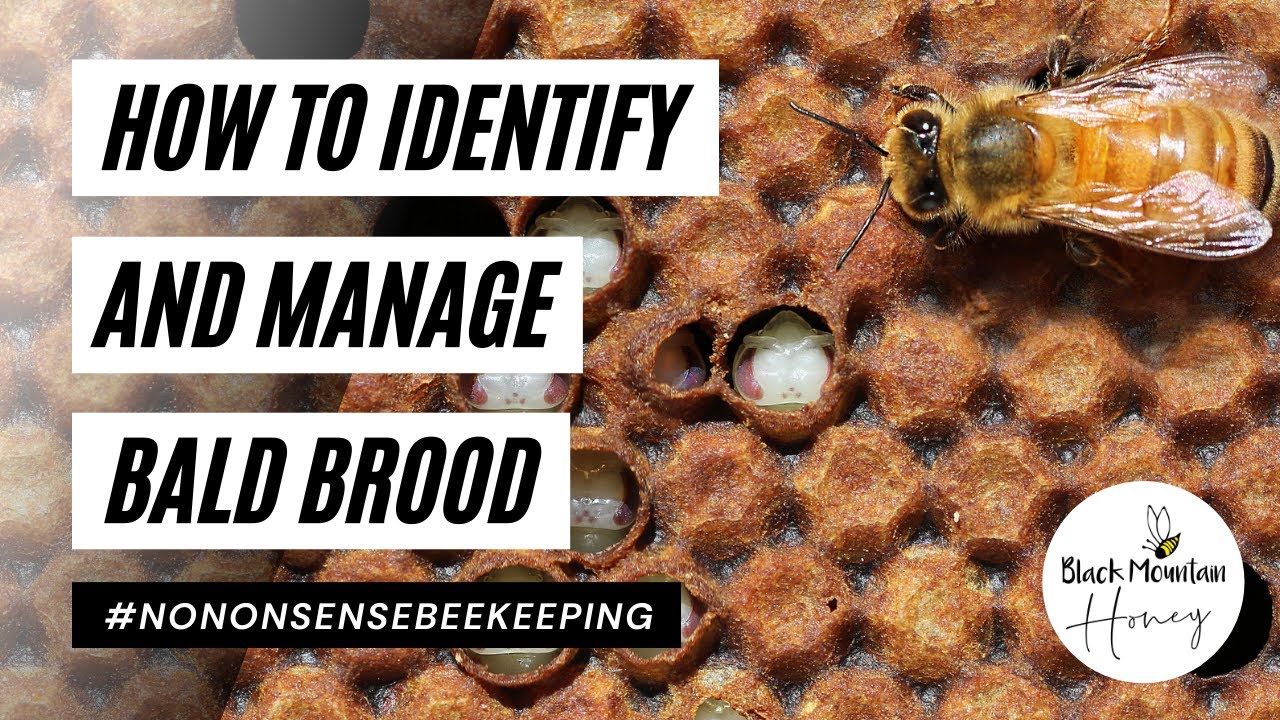
In this episode of No Nonsense Beekeeping, Laurence Edwards of Black Mountain Honey explains bald brood—a non‑infectious, genetically driven condition where pupae develop without wax cappings. He clarifies that while the trait is inherited from the queen, stressors such as food shortage or extreme temperatures can exacerbate its expression. Edwards walks through a real‑world inspection of a nuc exhibiting severe bald brood, describing how to differentiate it from sac brood by looking for uncapped pupae with visible eyes. He notes associated issues like poor colony vigor, perforated cappings, and possible varroa mite impact. The core management protocol he recommends is to eliminate the problematic queen, replace her with a cell from a known, healthy breeder, and simultaneously reduce mite load with a Sublimox blast of Apibioxal. He also advises against moving frames from affected colonies to prevent spreading other diseases, stresses the importance of minimizing stressors, and suggests supplemental brood frames to help the colony reach winter strength. The video concludes with a call to action for viewers to subscribe.
Chapters
Hi, I'm Laurence Edwards from Black Mountain Honey. Welcome to another episode of No Nonsense Beekeeping. Today we're going to be talking about a bit of a strange one, but it's another one in the disease recognition series, and that is bald brood. So bald brood's a very strange one, um, in that it's not really a disease, it's just something that the bees do that's really undesirable and detrimental to the colony. It's not something that you can catch, it's not something that the bees will go away and forage on something and bring back and then they'd start developing bald brood, it's not necessarily a reaction to environmental conditions, so like chalkbrood, if it gets a bit more damp the bacterial infection gets worse, it's solely down to the queen and her genetics. What it can be though is it can be brought about through stress in a colony. So if a colony is struggling for food or if a colony is stressed in any other way, maybe it's too hot, then that can make the symptoms of bald brood a lot worse. So if a colony is firing on all cylinders but they have a genetic disposition towards bald brood, they might not show it that much, and then if you add some stressors into that colony, so lack of food or extreme temperature or heat, then that can bring about signs of bald brood. All bald brood is though, it is effectively a healthy pupa without the capping over it. And then that pupa will emerge as a worker bee. Maybe not the healthiest of worker bees. I haven't really seen studies into whether they're just as healthy as a worker bee that's come through once it has the capping on it. But in my own experience, the colonies just don't thrive anywhere near as much. They take really, really long time to get going. And again, it's something, why would I want a colony that has such poor genetics in my apiary? The drones are going to be going out, they're going to be mating with my queens. I don't want that. I don't want to send them to any beginners. It's an undesirable trait. I definitely don't want it as a honey production colony. So all I do is I squish the queen and I add a cell of known heritage, and that solves the problem. So I'll show you, I've got one colony like this this year. This is the worst bald brood I've ever experienced. But like I say, really, really simple remedy to kind of make sure that this doesn't happen again. So I'll cut to the video and I'll show you what some bald brood looks like. So this is the nuc that I've been having issues with, with bald brood. I originally thought it could be a case of sack brood, but I kind of confirmed it with our seasonal bee inspector, and he's definitely confirmed that it is bald brood. So I'll get inside and I'll show you exactly what we're talking about. So I immediately noticed just opening these guys up, they're a little bit weaker than other colonies, and this is what alerted me to the fact that there might be something wrong with this colony in the first instance. Now, when I first opened this up with the seasonal bee inspector, there was hardly any stores in here as well. So as I mentioned, stressors can bring out the worst in these diseases. Or bad traits in the bees, and I think that the lack of nectar and forage available was making this worse. So I'm hoping to see a bit of an improvement since the last time I checked this colony, which was about 2 weeks ago, but I'm pretty sure that we'll still see some evidence of the bald brood. And there's absolutely no improvement whatsoever. So you'll see in this now when I do the close-up, we've got a full ring of stores in here. So feeding them, reducing the stress on this colony has made zero difference whatsoever. It's clearly a genetic disposition to have bald brood, and it's not something that I want in my colonies. So you can see the frame there, and you can see it on that side as well. I'll do some close-ups. My first impression was it is a really poorly mated queen. That was my first suspicion, and then I thought, no, it's kind of— it's laying in a reasonable pattern, it's just there's something wrong with it. So I thought it must be sac brood because there was a little bit of sac brood in here as well. And then it was only once I spoke to the SBI and kind of gave him my concerns, he said it was definitely bald brood. So we've gone through that, and then it's really quite easy to see that it's bald brood. It's one of those things that once you know it, it's quite easy to identify, and the dead giveaway is the fact that you can see larva. You can see the larva and you can see them turning into pupa and you can see that they're not capped. So instead of where sac brood is like, looks like a pointy tail, and I'll show you a picture of some sac brood and I'll show you a picture of some bald brood as a comparison. The bald brood, you can see the eyes forming and that's a really, really easy way of understanding the difference is that if you can see formed pupae with eyes, it's almost certainly going to be bald brood. So you can see though, here's a recently emerged bee, very, very kind of young and fluffy. So they do emerge. It's strange, like it doesn't kind of sit right with me that they're going to be healthy bees, but you can see it there. I mean, there's a recently emerged bee, more than likely wasn't capped over or Although you can see some of it does get capped over. So what I'm also seeing in this colony though is quite a lot of perforations in the wax cappings. Now I'm not sure whether that's as a result of the bees' genetic disposition to not cap things very well, or is there an underlying issue with this colony which is varroa impact? So we definitely know that there is a genetic disposition to bald brood, and the chances are there's going to be an impact of varroa in this colony as well. So what do we do about this colony? The chances of getting this colony through the winter like this, I'd say it's toss of a coin, but if I get them through the winter, I'm going to have to requeen them anyway, so I might as well take the action now to requeen. So that's what I'm going to do with this colony. I'm going to find the queen, I'm going to kill the queen, and I'm going to add a cell into this colony. But firstly, what I'm going to do is I'm going to give them a blast from the Sublimox with some apibioxal just to reduce that mite load down to a hopefully acceptable level. I'm not going to test them because it would take me longer to do a test than it would to give them a blast. It's a bit of an insurance policy to say, right, if there is a high load of varroa, I'll give them a blast with the apibioxal first. That reduces the load down to an acceptable level. Then I can take my next action, which is I want to get rid of the genetics from the colony. I'll kill the queen and I'll add a cell from my F0 breeder queen, and then that will resolve the issue that we've got with bald brood. So once that queen's mated, give it 3 or 4 weeks, we'll come back, check the first capped worker brood, and we'll be able to tell whether that's resolved the problem or not. So that's it, that's bald brood. Doesn't look too bad, but that colony really, really is struggling to kind of build any further than the number of frames that are there. So the remedy is I'm going to squish that queen and I'll add a new cell. And then that colony, within 3 to 4 weeks, you'll start to get some normal worker brood once that queen is mated, and then they can start to expand naturally again. What I need to make sure is I don't add any further stresses to that colony, just to kind of make sure that they can build up and they've got suitable stores in them going into winter. What I will do is I'll add an additional frame of brood into that colony where the last kind of 4 to 6 weeks they've dwindled a little bit. They need the additional bees in order to kind of get to a suitable size going into winter, so I'll give them a little bit of a boost. I obviously wouldn't do it the other way. I don't want to be transferring anything out of any of the diseased colonies, any of the bald brood, even though it's not contagious, any of the chalk brood with the bacterial infection, or any of the sac brood with the virus. You need to be really, really careful about kind of not swapping over any frames with any of those issues because you will spread diseases throughout the apiary. So that's it for the video. Hope you've enjoyed this one. Please hit the subscribe button, please hit the bell so you're notified of every video, and I'll see you next time. Bye.