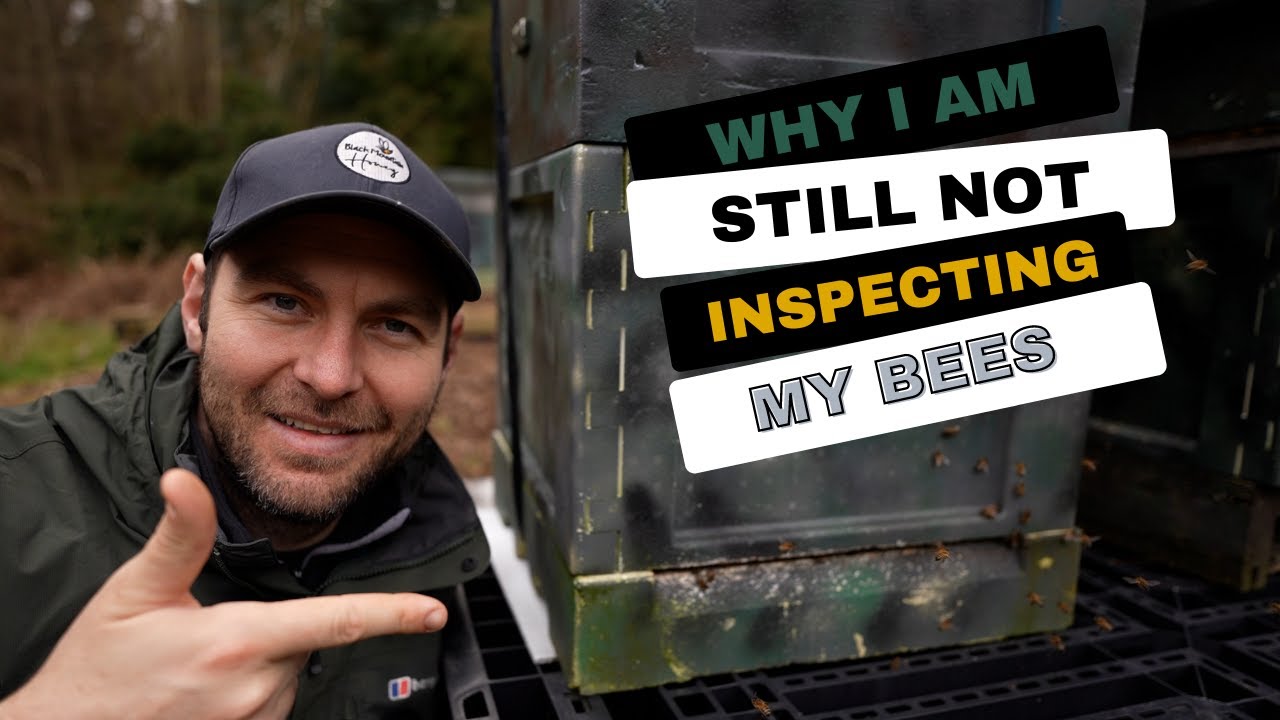
Laurence Edwards advises against opening hives early in spring, even with warm weather and visible pollen. Opening the colony risks squashing the queen and creates problems you can't fix yet because replacement queens aren't available. Wait until late March or April to inspect, and just heft the hive to check food stores in the meantime.
Chapters
So for plenty of people, it's probably a warm sunny day, 15, 16 degrees, the bees are flying, they're bringing in pollen, it's t-shirt weather. So surely that means it's time to start doing your beekeeping inspections to make sure that your bees don't swarm. That is something that I definitely do not recommend doing just yet. We're getting closer and closer to that point, but I really do think that you always run the risk of doing more damage to your colonies by going in pulling out frames of brood at this moment in time. You're much better off sitting on your hands waiting for those bees to build up to a suitable size before you start going in there and actually pulling out frames of brood. You just need to think about it a little bit. What good can come from pulling out frames of brood at this point of the season? If you genuinely think there's something in the UK that you can learn from your bees in March by going in and pulling out frames of brood, Stick it in the comments because I'm genuinely interested to know. I've said this on previous videos, all it does is it satisfies your own curiosity to see what's going on in the colony. You might pull out frames of brood, see 6 or 7 frames of brood, see the queen, see she's still marked, same queen that went in in 2021, got through the winter. You walk away and you'll feel happy because you'll think my bees have made it through. But guess what? As you're putting that colony back together again, The frame with the queen on it, you might have squished her, and you might not know that you squished her until you go back again, see that they've drawn out loads of emergency cells. There's loads of different permutations on that in terms of the damage that you can do by going into your colony this early in the season. You're only satisfying your own curiosity. I do just want to debunk another myth because I hear it all the time as well. So if your bees are looking like this and they're bringing in loads of pollen, that doesn't mean that there's a queen in there, and that doesn't mean that they're rearing brood. I see it all the time where you've got like a failing queen or you've got a drone laying queen or you've got a colony with no queen and it's just got cells and they bring in loads of pollen. Bees are opportunists and if they're alive and the temperature allows it and there's pollen available, they'll go out and they'll collect pollen. So don't read anything into the fact that the bees are bringing in pollen. But I just urge you all just to sit on your hands for a little bit longer. We're only 2 or 3 weeks away really from when I'd recommend people going in and actually starting to do those inspections. And it is a fine line in terms of making sure they've got enough space. I'll stick a link to the video that I did previously the other week, which is if you need to add space to your colony, just go ahead and add space to your colony. Don't add it at the top, add it underneath. Increase the space that's available without giving the bees any heating issues. If you do get a late cold snap, you don't need to start pulling out frames in order to do that. And the manipulation is a lot safer than going in at this time of year, because if you find anything that's wrong, so if you find a drone-laying queen or you find that the colony's dead, Or you find that there's some nasty disease that's going on. What can you do? You literally cannot do anything yet. There's no queens available. You're not going to combine it with another colony because it's too much of a risk. So all you'll do is you'll identify a problem, and then you're not going to fix that problem because you've got no means to fix it. And then the other issue is that there might not be a problem, and then you introduce a problem by going in to satisfy your own curiosity to see how the bees are getting on. All you need to do at this point of the season. Heft your bees, make sure they've got enough food. If you're really worried, lift the box up, stick another box underneath, gives them room for expansion. But I bet you any money, if anybody that does that, like I did on the other video, 4 weeks later, I bet you they've not even gone into the box. Bees don't expand at a rapid rate at this point of year. It's kind of like towards the back end of March, early April, into April when they really start to get going. So you can be completely honest with me, trust me, I won't take offense. How many people wanted me to get stung in this video? I bet every single one of you did, and I bet you're gutted that I didn't get stung. And how good would it have been if, as I was saying that, I got stung in the face? So I'm going to stop pushing my luck. I'm going to finish the video there. When it comes around to doing your first inspections, check out this video here where I show you how to do your first inspection in the spring.