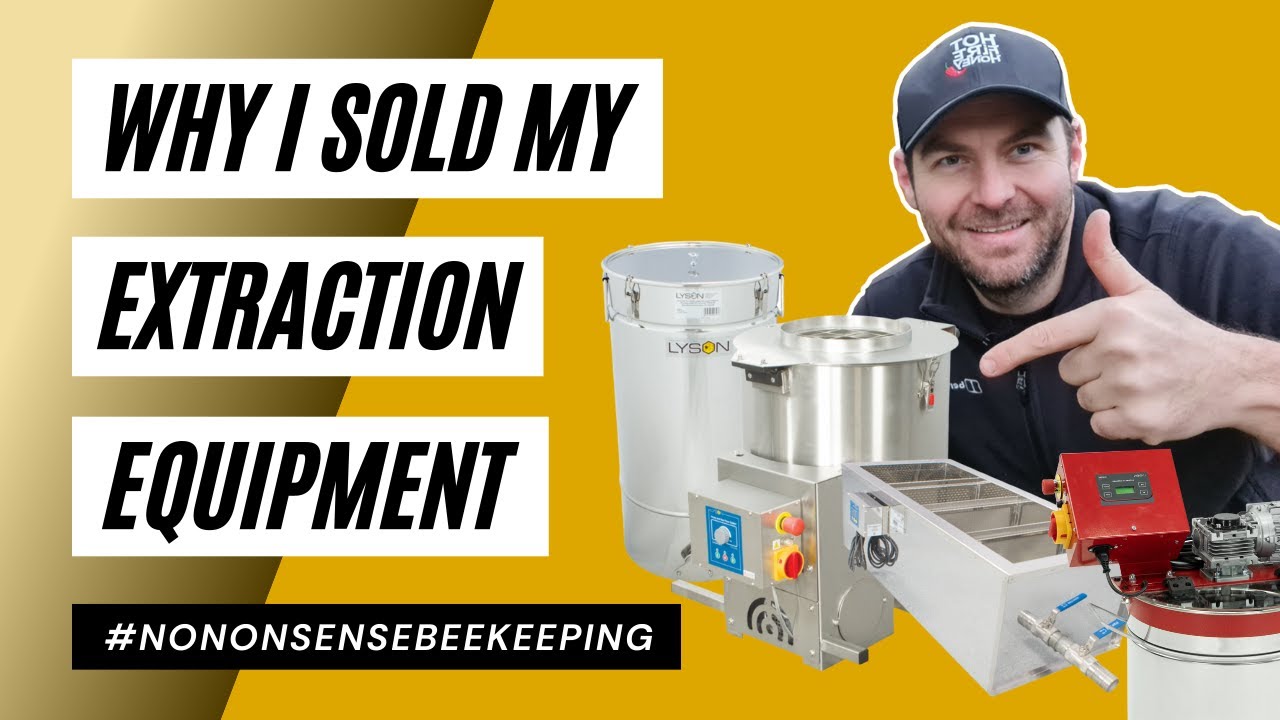
In this video, beekeeping enthusiast Laurence Edwards explains why he sold more than 40% of his honey extraction gear to better fit his small extraction room and streamline his workflow. He walks through each piece of equipment he let go: a honey sump (a heated filtration box) which he discarded due to lack of space despite its product quality benefits; a wax capping spinner that proved too slow for filtering heather honey; a 100‑liter premium settling tank that was replaced by a 200‑liter tank with a valve for direct bottling, eliminating bottling bottlenecks; and a 100‑liter creamer that was also upgraded to a 200‑liter version for the same reason. Edwards emphasizes that the sold items are high‑grade but don’t suit his current process, and that standardizing to larger 200‑liter units improves efficiency and reduces the need for duplicate equipment. He directs viewers to follow‑up videos for his current filtering setup and a close‑up tour of the remaining equipment.
Chapters
In this video, I'm going to tell you why I sold over 40% of my honey extraction equipment. 40% of my honey extraction equipment is now sold. In this video, I'm going to go through every single item I've sold and tell you why I've sold that equipment. Before we get into that, let's understand a little bit about the driver for the main change. Why did I need to sell any of my equipment, and why did I buy it in the first Honey extraction equipment, I do have a little bit of a fetish, and I see something I think that's really, really good, that's going to help my process, or that's going to lead me to a better end product. They're generally the reasons that I'll buy stuff. The limitation that I have is that I'm in a very small honey extraction room, and I need to really carefully choose what I keep and what I sell. So let's go through the items that I've sold then. Number 1, I sold my honey sump. So a honey sump is a big heated box, has vertical filters running through it. You decant honey from your wax cappings press, you decant honey from your honey extractor. It has a float on it, so when it gets up to a certain height, the honey pumps out and you can decant it into storage tanks or buckets. Now, a lot of people use honey sumps, and honey sumps are a really good way to end the extraction day with finely filtered honey. I do not have the room for a honey extraction sump in here. It's a shame because it's something that definitely means that I end up with a superior product at the end of the day, but I just couldn't justify it due to the space. If you want to find out how I filter my honey now, next video will show you around all of my honey extraction equipment. Next item that I sold was a wax capping spinner. I bought the spinner because I wanted to filter my heather honey. Filtering heather honey is really difficult, and I'm still looking for that perfect process. But for me, the wax capping spinner wasn't the best at filtering the honey. It worked, but it was slow. So I had to make a decision between do I use that space for something that's not very efficient in my process, or do I get rid of it and go with a slightly slower process? I chose the I'll show you in another video what I do now to filter my heather honey. The next thing I sold was a 100-liter premium settling tank. And you might think, why are you selling a settling tank? Surely the more settling tanks the better. But the reason that I sold it is that I actually upgraded that settling tank to a 200-liter settling tank, got a valve on it, and I can bottle straight out of it. So having a 200-liter one and a 100-liter one with 2 people doing the bottling on it, it means that one person finishes halfway through. So you have to think really clever and smart whenever you've got 2 of anything. They really do need to be the same size or it causes you quite a lot of issues. The next thing I sold, my 100-liter creamer. That is the exact same scenario as the previous one. I upgraded to a 200-liter creamer because for me, 100-liter wasn't enough. And then running the 2 of them, it's just not efficient when it comes to actually putting the honey into jars because somebody finishes early. So I'm upgrading everything to 200 liters, and then I can't justify with the space that I've got a 100-liter creamer and a 200-liter creamer. So that's it, 40% of my honey extraction equipment has sold. Is all of the stuff I've sold no good? Definitely not. It's high-grade equipment and somebody got a very good deal on it. Does it suit my process? No. And what honey extraction equipment remains in my room? Check out this video here for a close-up view of all of my honey extraction equipment.