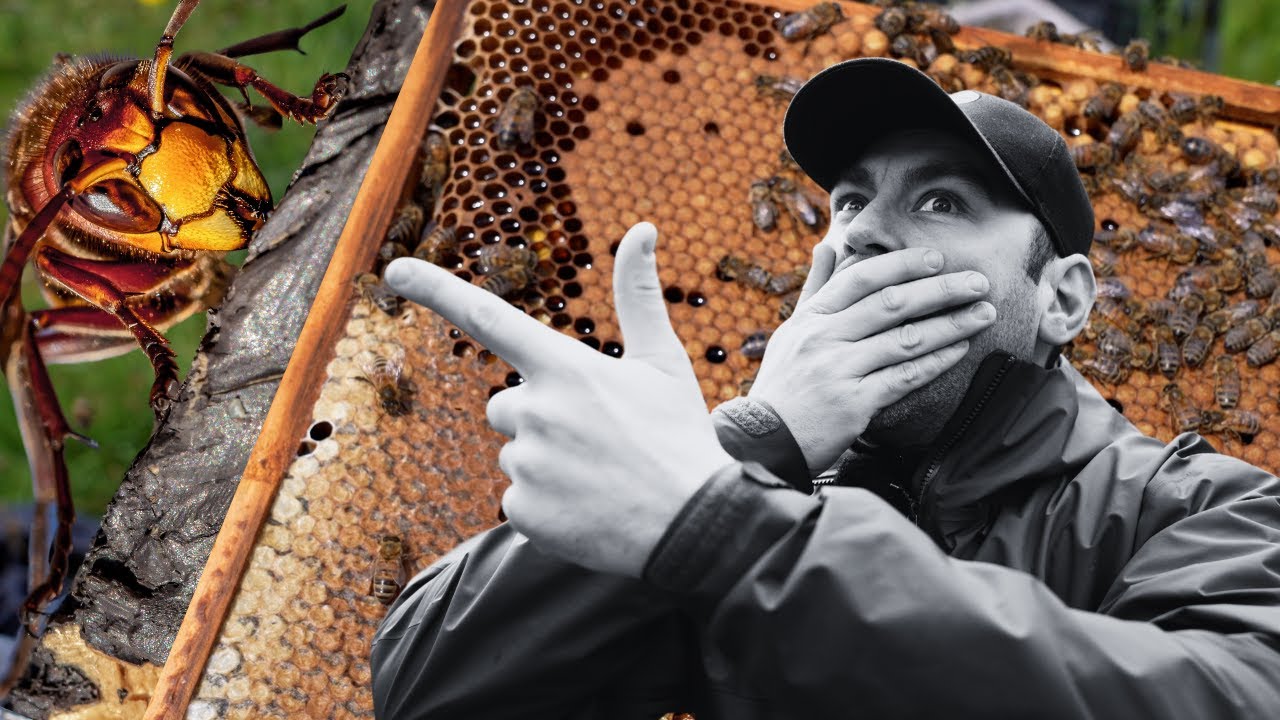
Laurence Edwards found a dead European hornet queen in his Flow Hive and discovered his colony is making emergency queen cells after a failed requeening attempt. The hive is about 50% full of honey, and he'll check back in three weeks to see if the new queen takes and the honey is ready to harvest.
Chapters
In this video, we've got European hornets' nests, European hornets' queens, swarm cells, friendly bees, and lots and lots of Flow Hive hunts. The last time I went into my fake Flow Hive, the bees were trying to swarm because they didn't have anywhere near enough space in a single brood box and a single super. We made some splits, we tried to requeen some other colonies. I left a single queen cell in here, came back 3 weeks later, and what did I find? I found the same single queen cell. So annoying when that happens. You try and pick a good one, and the one that I chose had failed. So what did I do? I took that queen cell out and I added another frame of eggs and brood. Capped brood to boost the numbers, eggs for them to try and requeen again. That was a couple of weeks ago. I might be going in a little bit prematurely, but I just want to show you the state of this colony. Probably about 4 weeks since they've had a laying queen. I'm expecting the numbers to dwindle a bit, but But I'm expecting there to be a lot of honey upstairs in the fake Flow Hive frame. So the last time we were here, we showed you that we had a European hornet's nest, and look what I found as I've come here today, a dead European hornet queen. I'm a little bit gutted about that. I thought we were gonna have a proper European hornet's nest in here. To be honest, the European hornets might still be alright, and the queen's done her job and laid up that nest, but what we definitely have is one dead European hornet queen. Definitely going to have a look in the nest again. Going to take that off, see if we've got any larvae still in there, see if they're emerging, see if we've got some European hornets. Right, as I said, I'm no expert, but see if you can see what is in here. We've got lots of larvae, looks like some capped over larvae as well, but see what is hiding around the side. Oh my goodness, scared the absolute life out of me, this did. I'm not an expert when it comes to the life cycle of the European hornet. In fact, I know nothing about it whatsoever. I can identify it though. I know this isn't an Asian hornet, but look at that poking out there. Absolutely spectacular. Cannot quite believe that. And there she goes, she's gone off for a flight. So I am so glad I'm in my Ultra Suit. I don't know why I get so scared of European hornets, like petrified. I can feel the blood coursing through my veins. I'm gonna put this nest back together again now. Hopefully you got a good glimpse of it. I don't want to annoy that hornet queen. So really good identifier for people there. Hopefully you got a close-up. That is a European hornet. That is definitely not an Asian hornet. I'm going to put this nest off to one side now very carefully, and I will set it all back up for the queen to come back and tend to that nest. Right, just lifting up the flow box. Wow, it is super heavy. I'll show you that at the end. Let's look at the brood box first. So I really, really like these bees. Docile F1 Buckfast. But we're trying to requeen them down to an F2. Not sure they're going to be there quite yet, but I've still got the remnants of the F1 daughters and they are very, very calm indeed. So starting off with a beautiful frame of pollen, really nice. A lot of these colonies are verging on pollen bound. I want to double brood this one up because there really isn't enough space once they get going. Right, so we've got some good news. The bees have done what I expected them to do. They've taken the frame of eggs and larvae that I've given them And they have produced a number of new queen cells. Now, when you get to this point, the bees aren't trying to swarm, so you don't need to remove all of the cells and just leave one. You only need to do that when they're trying to swarm. You could just let the virgins fight it out in this case, and I'm confident that we'll just come back and there will be one virgin or a mated queen, and all of the bees will remain in situ. Right, so I put the brood nest back together again. We've got queen cells in there, emergency queen cells. I'm happy they're going to sort themselves out. Lovely temperament colony. I've got a European hornet queen flying around, absolutely battering me. She is not happy. We're going to do this as quick as we possibly can. Now we're going to take a look inside and see how much honey they've got upstairs in the fake Flow Hive super. So the bees are very busy upstairs. Even with reduced numbers, they've still done well to put lots of honey away up there. I reckon we're about 50% full up here. Lots of capped honey. Lots of open honey as well, and it's pretty similar across all of the frames. So I don't want to mess around with that European hornet's nest any longer. We're all fixed downstairs in the brood nest. We've got queen cells. They're not hopelessly queenless because they've got the resources to make themselves a queen, which they've done with emergency cells. Plenty of bees still left, lots of honey upstairs. I'm so excited to come back to this colony in about 3 weeks. Hopefully the supers are full and ready for extraction, and hopefully we've requeened with a nice calm F2 Buckfast queen.