Lynne Twist – Change the World Today
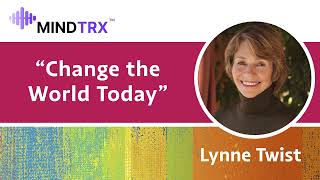
Lynne Twist talks about living a committed life: taking a stand versus holding a position, moving from scarcity to sufficiency, and grounding optimism in real action. She draws on decades with the Hunger Project and her work with Mother Teresa in Ethiopia to show how context and vision shape what becomes possible.
Questions this video answers
Ethiopia
The Soul of Money; Living a Committed Life
Chapters
When you relinquish that and take a stand, it's almost like you raise up above and you can see all the points of view. And you have vision. And vision is both what you see and the capacity to see. It's both a, a noun and a verb. And when you have vision, you have the capacity to see all points of view. They all are informative. They all make sense. You can see why Paul thinks this and why Susie thinks that, and why Scott thinks this, and why Ryan thinks that. You have the capacity, because you've taken a stand, to be informed by all points of view in a way that you can really make something beautiful happen. And a stand is always for something.
Welcome to the mindtrax podcast with breakthrough ideas to live your best life possible and how to make it happen. I'm Paul Shealy, and today we'll be talking with Lynn Twist. Lind Twist is a global visionary committed to alleviating poverty, ending world hunger, and supporting social justice and environmental issues. She is the author of the bestselling book the Soul of Transforming youg Relationship with Money and Life, and her newest book, Living a Committed Finding Freedom and Fulfillment in a Purpose Larger Than Yourself.
Foreign.
You're one of the most significant voices of our age doing transformational work. A committed life. You are a model of it. And your book, Living a Committed Life, is really a beautiful template for how anyone who can recognize that there's more to their life can start showing up and delivering their gifts to the world. Thank you for writing it.
Oh, my, my pleasure. I, I, I'm so grateful that I, that I did write it, even though it, it was kind of a struggle to get it out of me. But you, you know, probably from the book that our friend Jack Canfield was very helpful in getting me to write, write this book as he has with so many other people. So I'm, I'm grateful that he kind of made me do it.
Good. I am, too. And I'll tell you, there are a number of very powerful ideas within it. I'm not going to offer a spoiler alert. I'd really like to dig in and try to get at some of the important distinctions that you're making so that anyone can really relate to what it is you're attempting to share. As I read the book, I thought, oh my goodness, your life is so rich there. It's such a delightful story to really know you from the narrative of your own life. Thank you for that. And there are a couple of terms that I'd like to get into There is a statement that you made. It says, taking a stand leads to a commitment which gives your life purpose. So obviously living a committed life, the emphasis is on commitment. But I want to, I don't really want to start necessarily understanding what the depth of what commitment makes. I saw that what you did is use the analogy of Archimedes. He said, give me a lever big enough and I can move the world. And you use that analogy to describe commitment. So say more about that if you would.
The full quote from Archimedes is, give me a place to stand and liver long enough and I'll move the world.
Beautiful.
And I actually think that's how it works. It certainly has worked that way for me. Which means that you stand for something larger than your own life starring you. And that's, that's a, a tall order for people because usually what we're sort of brainwashed to do is try to figure out how to succeed as a human being just sort of on our own terms. How to be cool, how to be, how to be relatively happy, how to, how to be, you know, financially, be able to take care of ourselves. All of those things are very important, very good and very healthy. At a certain point, though, they don't give us the life that, that we have the possibility of living. And, and, and sometimes even taking a stand for something larger than your own life can shape your life and shape you into the person who can fulfill that stand. And it's a little bit or that commitment, really, let me say, let me stay with the commitment. You know, we, we sometimes think that in order to make a big, a bold commitment, you need to, first I have to do this, and first I have to do that. I have to get a PhD or I have to, you know, learn more about this or I have to lose more weight or I have to this or I have to that.
And the first we have to thing can go on for your whole life, actually, or you can see what calls to you. Why were you born now at this epic, epic time in history? I think if you're alive now, you have a role to play. And I feel very certain about that. I can't prove it, but I think if anybody's alive on this planet now, they have a role to play because we're living in epic times.
Totally on board with that idea. Yes.
And so, you know, you don't have to, but you can. And there's a huge calling for all of us to step into the next level of who we are as a human family and who we are as human beings individually and who we are as a species. You know, we've been, we're getting big feedback called the pandemic, we're giving big feedback, we're getting big feedback called climate crisis. One could say that that's feedback so strong, so powerful, that it's really stopping us in our tracks so that we have to rethink who we are. Now, that's an individual job, but it's also a cultural job. It's also actually, I think, a species job. And so all of what I'm saying now, we live inside of an epic time that's calling for us to be way more than maybe previous generations have been called to be. I don't know. I didn't live then, but now I can feel it. And it not only frees you into full self expression, it demands that you be great. And so rather than get yourself all ready to be great, the commitment reaches back into your life and makes you into who you need to be to fulfill it.
And I love that aspect of all of this and because very often we think, well, I have to have it figured out, how is this actually going to take place before I make a commitment? And you're saying, no, no, no, no, no, no. And I remember our friend Reverend Michael Beckwith, he says that God doesn't call the qualified God qualifies the call.
Right? So, yes.
So once you heed the call, like Moses on the hill. Right. You got the wrong guy. I'm not. I can't do that. Right. As soon as we heed the call, we cross a threshold into a transformation where the rest of our life isn't going to look the way we thought it was, but it will all make sense in a new way. And so what you've stated is a very important idea, that taking a stand, making this commitment, changes the context of your life. Now, the word context doesn't mean a lot to a lot of people, the way you and I understand it. So would you please take a moment to really describe what the concept of context means?
Okay. Well, context informs the content.
And I'll give you a demonstration if I put up.
My fingers like this.
There's many different ways you could describe what I'm doing. You could say, she's pointing up to the ceiling or to the sky. Or you could say, she's.
Showing two fingers, she's creating the word, the distinction, two. Or you could say, no, that's an 11.
And that's whatever it is, this is the same. But what context you create. If I Say this is a number, then you could argue with me. Is it 2 or 11? Suddenly it makes sense inside of that. If I say this is a direction, then you would say up. So the context informs the content. It's the frame.
It'S the ecosystem in which something lives. And we have a lot of power over the context. You know, we. We talk about life is really about how you interpret it or the conversation you have that defines your experience rather than the experience itself. So, you know, some people might say that the cancer diagnosis, they had completely destroyed their life and they gave up on life and they just surrendered themselves to letting go and being at the end of their life. Some other people might say the same exact cancer diagnosis transformed their life and they became more dedicated to living than they'd ever been before and appreciated every moment of life. That's a context inside of which there's a cancer diagnosis. So context informs the content, and it has enormous power. And we are the creators of contents, context. So the context that we generate, the contexts we see things in. So, for example, when I say the climate crisis, where it may be, as Paul Hawkins says, we're not the victims of it. It's not happening to us, it's happening for us because we need a huge course correction as a species. And so the climate crisis is happening for us. Feedback to give us the information we need and the feedback we need to make a really significant, huge, you know, epic transformational shift in the way we live.
So this really gets at the idea that we don't always choose the circumstances of our lives, but we absolutely have omnipotence over what we do with the circumstances that we're handed. And if we take something like systemic racism as privileged white people, we don't perpetuate racism. We have inherited it. So what's the dialog? What's the conversation we're going to have that we might end systemic racism in our lifetimes? And so that context begins to shift. It start. Our commitment, starts to define the context wherever we are, of whatever circumstance we're in.
Exactly. And I really learned this with the Hunger Project, because.
When the Hunger Project began, all the organizations working on hunger and poverty were working to alleviate the suffering. But hunger was seen as a hopeless, inevitable problem and part of the human condition. When the Hunger Project began.
The founder group, which included Werner Erhard, John Denver, and also Buckminster Fuller, was in there and other people. The declaration that hunger could end and that this group of people was committed to ending world hunger completely changed the way that we were working on it, the way we addressed it, the way we talked about it, the way we lived in it. And that context became the worldwide context eventually. And now all the organizations, care, unicef, Save the Children, Christian Children's Fund, they're all working on ending world hunger, which is a very distinct shift in the context, but also in the content. The content lines up always with the context. So if you know what the context is, you can see how the content lines up with it. If you shift the context, it shifts the nature, the magnetic field of the content. So that's a little bit, you know, theoretical and esoteric, but it really does work that way.
Yeah. And I think it's also, somebody takes a new job and they're not sure if they're really prepared for it because there's a lot of new responsibilities, a lot of new skills are going to have to acquire and so on. But when they hear more about it, they realize, oh my goodness, everything in my life has prepared me for this moment. This is the ideal place for me to land right now. I. The story you told of meeting with seven women in Nigeria, I believe it was, and hearing their stories and just being so overcome by the depth of their suffering, being in the proximity of suffering, as you describe in the book, and then coming to New York City where seven privileged white women were meeting, and suddenly it dawned on you that here's an opportunity for a co respondence that may have never existed in our lifetime before. And there was something that shifted in you that now the context was set in a different way and a possibility emerge. I would love to have you speak about the possibilist or possibil. How do you pronounce that? Possibilist. Right. A grounded optimism that leads to possibilities. Say more about that because it's truly a gift of yours, a possible list.
Which is a term that I think Frankie Moore Lepe, who's this wonderful friend of mine and author made up. But I love it because I feel that I can generate possibility out of a, you know, out of a rock. I mean, I love generating possibility. And when a possibility is there, when there's a vision, when you can see the way through, then that is, that pulls you, calls to you, pulls you through difficulties, obstacles, as you find a way getting around up underneath, transforming that what's between you and what you're dreaming of, what you. What you've committed to, what you've made public, you are for. And. And so grounded optimism, which is, I think, your question, and generating possibility, it's. It needs to be Grounded, so that it's not foolhardy, so it's not wishful thinking, but thoughtful wishing. As my friend Carolyn Buckluce would say, it turns you in from a worrier about the world into a warrior for what you're committed to. So all the energy that goes into worry gets transformed into becoming a warrior rather than a worrier. And it takes energy that was going into the negative or the doubting or not being so sure, being afraid, or worrying that it's not going to turn out, into causing it to turn out. Because that energy is valuable, that's a valuable resource. It's completely transformable. That energy is very important and very useful, and you could put it to work resolving, healing, completing and generating the future that you want. So a grounded optimist is someone who generates possibility.
So in that moment where you made the connection between seven women in New York and seven women in Africa, what was it that you suddenly saw as a vision or a possibility?
Well, I. I want to answer that, but let me just say. Okay, one of the things that I need to say before that is I have.
I have. The country was Ethiopia. Ethiopia, not Nigeria. The seven women had been through the worst famine in the history of the world. Every one of them had lost every single one of their children to starvation. So anyone who's a parent, or even if you're not a parent, just imagine child after child after child after child dying because you cannot feed them, you can't get water, you can't. And they die in your arms. And somehow, for some reason you don't understand, you're still alive and your children are all dead. So these are the women you're talking about?
Yes.
And what I kind of. In order to answer your question authentically, I need to say that being with them around a dry well at the end of that famine, one woman had lost 11 children, another five, another seven. And having them honor the death, the life and death of each one of their children through wailing and crying and describing the child and the excruciating experience of their death until we had cried and wailed and screamed so that we were so exhausted we couldn't. We couldn't continue.
And then they made a commitment.
To live the rest of their lives in a way that no mother would ever need to go through that again.
Given that they were now childless mothers.
Made.
Me see how awesome human beings are. No matter what. The human spirit is stronger than anything. I mean, it's incomprehensible to lose any children, not even one, but to lose all your children. And then to commit to not taking your own life, but to living a life of meaning and power and getting yourself educated, which is what they all did.
Who they became, who they. Who they became is just so inspiring.
Staggering. So after being with them, not only was I emotionally drained from being with them for, you know, five days and five nights around this dry well and wailing and crying and, you know, just really. It's almost incomprehensible talking about it now, the. The physical exhaustion of that kind of emotion. But I also was so. I'm exhausted. And then I'm super, super, super, super inspired by their courage and their resolve and their determination to live the rest of their life in a way that they got educated and stopped the horrors in their country. And the horrors, you know, H O R R O R S. The famine, the starvation, the corruption, all of it. So then I go to New York and I'm in the company of women that are addressed to the nines with couture and beautiful apartment and, you know, drinking the finest French wine and having an awesome dinner. And then I'm supposed to guide them on their investment strategy. And they're all married to Wall street titans, and I can't talk about anything but the women I was just with in Ethiopia. So it. It. The. The moment came when I was in New York because I couldn't talk about anything else but the women in Ethiopia when I was sobbing and they were sobbing, the women in New York. And at the end of that cathartic sharing of what I'd been through, what I'd witnessed, what I'd been honored and privileged to be part of.
They wanted nothing more than to meet the women in Ethiopia and be. Be sisters to them. Not feeling sorry for them, I gotta say. Not sentimentality, not pity.
Wasn't sure that they were trying to make. Yeah.
Respect. And. And not seeing the women in Ethiopia as poor because they're not poor. They're strong. What's poor is their circumstances.
So love that distinction you make.
Yeah. And. And the women in New York actually seeing the women in Ethiopia as strong, powerful, admirable, dignified human beings. Seeing them see that, which is something that I saw too, but having them see it out of my story, I knew that working, putting them together was the right thing to do.
It gets back to the very first quotation.
Taking a stand leads to a commitment which gives your life purpose.
Yes.
And to see purpose emerging from that connection is just so inspiring to me. I really got what it was that you were communicating in that. So thank you so much for it. There is this other statement that you make.
This idea that we be in dialogue.
That what we're doing is we. If we aim to live a committed life, it is our responsibility to listen for and generate conversations and contexts that empower ourselves and others. So that story, to me, is a great example of how that emerged. That how could we possibly. How could you have possibly spoken about anything else?
Yes.
But what's stirred your soul to the very core. And. And Will, somebody once said to me, well, you know, I just don't feel I can. I can talk about transformational ideas with the people I hang out with. I said, have you ever tried. No, I think they think I would be weird. I said, try it because the reason they're in front of you at this moment.
Yes.
Is because they're waiting to hear that story that's on your heart. So I said, I have never found myself in a situation telling a profound story that wasn't exactly what needed to land on that person exactly in that moment. And I don't know.
How that all gets orchestrated from the divine, but almost without exception, that's the case.
Yes.
And you. You demonstrate that so beautifully, the willingness to speak from that place of the stand that you take. So let's talk about the difference between stand and position, because I've used that distinction that you make so many times, and every time I use it with someone, they, oh, I get it now. So would you please share that distinction?
The domain of positionality, or taking a position.
Is the domain of points of view, is another way of saying position and positionality. It's energetically kind of designed to create its oppositionality. So if I say right, it literally creates left. If I say here, it generates there. If I say us, it generates them. You know, if I say up, it generates down. So you get the point. So positionality generates its oppositionality. And that's.
And it tends to be a narrow scope.
Yeah. And it tends to be kind of binary also. And then there's higher and lower, but it's all relative, it's all comparative. It's a little bit competitive. And then there's this other way of talking about it, which is a position is really a point of view. So it's almost like a point of view. Like I'm sitting here looking at the screen, and this is my point of view. If I were sitting off to the side of this room and looking at the screen, I would have a completely different point of view. I wouldn't see your face. I wouldn't see that there's anything on the screen. It would look like I was talking to nothing. And that point of view would be totally 100% accurate for the person who's sitting at that point of view. But for the person sitting here, my point of view is completely different. And we start to think, one of the things we do as human beings, this is part of being human. If we start to think our point of view is the only point of view and that it's the truth for everybody else, it is the truth for, for me and that person's point of view is the truth for them. But we start getting a little righteous and we think, well, my point of view is, should be everybody's point of view. This is what I see, and this is the truth for me. And we get confused and we start to get righteous and we start to fight other points of view, other positions, and we make a big mess. So United States Congress is a beautiful example, or anybody running for office, they always have to make something wrong to make something right. And so what's so beautiful about points of view and positions is they're so informative when you're not stuck in yours and yours alone. And how you do that is you relinquish your point of view. And when you relinquish it, you have access suddenly to vision. Instead of a point of view from whence you're looking, you have vision. And we all have a point of view both kind of geographically and physically in a room. But we also have a point of view from where we were raised and what country we're from and what language we speak and what culture we were raised in. That's a point of view, really. But when you relinquish that and take a stand, it's almost like you raise up above and you can see all the points of view and you have vision. And vision is both what you see and the capacity to see. It's both a noun and a verb. And when you have vision, you have the capacity to see all points of view. They all are informative, they all make sense. You can see why Paul thinks this and why Susie thinks that and why Scott thinks this and why Brian thinks that and why this country thinks this and why that, and you become. You have the capacity, because you've taken a stand, to be informed by all points of view in a way that you can really make something beautiful happen. And a stand is always for something. So Martin Luther King, for example, was a stand taker. Now, it's not that he didn't have a position against this and a position against that. You know, he, he got legislation passed. He, he was, you know, a brilliant, brilliant man in taking positions and explaining his point of view. But who he was and where he spoke from and that's why his voice and the timbre of his voice and just hearing the, the Martin Luther King speech makes, stirs everybody's soul is because he spoke from and lived from and did his work from a stand.
Mahatma Gandhi, a stand, a stand that all people deserve a chance for a healthy and productive life. It wasn't that he was against white people and for black people. You know, you knew that by the way Martin Luther King lived his life. He was for everybody. So a stand is so much more powerful than we know. And when we take a stand with our life, it frees us into being a person who can be fully self expressed. And that's what I'm really recommending.
Yes, you know, a committed life.
Do it. But there's a possibility that everybody can take a stand.
Excellent. And, and that really is the nature of commitment. You can't have a committed life without taking a stand on something that stirs your soul and that also then gives your life a true purpose. And I would like to.
Talk about the biggest obstacle to a committed life. You state it in a couple of different places, but it's the idea of scarcity. And there are four or three myths of scarcity. Toxic myths of scarcity.
And the fact that it may be the biggest obstacle would also give us a good reason to talk about why we don't have to maintain that hypnotic trance any longer. So the three, just as a quickie, is that there's not enough scarce resources to go around for everybody. We've got a billion people on the planet, so there's not enough. Secondly is that more is better. And so we are really ought to work to get as much as we can while we can. Make hay while the sun shines. And the third is that, well, it's just the way it is. We don't have any control, we don't have any power to do anything about it. And so we become very resigned to it. One of the great quotations that you brought in, there's so many I could hardly stand myself because I love quotations. But Gandhi says there is enough for our need, but there isn't enough for our greed. So would you speak to these toxic myths and what is the best way for anyone to really recognize right now you have sufficiency? I think Your whole Soul of Money book does a beautiful job of describing it. But in the context of someone now listening, recognizing that they want to live a committed life, how do they overcome that sense of scarcity?
Well, first of all.
The condition of scarcity, which I call a lie.
Is a, is a way of thinking, a way of perceiving that's really, it's an unconscious, unexamined condition of thinking that I'm really insulting and we're insulting that together. And in the commercial consumer culture in which we live, it's promoted constantly. You're not, you know, subtly, it says you're not enough until you acquire this or buy this or lose more weight or get taller or skinnier or better looking or have more money. So, so our culture, you know, pummels us with met with messages that say you're not enough until you acquire or accumulate more.
And since our, since our parents came out of the depression and we came into the 50s.
Right, right.
And you know, here's all this abundance, all the promotion had to go to creating a consumer oriented society to grow the economy.
Yeah. And it's, and you know, there's a lot of good has come from that, but now it's out of control now we don't realize that it's, it's kind of a false frame of reference for life. And so we don't have enough time, we don't have enough money, we don't have enough this, we don't have enough that, we don't have sleep, we don't have enough sex, we don't have enough love. We wake up in the morning, we don't have enough time, we didn't get enough sleep, et cetera. It goes on and on and on. And most meetings and conversations are about what we don't have enough enough of. And I'm, I'm accusing us of being so caught in that conversation that we cannot see the forest for the trees. And the, the radical, surprising truth that I'm now going to name is that there's enough.
That you're enough, I'm enough. There is enough. We have enough. And that is like a revelation. I mean that's like really now I want to just make sure people know that I've worked with Mother Teresa, I worked on hunger and poverty. I work in the Amazon rainforest. I know there's places and people who don't have enough water, who don't have enough food, who don't have enough jobs. I mean, I know that and I'm not stepping over that. So I want to make sure people know that I understand that that's real. I'm talking about an unconscious, unexamined mindset. That has us producing people who make billions of dollars. I mean, how completely weird is that? That we have someone who's practically a trillionaire? Now, how could that be on a planet with 8 billion people. That we would allow that kind of accumulation?
And it's also the source of our environmental crisis. Are completely using, taking, consuming, Trying to get more and more and more of anything and everything. But when we recognize what I call the radical, surprising truth that there is enough.
We let go of trying to get more of what we don't really need. Which is what we're trying to get more of in most cases. And it frees up oceans of energy to turn and make. And pay attention to what we already have. When we pay attention to what we already have. When we nourish what we already have. When we love what we already have. And when we share what we already have. And make a difference with it. It expands. And that's the source of true abundance. Is being grounded in enough in a way that it overflows naturally into abundance. Rather than going from lack to more. And then lack to more and then lack to more. That will never produce true prosperity. It produces more, but it doesn't produce true prosperity or true abundance. And so we're caught in a cycle of lack and more. And lack and more and lack and more. Rather than recognizing, Stopping to say, wait a minute. We have enough. And enough is not an amount, actually. Yeah. It's a way of being so. So that's the short version of. Of that whole book called the Soul of Money.
I would like to say two things. Number one, our friend and mentor, Buckminster Fuller. Stood on the edge of the bridge. Ready to throw his life away. And he stepped off a bit back onto the bridge and said, okay, I'll admit it. I'm a throwaway. I'm a throwaway. So now I'm going to commit myself. To see how much one little man can do for this planet. And such a beautiful example of the failure of a certain type of thinking. And the absolute, supreme realization of a committed life. I really appreciate how much you brought Bucky into your dialogue. And I have to say, the idea of having at my dinner table. Talking with my kids would have been wonderful. But this idea that.
Abundance. This is the quote you made. Abundance flows through a portal of suffering. Now, that's an interesting way to frame the context of recognizing sufficiency. Out of a sense of Insufficiency. Would you be willing to say just a few words about that idea? Abundance flows through the portal of suffering.
Well.
It, there's a, you know, let's see. How can I talk about that without doing a whole chapter here? I, I, I feel that being proximate to suffering.
Is, is a powerful part of, has been a powerful part of my committed life.
Yeah. And I have to tell you that those were some of the more challenging aspects of the read that you provided for us because you did a beautiful job of sharing the depth from which true resilience, true prosperity emerged. And being proximate to that depth of suffering is, is a stunning aspect of your work. So thank you as a reader for.
Sharing those stories because Van Jones is now a sort of an icon for me and I think for many other people of.
A human being who, who.
Went for what he dreamed of, which was being in the White House with President Obama and being responsible for green jobs at the beginning of Obama's administration. And it was a miracle that he, as born in Tennessee from a relatively modest means, ended up becoming a lawyer and being devoted to stopping mass incarceration and providing green jobs, particularly for people, underprivileged people and people of color and people in urban ghettos and people who've come out of prison. And he ended up in the White House with, you know, his hero, President Obama, and then not long after that, was attacked by the press, by a particular part of the press, the right wing, you know, talk show host kind of press people, and so viciously. And it was, they were really trying to get at Obama. But what they did was they attacked Van and he had to resign. And.
The suffering he went through. And I was very intimately involved with that because a group of us raised money for his family so that he could just.
Make it through and, and, and, and go on sabbatical really, and just pray. The suffering he went through was so deep, so painful, so severe. And, you know, that's different than the suffering of me witnessing the lepers in the leprosy center in Calcutta, going with Mother Teresa, where, where I also witnessed a lot of suffering. So that's a certain kind of suffering that I was proximate to, but being proximate to the suffering of what I'll call, you know, your heart broken from your dream, falling, totally falling apart was what I witnessed with Van and Van's commitment to take that breakdown.
And own it and not become the victim of it for the rest of his life or cynical, or cynical or angry or resentful and transform all of that negative energy into a commitment to rise and grow and deepen his commitment to serve from it and then come out of it. I think, like 10 times more powerful now. Making a huge difference as a voice of media. He started five organizations. He passed.
The prison reform bill with President Trump, which is almost impossible, and stood next to him when Trump was signing the thing and Trump gave his pen. Bringing together the right and the left under Trump. I mean, it's incredible what he's done and way beyond what he ever probably could have done in the position he was in before. So every breakdown has the seeds of a breakthrough that's greater than the breakdown. And that's one reason why being proximate to suffering has. You see, if it's your suffering, yes, you can see it there, or if it's someone else's suffering that you're close to, you can see the power of the human spirit. It's so clear to me that that's one access to it. And when you see the power of the human spirit, the resilience of the human spirit, and anything's possible.
There are two things that you have referred to is doing hospice for what needs to pass and being midwives for what it is that needs to be birthed. And all of us at this time in human history are required in both roles. There are ways of being able to close a chapter of what.
What is ready to be released that is no longer sustainable, that has lived its useful life for whatever purpose it may have had. And no matter how devastating the consequences of that, again, if we create the right context, didn't happen to us, it happened for us, that we might awaken, that we might see this vision of possibility for humanity. And so we talk about what is it that's ours to give birth to. And there's this idea that you shared from. I believe it was Reverend Michael. Pain pushes, pain hurts, until vision pulls and vision liberates. What is it that needs to be born through us, as us?
I like thinking about all of us who are alive right now as the current blossom on the lineage of, you know, generation after generation after generation that came before and the ancestors for an age to come. And when you hold yourself that way, that's a context that and that we're living at an epic time in history where the crises are multiple and deep.
Gigantic. And in that way, as Bucky had predicted 50 years ago, every institution is dissolving and disassembling, and we can't fix them. And we need to recreate everything from a you and me paradigm rather than a you or me paradigm. Paradigm of go from paradigm of scarcity to a paradigm of sufficiency, or you and me. And that's an all hands on deck assignment. And when, you know, when you're aware of it, you want to play, I think, and if you're not aware of it, that's okay, too. But something's calling us as human beings to step into an evolutionary leap. And what a time to be alive. You know, I think I put in the book, I can't remember, but I think I put in this conversation I had with Joanna Macy, who's 93, who's a physicist and a Buddhist and a, you know, incredible systems analyst person, systems theorist. And she's, she's, you know, she's 93 and she's so excited that she's still alive to see the transition because she says, we're in it. It's the Great Turning. I'm witnessing it. I'm so excited. And it's, you know, scary and terrible and all the things that you could say about our times. It's also true that something is being born and the pain is part of it. The, the pain is part of it. When you think about your own life and where you really had a breakthrough, often it came out of an illness or a heartbreak or a divorce or a bankruptcy, or sometimes it's. It's not all that beautiful when we really grow. And, you know, I, I've said that, you know, perhaps the pandemic is morning sickness for a pregnant species that's a, that's going into a pregnancy. I don't know how long it'll be, whether it'll be 20 years or 30 years. I kind of think from 2020 to 2050, we'll be pregnant and giving birth, hopefully to a new kind of human being. And, and, you know, everybody doesn't have to believe this or even do it, but what an opportunity to be alive. What a thrill to be part of the Great turning, the massive, epic transformation that we know is happening right now. And some people ask me, well, gosh, Lynn, is it, is it really going to turn out? I don't even question that. No way. I don't even want to go there. No, I stand for. It is turning out.
It is, it is, as evidenced by our dialogue right now.
And so, final word, how can someone continue to build an ecosystem of support for them living into a fully committed life?
Well, I think it's all about community now and collaboration, if you think about that. Word co laboring, working together. We're all having this baby together, men and women. We're all pregnant and we're co laboring. It's going to hurt. Having a baby hurts. I've had three of them. It hurts. But the more it hurts, the closer you are to having a child. And that's how pain pushes and vision pulls. So stay in touch with the vision, generate that vision, keep creating possibility and we can get through anything, particularly if we do it together. If we co respond, collaborate and come into unity. Those words, community is coming into unity. Collaborate means co labor and correspond with each other, communicate with each other. All of that is, I think, key to getting through this and to what I know the other side is going to be really extraordinary and know that there's a divine appointment that we all have right now or we wouldn't be here.
We all signed on, we did this great moment. Lynn Twist, thank you so much. What a pleasure to be with you. Thank you for your good work in the world for Sophia Century and all the things that you are committed to in your life. It's been a pleasure. Blessings on your journey. Bye.
Thank you so much. Paul, I love, love talking to you anytime and I love your work and I love you so thank you so much for having me.
Peace and blessings.
Thank you.
I hope you enjoyed our conversation with Lynn Twist. You can learn more about Lynn@SoulOfMoney.org that's S O U L O F M o n e y.org and now in the second part of the podcast, it's just you and me. I'll tell you how to use the paralyminal sessions in the MindTrax app to easily handle obstacles and move toward the success you want, especially as it relates to Lyn's message. If you're new to the relaxing paralyminal audio sessions, they use breakthrough technologies to activate your whole mind and in only 20 minutes to help you improve any area of your life. Let's get going.
Hello. Good to be with you again. This is the follow up session on an absolutely marvelous interview that I had, a dialogue that I had with what I consider to be one of the most significant remarkable women on our planet today. A woman of great courage, tremendous commitment, author of the Soul of Money and Living a Committed Life, Lynn Twist. I absolutely loved being with her and she's such an inspiration to me. I was delighted to be able to have the time. But then also think about what's the best way for all of us to live into some of the ideas that she was sharing and suggestions that she had for how we could proceed. So I broke the interview into four components that I thought were significant that emerged from our time together. The first was what can help us live a committed life? Secondly, how can we maintain mindsets of grounded optimism and possibility? The third was how do we overcome the biggest barrier to living a committed life? What she referred to as the mindset of scarcity and the three toxic myths of scarcity. And finally, the idea of how do we support ourselves? How do we create an ecosystem of support as we move forward and face the challenges and the tests of our commitment that will invariably be ahead of us as we take on a goal, take on a purpose that's bigger than who we are, that's, that's actually motivated and made possible through strengths and powers and gifts that the universe gave to us. So let's break it down into some paralympicals that may be very helpful in each of these four categories. The first, living a committed life. I thought of the, the paralyminal fearlessness.
One of the things that Lynn and I spoke about is this idea that we can't always choose the circumstances that we're in, but we can choose the response we have to those circumstances. For that we are omnipotent, we have absolute agency and choice. So fearlessness really helps us do that. The second area was about maintaining mindsets of optimism and possibility. And she talked about being a grounded optimist, meaning she didn't have any kind of Pollyanna view of the way things should be. She recognizes the difficulty and the problems that are in front of her. They're real problems that need real solutions. And so there is the need to move away from the idea that it's just the way things are into what's possible here. Not that the world is happening to you, but the world is happening for you. We find ourselves in circumstances that we wish wouldn't have occurred, but what's happening is that we're recognizing, oh.
I'm not a victim of this circumstance. The circumstances is here to awaken me to what my life is to become.
So the belief paralleliminal is super powerful because you start rewriting beliefs of lack or limitation into beliefs of possibility.
Another parallel called euphoria, which is that idea that this is the natural energy within you. And Lynn spoke about a 93 year old woman who's just euphoric about the possibilities that are emerging right now. Euphoria really helps you develop that, even though what it is you're trying to address may be a Very gnarly problem that's going on in the world.
Third area is overcoming the big obstacle of a scarcity mindset. So certainly topping the list is the parallel I did with Lynn Twist called soul of money. It really gives us into that recognition of sufficiency. There is is enough. And she talks about it as a radical idea. It is, it's heretical, it's heresy compared to the consumer oriented mindset that our culture tends to insist that we play a part of. We don't need what we don't need. Focus on what it is that brings us a recognition of sufficiency. Keep in the flow of life. That's the soul of money. A couple of more abundant money mindset which helps change those myths that may have existed in the past or the present and establishes a new mindset, a new money story for going forward into the future. It's abundant money mindset. The next one, financial security really gets at the idea that there is enough and that your habits of spending and savings will on a daily basis determine your level of sufficiency. If you have a mindset there isn't enough, you'll have a tendency to overspend. But when you recognize I've got plenty, I don't need any more, you can save more, invest more and grow your financial wealth. Finally is the area of creating. Creating an ecosystem of support. I love that term. I had never really thought of my life as an ecosystem of interconnected forces. But yeah, does. It's obvious that it is. So when we start recognizing it and then purposefully.
Using it, relying on it, building and growing it, we are going to always be sufficiently supported to get us where we want to go.
Self love. So good where you're bringing your past self and your future self together in a circle with you as the present self and really supporting and learning and growing and reinforcing, acknowledging and recognizing the progress you've made. A big piece of what Lynn and I spoke about at the end of our call is this idea of making note of small concrete indicators of success. Very important. A lot of times we look at our past and we think about all the failures that we've had. We're not recognizing that we survived. We made it here, we're stronger for it. And your future self can encourage you as well in the same way that you can encourage your past self. So it's a beautiful parallel self love. Actually it's become one of my very favorites. And the final one I'd refer to in this area of creating an ecosystem of support is called Recover and re energize. Something happens to you. Illness, a setback, a difficult challenge, a big work project that you had to lean into, whatever it might be. Recover and re Energize. And in the context, remember the term context. In the context of living a committed life.
We'Re re energizing our purpose and our commitment and our stand for what it is we truly desire to see in the world. If you look at great figures from human history that she refers to past figures as well as current heroes and she rose, we start to recognize that they went through a lot and some.
Just about got taken out by it. So.
You'Re living a committed life.
You're attempting to achieve a calling, a purpose that settled on you from time to time. This self care, this ability.
Plug into a set of headphones. Listen to this is Paul Sheily. What happens is you can get yourself back on track.
That's it for this session. Thanks so much for participating. It's really a pleasure to serve you in this program.
Peace and blessing.
Thank you for joining me today. I applaud your willingness to maximize your potential. You can easily use the paralympical audio sessions in the MindTrax app to stimulate your non conscious mind, I.e. your inner mind, to reduce any resistance in your life and to propel you toward the success you want. Visit mindtrax.com to learn more. These amazing audio tools have helped millions and I encourage you to bring them into your world today. Be sure to be back for more episodes of the mindtrax Podcast. You'll find insightful conversations with authors, experts and thought leaders all devoted to improving your life's experience. Thank you again for being here on our MindTrax podcast.
Sa.










