Sadhvi Bhagawati Saraswati – Freedom
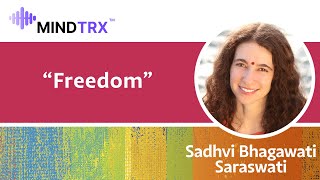
Podcast interview (MindTrax) featuring Sadhvi Bhagawati Saraswati in conversation with Paul Shealy about her memoir Hollywood to the Himalayas, the Himalayan tradition of yoga, meditation practices (walking, breath-based, Neti Neti), discernment around gurus, and applying contemplative practices in daily life. The episode includes a second segment where Paul Shealy links the conversation to MindTrax paraliminal tools (intuition, gratitude, fearlessness, joy) for personal growth.
Chapters
The word guru literally means the one who removes darkness and brings light. But in too many cases, the light that the guru brings is a light on themselves. So it's all about spotlight on me. Spotlight on me. Thou shalt love me and bow to me and worship me. Worship me and give me your life and in many cases, your money. And you know all of these things. Whereas a real guru, a real guru is shining the light on you. A real guru is shining that light so that you can see the truth of who you are.
Foreign.
Welcome to the mindtrax podcast with breakthrough ideas to live your best life possible and how to make it happen. I'm Paul Shealy and today we'll be talking with Sadvi Bhagavati Saraswati. Sadvi Bhagavati Saraswati is a renowned spiritual leader and motivational speaker. Originally from Los Angeles and and a PhD graduate of Stanford University, Sadvi has lived on the banks of the sacred River Ganga in the lap of the Himalayas for more than 25 years. Her best selling memoir, Hollywood to the Himalayas, recounts her journey of healing and transformation. Today, from one of the largest ashrams in India, Sadvi teaches meditation, provides spiritual counseling, and oversees a myriad of charitable and humanitarian activities. She travels far and wide and shares a stage with world leaders and spiritual luminaries alike. We were recently blessed to have her create the Pathway to Freedom program with us at Learning Strategies.
Foreign.
So good to be with you. Thank you for being a part of this podcast.
Of course. It's such a joy to be with you this morning.
Well, I absolutely loved reading your book. I read the manuscript when it was called river of Love. But Hollywood to the Himalayas is a beautiful testimony of your path and your commitment to a lineage which I hold dear to my heart. Could you explain just briefly, what is the Himalayan tradition of yoga?
Sure, yeah. You know, it's a tradition of lived experiential spirituality. So there's all of the teachings. I mean, the Himalayas are where the sage Vyasji sat and codified the Vedas. It's where according to our tradition, he spoke and Ganesh Ji wrote. So we've got all of the lineage of what we call Gyan yoga, the, the wisdom, the actual teachings of the Vedic tradition. But it's also the place of yoga, of meditation, of enlightenment, of awakening. So it's not just book knowledge. It's actually lived, experienced, practiced.
Awareness, awakening, enlightenment, transformation. And the way that I think about it personally, and the way that I think about it specifically in contrast to Hollywood, in terms of my My journey and the title of my memoir of Hollywood to the Himalayas. I think about it as in the Hollywood way of thinking, of living, tells us that we are our bodies. We are the size, the shape, the color, the bank account, the popularity, the history, that which happened to us, that which we have done, that we identify as all of that. And so we suffer. We suffer because we're not beautiful enough or smart enough or rich enough or successful enough or popular enough or happy enough. We suffer competition, jealousy, envy, resentment, despair, depression, all of these things that are epidemic here in the West. And the Himalayan way says, you have a body, but you're not the body. You are the soul, you are spirit, you are consciousness, you are love, you are truth, you are divinity. And that's where suffering ends. And, you know, you were speaking before you started recording in this beautiful invocation prayer that says, asatoma sad gamaya tamsoma jotir gamayarma amritam gamaya. And I won't go into too much of that, but there's. There's a very, very interesting and very powerful teaching in there, because it seems just like a prayer that says, oh, God, lead us from falsehood to truth, lead us from darkness to light, lead us from death or mortality to immortality. And yet.
You think, well, God is the one who created nature by whatever name, whatever form, whatever tradition we may connect with the divine. Nonetheless, that divine created a world in which that which is created gets uncreated. Whether you say it dissolves, it's destroyed, it dies, it finishes from a flower to a tree to a human life, we know that. And so for there to be this very fundamental prayer in which essentially we seem to be saying to God, break your rules for me, like you've made a rule that everything that is born dies. But leave me, just me. From death to immortality. It. It doesn't make any sense. It's not the oh God, make me the except to the rule prayer. But actually what it's saying is.
Lead me from that.
Falsehood, that darkness of ignorance in which I identify as the physical body, in which I identify as this size and shape and color and role and success and whatnot. Lead me from that to the light filled, wisdom filled truth in which I recognize that I was never born and never died, that I am that which is immortal. So bring me from an identification with that which perishes to an identification with that which which doesn't.
That's so gorgeous, and thank you for that. There's a lot that we can carefully peel apart in our time together, I would like to posit that my.
Experience of the Himalayan tradition of yoga, science and philosophy, the Royal Path, was what I was initiated in, really helped to calm the body, it really helped to calm the emotions, it really helped to calm the mind so that I could glimpse that truth. And once I did glimpse it, I knew that I was all in that.
Eternal truth, that we are timeless and eternal, ever free, ever pure, ever wise. And after getting involved in it, a lot of people were very concerned that I was joining some kind of cult, because this was back in the 70s when a lot of that sort of thing was happening. And I know in your memoir there was some concern of what your parents would think or what they were imagining when you went to Rishikesh or to Haridwar and, you know, didn't come back. So what. What in the world is happening to our daughter? What do you say to people who have been raised in other traditions when there is concern about a person getting sucked into something that they don't understand and they'll get lost in it?
Well, I think, first of all, it's important to recognize that just because both you and I were very blessed to be brought into traditions that were and are very real, very deep, very powerful, that doesn't mean that the threat of getting swept up into something that is more like a cult, something that is.
Not helpful for the person who's been swept up, it doesn't mean that that threat doesn't exist. You and I were really blessed. We were blessed with a power of discrimination that enabled us to.
Even in the early days, see truth and to see whether in the case of Swami Rama, in your case, and then Swami Vidb Bhartiji in your case, or in my case, whether it was Swami Chitananda Saraswati Ji, my guru, whether it was the sacred Mother Ganga, this Goddess Ganga. But we. We were able to recognize the truth and to.
Be blessed with grace, to be at the feet of and studying from real enlightened masters, Ra.
Simply charismatic people who were out there to accumulate and acquire devotees. So I do think that that threat exists, but.
It'S obviously not everywhere. There really are powerful lineages and masters who are steeped in wisdom and grace and truth and light. That brings healing to us, that brings wisdom to us, that brings transformation to us. I mean, the way that when I walked into Rishikesh, into Parmarth Nikathon, the ashram where I live, the ashram where my guru is the head, I was filled with an identification, an identification of who I thought I was, that was based, based on experiences that I had had in many cases based on traumatic experiences, suffering and conflict, but also, also some of the beautiful good stuff. And I really identified as the physical body, what it looked like, how attractive it was to.
Members of the opposite sex, how it looked to me in the mirror, how much it fit in with what our culture said was beautiful, what it could do, what kind of grades it got in. You know, my undergrad at Stanford, my PhD program was in a student. There was a whole ego sense that led to an incredible amount of suffering, an incredible amount of stress, an incredible amount of fear, and a sense of kind of what I think about as a death grip on life because nothing can move even a little bit here or there, or you feel like you're losing your grounding. And the light that was given to me and given to you is the light of being able to see the truth of who we are. And you know, one of the ways that I always tell people when they ask, how do you know if someone really is a, a right guru, the right master to, to follow? And I always say, you can't, you can't know for sure. Someone is. There isn't unfortunately an equation that you say, you know, if A plus B equals 3, then yeah, go ahead, but you can know if someone is not right. And this is what I would tell.
Both the people getting themselves into it as well as their friends and families who are concerned is the word guru literally means the one who removes darkness and brings light. But in too many cases, the light that the guru brings is a light on themselves. So it's all about spotlight on me, spotlight on me. Thou shalt love me and bow to me and worship me and give me your life and in many cases your money and you know, all of these things. Whereas a real guru, a real guru is shining the light on you, a real guru is shining that light so that you can see the truth of who you are. And that's the light that the guru shines. And so if this person is opening and unfolding into the light of who they are.
Well, that's a beautiful and exquisite and grace filled opportunity. If all they're doing is falling all over themselves about a guru who simply wants to shine light on himself or herself, then you may actually very well have reason to be concerned and.
Do what you can to help extricate them from that.
Yeah, I love that very often we're called into a study that could relieve us from our suffering. Many people are trying to move away from the negatives in their life that they don't want and to attain some positives that they're seeking. But at the same time, there are also parts of our lives that we don't want to give up, and there are parts of a potential negative future that we don't want to realize. What I loved about your story in the book that you told was how many of those emotions you went through, how many decisions you had to make, how many confrontations you had to have. And I'd like to read a passage that, that struck me. It says psychological work, it's kind of working on ourselves and all of our anxieties, etc. Psychological work without spiritual experience can become a quagmire of darkness. It's easy to sink into the quicksand of our own histories, wounded identities, fears and desires and relive them over and over again. On the other hand, a deep and honest dharmic fearless inquiry into our motivations, reactions, compulsions and anxieties can be a most helpful companion on the spiritual path. We can witness our anger, ego grasping and the repetition of decades old scripts with the deep presence of love and divine light and discover our humanity to be more companionable with our spiritual insight than we'd ever imagined possible. And I love that.
As a natural way for us to progress in our growth and development. If we call it self improvement, that's fine. But this idea that a deep spiritual grounding is an essential aspect to any work that we might do on ourselves, otherwise, it can lead us quite astray. Is there a simple way that you introduce people to a spiritual.
A spiritual path, a recognition practice that can help them in whatever growth they're choosing to achieve? Sure.
I mean, a lot of people come.
On already, they're already on different paths. And for me, it's really important not to make people think there's only one path or that there's one path that's better than others. A lot of people come in with a, a practice, a, a path that they're walking in. My role that feels very precious is to support them on it. But of course, if people are looking for a path, if they're beginning or they feel stuck and thwarted in some way, or, you know, they're not progressing, it's, it's a very, very simple practice, a, a meditative practice in which as you.
Exhale, you know, you get into a few minutes of just an awareness of the breath, just anchoring yourself in the breath to pull the awareness and attention away from things in the world. Around us. And then as you exhale.
On each exhalation, which becomes long and deep and deliberate on each exhalation, we. We let go and just let go of.
Another mask that you wear, another role that you play, another.
Stress, another responsibility, another story, another identity. And slowly, slowly as you exhale, then.
You drop very deeply at the end of each exhalation.
Into the core of the self. There's a. An energy center called chakras. And one of them is just about 2 inches below the belly button. You can't see it here in my screen, which is close up, but if you could see my lower abdomen below my belly button, there's an energy center chakra just about 2 inches below your belly button, just straight down below. If you stick your fingers in your belly button and you go down about 2 inches, there's an energy center there called the swadhisthan chakra. And swadhisthan literally means the place. Stan means place of the self. Swa itself. Stan is place. So it is the. The seat of the experience of the self. And so as you exhale and you let go of that which is not you, and you slowly drop deeply as the exhalation completes deeply into that swadhisthan chakra, you find yourself able to anchor and ground and rest.
In that true self. And that's a very simple, very, very simple practice, and it's very powerful. There's. If you wanted to go into a.
More.
Traditional meditative practice, there's a practice called niti Niti, which literally means not this, not that. And you begin, you know, you're meditating and you begin by saying, I'm not my clothes. I'm not the sorry that I'm wearing.
I'm not my skin.
I'm not my blood.
I'm not my bones. And you go slowly, slowly, slowly through the different aspects of the physical self, just with I am not this, I am not that. And you, you stay with each one until there's a. A yes in the being. Like, you get it, you know it, you agree with it. Not just you're reciting it, but yeah, yeah, I know that. The same way I know I'm not my clothes. You go deeper and deeper until you finally get to a place where you're saying, I am not the chemistry and the electricity, the chemicals and the electrical impulses that are running along and through and in the neurons in my brain.
And when you know you're not that.
Then you're not your thoughts, you're not your emotions, you're not your Memories, you're not your feelings, because all of those.
Are simply patterns of electrical and chemical activity in certain structures of the physical brain. And so if you're not the chemicals and you're not the electricity and you're not the white matter and you're not the gray matter.
Then you're not the thoughts and you're not the memories and you're not the emotions and you're not the identification. And it's a very, very powerful meditation. There's. I've led it online several times, so if somebody does want to go into that, you can just, you know, search on my YouTube for the Neti Nithi meditation. It's Neti N E T I. And it's a very powerful way of getting to a place where it's what the Buddhists tend to refer to as nothingness, shunyata, and it's what the Hindus tend to refer to as everythingness poornyata. But basically, they're talking about exactly the same place.
Yeah, beautiful.
Interesting for me, having studied Taoist meditation where they talk about the emptiness, our dear friend and colleague, Chen Yi Lin of Spring Forest Qigong, talks about going into the emptiness. And my teacher, Swami Veda, would always talk about this fullness, this light, the light of 10,000 suns in every molecule of your body. And it doesn't really matter which way you go. The end point is still recognizing that who you are at your essential nature is a being of light. I do want to.
Give a couple of thoughts. When people say I'm going to do my yoga practice, many times people are referring to hatha yoga, which is asanas, or postures. And all the postures are designed to open the channels within us for the purpose of assisting us in our meditation. Now, all these flow yoga programs can also be a contemplative practice as well. But I do want to encourage our listeners to go to the meditative side of whatever physical yoga practice they may be doing, because there is a huge landscape of beauty and energy that's available. Now. The one thing that I've often heard from people when recommending meditation, they say, oh, I've tried to meditate. Oh, it was a mess. My mind was just going crazy. It was worthless. I didn't even. I didn't even try it again. And I do. I do want to say that if you do try to meditate, and let's say we're awake 18 hours today and 17 hours and 45 minutes, your mind has been going crazy all day long, and now you stop and you sit for Meditation, guess what your mind is going to be doing, right? All of the. That craziness. And so there is a way to reign in that mind. And how long, how many.
Minutes or how many days would you recommend somebody try a simple practice like these that you've given us before, they might expect to sense that this is something that they can plug into anytime, wherever they are.
Ah, great, great question. So.
There are people for whom sitting and closing their eyes just brings up so much to do. Lists like, oh my God, I've got this to do and that to do and I completely forgot. Or it brings up anxiety, it brings up a lot for people. And then of course, when our mind wanders, we tell ourselves, oh, you can't even meditate. You're a failure at this spiritual thing also, right? All of that judgment kicks in that's constantly criticizing and constantly judging. And now our inability to meditate is yet just another failure of who we are. So one of the things that I recommend is if you find that's you begin with a walking meditation practice, spend 15 minutes if you can, 10 minutes if that's all you've got, and walk, ideally, in a best case scenario, you would do it outside, barefoot, in grass. But I realize a lot of people live in cities. Don't worry, walk in your living room, clear the path so that you're not worried too much about stepping over things that you've left on the way. Clear the path and just as you.
Walk.
Be completely immersed.
Fully attentive.
To the feel of the foot as it touches the ground, the feel of the leg as it rises. I mean, just work gently with bringing your awareness and your attention to where you want it to be. And what that will do is it'll start building a muscle for you. Oh, you know, as you walk, instead of your mind going there. Now my mind is actually on the walking. It's on how my feet feel on Mother Earth, how the.
Shifting of the weight of the body moves with each step, how my breath feels as it flows through my body as I walk. And of course you could do that, you know, many times a day if you leave enough time between meetings so that you're not rushing, you can do your mindful meditation as you're walking from your desk to the water cooler, as you walk to the bathroom, as you walk to lunch. So that can actually become something you do all day long. And then once you've got a little bit of a muscle of just knowing, oh, yeah.
I understand now how to bring that awareness in. Try it seated and if closing your eyes.
Makes everything go crazy in your mind, no problem. You can begin with the eyes. The eyes open. Begin by focusing on a candle flame. Focus on a beautiful image. It could be a flower, an image of the perfection of the divine. It could be a statue. If your spiritual practice has you connecting to the divine in different forms, whether it's, you know, the mother goddess, whether it's Hanuman, whether it's the Buddha, whether it's Tara, whether it's Jesus Christ, whatever. Whatever form, if your.
Particular inclination or tradition has a form, you can have your eyes open on that form.
And just begin with bringing that awareness to the breath, to the breath. And your mind will wander. Of course it'll wander. Every time it does, just recognize it's a reminder that you're still part of the human race and the human race has a wandering mind. And just bring it back. Just bring it back. Don't berate yourself. Don't tell yourself a story about how you can't meditate. Just gently and lovingly, tenderly bring it back. You know, we talk about training the mind the same way that you would train a. A puppy dog or, you know, a young toddler who's just beginning to explore the house. You're gonna. You're gonna not beat them for going someplace they shouldn't. You're gonna just gently, gently bring them back. Gently take their hand, or just gently, know, in here, in here, in here. And in the same way, that's what we do with the mind. Just gently bring it back. Gently bring it back. And I'd say, ideally, if you've got 15 minutes, you can put in in the morning and the evening. That's great. Obviously, if you've got more time, the more the better. But I think 15 minutes is really an ideal time to start. But if you don't have 15 minutes, don't not start, because you don't have 15 minutes. Start with five.
Yes. Yeah. Three minutes. Swami Veda was very insistent that two to three minutes is really all we need. In the early days of his teaching, for me, were very, very disciplined. And at the end, he said, you know, those of you who are Studying with me 35 years ago, I gave you a lot of disciplines, but forget about them. Just find three minutes to drop into silence. And there is something quite profound, sad v where we tap into that deep silence. There are many aspects of our tradition where the observation of silence is an important spiritual practice. And there is something quite profound, sadvi, where we tap into that deep silence. There are many aspects of our tradition where the observation of silence is an important spiritual practice. And what I'm hearing in what you're saying is that that's inherent within a mindfulness practice. So. Yes, yes, yes. And you can embody this awareness in anything that you do. A beautiful statement that my teacher used to say is only eat when you're fasting, only speak when you're observing silence. So it's this willful act of coming out to take food or to utter a sound. Every aspect of eating or speaking is then recognized and it becomes a spiritual practice in and of itself. So thank you, thank you for helping to distill a thousands of year old tradition into something the modern mind can engage in and begin stepping more gently and effortlessly along the spiritual path to discover the life that's available. I'd like to finish up our time because I know we all need to get back to our very busy and meaningful lives beyond this podcast. But I wanted to read a line from your book. When you quoted your teacher, he said to you, pleasures come and go. You can never hold on to them. Their nature is to be fleeting. The only non fleeting joy is in divine connection. This was a divine connection for me. Thank you for being a divine connection for our listeners as well. Would you have a final thought or word to conclude our time together?
I think for me.
To just leave everyone with one thought.
Would be the thought that who you really are at the deep core center of yourself.
Is not separate. You're not separate from your higher self. You're not separate from the divine. However you conceive of that, you're not separate from Mother Earth, that you are connected deeply, that you're inseparable.
From.
All of creation. And you know, these days we suffer so much depression and anxiety and addiction and conflict, and so much of that is rooted in this illusion of separation. We feel separate. We feel like there's an other. And to me, one of the most powerful and important teachings and lessons and experiences and embodiments is that we are not separate. And so if you ever find yourself slipping into.
Anxiety, stress, depression, conflict, ask yourself what you have started to feel separate from? Which illusion of separation have you started to.
Buy into?
And how can you transcend that? How can you re remember that you are not separate.
And come back to the truth. And that will bring you back.
To that peace, to that joy, to that, to that truth.
Gorgeous. Sadvi. Namaste.
Namaste. It was such a joy to be with you today and to be with your whole community. And thank you so much for the beautiful, beautiful, beautiful service that you are doing to bring these teachings to so many, so many beautiful people. And Namaste. The Divine in me recognizes and bows to the Divine in you. Says we recognize we are not separate. The Self in me bows to the self in you. And to all of you watching and so, so so much love.
Thank you so much peace and blessings.
Foreign.
I hope you enjoyed our conversation with Sadvi Bhagavati Saraswati. You can learn more about Sadvi@Sadvij.org that's S A D H V I J I dot O R G and now in the second part of the podcast, it's just you and me. I'll tell you how to use the paraliminal sessions in the MindTrax app to easily handle obstacles and move toward the success you want, especially as it relates to our discussion with Sudvi. If you're new to the relaxing paraliminal audio sessions, they use breakthrough technologies to activate your whole mind in only 20 minutes to help improve any area of your life. Let's get going.
Welcome to the Follow on to my conversation with Sadvi Bhagavati Saraswati. It was a delightful time talking about the Himalayan tradition. I like to call it Himalayan, but the Himalayan tradition of meditation and walking a spiritual path in life. There are really three areas that I thought might be relevant to talk about in terms of how we could use paralyminal technology to assist ourselves in our continued growth and development. The three areas include trusting the guidance of others.
Contemplative practice, and connecting to the divine.
Paralympical technology was actually inspired after I was initiated into the Raja Yoga tradition. You might not know that, but it really was a clear communication that came to me that said we don't need to create a technology that will tell people what they're supposed to do. What we need is a way to bring people in contact with that greater power and potential that's within them and show them how they can then apply that in the creation of the life that they choose to live. So the idea of this first concept, trusting the guidance of others, was really important in the work that my teacher did with me. He said, you will not give any suggestions to anyone. You won't play music in the background. You just guide them into that space within.
So paraliminal technology doesn't put you in a trance or tell you how to live. What it does is it actually helps to expand your internal awareness. Now one of the things that I asked Sadvi about was this idea of people thinking that yoga is some kind of a cult. What do you do about it? And she said, well, you know, we really should be careful. So I think that there are two parallel that could be very helpful. One is called intuition amplifier. If at any time you think you might be guided to do something that isn't in your best interest but is supportive of the individual who's encouraging you to do it, that's a good time to really trust your intuition. And when we can quiet the mind to the point where the noise of the outer world is minimized and the signal from your internal knowing is amplified, that's when intuition can serve you best. So the intuition amplifier is a great way of doing that. Being able to not only make contact with your intuition, but then learning to be able to trust it and the guidance that it gives you. The second parallel I'd recommend is called positive relations. Now, the session A is about interpersonal conflict and how you can more effectively resolve it. But session B is the one I'm going to recommend, which is basically attracting to you those people who are going to be supportive of you in getting you to where you want to go. So positive relationships, essentially, you're becoming a magnet for the beneficial support that can help you. The second area that was a big part of my conversation was Sadi was the idea of embarking on a contemplative practice. Now, I've been involved in meditation since I was 19 years old. One of the things that my teacher came to is he said all the practice sitting for 20 minutes twice a day or an hour, or whatever you can do. Yeah, it's wonderful. However, all that you really have to do is to drop into a place of silence every couple hours throughout the day.
That's going to give you all of the benefits that you're really looking for. He said that whatever the mind does repeatedly becomes the mind's habit. As a result of that and doing a home study program with my teacher, what I did is I built into almost all my work subsequent to that.
The idea of dropping in, taking a moment to pause, to relax the shoulders, relax the face, become aware of the rhythm and flow of the breath.
And just tuning into that breath. And the breath is going to guide you to a deeper place of silence. The mind wandering away to all kinds of other things. Just come back to that feeling, the very touch of the breath in that space of the nostrils. That as a contemplative practice, or either of the two that Sudvi gave you tremendous. Because what it does is it minimizes the distractions of this world filled with weapons of mass distraction and brings you in touch with an interior world. That interior world is your connection to the divine. So I think that there's two parallel that would be super helpful in this. One is called gratitude, where on a daily basis, wherever you might be, whatever you might be doing, find something for which you can be grateful. As our friend Lynn Twist said, it's when you tap into the great fullness that life truly is. Instead of seeing what we don't have, comparing ourselves and seeing other with more and being jealous, envious, wanting, just come to that place of sufficiency where you recognize with gratitude all that is already given to you. It's a wonderful contemplative practice. Many people keep a gratitude journal. I know many people who establish with their spouse a time at the end of the day to talk about those things for which they're most grateful. The second parallel that can be very helpful in building a contemplative practice is called focus and concentration. I mentioned earlier the idea of just tuning into the rhythm and flow of your breath. It's very difficult to just follow the breath out and in for more than a few breaths before the mind wanders off to other things. And so we learn to bring the mind back. And I love the way Sadvi talked about it. Don't punish yourself for having wandered off, but gently guiding yourself back to that flow, the rhythm, the touch of the breath. It's a beautiful practice and it will lead you to that sense of the great fullness that is our natural birthright as one who has inherited all the gifts of this magnificent universe. So consider a practice that you might.
Play with on a daily basis. If you can find a time in the day when you do that, like in the first hour of your day or the last few minutes of the day, even better, because then everything in your body and mind start to anticipate that time when you really do connect in. It's a powerful way to develop a wonderful contemplative practice. Now, she also talked about contemplative walking, and I do want to say that the paralympical walkabout are all about that. If you haven't heard them, check them out. Powerful way to go on a walk and really be in nature, feeling the support of the natural world, that sense of awe, and developing that silent place within yourself. The third area is the concept of connection to the divine. Connecting to the divine. Now, because I work with people from all walks of life and all faiths, what I I don't proselytize Any one way of being or doing. I really give tools that anyone following any walk of faith can engage in and use to enhance their closer walk with the divine. So whatever yours is, follow that. And when we are a disciple of a particular path, then we have a discipline, right? And the parallel is called self discipline. If you know that there is a favorite method of yours, meditation, prayer, reading of scripture, whatever that may be.
Do it. And if you find yourself veering off path, self discipline is like putting a compass in your hands. Now, we say that if you know what direction you're headed, all you need to do is walk, just keep walking. But it's also helpful to have a compass, so if for some reason we happen to get veered off, we can quickly come back on and stay with the path that we're following. So the self discipline parallel two others. One is fearlessness. Because very often.
It'S our fears of our limitations and the things in the world that we feel could wound us or we are victims of that keep us from recognizing the support that the divine really gives to us, that there's nothing in the world that can harm us. There's nothing to be afraid of. But if we are living in fear, the fearlessness Paralympical puts you back into that recognition, that deep and relentless knowing that you are okay right now. And right now in this moment, as you're listening to me, there might be a lot of things that you're really anxious about. But if you just come into this now moment.
Just be here and be still in this now moment, you're okay. Maybe you won't be five minutes from now, but right now you're okay. And, oh, by the way, five minutes ago, you were also okay. So probably five minutes from now, you'll also be okay. And it's that recognition that everything is going to be okay as you continue to walk the path that you selected with the goals that you have in mind, what it is you're choosing to create, everything in the universe is conspiring to help you get there. So fearlessness is a fabulous parallel to listen to. And the final one, I think, really captures the essence of the whole story that Sudvi lived in her book, her memoir of Hollywood to the Himalayas. And I was. I had a grin on my face the entire time I read it. It was an absolute delight. Now, I've been to the places that she talked about in Rishikesh, India. I spent a month there, and I. I just. Everything she talked about, that sense of being connected to a divine presence that was really there holding her, the teachers that she met, the gurus that she connected with, and the fact that this thousands of years tradition is in that place, the place where the Rishis, the holy people of the Himalayas, came and codified the deep spiritual works for humanity. And as in her work as a disciple of that long lineage, being able to represent it, I heard Joy and I don't know if you know about the orange robes, but that's to show the light, the sunlight, the pure joy of being on a spiritual path. So the paralyminal called Joy I think is very choice for everything that Sunvi and I had the opportunity to talk about. I hope you enjoyed the connection with her as much as I did. I think she's a brilliant teacher. What a kind and gentle soul, didn't you think? Well, thanks so much for being here. Peace and blessings on your path.
Thank you for joining me today. I applaud your willingness to maximize your potential. You can easily use the paralliminal audio sessions in the MindTracks app to stimulate your non conscious mind, I.e. your inner mind, to reduce any resistance in your life and to propel you toward the success you want. Go to www.mindtracks.com go that's www.m I n--t r x.com go. These amazing audio tools have helped millions and I encourage you to bring them into your world today. Be sure to be back for more episodes of the mindtracks podcast. You'll find insightful conversations with authors, experts and thought leaders all devoted to improving your life's experience. Thank you again for being here on our MindTrax podcast.
Sa.
Sam.










