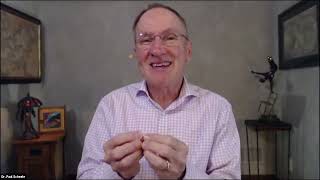
Dr. Paul Scheele and Tom McCarthy teach how to speak with confidence by shifting focus from yourself to your audience. Stop monitoring yourself and match the listener's tone, tempo, and rhythm instead. Scheele shares how he reframed nervousness as excitement before a live CBS appearance to millions.
Chapters
You.
Welcome aboard. It's delightful to be with you. And let's talk about the power of communication, shall we? Communication is something that we are all doing from the moment we're born. We're always trying to get our needs met. As we grow up, we get a lot of signals from our world that says, oh, don't speak like that, or don't be like that, or wasn't it silly that you said that? And so many of us receive a lot of shaming messages, and we don't like the sound of our voice, and we think we could have done better. And there's so many different ways that communication goes wrong. As we grow up, the many of us don't feel we have the skills to really communicate in a way that allows us to feel comfortable, allows us to have a positive influence on those around us to get our own needs met, but also to assist others in getting their needs met. So talking to Wynn really is right in the center of what this is all about. Now, this is applicable in all communication settings, whether it's with a teenage child or a relative or with a co worker or with customers, or maybe it's with a customer service representative. When you're not getting your needs met, you need to go up higher in the chain. I want to talk to your manager. I want to talk to the owner of the company, you know, whatever it might be. The idea is we want to be able to clearly communicate our message, especially when we may feel that this is super important for us to get through. I'm joined in this para liminal by a person who has spent his life making a living for himself, coaching executives on how to be effective communicators, and also as a public speaker, talking to audiences worldwide. His name is Tom McCarthy. So I take his work and my work and we merge it together in this program. And this first session helps to resolve one of the most fundamental conundrums that communicators have.
When I had the opportunity to go live on CBS up to the minute news out of New York, I was really nervous. But what I discovered is that I was excited. And there's a difference between nervous that I'm going to fail and excited that I really want to do well at something. And shifting that is an important internal distinction that we all need to make now. When I first tried to be a public speaker, I joined a group called Toastmasters International. I didn't do very well in my icebreaker speech, but I spent a number of years refining my abilities, getting my ability to communicate Organize a message effectively and have an animated presentation when it was time for me to communicate, that was great training. And when I got up in front of groups of 400,000, 1200, 6000 people on TV with two and a half million people watching, the idea is that in every one of those situations, I was able to do this essential internal shift that Tom McCarthy and I both bring to you in talking to in Session A. It's that shift from focus on yourself as a communicator.
To the other person as a listener, so that you can effectively get your message through.
So what is that conundrum that we get ourselves into? It's an essential paradox. It's the be spontaneous paradoxes, how I like to refer to it. What's paradox? It's two mutually exclusive ideas simultaneously existing. So if I say to you, okay, you ready to talk? Be spontaneous.
Well, now that you've told me to be spontaneous, I can't because I'm thinking about it. Well, then, be yourself. Well, wait a minute. How could I be anything other than myself? Even when I'm anxious and nervous and doing terribly.
Well, just be authentically you. Well, how can I be anyone other than authentically me? Do you see that? The command that we put on ourselves to be spontaneous, be yourself, be authentic, communicate. Your message puts us in this weird loop of looking at ourselves. Am I doing it now? Am I being spontaneous now? You can't resolve it from inside of your own head. So the idea is you can get out of that when you plan what it is you're interested in doing. And focus your attention on the person who's listening, on their facial features, on the energy of the room, on the quality of the tone of the voice. And as they speak, as you match your voice tone and tempo and rhythm and volume to the people that you're speaking with. And all of these things are focusing on the message and the receiver far more than on who you are as a presenter. The idea is to please establish for yourself what is the situation that's coming up in the near future. It's December, the holidays are coming up, you might be getting together with a crazy relative, even if it's only on zoom. And how do you want to be in that communication? The idea here is think of a situation, a real life situation, where you really do want to have a strong, powerful, influential communication that serves the listener as well as you. This is a marvelous opportunity for you. And throughout this month, every Friday, I encourage you to focus on talking to Wynn Session A. And tomorrow we're going to get into session B where you really get to discover those skills within you to send the message out in a powerful way. Have fun. Have a wonderful day. We'll see you tomorrow. Bye for now.