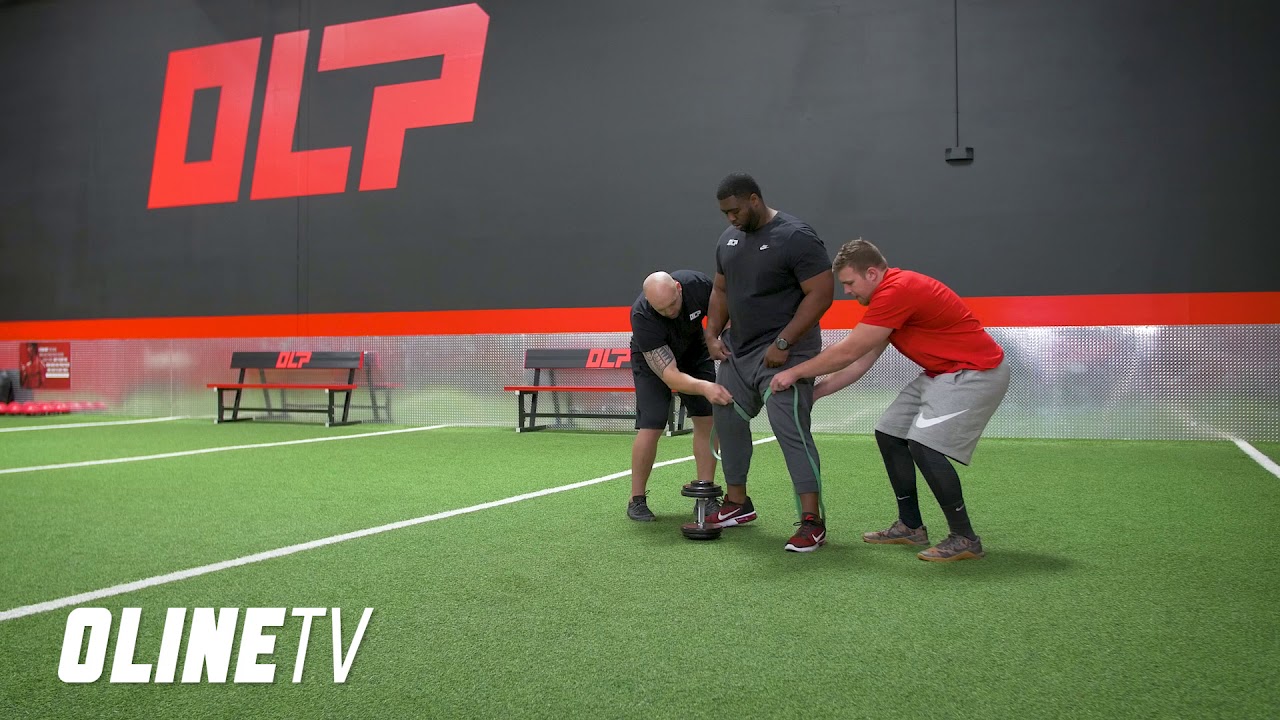
In this instructional segment from O‑Line TV, the presenter explains the distinctive stance requirements for offensive line centers and demonstrates a targeted training drill to develop the necessary posture and stability. He contrasts the center’s stance with that of guards and tackles, highlighting that centers use two “kick‑stand” legs (both feet slightly outward with the knees tucked) instead of a staggered single‑kick‑stand stance. The coach stresses the need for constant adductor engagement to prevent knee collapse and critiques the common mistake of squatting too low, which reduces adductor activation. He advocates initiating the stance with a hip hinge, keeping the butt back and the spine neutral, which better engages the adductors and provides a stable base. To teach this movement pattern, he adapts a sumo deadlift using resistance bands placed high on the mid‑thighs and a light dumbbell. The bands create tension that mimics the forces experienced in the center stance, forcing the athlete to keep the knees stable and the core engaged while holding a partial lift. The drill is presented as a practical tool for coaches to reinforce proper posture, improve specific strength, and correct common stance errors in young centers.
Chapters
Welcome back to O-Line TV. Today we're gonna talk about the center stance and give you a method to use in training to help build the proper posture that we're looking for in the center stance. Now, obviously the center has a unique stance when compared to his or her offensive line counterparts on the line. Obviously, there's gonna be no stagger compared to guards and tackles, but more so, the center is gonna have two kickstands in their stance, whereas guards and tackles only have one kickstand. And what do I mean by kickstand exactly? That's just our leg that is going to have the foot slightly pointed out, the knee more tucked inside of the foot compared to the up leg. But in the center's, uh, case, there is no up leg, so there's going to have to be two kickstands. Now, this is important because it creates more stability in our stance. Uh, to do this, we really need to keep the adductors engaged so that the knees aren't flopping around when we start movement. And a common issue we see with centers is they try to get their butt really low and squat into a stance more so than hinging. So CJ will show us more of a squatty stance, and if you notice, there really is no kickstand in this stance. The knee is almost directly over the toe, and if I were to pull on CJ's knee, he doesn't have a lot of control over my force that I'm applying because those adductors are not engaged. So how do we fix this? Well, we fix this by initiating the stance with a hinge rather than a squat. So if CJ turns to the side here and you notice his butt will be pushed back as he goes through his stance setup. And at this point, his butt is higher than his knees. He's not squatting into his stance. This allows him to keep his adductors much more engaged. And if you also notice, he has a stable, neutral spine in this position. This is going to be the best starting stance for a center. So that's great to know, but how do we build it? There's more to it than just getting into the stance over and over again to learn this process. We can actually use some training tools to teach what the movement should feel like rather than just by going off of looks. So with your young athletes, we can take a very common exercise, which is the sumo deadlift, but add a few twists to it to make it more reflective of the center's posture in performance. So I'll have Boggs come over here. He'll hand me one band. He'll take the other band, and we'll put these around CJ's legs. Here we go. And we're going to really emphasize putting the band higher on the mid, on the mid-thigh area rather than at the knees. Because when we engage the adductors, we don't want to pull from the knee. We don't want to try to collapse the knee. We want to pull from the higher groin area muscles. This is going to put us in much more stable, less compromised position when we're engaging the adductors. And when we create the tension with the bands, we want to pull slightly behind where the athlete's going to be to match the angle of the foot. So this will emulate the forces that are going to be applied in the stance. This is going to train those muscles in a very specific way. And as CJ hinges down, focusing on pushing the butt back, he's going to grab the dumbbell and he's not going to, he's not going to go through a full rep. He's just going to slightly lift it off the ground and hold this position. Now it looks easy, but it gets hard over time. It's really challenging his adductors to keep his knees in a stable position. His spine is really being— or his low back, his core is really being challenged to keep the spine stable. And as you can see, after a few seconds, he's already starting to shake. You go ahead and put it down, CJ, and then take a rest as needed. But this is a great tool to not only build specific strength, but to teach the posture that we're going to need in the center stance. So I hope you can take something from this and that it helps you address certain posture issues that you may notice with your centers in their stance. Thank you.