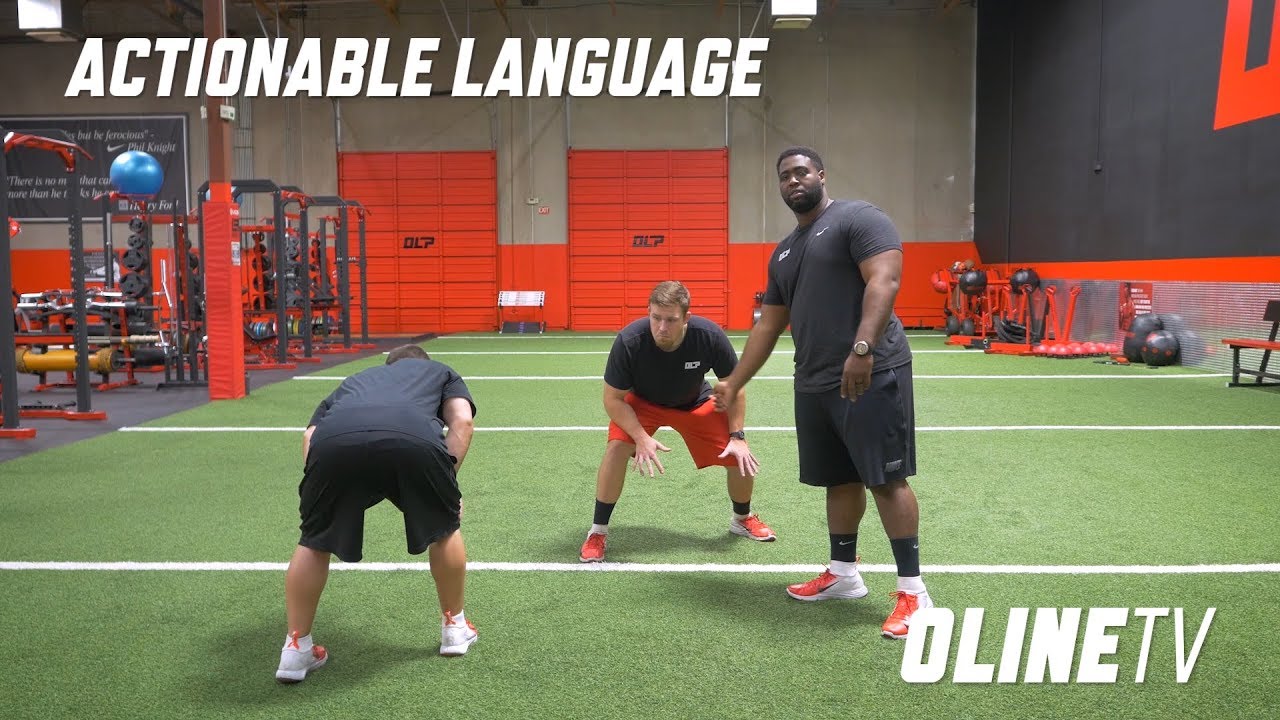
LeCharles Bentley breaks down why linemen shouldn't step straight into the line on down blocks. The defender is moving, so you need to set your hips on an angle that cuts off their path. Hip angle and force matter more than forward ground.
Chapters
Welcome back to O-line TV. Today we're going to talk about the down block and specifically how we're teaching our athletes to move themselves to execute the down block, because we can talk about hands all we want, we can talk about where you're going to strike the defender on a down block, but if you're not getting there with your feet in the most appropriate way, it doesn't matter. So the common themes that we see is coaching telling— coaches telling players to step into the line of scrimmage, to to gain ground on their initial step. And the reason that's such an issue is because the game's all about angles. We wanna put ourselves in the most advantageous position to cut off the angle of the defender because the defender's moving. We're not blocking a static target, we're not blocking pads when we go onto the field and into the game. So something that may work on a bag, on a pad, isn't necessarily going to work once we get into that live performance and stepping into the defender or stepping into the line of scrimmage is one of those clear examples. So we have CJ and Brian here who are gonna kind of show us what it looks like. And CJ is gonna play, he's gonna be a left guard, left tackle, it doesn't matter. But as you see here, Brian has inside leverage onto CJ. And if I'm a coach and I'm telling CJ, hey, you have to cross this white line on your first step and then down block the defender. We'll walk through that and we'll see what happens. CJ, make sure you cross that line with your first step. I don't want to see you move laterally. I don't want to see that foot drop. It needs to go into the line of scrimmage. Ready, go. What you see here is penetration, and that's the— that's what we're trying to stop. But when CJ steps into the line of scrimmage, if you look at his hips— CJ, go ahead and step into the line, and Brian, take your first step too. His hips are still pointing up the field. He hasn't put his body into that intersection point. So CJ, why don't you get back and set up? What we need to be telling our athletes is to set their hips on the angle to cut off the defender. Now I'm not telling them where that— this right foot is going to be. I don't know where it's going to be. I really don't care where it's going to be. I want to make sure that his hips though are set on a track or in other words, an angle to cut off the angle of the defender. And since the defender is going to be moving upfield, that sure as heck isn't going to be straightforward. We're going to need to apply force to the ground through this outside leg, just like any other football play. It just isn't specific to the down block, but we need to set our hips on that angle by applying that force. And depending on where I want to set his aiming point, because every coach likes to teach it a little differently. I'm going to tell CJ, hey, I want you to set your angle through this playside number of the defender and then just own that angle. We'll see what happens now. Set, go.
Good.
As you can see there, yeah, it looks like he did lose ground, but what he didn't lose was the violence of his track. He was able to actually, even though it may look like he's losing ground on the back end, not getting penetration into the line of scrimmage, he's not allowing that penetration of the defender. And that's what we really want. Just because we tell our athletes that the goal on this play is to not allow penetration doesn't mean that we have to step into the line of scrimmage.
Coaches, a quick Coach EQ for your players. Tell your players to take their hips and go play in traffic. We talked about the intersect point. That's what a collision is. There's a car accident there. We don't want to avoid that traffic. When we tell our players to drive their foot up the field, we're avoiding traffic, right? See the hips? There's no noise going to actually happen here. Get set. When I tell them, hey, I want you to drive your hips, I want to own this angle through the outside number, there's going to be a collision there. We want to play our hips through traffic. Ready, set, go. That clears the down block up pretty quickly. Tell them to go play in traffic. I know it's not what we normally say, but it works here.