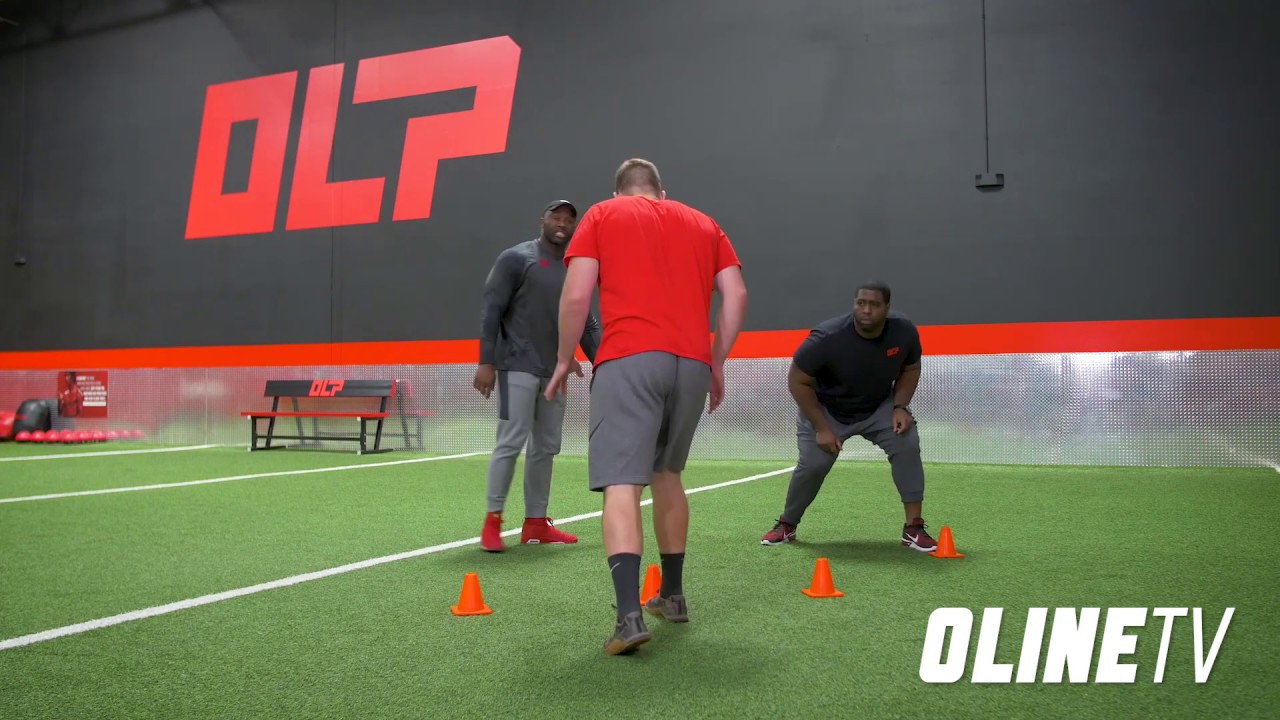
LeCharles Bentley shows why forcing linemen to take a fixed number of kicks during pass sets backfires. A rigid two-kick rule causes oversetting and lost leverage when defenders line up at different angles. Better to teach knee-to-crotch positioning and let athletes move naturally than count steps.
Chapters
Welcome back to O-Line TV. I am LeCharles Bentley. I'm joined by Mr. CJ Davis and Mr. Josh Hanson. We're going to discuss something that is quite unfortunate in the coaching community, and that's the idea of mandating a number of kicks during a pass set. Now, you know how I feel about the term kicking. It's not something athletes do. Especially offensive line athletes, we move our bodies with force through driving. But just for the sake of argument, to keep this very simple, when I say the word kick, it's in relation to taking a pass set. But when we hear coaches say this, "I only want my athletes to take 2 kicks to get to a particular spot in a pass pro," regardless of where that defender is aligned. That is a tremendous problem for football players. A tremendous problem. Here's why. So CJ is going to be your O-line athlete. Josh is now a D-lineman. So let's just assume I've mandated foolishly for CJ to take 2 kicks to get to his spot regardless of where the defender is now aligned. Here we go, take a look. Set, hit, 1, 2. At this point, as you can see, he's now overset this particular defender. He walks into him. Josh now, as a defensive line athlete, has a multiple way go. He can play inside, he can play through him, he can also play around him. But as you can see clearly, he's overset. But let's go a little bit wider now. CJ still locked into this notion of two kicks, but in our vernacular, two drives. But the defender has now widened. It's a problem. Here we go. Set, hit, one-two. Come on in. Oh, he's got lucky. He's actually established Knee-to-cross relationship. It worked out perfectly in this scenario. But let's go a little bit wider. We see now when the defender's tighter, it's a problem. When he's about middle of the rush, it's okay. But now the defender gets wider, you're going to see exactly why this causes problems for players. Set, hit, 1, 2. No leverage. And you're wondering why players are getting beat on the edge. If we start to look at this thing from a value perspective, it makes zero sense in being able to actually move the needle or making our athletes more effective during pass pro. You can't be that bullheaded or stubborn of a coach to only want it to be done your way. Unfortunately, football is a game of permutations. This is why defenders move. That's why there are blitzes. That's why there are dogs. That's why there are things that happen that allow the defense or the defensive player to create advantages, which is why you see players move. But if we take away our offensive line athletes' advantage, which is the opportunity to create leverage, then we've lost. We've lost leverage when a defender is tight by mandating two kicks. We've lost leverage by mandating two kicks when the defender is wider. So if you're one of those coaches that are operating in that world of it has to be done this way, I hope this visual gives you a better understanding as to why that doesn't make any sense. But I know what's happening. There's someone that's watching this saying, "Well, that's what I teach. All you got to do is just kick harder." Aha. Aha. Just like in Coming to America. Here we go. Come on over. Aha. Let's just say you're that guy. I want my guys to just kick harder. Let's go worst-case scenario out the gate. A wide defender. Let's remember this. The intent, the purpose of a pass set, or excuse me, of a stance is to put the player in a fighting position. Right? That's the point of a stance. To put the player in a position to fight. So as they begin to move through their pass set, by the time they get to their spot, you should still be in that position to fight. But if what I'm telling you to do, in terms of your movement, puts you in a position to lose, that advantage of being in that position to fight, I've screwed you over as a coach. So if CJ here is saying, "I'll just kick harder," fine CJ, kick harder. Here we go. Set, hit. Does he look stable and sound there? Can you maintain that for 4 quarters of football against an elite pass rusher? I don't think so. It's not possible. And the idea of good high-level O-line play is efficiency. And if we're going to be efficient, we have to be consistent. It's not just kick harder or kick less. That's not how it works. It's you play the game based on what you have. We know that if CJ is here and Josh goes back to my defensive spot, the first one, and I just say, Josh, Just take your rush, do your thing. CJ, do your thing. Establish knee-to-crotch relationship. Apply your force. Get to your spot. Let the athlete be the athlete. What do you get? Here we go. Hit. Boom. It took him one. Here we go. He's wider. Let's see what it takes now. Same deal, knee-to-crotch relationship. Hit. It took him two. Now we get to 3. He's wide out here. He's wide. What is it going to take, CJ? I don't know. We'll figure it out. Here we go. Hit. Bam. Beautiful. Don't count. You want to count? Go to math class. You want to count? Go to the bank. Don't count. Just play. Because when you start counting and things start to change, you won't have an answer other than to panic. So I hope this helps you. I hope this clears some things up for you. We got plenty more content coming your way, so stay tuned.