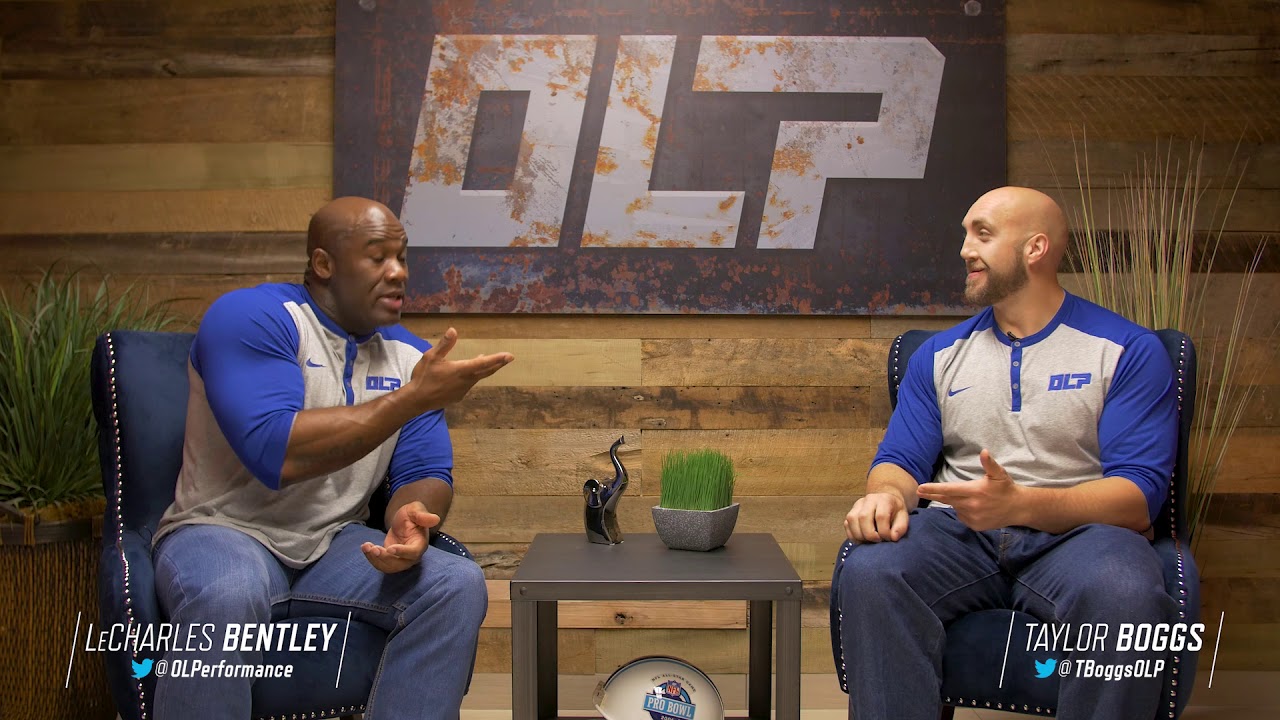
In this conversational episode, LeCharles Bentley and Speaker B discuss the pervasive bias in football recruiting that favors specific body types for each position. Speaker B shares his personal experience of being deemed "too small" throughout high school, despite eventually earning a spot on the team at 5'11" and 195 lb. They critique coaches who rigidly apply size prototypes, arguing that such dogma excludes talented athletes and perpetuates a cycle of missed opportunities. The dialogue cites NFL examples—Walter Jones (6'4" LT), Kelvin Beachum (6'3" OT), and Olin Cruz (285 lb C)—who succeeded despite not fitting traditional measurements, illustrating that skill and technique can outweigh raw dimensions. The hosts advocate for a principle‑driven coaching philosophy: focus on fundamentals like footwork, leverage, and game understanding rather than chasing ever‑larger bodies. They warn of a slippery slope where coaches continuously upsize players (6'6" to 6'8" tackles, 305 lb to 330 lb guards) without addressing underlying method failures. The episode concludes with a call for coaches to develop athletes through skill, adaptability, and consistent principles, rejecting size‑based shortcuts.
Chapters
You had an issue last night with some coaches regarding body types and some coaches subscribing to the notion that they want a specific body type for a specific position. You had a personal take on this. I need to know more about it and I want to give you my opinion as well.
Oh yeah, so like the question was, you know, what body type for each position. Do you want your tackles long and, you know, Everyone kind of subscribed to tall, athletic, good feet, and we wanted the road grader. Then my center has to have a 4.6 GPA and never miss class. This hits home with me, 'cause my first, from 7 years old to my senior year in high school, it was too small, too small, too small. Then finally, the team was so bad that they were like, if I was out there whooping some butt, "Hey, you know what? He's good enough. That's the one." He's good enough. I worked my way in, but I'm 5'11".
5'11".
Right now I'm 6'5". Yeah. And luckily I grew after college.
You're 6' what?
At least 5'. I'll let that slide. So, but in high school I was 5'11", 195, and I played left guard. So by anyone's standards, I'm too small. So if that was the case, I'm not an O.L.P. I didn't have a vested NFL career. I wasn't a Hall of Famer at Humboldt State, whatever. Because if we subscribe to body types versus how effective or can they get the job done, each is regardless, in spite of what your standards may be, you're ruining, you're taking away a person's chance of success or their future. So it's personal to me when I hear coaches still subscribing to this. It's stupid.
But what about the notion that some coaches use it as just context? Or it's okay for me to like a certain thing. What's the downside of that?
Because you'll start searching and you'll overlook what someone really brings to the table. These like comparisons and creating these boundaries, first off, that Rob jobs people enjoy outside of football. But in the game, that's— you're, you're, you're missing, you're missing out on guys, and you're not going to be as excited about this guy that, uh, potentially will be calling you a moron after his NFL career, right? Because, you know, the truth is, I got coaches that said I was too small and I couldn't play at the high school level. Those coaches always come up to me when I'm back home trying to be my friend. I don't have time for you. 'Cause you didn't have time for me 'cause I didn't fit your standard of size. So, you know what? And I'm not unique situation. There's so many people like me.
But that's the irony. Many of the people that subscribe to this ideal of the prototype, they were coaches or they were athletes that are now the coaches, that when they were athletes, they didn't fit the prototype either.
Yeah, so now it's like, "Well, it's always been done that way." Don't you wanna make it better?
Don't you wanna change it?
Don't you wanna make it better? I can tell you like, okay, This is why I don't believe in this stuff. Like, OK, Walter Jones is 6'4". That's not tall enough for a left tackle.
Kelvin Beachum's 6'3".
Kelvin Beachum's 6'3". That's not tall enough for a left tackle.
You were—
what'd you weigh as a center?
305.
305. Olin was 285.
Right.
And—
He wasn't big enough.
He wasn't big enough.
Right.
That's crazy.
To think now that someone like Olin Cruz probably wouldn't play Division I football.
Yeah.
And myself either.
Yeah, well, we would have the best O-line at Humboldt State.
Yeah, for sure. But you and Olin, if you think about it from maybe Division I, I wouldn't have definitely been on Ohio State.
Maybe like a mid-major.
Yeah, like a MAC school. I would have been at for sure a MAC school, but I would not have received an offer from Ohio State. I'm not sure if a school like Washington would be looking for a 260-pound center in today's game because when you look at the articles on thisscouting.com or thisscouting.com, when you see 6'2", 260, center, it's like, "Oh, what is he gonna play, linebacker?" Like, "No, I'm here to play center." I'm here to play center.
I'm gonna move for those guards. No, and like, we're at Humboldt. You know, we have Josh here. I'm what, 6'2"? Josh is what? How tall is Josh?
10.
And he's one of the best guards ever to come out of there. Uh, when I played, I was the smallest on the O-line. Maybe one of our tackles was maybe lighter, but he was taller. Um, but I was the smallest on the O-line. And every year the head coach would tell the strength coach, hey, we got to get bigger guys. This year our thing recruiting is bigger guys. The big guys never panned out outside of Alex Kappa, but he wasn't a big guy. He was 240 pounds when he came into high school. So yet we had all these All-American walk-ons, all-conference walk-ons that were too small, didn't fit it. And somehow it was still every offseason, let's go get these big guys and give them a scholarship, which is valuable at Humboldt State because there's not a lot of money. And then they don't pan out. I'm like, what are we missing here? Why are we trying to fit to these molds? Like, history didn't tell a good story here.
I think what we're missing is the idea that Skills will always rule the game. But when we subscribe to methods, and this kind of brings it all back together. Yeah. We subscribe to methods. We need an ideal to fit the method. So my particular method with left tackles, I want you to have reach. I want you to have length. I want you to be a guy that has really good feet and can cover space. Well, if you can take any athlete and I'm Apply the principles. I don't care if you're 6'2" or 6'7", whatever it may be. If that athlete can move within principles, they understand how to play the game, they understand the context of the game, it does not matter. It just doesn't matter. Are there some benefits to maybe having 2-inch longer arms? But what the hell does it matter if you don't know how to strike anyway?
Seriously.
What does it matter if you don't know how to move your feet?
Yeah.
What does it matter if your players are in bad stances? It doesn't matter what you're looking for. But this is the beginning. The beginning of that slippery slope. When your methods aren't working, you're looking for something bigger and better. Well, you got a 6'6" tackle, your methods aren't working, well now you need a 6'7" tackle. Now you need a 6'8" tackle. Well, your methods aren't working because all of a sudden your 305-pound guard can't stop a bull rush. Now you need a 315-pound guard. Now you need a 330-pound guard. At what point does it stop?
Yeah, I just need football players.
That's it!
I just need Texas football players.
That's all you ever need.
What do you say like, and I've personally heard this, "Man, he's big for nothing." And he was like, "That's the softest 6-foot-8 guy I've ever seen." We're like, "Okay, so that just goes back to the whole thing that you didn't develop the skill, that your drills didn't transfer to developing, and then you also were caught in this dogma of a 6-foot-8 player is supposed to be good." Correct. No, they gotta be developed like everyone else, and if they don't, it has nothing to do with their height.
It has nothing to do with you.
It's you. And the minute we start saying, "Oh, you know, he's just, he's not big enough," or "He's big for nothing." Not tough enough. You've given your power away.
Yeah.
Now you're saying, I can't develop them. What— then what the heck are you doing?
Yeah.
If that's what we're gonna go by.
But if we're gonna live in this world where your identity is wrapped up in what you believe and your methodologies, we'll never get to the point where we can truly begin to develop our athletes. We'll always be looking for the next big thing. We'll always be looking for the next drill, the next method, the next scheme, the next whatever it might be. But if we live in a world where we understand principles, those principles can apply to anything and anybody, any method, any drill, any scheme, any system. But that takes time, and that's the process. And if you aren't willing to go through the process as a coach, damn it, I don't want to hear you talking about the process on your locker room materials, on social media, or anywhere else. Because if you're going to challenge your players to get uncomfortable and challenge them to be more and to discover more about who they are as players and as people, well, you better sign up as well. So that's it for this episode. Anything else, brother? No, good. We got a day full of work, uh, to take care of, and, um, I'm gonna go home, so I'm good. Take care.