IGCT Episode #123: LeCharles Bentley - "Don't Be Allergic To Iron"
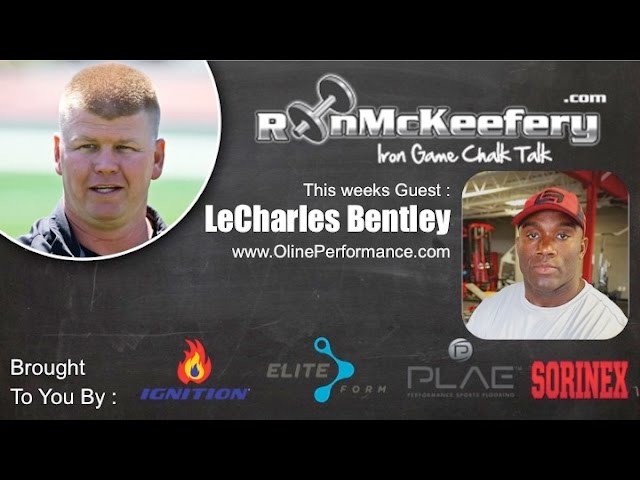
In Iron Game Chalk Talk episode 123, host Ron McKeefer interviews former NFL Pro Bowler and offensive‑line specialist LeCharles Bentley. Bentley recounts how an early high‑school strength coach sparked his lifelong interest in merging offensive‑line technique with off‑field training. He outlines a holistic, 360‑degree approach that prioritizes mental conditioning (overcoming fight‑or‑flight), strength (platform work and core lifts), nutrition, mobility, and recovery. He emphasizes the importance of ankle mobility as the foundation for lower‑body mechanics and describes his typical offseason periodization: a 10‑week block focused first on mobility and light platform work, then progressive intensity, with a strong emphasis on body‑composition and diet. Bentley critiques current industry trends, noting that CrossFit has re‑introduced Olympic‑lifting platforms to football training but also brought injury concerns that cause some coaches to shy away. He discusses his niche business model— a performance facility dedicated solely to offensive linemen— and offers advice for coaches wanting to specialize, stressing passion, simplicity in programming (core lifts like lunges, hang cleans, bench), and a clear business structure. Bentley also shares his personal development habits, including certifications, stretch‑therapy, and learning from other sports (e.g., bobsled) and Twitter influencers. The conversation concludes with recommendations for a book, an app (Twitter), and a website, and a final note of gratitude for his contributions to the performance community.
Chapters
The Iron Game Chalk Talk podcast is brought to you by the following sponsors: EliteForm.com, IgnitionAPG.com, PlayUSA at PlayUSA.com, and Sorinex exercise equipment at Sorinex.com. And now, the Iron Game Chalk Talk podcast. Welcome to Iron Game Chalk Talk with your host, Ron McKiefer.
Every time our athletes walk into this weight room, they're going to be pushed to the max. Let's go!
Everything On this podcast, hear Coach McKeefer's straight talk about training, featuring the top strength and conditioning professionals from around the world. And now, here's your host, Ron McKeefer.
Hey guys, welcome back to Iron Game Chalk Talk. I'm your host, Ron McKeefer, and this is episode number 123. Iron Game Chalk Talk is a weekly podcast where I bring you experts in the field to talk shop. If you haven't already done so, please subscribe to us on iTunes or YouTube or join the mailing list at rommckiefer.com to stay up to date with the latest guests and anything else that I have going on. This week, super excited to have LeCharles Bentley with us. LeCharles owns a performance facility specifically for offensive linemen down in Scottsdale, Arizona. He was a Pro Bowler, had a great NFL career, great college career at Ohio State. This has got a great business model, has a great thing going down there. We bring him on, we talk a little bit about, you know, what makes training offensive linemen different, you know, some of the trends that he's seen, both good and bad, when working with that population. We talk a little bit about his business model and how he's been able to niche down into a real targeted demographic and be able to sustain a business and a career out of that. Just a really— I really enjoyed this conversation. Just a guy that's salt of the earth, tells you how it is, and really you can see really quickly why he's as infectious and has the following of his clients and friends in the business there. So Tons of great information in this episode. Before we get started though, we want to make sure we recognize all of our sponsors. We have PlayUSA.com, Sorenax.com, EliteForm.com, and of course Ignition APG. You know, I love this time of year because, you know, these guys are some of the most humble guys in the business, and you know, but they're also, you know, they They work with some of the very best that are out there. And so you just, you take a look at their Facebook page. If you're not following them on Facebook, make sure you go and follow Ignition APG on Facebook. But just to see some of the guys that they work with, you know, the different athletes and being able to, you know, just see all the different creative ways that they're working with some elite-level athletes. Cliff has a great column or blog or whatever you want to call it that's up on NFL.com. You go to up.nfl.com and he's got some of the athletes that he's worked with and the workouts that he's actually put them through there. It's just a really neat initiative by the NFL. To recognize some of the coaches that are working with some of these athletes around the country. And so make sure you check out Ignition APG. They always make sure they reference anything that they got on NFL.com, but follow those guys. You're going to get tons of great ideas. You're going to get some motivation and just some inspiration when it comes to doing things the right way and working with athletes. Mind, Body, and Spirit. So check them out. I want to get to this episode. Know you're going to get a ton out of LeCharles. Sit back and enjoy, and we'll see you on the other side. All right guys, welcome back to Iron Gape Chalk Talk. Super excited to have LeCharles Bentley with us, the guy I followed for a long time, all the way back to the Cleveland days. And, uh, this is what, our third attempt to try to make this work?
So finally made it work.
I appreciate you, your patience, man, and, and, uh, really an honor to have you on the show, brother.
Thank you. I appreciate you. Thank you for having me.
LeCharles Bentley, you have a great story, man. Can you kind of go backwards a little bit and, you know, what— where did your passion come from? And then kind of what's led you to where you're currently at?
Well, I've been lucky. I would like to say really blessed in the sense that early on in my high school career, because I didn't start playing football until high school, I was very fortunate to have a coach that just so happened to be my strength coach. And the offensive line coach that was really, really willing to work with me and then develop me as a player because I'd never gone through the rigors of offseason training, the rigors of a training camp. And, you know, I was just this big baby, to be quite frank with you. But what ended up happening was I really, really sparked an interest in the training and the football aspect and the merging of offensive line play and the off-the-field component. And he really took me under his wing. And I remember back in the day with, you know, Bigger, Faster, Stronger magazines. I was a kid that always had questions. Why are we doing it this way? Why are we doing it this way? Because I've never been in an athletic environment before. And what he did was he would allow me to go into the office and look at the magazines and come up with different programs and just try to be creative myself. And that really where it all started from. That's really where the interest in the training aspect really just, just blossomed. So throughout my career, I've always been, you know, labeled as a weight room guy or weight room junkie, uh, which I always hated that aspect of it. But anywho, that's what I always was labeled as, a weight room guy. So throughout my career, that's where I lived. I lived in a performance world and always tried to marry my offensive line performance to the training that I was doing. And throughout my career, I, you know, I didn't make a lot of friends with the strength coaches because I was always the guy that asked questions. And some of the strength coaches I had were very open and honest and developed really good relationships even to this day. But then obviously, as you know, you get a couple that just want you to just shut up and do it my way. But that's really where it all started for me, is back in high school.
Now it's led you to a career now, you know, after obviously a great playing career, to now owning your own performance facility down in Arizona and, and niching completely down to training offensive linemen specifically. As you know, one of the things that— and our players, I mean, they, you know, they watch things that you put out all the time. Our coaches, you know, our offensive line coach is a big fan. You know, one of the things that you preach and that we love is the fact that it's a 360-degree approach. I mean, it's not just the weight room, like you said, you know, although that's a big factor, but it's, you know, it's technical proficiency, it's nutrition, which is probably the thing that I respect the most about you. What makes training offensive line so different?
I believe that— well, let me say this first, a caveat to that is I believe that the problem, before I identify the solution, the problem with offensive line play is it's been the red-headed bastard stepchild of the football performance world and everything in terms of development of the position had been partitioned off to every other —genre of athletics. Now we're seeing this big boom with MMA fighting and the big guys getting heavily involved in that. A guy that wants to improve his foot speed or let's say his hand speed, it's always, "Well, why don't you get into boxing?" Everything has been just so marginalized in terms of the development. As I've gone through that process of understanding that, hey, offensive line is a unique skill set within itself. Offensive line is similar to cornerback in the sense that, in my humble opinion, it's the only true learned skill set on the football field. There isn't one of us born, uh, that's played the game at a high level or whatever level it may be at this particular position that understood coming out the womb how to take a kick set. You know, those are the type of things that neurologically you're trained to do. And then every time that you step on the football field, as an offensive lineman in the trenches lined up against a player like an Adama Konsoo or whomever it may be, you're constantly trying to override that fight or flight instinct. Your body and your brain is saying, hey, I don't want to do this. I don't want to live in this world because I don't want to get hurt. And that's what you're constantly exposed to as an offensive lineman. So when it comes down to the training aspect of it, I've been a big believer that if you're going to live in this world as an offensive lineman, you have to train in that world as an offensive lineman, meaning that you want a powerlifter. So with that being said, you don't have to reach for these really big numbers because that's really not going to always carry over to the field. You don't have to live in a world where everyone else is saying that, well, you need to eat this way because you want to get big, you need to train this way because you want to only get strong. Well, the problem with offensive line is the fact that there are so many skill sets required to play the position at a high level. You can have a big guy that's just big and goes out there and gets his butt kicked every play, or you can have a strong guy who doesn't have any true transferable skill sets that goes out there and just a big strong guy that's getting pushed around. So the problem, as I said early on, is the fact that what you want to do is take a very holistic approach developing the player from, A, in my opinion, the mental aspect first, because that's the most difficult part of the position, is overriding that fight or flight consistently. Consistently and being able to do it at a very high level, playing in, play out. Then from the physical standpoint, yes, you do have to be strong. Yes, you do have to be a quote-unquote weight room guy in order to become the best player that you can be. But it's training the areas that need to be trained that's going to transfer that strength to the field of play. Then once you get on the field, you have to know how to apply that strength, how to move your body from a biomechanical standpoint that's going to put you at the most advantageous angles to be able to utilize said strength. So with that being said, you have to really take a very holistic approach from the training aspect of it, nutrition aspect of it, the mobility aspect of it. You have to pull from so many different areas because that's the, the demands of the position. It's going to ask your body to do things that naturally, A, you don't want to do, and then B, your body is going to be tested in ways that it's not very natural. Natural. So with that being said, uh, that's why and how I've gone through this process of developing it. And I get to pull from so many different aspects of my personal life. A, as a player, I've gone through the whole certification process with the CSCS, sports nutrition, fascial stretch therapy, uh, the USAW. I've done all that stuff, and there's a place for it all. And being able to pull from so many different areas now on this side of That's ultimately what I feel is the best way to go about developing an offensive lineman. That's great.
You know, I want to pull out one of the things you mentioned in there was the rigors of competition, that fight or flight, and just the abuse that an offensive lineman takes. Obviously, it's been equated to being in a car crash at however many miles per hour every play. How do you, you know, how do you prepare against that? I mean, that's something that, you know, it's not like you're going to sit there and just run into the guy 50 times and call it a workout, you know, I mean, but that's what he has to be prepared to do, you know. So how do you prepare the body, not just for the performance aspect, but for the abuse that it's going to take?
I think two ways you do that. A, you prepare the mind first, then B, you go into preparing the body. In terms of the mental aspect of it, I almost, you know, I said I've been a weight room guy my entire life. I believe that starts in the weight room. And so many players at this position are, as I always say, they're allergic to iron for whatever the reason may or may not be. They have this allergy to iron, but you have to get addicted to that. It has to be a, that has to be a part of your DNA as an offensive lineman. You have to love training. And at some point, what ends up happening is, as a player, you get so used to pushing yourself in ways in the training aspect that's going to ultimately carry over onto the football field. I truly believe that at some point in a player's training, that he has to be, uh, at the point where he gets under a bar and you got to be scared. You have to truly be afraid to put 600 pounds in your back and then drop it down to the ground. And you know what, You better be worried about coming back up. That's a true training stimulus that you— that at the end of the day, that's going to happen on a football field. You don't think when you line up against Adama Gasu, your body's gonna be like, hey, I don't think this is a really good idea. But at some point you have to be able to train through that fear, override those mechanisms that tells your body and brain, this isn't for me. And putting 600 pounds on your back or whatever it may be, at some point, hey, you know what, you got to get there. You got to get there in your training. And I believe that allows you as a player to begin to override that fear, that constant, um, yeah, I'm gonna use that word again because you have to. It's fear, and you have to override that. And as a player, every time I stepped on the football field, I was afraid. I'm not gonna lie to you and say, oh, I was just— yeah, I was bad, I was tough, I was this, but I was well trained. That's what I was. That allowed me to, when I got on the football field and my heart was beating out my chest, butterflies in my stomach, and I lined up against Warren Sapp, my first NFL start, and I'm sitting there saying, oh my God, like, this is the show, this is it. But I had been there before. I had been there before in my training. I had been in situations where I picked up whatever it might have been, 405 on a power clean, and thinking to myself, man, I don't know if I'm going to get this, but you override it. That's right. It's the same thing when that ball is snapped, it over— you override it. And I believe that's how you train, uh, for lack of a better term, you train the fear out of a player. Uh, so that's, you know, I hope I answered your question.
No, I said I can't.
No, it's great. Beyond that, the skill training aspect of it, you gotta dumb it down. Make this very simple for the player. You know, what ends up happening, I see, from the, the technical aspect, the coaching aspect, and the teaching aspect, from on-the-field perspective, is try to get too fancy. We try to make it more complicated than it really needs to be. Here's the fact about offensive line play: it ain't rocket science, it ain't brain surgery. But at some point, I have to be willing A player has to be willing to physically choke another man and impose your will on him. That's it. That's what this is at the end of the day. Now, it ain't about, uh, you know, being fancy and what your offensive coordinator wants to do, and you know who your quarterback is. You— it doesn't matter because on a 4th and 1, it's me versus you. And someplace, somehow, I have to be able to go into a deep, dark place in my mind and come out on the other side as the victim. And that's what offensive line play is solely about. Once you prepare a player from the physical aspect and then the mental aspect, and then you dumb it down, turn the volume down, now you can start to see what a true— what the true merit of a player is.
No, I agree. That's, that's that Gladiator mindset, you know. And the Gladiators, you know, they, they had that mindset in battle because they had trained so so much and prepared so much on the front end that they felt like they were invincible when they went into battle. So I couldn't agree with you more. What about, you know, you're, you know, living in the performance world now and having access to players that are going to all, you know, some, you know, the top strength programs in the world and the whole deal. What are some things that you're seeing, some trends in training that you see that are, that are good? And then what are you seeing some that are like, you know, it doesn't make sense to you? The good is—
there's the good and the bad both in the same, same vein at this position. The good is you're seeing more coaches get back into the Olympic lifting world, which I do believe as an offensive lineman you have to live on the platform. That's where you're going to get your most development. Uh, I think a lot of that has been spurred by the CrossFit movement. Yeah, for right or for wrong, you know, I'm not going to get into that debate, but at the end of the day, the one thing that we can't say about CrossFit is it has got people back active. Sure. To what level, different story, but they're back active, they're doing something. Sure. I think a lot of that, uh, that excitement in that industry has then bled over into the football world, and we're still starting to see coaches get their players back on the platform. I think that's great. Uh, the flip side is we're also seeing at the same time, uh, more so from the byproduct of the CrossFit world again with such, so many injuries that take place on that side of the fence, I think some coaches have gotten afraid and started taking their players away from the platform. I believe that's a true hindrance to the development in terms of this particular position. So it's twofold. And as you know very well, much better than I do, in the sense, because you've been in the business for so long, you understand the business is all about ebbs and flows. There's trends, there's good things and bad things that people pick up, and we're all human beings. And as educated as a person may be, you know, it's hard to look over to your neighbor's fence and see those guys doing something and everyone seems to be enjoying it, seems to be working, and you say, well, maybe I can try it too, or maybe it doesn't have X, Y, and Z merit. So I think that's what's happening with the performance world is, you know, you hate to say it, but CrossFit has had a carryover in a very positive and negative effect. So that's what I've been seeing is the positive We're seeing players more on the platform. But the negative, I think that so many injuries in the CrossFit world has elicited unnecessary fear of the platform in some coaches.
No, I couldn't agree with you more. And to add to that, I would say that, you know, that tribal mentality of CrossFit is— I mean, that's what every single coach is trying to replicate, you know. They're trying to replicate just that deep passion and unity in their weight rooms, you know. And so I think that's a positive as well, but Um, with the offseason, you know, with, with, you know, the CBA and, and the season becoming longer and the whole deal, the offseason shrinking. And so you're seeing— you're only seeing your players for X amount of time. You got a short amount of time to make a big impact, big difference. What's a, what's a kind of a normal program and what's kind of a normal training session?
Well, a typical program is we go about— I have a a 10-week minimum with all my players in the offseason. I believe that if you're going to make the most gains, you got to make a commitment. So from many different angles, I'm able to, you know, I guess you can say demand that from the guys. Uh, so I get a 10-week commitment, period. And that's just for the first block of offseason training. So you're looking at potentially February, March, April, then about the end of April they start to head back for OTAs minicamp and whatever else they need to do. And then you get about 4 weeks on the back end right before training camp. So what I primarily try to focus on, on the first, uh, the first 3 to 4 weeks is just getting their bodies back moving around. Uh, we're not doing any level of spinal load because they've been just banging throughout the last 16, 17 weeks of the season at game tempo, not including OTAs and minicamp and everything else and, uh, training camp. So what I do is I focus primarily on just the mobility aspect. We're going to move weight, but we're going to be relatively light in the training just to get those guys back. A lot of sled work as well. So at the end of a typical training session, a guy come— or beginning of a training session, the guy comes in, we're doing our mobility sessions, uh, we get into the platform work, which is relatively light once again. We're going to do some things at a pretty dynamic tempo. Then at that point, we get into some positional work, very light once again, uh, that has a direct carryover, but we're not focusing on the minute details because, you know, to be frank, most of the guys just got done taking pass sets at the end of the season. So what are we going to keep— what are we beating a dead horse for, right? Uh, so that's really the first block of offseason training, and then we really don't up the tempo until— or the intensity— until they come back from OTAs and minicamp. Uh, a primary focus for me is body composition. And all these guys are strong. And if I were dealing with high school athletes or collegiate athletes, it's obviously would be a bit different, but these guys that we're working with at this level are all physically gifted. But in order to get the most out of them, I really choose to spend that time more effectively working on diet, because I always believe that if I can get you leaner, you know, I can get you stronger, but leaner is the most difficult aspect, especially with The way that these many, so many of these guys have been raised is, you know, food is their friend, right? They think they can out-train a bad diet, and that's just not the case.
Agreed. No, I couldn't agree with you more on that. When, you know, with some of those mobility sessions, you know, what, what I'm assuming that recovery is coming into a big part of that as well. You know, what are some of the strategies, some of the, maybe some of the technologies that you're using that you feel are having the most bang for your buck?
I'm old school. I'm only 35, but it sounds kind of crazy to say I'm old school. But I'm old school in the sense that, you know, I haven't gotten fancy. I use rubber bands. I use bands. I have a stretch therapist that comes in. I'm a stretch therapist myself, but I don't like touching on the guys all like that, so I have someone else come in and they take care of all those type of things. I always say, be strong when you're strong. Right. But anywho, the first thing that we really focus on is ankles. As you know very well, ankle mobility— well, first, the ankle is the key to all movement. Great. And in order for some of these guys to be able to fix the problem that may be perceived as knee bend or the problem at the hip or whatever, they're playing too high, well, it starts at the ankles first. So being into the fact that so many of the guys spat throughout the season ankles become very immobile, uh, then it would be really asinine for me to come in and ask the guy to squat, uh, when the ankles aren't where they need to be. So we focus a lot on doing the mobility aspect, just getting the ankles right first, and then we start working on the hips. And at that point, we've taken care of the two major hinge points, and all of a sudden you can bend your knees a bit more effectively because the knees are only going to do what the ankles and the hips will allow it to do. So with that being said, just using TheraBands and different rubber bands. I'm a big believer in Donnie Thompson. I'm not sure if you're familiar with Donnie Thompson. Yeah, oh yeah. I'm a big believer in what Donnie Thompson is doing. Donnie Thompson will come out and he'll do a couple of sessions with some of the players. So that's really where the energy really goes into.
Ah, that's great. Well, I want to shift gears just a little bit because we do have some people that listen to the show that are in the performance world as well. I would imagine when you set out to do this,— you know, people probably in the business probably said you were crazy niching down to such a small demographic. And not only that, but then turn around and having such a beautiful facility as well, you know, and overhead and things along those lines. You know, not with it getting into the proprietary type stuff, but you know, what advice would you have for someone that's in the performance world that's like, you know, I want to work with this this demographic, this is my passion. Your passion is offensive line. You played it, you know it, you're the best at it. What, you know, for somebody that has a similar, maybe, you know, cross-country runners or, or, or Ironman athletes or whatever, what advice would you have for somebody that wants to niche down that, you know, to that such a, a small demographic?
I believe that obviously you have to always obviously take into account your overall business structure.— and as you mentioned earlier, how you can make ends meet at the end of the day. Because, you know, I love my business, but it's not the goodwill. I'm not giving anything away for free. Excuse me, sorry about that. It's not goodwill. So, you know, this isn't a 501 nonprofit organization. But with that being said, I do believe for anything to be successful, you do have to find your passion. In terms of overall business layout, I believe that whatever it is that you're trying to do, say for example, I know this is way off the grid, but I'm a baker and I love baking cupcakes. But as you can see now, the industry is saturated with people that are so quote-unquote experts at making cupcakes. But you also have skill sets that you're really good at baking bread. You're also really good at baking, uh, loaves of whatever it may or may not be. But why not open a bake shop and focus on the baking aspect, but you really put a lot of energy into making the best possible cupcakes? And ultimately what ends up happening is people that people believe are the experts in a particular industry, they come to your cupcake shop or your bakery shop and they try your cupcakes because you got the best cupcakes around. Now all of a sudden you got a customer that's not only buying your bread, not only buying your zucchini loaf, but they've fallen in love with your passion. Your passion is truly being the best cupcake person that you can be. So with that being said, I think that's how people begin to carve out their niches. You look at the business model from a very holistic perspective. What can you provide on many different levels? But where does your passion fit? And as long as your passion fits into that very holistic approach, I think you have a unique opportunity at that point to then carve out something pretty special.
No, I agree with you, man. Well, brother, we, we finish these episodes with some, some resources here. Give us, you know, I mean, you've had some great coaches through the years. I mean, what's, what's the best piece of coaching advice that you've ever received?
Keep it simple. That's really been the best piece of coaching advice, and I got that from— I'm sure you're familiar with them— from Dave Kennedy. He was one of my coaches at Ohio State, and, uh, being with the Buccaneers at this point right now, but even at Ohio State, we did 3 primary lifts. We had lunges, hang cleans, and bench press. That's where he felt that we needed to focus on. We hardly even did squat. Looking back on it, it was just a very simple format that seemed to work. So with that being said, I applied that. That's the one thing that I've always really stuck to in this day and age with everything being so fancy and so high-tech. Just keep it simple, right? You're dealing with athletes that are coming from a very complicated world, be it right or wrong, they live in a complex world. So the last thing you want them to do is come into an environment in their training that once again adds a level of complexity to their world. So I think keeping it simple would be the best piece of advice.
No, I agree with that. What about, you know, your own personal development? I mean, you mentioned that you have you know, a lot of different certifications that, you know, that have all played a part in your, your product. But, you know, you're constantly— it sounds like you're constantly searching and sharpening the sword. What— give us a book, an app, and a website recommendation.
Well, a book— shameless plug— but your book.
Appreciate that. I think your book is—
that's the latest one I've been really going through, and I love it. I think you did a phenomenal job with it. And if you're a young coach in this business, or even an old coach in this business, I think it would be foolish not to go out there and grab that because I think what you do a phenomenal job of is really educating from the business aspect of this thing. Uh, you know, at the end of the day, if you're going to get into it, you want to make sure your passion really is something that you can sustain and make it sustainable. I think with your years of experience in so many different levels and currently where you are and this brand that you've built for yourself, I think most young people and older people would just be foolish not to go out and purchase that. So that's the book.
No, I appreciate that.
From the app aspect, I'm not a big app guy, but well, if you consider Twitter an app, then yes, I'm an app guy. I love Twitter because you have so many opportunities to follow different people that, right, you know, be their opinions good or bad, you always have something to pull from. And one of the people that I had a tremendous opportunity to learn from is Dan Pav. Yeah, Dan Pav, I think, is brilliant in so many different levels. And the irony is he's from Ohio and he used to be a high school offensive line coach. Go figure. Uh, but with that being said, following people like Dan Pav, people like Stuart McMillan, two of the people that I follow that, you know, give you, give you so much insight outside the world of football, the world I live in. I think that's the best way to grow is, is to get outside of the current world that you live in and really start to explore different sports. I really study a lot of what goes on in bobsled. Go figure, well, it's a lot of pushing and high-intensity, all-out effort in a short burst of time. Well, that's offensive line play. And some of the mechanics that takes place in that, I can learn from and benefit from. I apologize, you know, people calling, so I'm sorry about that. No, you're fine, brother. But that's the best piece of advice and that's really where I make the most inroads because as you know, we're so mobile nowadays, you rarely get a time to really sit down and just read a book. So that's where I learn.
Well, man, you know, like I said earlier in the beginning, you've been a huge resource for me with our athletes, with our coaches. You know, it's, it's refreshing to be able to throw somebody on that's played at a high level, that's, that's taking this 360-degree approach to training. And providing such a great example. And so, you know, I can't thank you enough for the information that you're putting out, the way that you're going about your business, and coming on, spend some time on the show and sharing, man. Thank you, I really appreciate you having me.
Thank you.
That's it for this episode of Iron Game Chalk Talk. Thanks to this week's guests as well as our sponsors for bringing this episode to you for free. Make sure to check out ronmckeefree.com where you can join our mailing list find the show notes including all the links and resources mentioned and information about Coach McKeefer's other products. While you are there, please join Coach McKeefer in the comments section thanking our guests for sharing. If you haven't subscribed to Iron Game Chalk Talk on YouTube or iTunes yet, make sure to do so. Comments, ratings, and reviews are always welcome. Coach McKeefer can be found on Twitter @rmckeefer, on Facebook and YouTube at /ron.mckeefer, That's it for this week. Be sure to check back next week for another great episode of Iron Game— Chop Talk.
More from LeCharles






LeCharles Bentley on Teaching, Sports Agency, Saints Franchise Progression | Lagniappe w/ Legends




