Offensive Linemen Workouts to Improve Posture & Strength
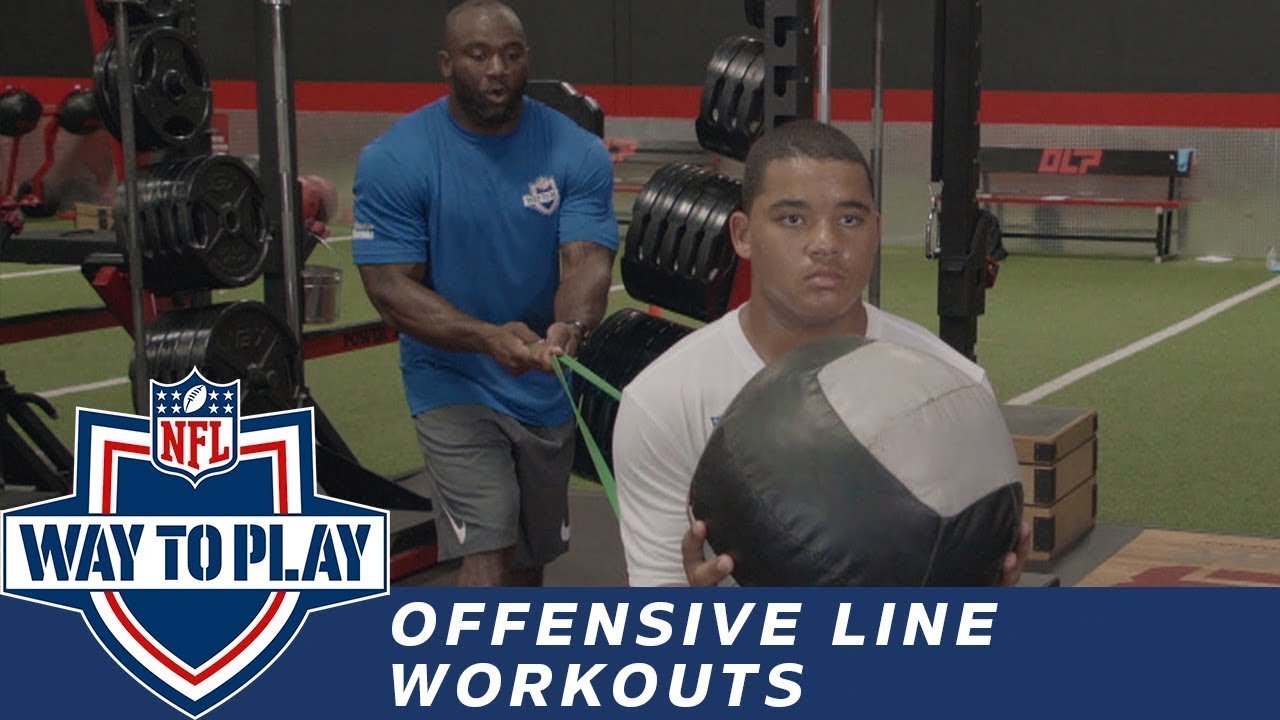
LeCharles Bentley and Orlando Pace teach offensive linemen a three-phase training program using bands and medicine balls: posture work for shoulder and spine alignment, approach drills for hip mobility and angle, and finish exercises like front squats for power. They emphasize simple home equipment over heavy weights for younger athletes.
Chapters
We just went through the 3 phases of the game: posture, approach, and finish. It's all great, but the kids have to be able to functionally perform. So the first thing we're going to focus on right here is our posture. So we'll take our young athlete here. We're going to do a banded torso hold. Set your feet in. Band's going to be around your neck. It's a real simple way, oh, to build athletes without having to get really deep into the weight room. There's a time and a place for the weight room. You need it at the end of the day. But at the same time, we like to do simple, basic things, as you said, you can do at home with mom, with dad, that's going to reinforce everything we just talked about in terms of posture, approach, and contact. So young athlete gets himself down. With the band here, there's going to be tension pulling him forward. We want to make sure that the band is inside the knees to get ideal tension here. If he were to relax his shoulders, the band's gonna now pull him forward.
Absolutely.
But we have to get the athlete strong and stable in this position. So sit on down right there, shoulder blades pulled back, and now we can build this. And they can do this something for time. As they get stronger, they get more, uh, more stable in this position, you can add different variations to it. But just to start a young athlete off, just start them with something very simple, something basic. We talked about the importance of pulling the shoulder blades back. We just fixed the rounded back. Now let's talk about these shoulders. We're going to do a basic face pull. The difference here is this: most kids, they get on down, they're going to just pull it there. If you notice here, he hasn't engaged his back. You want these shoulder blades to pinch together. So the first motion is going to be retracting the shoulder blades, and now we're going to pull. Relax it. Relax the shoulders. Shoulder blades squeeze. Pull back. Perfect. Let's do 2 more like that. Relax the shoulder blades. Squeeze them back. Pull. 1 more. Last one. Pull. Squeeze. Good job. Now an athlete can feel what it's like to get into their stance. So we take our young athlete back to the posture phase. 2 things we've already corrected with him. He can now get rid of that rounded back. Get on down. The rounded back is now gone, and he understands what it's like to pull those shoulder blades back. Key thing with this is you have to make sure the band is at approximately eye level, because if we go too high, oh, what happens is the athlete starts to pull down. We don't want them to pull down. And if we go too low, obviously they begin to pull up. And we lose this motion of pulling the shoulder blades back and setting it to that position. We get into a nice little dilly we hear we call the adductor hold. So go ahead and set yourself. Now he's in his stance, great posture here, shoulder blades are pulled back, head is up. We got that right leg back. Key thing, oh, most young athletes don't know how to pull this knee in. What ends up happening is they start taking their pass sets or they get into the run game and this knee flares all over the place. We want to stay tight and crisp as you talked about. So we get him down and now we just sit him into this position and we just get a nice little tug. And so now he understands what it feels like to stay engaged in this area. What are your thoughts on this so far?
I like it so far. I think what it works also is those small muscles in the leg. —stabilizer to help stabilize those muscles, and then it'll stabilize that leg when he's pushing off of it and when he's making his movements.
Now let's talk about approach. The thing with approach is it's about angles, it's about movement. Most young athletes, just because of the environment that they're in, sitting head down, hunched over, they get really tight in the hips. You talked about it, stand square. We got to open these hips up. Absolutely. And the best way to open hips up, in my opinion, lunges. So we're going to do the 8-angle lunge. And why is it 8 angles? There's 8 angles to offensive line play. So we're going to go on down to the first angle. Good. Here we go. Boom, boom. Now we're going to work a 45 here. And the key thing here, O, is— go back to that first 45 for me. You don't want the athlete to lose the squareness of the hips. Right, right. Go back to your left. Here we go. Good. Now we're gonna go lateral. Same thing here. Good job.
Great thing I like about this is it's not a perfect game, right? Right. So we have to be able to move in different angles at all times. You never know what a defensive lineman may give us. Correct. Opening up, doing different things, being on one foot, being off balance a little bit. So I think this is a great exercise for just opening the hips up.
So now we're speaking of that, we're going to go right into the banded med ball toe. So we're still in this approach phase. We haven't made contact with the opponent. You already talked about this. Oh, set your hands. You want nice torque in elbows. The reason we like to use a round ball is it gives you a better surface to lock it in. And now all I'm going to do, take a half a step back. Set yourself into a nice run block position. Elbows nice and tight. Now I'm gonna just apply some resistance. He's gonna take about 2, 3 good steps. On you. Good. Walk it on back slow. Walk it back slow. Good. We keep tension the entire time. Here we go one more time. On you. Good. Then we can take it a little bit more advanced. Unhook that. Now face me. All I'm gonna do here— Just press into you. Relax your elbows a little bit. If I press into you, you're going to lose it. We already talked about that. Lock the elbows in, good torque position, and lean into me. Press into me. Press into me. Here we go. Start driving just a little bit. Nice job. Good. It's a good way to build that lower body. It's also a great way to keep reinforcing these principles that we talked about.
Thoughts? Oh, I love, I love each one of each one of the drills. For the simple fact you can do all these drills, work the muscles of an offensive lineman, the muscles that we use quite a bit, and without the contact. Yes, yes, yes. That's the key. You don't have to put, you know, 315 pounds on his back. He can still get that workload based on some bands and a ball, resistance ball.
We've used 2 bands, 3 bands, and med ball. Absolutely. You can pick this up at any sporting goods store.
Absolutely.
You know, it's great to have access to a luxurious weight room, But for those that do not, and even those younger athletes, you may not want to start them off that early in a weight room, but you have to start building posture and capacity at an early age. I'm a big believer in the front squat. You know, as a father, I didn't start my boys squatting with the bar on the back until about high school, only because I don't want that spine to get compressed. Right. And then also with the front squat, allows you to build posture that we talk about as an athlete. Because if the bar's in the front or the load is in the front and you start to sink down and you get sloppy, yep, you're gonna dump the bar. Absolutely. So let's make, let's make a quick visual what it looks like commonly when kids do it the wrong way. They bend down, bend down, bend down, and they get there, and then that becomes their stance. Yep. So here we go, we're gonna do it the right way now. We're gonna sink on down, Stay nice and tight. Beautiful posture here. Squeeze on up. Let's do 2 more like that. Squeeze on up. Good job. Last one. And now I'mma challenge you a little bit. I'mma challenge you a little bit. Here we go. Great job. Sink on back down. Hold that position there. Drive the elbows tight and squeeze. Perfect job. So we've done the posture element. We've got the athlete nice and aligned. We've got them into a position where They're stable, they're strong. Now we got to get dynamic because football is this. Set, go. Right. So we got to build that as well. So now we're going to go right back to our med ball, same front squat position. So we're going to go from static to dynamic. Sink on down. Let's hold for a 2-count and we're going to get vertical on you. Good. Let's do one more like that. Explode. Boom. And then now we're going to change the angles because we have to play this game horizontally. Unfortunately, we don't get to be vertical like, you know, you play basketball. We got to take our force horizontally, but you want to build capacity in all areas. So now we're going to get horizontal. So imagine now we're exploding off the ball, tight elbows, tight, tight hands, putting force to the ground. Great job. Last one. Boom. Great. So this is now simulating what it's like on contact. Yep. Absolutely. We've now created an environment where the athlete says, "This is the intent in which I have to play with." Right. In terms of what's happening with the feet and the hips. Yeah.
Some people may look at the vertical, but it all works together with offensive linemen because it's still that explosion. Correct. When you're making contact and you're working those muscles, those hips, those legs, that's going to create more power as you make contact with the defenders.
Correct. This is the one that we all hate, the push-up. So get on down, man. Get on down. And this push-up is going to be a little unique because it's going to play off of that shoulder torque. So instead of just having the thumbs in, go ahead and set yourself into a proper push-up position. Typically what happens, obviously, young athletes start to sag at the hips. Yep. We don't want that. We got to keep that core nice nice and tight. But let's just start with something very basic. Most athletes have a hard time holding just this position. So we're gonna put the knees on the ground. Make it nice and simple for now. We're gonna let the hips fall forward a little bit. We'll take the hands forward a little bit more. Nice stable strong position. But what's gonna be unique to us is this. We're gonna now allow the thumbs to rotate away. So now the shoulders screw in. Yep. So now we're gonna go 5 seconds to the ground and then squeeze back up. Here we go. Squeeze, squeeze, squeeze, squeeze. Drive up. Good. Here we go. 5, 4— oh, that's too fast. Come on. Here we go. 5, 4, 3, 2, squeeze. Good. One more. 5, 4, 3, 2, squeeze. Good. And the reason we focus on that eccentric component, meaning the lowering aspect of it, is this: when I lock into that opponent and he's pressing into me, that's a lot of eccentric force I'm applying back into him. I want to be strong along in that phase. So you can work your pass set. Yep. Work your stance. Yep. Work on your muscles, your stability, your strength, all on your own. All on your own. Last point, let's talk about that ownership. Young athletes taking ownership of their careers, in their game, in the development. How important is that?
Well, it, it's extremely important, and I say that because obviously everybody wants to be really good on football offensive line play. But it just can't happen at practice. It just can't happen in the weight room. You have to do some work on your own as a young player. That's the only way you're going to get better. Whether you're going to do sprints, you're doing whatever you need in your specific area. It can't just be the 2 hours you have on the field. You have to work at home, get a couple buddies, just work out together. You can do anything, but you have to work on your game outside of the practice. Right.
And I really appreciate this.
No problem, man. Absolutely. It's been good.
LeCharles Bentley, Orlando Pace with The Way 2 Play.
More from LeCharles






LeCharles Bentley on Teaching, Sports Agency, Saints Franchise Progression | Lagniappe w/ Legends




