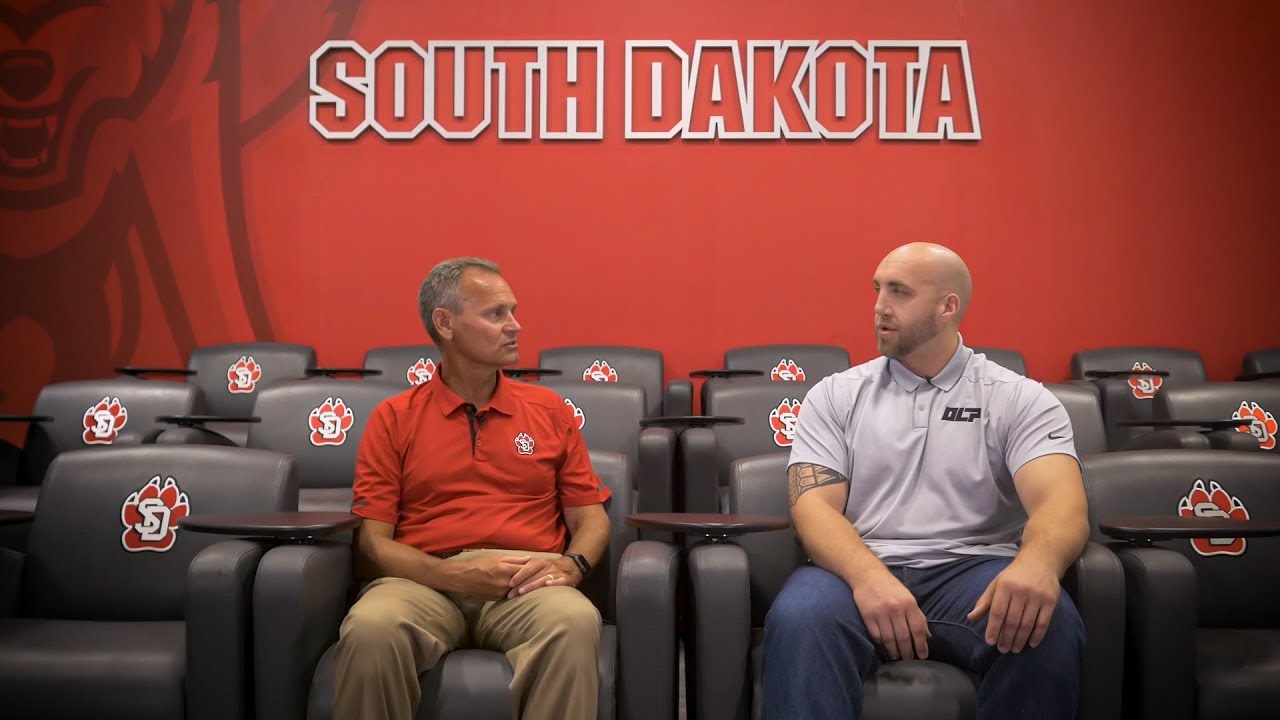
In this on‑site interview at the University of South Dakota, hosts discuss the program’s recent facility upgrades—including a dome renovation—and how these resources position the team to compete at the Division I level. Coaches emphasize the importance of building lasting relationships with student‑athletes, focusing on their growth as players, students, and individuals. Recruiting is framed around potential, work ethic, character, and a willingness to win, with an eye toward long‑term development rather than immediate performance. The coaching staff describes the team culture as rooted in accountability, especially for incoming freshmen, and highlights the benefits of a small‑town, small‑school environment that offers focused training, minimal distractions, and strong university and community support. Overall, the conversation paints a picture of a program leveraging upgraded facilities, a values‑driven culture, and targeted recruiting to elevate its competitive standing.
Chapters
Welcome to OLP On Site. We're at the University of South Dakota. We're in the middle of this development with this amazing facility that's gonna be able to compete with any college in the country, and we're gonna go talk with some coaches. We're gonna talk about some culture, we're gonna talk about some recruiting, and we're gonna talk development. Stick with us and enjoy. Coach, so I'm a small school guy. I love small school. To me, I don't want to offend any big school or D1 programs or Power Five, I should say, but I always look at small school as the embodiment of football. I love it. You know, it's kind of that blue-collar guy that maybe wasn't that good and he has this extra 4 years to develop and kind of become the player they want to become. This doesn't fit like that small school to me. This is an amazing field. As far as the facility is concerned and seeing where you guys are headed with this. This is amazing. Could you talk to us a little bit about that?
Yeah, you know, it's an exciting place to be right now with the commitment that we're making to Division I football. And having been a guy that's coached at all three levels of college football, coming up through the Division III and Division II ranks, this is a, you know, this is a special place. We still hold those kinds of values and put the importance on education, but at the same time, the commitment that we're making with facilities and the commitment to our student athletes is one that gives us a chance to be successful at the Division I level.
I mean, that's incredible. Just the fact that, you know, obviously I'm from California, so, you know, a cold day to us is 50, but seeing a dome at this level is amazing. I mean, I'd be excited to play in that any time.
Yeah, you know, the dome's a real icon in the state of South Dakota. It's, you know, 40 years ago it was built, certainly due for the renovation project that we're doing right now. I think it creates an advantage for us to be able to play the kind of football that we want to play and also, you know, recruit athletes that feel like playing indoors is a great thing in November and December.
So I've done a little research and I saw A lot of your former players just love you, speak the world of you, and I think that's huge because I believe the game is kind of built on relationships, you know, and football only lasts so long, but you want these relationships to kind of last forever, you know. Yeah. Could you kind of speak to that?
Well, I think it's really about building a relationship, you know, and trying to help a young man create, you know, and develop as not just a football player, but also as a student and as a person. We've tried to stress those kinds of values in our program. You know, I think the other thing is I've always looked at it this way, that after a guy 4 or 5 years has been in the program and they're sitting across your desk, With graduation close at hand, you want them to say, "Coach, that was great." You know, that they were surrounded by great people, that you were successful as a team, and that they have a degree in their back pocket that's going to open doors for them for the rest of their life.
I love that because unfortunately I see a lot of guys finish their 4 or 5 years and they're in a— even if a team has some success or they did well, I just see a lot of bitterness leaving the game, and I'd like to see everyone seeing— being able to use the game for you know, the lessons it gives and, you know, kind of those relationships. I love hearing that you said that.
Yeah, yeah, it's, uh, you know, that's what it's all about, you know. We make a profession out of it, uh, but it's still the greatest game in the world, and, and, uh, it should be fun and rewarding.
Fun, yeah. See, I, I agree that I believe that is an amazing game because, you know, I always get told football makes people who they are. I, I don't necessarily agree with that all the time. More I believe it might expose where you are, but it can challenge you in ways that you, day in, day out, that you can kind of use those lessons for the rest of your life. When you're looking for players, what type of young men are you looking for?
Uh, you always want to look at the potential, the upside, their ability to develop. Um, you know, I think if a player hasn't improved immensely over their 4 or 5 years, we haven't done our job as coaches. And I also think that's the way that you build consistency in your program is having a good developmental structure. And I, you know, I look at programs across the country and there are some programs that you look at right away and you say, boy, that's a program that does a great job of developing players. And, you know, we want to be that kind of program. Characteristically, you know, we want good people that are going to come in and work hard, be good teammates. We want capable students. That doesn't mean everybody in our program is a straight-A student, but we want guys that are going to work hard and take seriously the, the fact that a degree is meaningful. And we want people that want to win. You know, I think sometimes that's undervalued in the recruiting process is how important winning is to somebody and how willing they are to sacrifice the things that you need to do to win.
When it comes to establishing a culture, you are kind of at the forefront of, you know, how this football team is going to be not only on the field but off the field. So how do you go about building whatever type of culture you want?
To me, culture is really just boils down to accountability. It's our guys doing what they're supposed to do when they're supposed to do it at the effort that they're supposed to be putting into it. It starts with that. And that's why, like, our freshmen come in, our freshmen don't train with the veterans for the first 6 months that they're here. Because it's— they need to understand and appreciate, hey, this is how we do things, this is why we do these things. If you're cutting corners, that's not, that's not acceptable. And it's not because it makes me mad, it's, it's everybody around you should be upset whenever, whenever somebody does something like that because you're doing it to your teammates. So we really, really spend a lot of time making sure that they understand and appreciate that, hey, What you do reflects on everybody else.
What is it about the resources and the, the uniqueness of University of South Dakota and your training environment that is going to help players? Because a lot of times we get into this idea of bigger is better, bigger is better, going to the bigger school is going to make me better. But what is it about coming to a— choosing a smaller school that is going to help their development in the long run?
That is a— that again, that's a very good question. I'll probably start by saying it's not for everyone. Guys need to come in and whenever they're on campus, really take it in and say, hey, is this a place where I feel like I can, I can really work on my craft? The fact that it's a small town, I personally love that. Like, that's, that's amazing to me. I mean, it's easy to get to major metropolitan areas very quickly. It's very close. But we're still in a small town environment without distraction, and that is huge. I think that's a really big bonus, is that you're here and there's not— you get an opportunity to really focus on your craft. You get to focus on— you get to immerse yourself in it in like a Spartan kind of— in a Spartan kind of way. So that, that's really good. Um, when guys come in And if big bright lights and stuff like that are very important to you, then maybe this isn't the right spot. But if you're somebody who comes in and really values work and really wants to be able to stay focused on the things that are going to get you to the next level, then this is a— to me, this is a perfect environment for being able to do that. The university is fantastic. Like, the support that we get from them is unbelievable. There's— it's not— the president's at almost all of our athletic events.
Huge.
Obviously, the donor support, like, this is hands down what— like, I've worked in the Pac-12, I've worked in the Big Ten, I've worked in the MAC. This is the best weight room I've ever lived in. And it's because of the donor support that we get from people who recognize that their experience was very, very good here and that they want to share that experience with other people. We talked about some of the training equipment in here. It doesn't exist anywhere else in the United States because people that are here that have the resources to be able to do it made it for me. It's like, that's unheard of. So it's, it's like, hey, I need to do this. They're like, okay, I'm on board. Let's, let's do this. So when you talk about support, it's, it's off the charts, like from the community, from the, the university, and then from our, our alumni. It's just fantastic. And they see what the potential of this place is. They see what the potential of the coaching staff that we have right now. It's, it's, it's really a very awesome place to be.