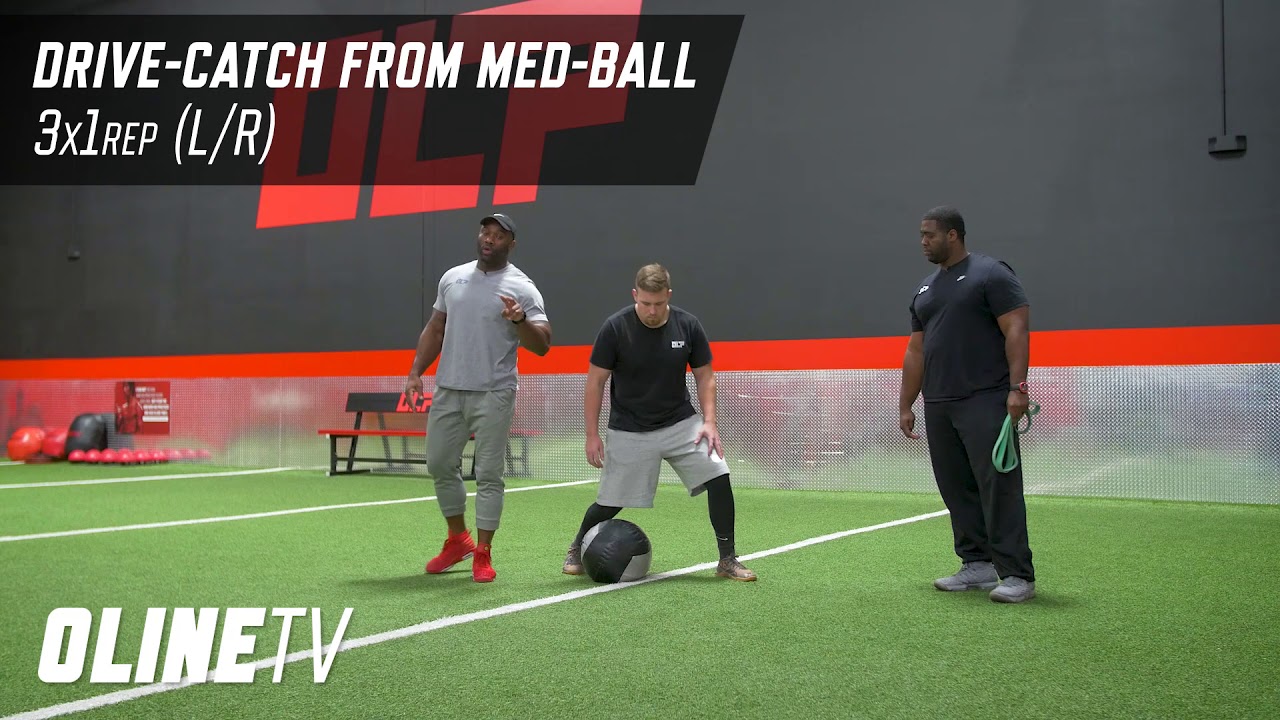
LeCharles Bentley and coaches Josh Hansen and CJ Davis teach a med-ball progression for offensive linemen's run blocking. A collapsing knee creates a force leak that reduces power and changes blocking angles. The drills move from priming exercises through med-ball work to full stance, emphasizing core engagement and ground force for zone runs.
Chapters
Welcome back to O-Line TV. I'm LeCharles Bentley, and I'm joined by part of our OLP crew, Mr. Josh Hansen and Mr. CJ Davis. We're going to take you through the drive-catch progression for the run game utilizing the med ball. There's one significant difference. Most of the movements you're going to see are going to be what you've seen with the pass set version of this, but the key significance you're going to notice here, and that's something that really is going to be much more applicable to the run game than in the pass game. So Josh and CJ are going to be in their own world. I'm going to kind of narrate and make some points, pointers here and there. But this is where all the action is going to be. You just hear me babbling in the background. So you guys ready? Yes, sir. So Josh is going to start on the knee. This is something you can do once again with your athletes pregame, pre-practice. We're not trying to crush the athlete.
I'm going to iso hold lunge.
Iso lunge, hold position. 3 to 5 seconds. Where this isn't a training deal right now. This is a priming deal.
Now we're gonna go to iso hold pumps. A little more dynamic, not as long with the hold. Ready?
Yep. If you notice what CJ just said, a little bit more dynamic. Want to get the athlete primed to start driving force through the ground.
That's good. Good and solid. All right, now we're going to warm up that glute med, that buttocks.
So here we go. CJ said it. Glute med, buttocks, or more so the lateral lines. Before they get going, you'll notice here the band is being pulled in now, which means that Josh here is going to have to stabilize the knee. We don't want him to get pulled all the way through because if you think about it from the run game aspect of it, if you go to drive, say to his right, and this knee collapses, that's a leak in force output. In the run game, in the pass game as well, but O-line in general, We need force, we need maximal force, and we need it as quickly as possible. So by stabilizing this in this position, you're getting the glute med, the buttocks, as CJ said, but the lateral lines primed to drive. So here we go.
All right, ready? Give you a little pressure.
Ready?
Up. Good. Come on down.
Good.
A little more pressure. Ready?
Up. Good.
Come on back down. Last one. Give you a little bit more pressure. Nice. Nice job.
Good. Let's see, fall over, Big Daddy.
There we go. There we go.
So now we're transitioning from here.
Now we're going to the knee.
To the knee. With the med ball. Before we move, the idea is run game. It's still angles. He's working an angle. Inside zone, outside zone. CJ, if you were inside zone, what would change? Oh, the world. Nah, just the angle.
Just the angle.
Just the angle. That's it. If it's outside zone, what changes?
The angle.
Just the angle. So right now let's just give them a visual for inside zone.
Inside zone. So the angle going to be a little tight. All right, we got the ball. Take the intensity off a little bit. Really focus on engaging that core.
On you.
Nice. Bring it on back. I think you got a little more, a little more force this time. You got it, you got it. Ready? There you go. There she go, there she go.
Now you can see why it was so important to get the lateral line, the glute med, the buttocks a little bit more primed. We're going to give you a quick visual. Go ahead, back down. If, once again, there were a leak here, so if Josh were to begin driving and there were to collapse, number 1, force output goes down. Number 2, injury risk goes up. Number 3, it dramatically changes your angle. Did you see that? The last part? It changes your angle. Yes, number 1, number 2, most important. But at the same time, in terms of what we're going to see on the field, if you avoid injury, is your angle is always going to be off. What ends up happening is this internal rotation redirects the hips. So now, as TJ is saying, if we're now inside zone, we want a little bit tighter target, and we got this force leak here, it sets us off of our path. So that could be something your players are struggling with in the run game and not really be understanding why. This might be the connecting link. So here we go, CJ, you got it.
Last one on this ball. I'm going to go to a knee.
Ready?
Set. Go!
Perfect.
Good. Good. Get the ball out of there.
Now we're going to test them.
All right, now we prime. Now we ready to go. Same thing. Focus on the same thing. A little more intensity this time.
Ready?
Set. Go!
Perfect.
There she go. Perfect.
Perfect.
Last one. Let's just go to a stance now. Let's go to a stance. Let's go to a stance.
Last one. Nice and clean.
Say go.
Good.
There you go.
Now you got the idea of the drive-catch progression utilizing the med ball with the whole idea from teaching your athletes to drive force through the ground. Hopefully this helps you. This is a little bit more detailed versus what we did with the pass game because the run game is something I think that as coaches and athletes, we just Eh, it'll take care of itself. No, it's still technically involved that we have to be very specific in how our athletes are developed in this process. And number 2, we have to be very specific in what we want from them in relation to their performance. Thank you.