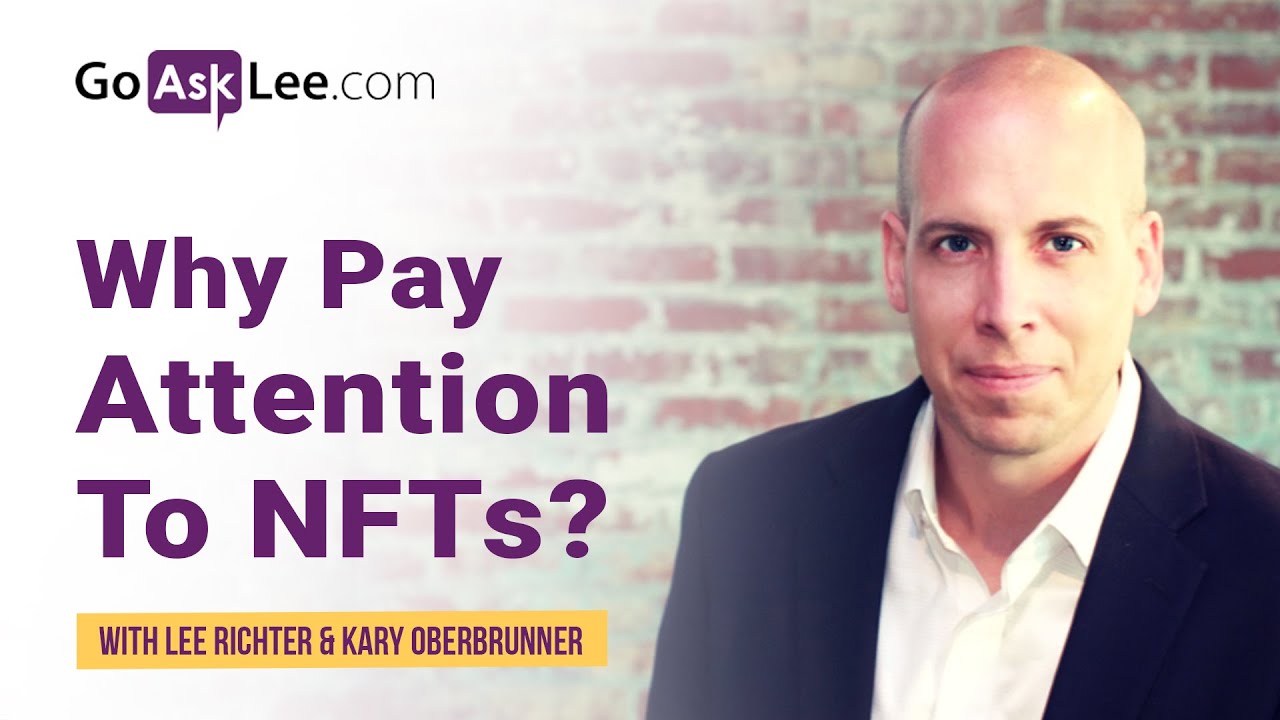
Lee Richter and Keri Oberbrunner discuss why NFTs matter for creators. They cover Beeple's $69 million sale, NBA Top Shot, and how smart contracts let artists earn royalties on secondary sales. They're building courses and focus groups to help authors and speakers understand Web3.
Chapters
Hello everyone, we are talking about NFTs today and my name is Lee Richter.
And I'm Keri Oberbrunner.
And we are talking about why we're paying attention to NFTs. So Keri, thanks for being with us today. I'm thrilled. And here we are in Arizona.
Oh, it's beautiful.
We're at our friend Lee's house doing our little fireside chat and what we're talking about is why we're paying attention. I mean, we have so many things we're doing. You're working with thousands of authors. I'm working with people around the world, but we're making room for NFTs in our business and in our life, right?
I'll never forget last March I was in Miami and I heard the name NFT and I thought, what in the heck is that? And my host Tyler said it's a non-fungible token. And as he started to explain it, I thought, oh my gosh, this is going to change the world.
And that was kind of the beginning of everyone learning because that is the month that Beeple sold his for more than $69 million. That made headlines everywhere. And that was confirming to me to pay attention at a higher level too. So we've been watching from afar, but that's when I got in the game. That's when I was like, wait a second, I am going to be part of this.
Absolutely. And Miami, you talk about cities, oh my gosh, you've been there, I've been there.
Been there last year, going back this year, and it is a hotspot. They really, really want to be known for supporting people in cryptocurrency and supporting NFT artists and collectors.
Yes, I think the reason why NFTs are so critical, we've moved into a digital world even more since the pandemic. We used to tell—
I mean, we know we call them Zoom towns, right? Because almost all of our meetings that we were flying and going to were meeting on Zoom.
That's true.
So that is a digital space.
It is, it is. And remember how we used to tell kids, don't Sit so close to the screen. Today we're like, strap on a VR headset, you know, you go to school on the screen. But I think NFTs, like, the kids are showing up, and even the adults, with social currency. NFTs create social currency, just like back in our day people would wear jewelry or cars. Now you're pulling up with your digital wallet, and you're basically showcasing your assets.
That's true. In my OpenSea right now, I have over 150 NFTs. And some of them are on the front, everyone can see, and some are hidden, just I can see. So we're selective with what we want to do with them. But also, my team wants to create a gallery.
Yes.
But the beauty about the NFTs is not always the art and the gallery piece, it's what's behind it. What access do you have?
Community too, right?
The community, the access through either smart contracts or promises or unlockables. So what happens is it creates a way for having a deeper connection with the people we care about.
And you can almost turn anything into an NFT. In fact, you wrote an article on that. It was fantastic. One of our friends just played a little guitar riff and you said you could turn that into an NFT.
I said, not just that, that riff is so good. Somebody might want to use it over and over again. And this way, when they own it, now they own the rights to play it and use it over and over.
Do you remember when NBA Top Shot came out? You know, that whole thing?
We saw them in New York City. The CEO and founder was one of the speakers. I got to see him backstage. And It was an idea and he got people behind him, he got collaborators, and now it's a movement.
It's millions and millions of dollars.
But the NFL is doing that too. They're selling their best plays as NFTs.
That makes a ton of sense. I mean, think about this. You got my mind thinking. I know a lot of speakers, they could sell their best little speech.
Absolutely. We're seeing it with Gary Vaynerchuk right now.
He is not only doing it as a speech, he's using an NFT at the end to authenticate that that speech In fact, one of your teammates, Ian, was telling me that with manipulation these days, anyone can kind of make anyone say anything. And so in the future, you're going to actually issue a statement with an NFT so people know, oh, it wasn't doctored up.
Absolutely. Especially like celebrities or politicians, politicians where somebody might come in and have fakery behind the scenes. Now they can say, wait, I didn't validate that. That's not me. Whereas this one I did validate, that is mine and I own it 100%.
Do you think there's any industry that won't have NFTs? I mean, I'm trying to think of things, but—
You know, it's interesting because I was in some meetings this week and there's so many people in different verticals. And actually, you mentioned Ian, and one of the things he says all the time is not everything should be an NFT. It could be, doesn't mean it should be. And so, yeah, I think there's going to be filters that go through. And also it's going to be up to the value that the community puts on it. So in my case, you know, I own veterinary hospitals, right? There's some things that we can do with photos and different things. Maybe an NFT will get them access or to the front of the line or maybe a VIP with one of the doctors. But even in my case, there's sometimes where I'm like, well, that's really private. We don't want to make it into an NFT. Or that person made a mistake. We want to keep that so that it's not turned into a public conversation. But there's going to be other ones that are worthy of the public conversation.
Yes, I can see that.
We're going to see that happening.
You said something the other day, I think actually where you said Web 1, Web 2, Web 3.
Yes.
And I thought that was so brilliant. I think that'll give people a little taste. You said Web 1.0 was like information or something?
Web 1.0 was back in the beginning when companies had websites and they shared information with you and they owned the website, they owned the platform, and they owned the information. Web 2.0 is when things like Facebook came out. Now Facebook owns the platform, but the community creates the content. However, Facebook still owns the rights to that. So they own the platform, we're the creators creating, but at the same time they still own the IP around that.
So they're profiting.
They are off of our content we're giving them for free. Whereas 3.0, the creators are creating and owning.
I love that.
Creating and owning. So Web 3.0 is the decentralized land, the decentralized way that the creator gets to own the content themselves.
And me, as a CEO of a publishing company, that's what hit me, 'cause I'm like, oh my gosh, thousands of authors, and yet Amazon's the big company that's taking all the profit. But now we don't even need Amazon. I mean, technically—
As much. I mean, they're gonna be one of the players in your ways to reach your ideal client, but they might not be the only or the main one anymore. Actually, I know people have leveraged that over the years where they realize, They didn't want all of their business to be in one place, and they had to find other avenues. NFTs are one of those avenues.
Yes. And you're a best-selling author. I am too. We've talked about— and that's why I love our lunches, it's like we get so fired up— but you can even provide with your book purchase other bonuses.
Absolutely. Including you reading it. I mean, like, think about it, a famous author or someone you really follow. Yeah. They don't have time to be in front of thousands and thousands of people, but maybe they have a small group of 100 or 100 even online. And if they buy it at a certain time or a certain number, they might get that VIP access to them directly. And, and sometimes it might even be for a signed copy of the book, right?
Yes.
Now I happen to have a friend, Dr. Ben Hardy. He's a published author, international bestseller. He was number 1 on Medium even before he was a PhD. Like, he's just brilliant. And he's looking at ways right now of re-releasing books and giving access to people, and he's looking at creative ways of not only bringing value to the audience but making it so special with them they come on even a bigger part of the journey with him.
I like that.
So he's teaching people how to think about their best future self.
Yes.
Right? And during that he can share different pieces of art, different ideas, different memes, different quotes.
Bonus interviews.
And bonus interviews and even advanced chapters or chapters that didn't make it in the book.
Yes.
Or how about chapters that will be developed a year from now that he didn't even think about?
Ooh, I like that.
Those might be the first ones who get it.
I think there's something there with Launch teams.
Absolutely.
You're, you know, whoever buys the book as a presale could get an NFT that lets them into the launch team, which gives special access.
Absolutely. And people, especially if it's someone you care about— the other day I was with an artist, a musician, and he had this idea about NFTs with us in October last year. He's already created an entire marketplace for other musicians to come in, and he's got so much momentum with his own millions of fans that they're supporting him at such a level that it's already in profit. He didn't have to take funding. He didn't have to ask for favors. All he did was create a way that people can come on the journey and create momentum with him. And it's going. In just a few months, he created something that would have taken most people years.
Yes.
But the community's helping him build it. The developers are showing up not only as fans but as people that want to help with the movement. And I'll tell you, I'm inspired just watching how much he's done in just a few months.
Talk about the secondary sales. Because, you know, when you buy a book, you usually read it, put it on the shelf, it's done forever. You might pick it up one other time. But now if you buy an NFT that's also a book, you could sell that, a secondary market, and the author gets royalties.
They can build in the smart contract that every single time either their art, their experience, anything that's resold again can have a bump back to them or to somebody else in their team. What I'm seeing, like, if you look at Gary Vee, when he launched his Gary Vee and Friends, you know, he did more than $90 million in sales. And what he announced when we were in New York last year was he has more— he has tens of millions in resales.
Wow.
And he's seeing firsthand, like, how mind-blowing it is because somebody might have bought something for access, had access, but maybe there's 2 or 3 more years of access on it. Rather than them taking it, they can resell it to someone else, or they just might see the value went up and they want to take the profit. But Gary is part of every single sale. And that's the part that in the beginning we were like, this is a great idea, but now we're seeing it actually work. And you think about that with art too, because the first time someone sells a piece of art, yes, the artist is included, but a lot of times it's the galleries and the collectors that are included in the subsequent sales. Now, because of the smart contracts, I can be included not only in every sale right now, but even for their heirs later when they pass away or build a legacy.
You're on to that because I looked up metaverse the other day and it brought up Pablo Picasso's descendants who are turning his work into NFTs.
Right. I mean, what did we do yesterday? We saw the Monet. Oh, the Van Gogh. Right. We went to the Van Gogh exhibit and we watched what their community did, what their family did when they released it. They took it and pretty much they created a VR experience for us in the big room.
Yes.
And so we're sitting there and we're watching. It used to be a stagnant piece of art, but they took some license because they own the IP and they were able to turn it into something even better. Now, I don't think they thought about it years ago, but because of technology, because of the audience, because of the experiences, because people want experiences, it was perfect timing now.
And you and I are sitting there and we're geeking out because we said, oh my gosh, they could have turned that ticket into an NFT.
Right. And maybe only 10% of those people bought that ticket, but we got a bonus when we got in. They gave us a little cushion. They gave you some— they gave you the sunflowers on the way out. Those little bonuses can be built into the NFT holders as well. Doesn't mean 100% of your people have to buy it through the NFT, but the ones that do can get that extra added value.
Do you think it's ever going to be easier to onboard? I know we were chatting, like, right now you got MetaMask, and whether it's going to get When we show steps, you know, our team has created a step-by-step guide.
You know, we have our goasklee.com/101.
And the course.
That's the course. And in the course, we're setting up the step-by-step guide. But do I think 6 months from now, a year from now, it's gonna be less steps and a lot easier? 100%. There's already companies that are in competition for each other for that mindshare, but also for the audience in the future of, come with us, it's a lot easier.
But why should people now take action instead of wait 6 months?
That's a really good question. We actually asked Tom Bilyeu that question just a couple days ago. We're like, Tom, if it's so early, why? And he's like, because the early adopters are going to be the smartest ones later understanding the pathway, understanding the mechanics. But also everything in social media, everything in digital world is dated. Yeah, so we could actually see when did you open your Twitter account, when did you open your Discord. Everything is dated. When did you join Facebook? All of that is data. So the early adopters are gonna have that, I've been in the space since this date. It's gonna be verified. Any new adopters, it's gonna be harder to catch up.
And they even call it OGs.
The OGs, the founders. Yes, I mean, we're in the top 1% right now of OGs in this space. Even though it seems like when we were in New York, everyone was talking about it, it's still a small percentage of the population. However, I will say in New York, there were 5,000 people in the conference and there were 5,000 people who wanted to be in. and they just didn't have enough space and enough tickets.
And you were saying even different demographics. This wasn't just all 30-somethings. This was—
It was the full gamut. There was 12-year-olds in there. We've already seen 12-year-olds make millions of dollars selling their art and NFTs. They're just creative. We've seen some international students sell little things that they thought was going to be funny, and they've turned into millionaires because they had enough people following them that want to support them, right? So one of the things I was telling some of the thought leaders like Lisa Nichols and JJ Virgin, we're talking to them about their strategies right now and how to help their clients come along. Now, JJ Virgin, one of the things she wanted to do is protect herself from more transactions.
Yeah.
So basically, if she sells the NFT, if somebody wants a refund, they wouldn't do a refund, they would just resell the NFT. And that allows her to be in her genius creating more content instead of going back and having to resell that again. No, she sold it once, they're happy, Let them be the ones to share it.
This is their new asset now.
Absolutely. The other thing is you can see who your real fans are, right? So say you have 100 podcasts, turn each one into an NFT. Those people that buy those are your true fans. Those people are the ones that want to come with you on your journey. They're the ones you invite into your metaverse. They're the ones that you invite on the journey. They're engaged. They're not just sitting on the sidelines. They're actually supporting you in what you do.
I love that. So what about the haters? Because I know you get some haters, I get some haters.
Well, you know what? They just don't know what they don't know yet. And a lot of times fear creeps in. That's the whole thing. A lot of times, way back in the day when we had to do HTTP to get into our websites, there were people that were like, oh, I'm not into it. They weren't buying their name .com. They just thought it was too early. But later, as everyone was in it and the tipping point was there, so many of them said, I wish I started earlier. I even learned that I didn't get my name.com because I didn't take action soon enough. But you better believe I got lerichter.eth because I'm not going to miss that. My team went, they got it. It's in my NFT vault at OpenSea. And now we're even buying it for friends as gifts.
I love that. That is so good. Well, I learned so much. You are blowing my mind. In fact, I got to give a plug for your course.
Oh, I would love that. You're taking it?
Well, I am taking it. And not only that, my team is taking it because, you know, we chatted about that, that not everyone's team is ready.
That's true. One of the things we discovered is in the beginning we were teaching our team about this, and what I learned is they have to have passion for it too and be interested. And so we started looking for people already interested, already addicted to the space, and saying, wait a second, why don't you come along with us?
Yeah, I, I wake up every day, I type in NFT, I hit news. I love learning about this space. I think it's going huge places. Yeah.
And I'm glad we're on this journey together.
Yes.
Now, we've been inspired by our common mentor, Dan Sullivan from Strategic Coach, who said, why don't we talk about collaboration?
Yeah, you bring a skill set, I bring a skill set, and we kind of both share this passion for Web3.
And we're taking action.
So we're going to write a book. We are writing a book. blockchain, and underneath that is the VR, the AR. And then tell them about the generations. That's cool.
Yes, well, one of the things we talked about was man in his 40s, woman in her 50s. We have perspectives based on our age groups, based on our background. If you look at people in their teens, if you look at people in their 20s, their 30s, we might have different ideas on how to approach things.
You have a 17-year-old daughter.
I do have a 17-year-old daughter, and I know she looks at things much differently than I a lot of times, and I learn from her. So one of the things we're doing is creating focus groups, and actually you can apply to be part of that focus group as well, in every age group. And so when we're answering questions from my perspective, from your perspective, we get that. But what about a 20-year-old perspective on the same topic?
Sure.
Or a 30-something, right? So we want to see what's each decade think about that. And as we're developing new things, things we can't even imagine or new things we're going to discover, they can say how it affects them. them or what they think. Are they fearful? Are they excited? Are they curious? Who's their collaborators? And what we'll learn is who's gaming, who's not gaming. People in my age group might not be gaming, but their kids might be.
Yes.
And now because their kids are gaming, they're learning more and teaching them. So I think what we're going to see is, as this develops, more and more what each generation and each decade is saying. But then now we can take that and cross-pollinate. I can think, wait, that's what 20-year-olds are thinking? It's really successful. Let me adopt that mindset. I love that. So we can be curious but also collaborative in many, many ways.
And I don't think it's just a young person's thing at all because I'm chatting with people. I was just with 30, 40, 50, 60, 70-year-olds last night and they're bringing up their own lens. It's like we all see this from our own lens.
Yes.
It's beautiful.
It is really true. And some people are like, oh, I don't want to add one new thing. But at the same time, there's others who are like, I don't want to be left behind.
That's it.
I don't want to be— that was my motivator. Yeah, my motivator was I don't want to just be on the ship. I want to be the captain of the ship. Right. So the boat has not left the dock yet. We all can hop on, but you get to find your place. Where do you want to be? Do you want to be the captain of your ship? Do you want to follow? Do you want to collaborate? First mate? You get to choose.
I love it.
So here we are, NFT speak. I'm so glad we get to share it. We're living the blockchain life. We're going to be sharing it with you along the way, and keep tuned. Kari, thank you so much for sharing your genius and your passion. I know you left your family behind to spend a few days here talking about this, sharing this, and I hope it was worth it for you.
It was absolutely worth it, and I can't wait to journey with these people.
Excellent. More to come. Stay tuned.
More from Lee

Do You Actually Own AI Content? The Copyright Truth Every Entrepreneur Needs to Know (2025)