10-Minute Knee Mobility Workout | Relieve Knee Pain & Improve Flexion
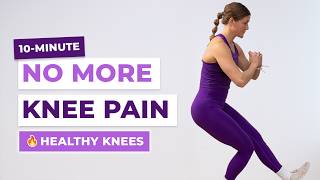
Lindsey Bomgren leads a 10-minute knee mobility routine she developed over three years after her own knee surgery. Nine exercises target extension, flexion, ankle mobility, and hamstring strength, with beginner and advanced versions. She covers quad extensions, glute bridges, ankle rocks, and hamstring curls, ending with an isometric lunge hold to test your range before progressing to full lunges.
Chapters
Knee pain does not have to be your normal. Today we're doing a quick 10-minute knee mobility routine designed to get you moving pain-free again. These are 9 of my favorite knee mobility exercises I've personally been doing for the past 3 years since my own knee surgery. So let's dive right in. I am sharing or walking you through 9 of my favorite exercises to both increase knee, knee mobility or your knee range of motion, flexion and extension, ultimately get you moving and lunging and squatting pain-free. I personally went through my own knee surgery journey 3 years ago, and I have learned so much about knee health, and I love sharing about it because getting moving pain-free again, especially in the knees, has been so critical for me, and I want to share that with you. So these are 9 exercises I've personally done to take my knee range of motion from like being able to just be able to do this— I remember when this was so painful— to being able to fully sit back on my heels confidently and pain-free. So here we go. We're going to start with a couple simple exercises, and I'll give you options to scale up or scale down based on where you're at. I'm going to start by sitting. Okay, we're going to do some extension exercises first. So we just focus on a seated single leg knee extension. So you're just going to start and you're going to activate the quad, and you're just going to extend at the knee joint. So you're just flexing and then you're extending. If you've gone through any type of knee surgery, I'm very certain you're familiar, as am I, with quad sets, right? The number one thing that atrophies or decreases in muscle mass is your quad as you go through knee surgery and recovery and have to get locked out straight. And so your PT is going to have you doing a lot of quad sets, or in this case, you're doing a full extension. So you could start by doing just a straight leg quad set, activating your quad, but we're on the other side. We're recovering, we're getting stronger, and so we're doing a full extension into a quad flex or quad hold at the top. So I would suggest doing 10 reps per day to 10 reps per leg. So you're going into that full extension, squeezing, activating the quad, and holding at the top, and then lowering with control. So that's extension exercise number 1. Extension exercise number 2 is going to take us over here where I have a long loop resistance band. I'm going to step one leg into the resistance band, have some resistance on this band. Okay, so the band is behind my knee joint and I'm going to go— and resistance is dependent on you. I'm going to go into a soft knee and then I'm going to go into extension, fully locking out. Soft knee into extension. So fighting the band and going into extension. So we're focusing on extension first, full extension at the top. Again, soft bend, full extension, and we're looking for 10 reps per leg. This would be the beginner version. As you scale up and get into a more advanced version, we go into a full Spanish squat where I'm going to step both legs in here, get a solid amount of tension on this band. Band stays behind my knee. I'm going to go into a full squat and extension at the top. Full squat and extension at the top. Really focusing on that extension at the top. We're going to do this for about 10 reps. All the way down, all the way up, all the way down, all the way up. Nice Spanish squat here. Nice. I'll do 2 more. Down, up. One more. Down, up. So we've hit a solid amount of extension exercises, and from there I would move into flexion exercises. So I'm going to step out of the band, I'm going to come back to a seated position. The knees, if you've had knee surgery, you might also remember, I remember sitting on my bathroom floor doing many of these. I'm going to use a towel underneath because I have a shoe on. You can take a towel. I started with the towel for assistance, sliding your heel back into flexion. I now have the capacity post-knee surgery to do this. You're going to slide into extension, and if you want, you can even give yourself a little squeeze at the top. To really work on that flexion. Sorry, I said extension, I meant flexion. I'm going to go all the way out and then I'm going to pull the heel. The harder I push the heel into the ground, the harder it's going to be, and then I can use assistance to really get myself into that full flexion. Again, range of motion here is really going to vary dependent on your knee mobility. I'm trying to increase that knee mobility continually, driving my heel into the ground, activating that hamstring. We activated the quad for the first 3 exercises. Now we're hitting the back of the leg or the hamstring for these flexion exercises, pulling that heel as close as we can towards our glute. Again, I would do 10 of these per leg and then we would move into the advanced version of this, which is going to be the glute bridge. Very common exercise where I'm starting with both heels, tight to my glute. I'm lifting my glutes off the ground, squeezing and activating, lowering with control. You could do 10 reps here, building that hamstring strength in a flexion position. If you wanted to scale that up, you would take it to a single leg, or you would hover and drive, hover and drive. Anytime I'm going to that single leg, very important, even if you just had one knee go through knee surgery, that you do this on both legs. I would take this exercise to 10 reps on both legs. Drive through that heel, hold at the top, squeeze. You're going to feel that hamstring and that glute firing for you. Then to work on flexion range of motion, this is going to be a very advanced exercise, what I showed you in the beginning, not something you can just jump right into, especially if you're coming back from a knee surgery. You can start in a tabletop position and slowly shift your way back. Shoelaces or feet are going to be down on the mat to where you can get to sitting on your heels and just hanging out here. Again, this is taking my knees into full flexion with load because my body is sitting on top of this. If that is not accessible to you, that is absolutely okay. It took me a long time to get here. A way to scale that down, I'm going to pull this chair back into play. Another exercise I worked on a lot— actually, I'll go to my outside knee so you can see better— is the couch or wall stretch. You're going to place your one leg in a split position. You can start out here and then slowly get yourself into a more upright position where you're finding this flexion, ideally trying to get your butt to your heel, but now I don't have my full body weight or load sitting on it. It's a little bit less stress on that flexion joint or on the knee joint in flexion. Right here, trying to slowly work my way back to getting my heel close to my glute as possible in a couch or wall stretch. That's another way to look at doing kneeling flexion without having your whole body weight sitting on top of your heels. Okay. And then also what's really important for our knees is our ankle mobility. Often when you go into a squat or a lunge, you are limited in your knee mobility because your ankles have limited mobility. So I also think it's really important when hitting the knees to think about the ankles starting at the ground up. And so I really like to work on ankle mobility by doing ankle rocks. And so my heel is going to stay planted on the ground. My goal is to drive my knee over my toe, putting me into this flexion position again, putting me into flexion. Trying to keep my heel connected to the mat and drive my knee over my toe and then come back. I'm going to show you from a side angle so you can really see, but you could really just do this straight on, driving knee over toe flexion. How far can I get my knee over my toe with my heel connected to the mat? Something you can continually work towards. You could put your toe up against a wall, see if you can get your knee to the wall. Again, I would do 10 ankle mobility rocks on this side, and then I would switch and do 10 ankle mobility rocks on this side. Great way to get that knee into flexion and increase ankle mobility at the same time. Then to go into a standing flexion, Hamstring curls or a standing hamstring curl are really important. You could use a chair. I could just take this chair or I could go onto the rack, but you don't need a full rack. Really, you're just working on a standing hamstring curl. You're just standing. You can start by using just body weight and you're just going to think about activating the hamstring. Pulling the heel towards the glute and lowering with control. If you had a resistance band, you could add a resistance band. As I went through, my own knee surgery and recovery, rebuilding this hamstring strength was really difficult for me since I didn't have access to gym equipment or a hamstring curl-down machine. I actually invested in this monkey foot. You can simply strap this on your foot and it's a great way to add weight to a hamstring curl. We know that our muscles need load in order to come back stronger. Body weight is only going to get you so far. This allows you— this is a challenging weight on there. I'm going to feel a hamstring cramp doing this one to work on flexion in a loaded position. Then I got one more exercise for you. It is pretty simple. Once we get through 10 reps of all of those, we go into the final test. The final test is as we continue to work through these exercises, can we get ourselves into an isometric lunge hold without knee pain? Can I find this position, back knee hovering off the mat, nice stable base on train tracks? Can I just work on an isometric hold? When people say they have knee pain during lunges, I say try an isometric hold. When you're doing a workout video and if you're experiencing knee pain during lunges, try an isometric hold. This is where we want to get to pain-free. Once we get here pain-free, then we can go into that full lunge where we're really driving through this front foot and trying to get to do this pain-free. I hope you found these exercises valuable. I would love for you to continue to build them into your weekly and daily rhythms and routines so you can build stronger, mobile knees that don't hurt when you squat or lunge. And get to pain-free movement again. That's the goal. Stay in the game, keep working out. We'd love to see you back on the mat soon. I hope you enjoyed those exercises and they add value to your life. If so, hit subscribe to my YouTube channel and I've queued up a knee-friendly leg day you might like here. Otherwise, I would love for you to join me in a 2-week strength challenge and you can find it all in this playlist right here. Have a great day.
More from Lindsey

Here's my winter arc 👇 #shorts #winterarcchallenge #strengthtraining #workoutplan

The only lunchbox snack that always comes back empty 🥨 #shorts #kindlingpretzels #proteinpretzels
Strength training is the foundation. #shorts #winterarc #strengthtraining #workoutplan

I’m not waiting until January to reset ... Are you? #shorts #winterarc #12weekplan


LOCK IN your Winter Arc: our 12-week program starts MONDAY ❄️ #shorts #winterarc #workoutplan