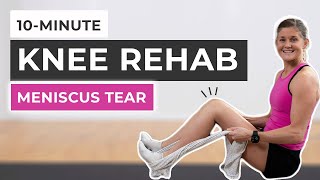
In this 10‑minute instructional video, Lindsey Baumgren (Nourish Move Love) shares the exact knee‑rehab routine she follows six weeks after undergoing surgery to repair a complete bucket‑handle meniscus tear. She outlines a nine‑exercise sequence, each performed for 40 seconds with 20‑second rests, using minimal equipment—a baby blanket, ankle weight, resistance band, and a Pilates ball (or household substitutes). The routine progresses from basic heel slides (limited to 90° flexion to protect the hamstring‑meniscus connection) to straight‑leg lifts with toe‑rotation variations, side‑lying leg lifts for outer glutes, prone leg lifts and out‑in V‑taps for hamstrings and low back, seated leg extensions, banded seated abductions, and finally ball squeezes to engage inner thighs and the pelvic floor. Lindsey emphasizes safety cues (e.g., avoiding hamstring activation in flexion, respecting surgeon limits), progressive loading (adding ankle weight, moving the weight farther from the body), and the importance of consistent physical‑therapy guidance. She encourages viewers to repeat the routine, adapt equipment as needed, and stay engaged with their PT for optimal recovery.
Chapters
Hi, I'm Lindsey Baumgren of Nourish Move Love and this is a 10 minute knee rehab routine that I'm doing for my meniscus tear. If you'd find this helpful hit, subscribe to our YouTube channel. All right, you guys, I am about six weeks, almost six weeks post surgery. I had a complete bucket handle tear of my meniscus. It was all wrapped up inside my knee. Fortunately, they were able to do surgery and repair it and I am on the road to recovery and so I'm just sharing the exercises that have helped me. It's a quick 10 minute routine for hopefully it'll help you if you are recovering from meniscus tear as well. These are just exercises I've been doing with my physical therapist along the way. So we're going to start with the basic stuff and move on. I have a baby blanket here. This is my son's baby blanket. I think it's just the best for my heel slides. So that's what I use. I also have an ankle weight, a resistance band and a little pilates ball. If you don't have this stuff, don't worry, you can do a lot of it without it. You could grab a throw pillow, you could roll up a sports bra for the band and you don't even need an ankle weight. Okay, so this is what we're gonna do. You, you have nine moves. We're just going to walk through these nine moves just on my surgery leg. Okay. I'm just going to do it on my bad knee and we're going to do each exercise for 40 seconds followed by 20 seconds of rest and transition to the next one. So quick and dirty. Show you the moves that I've been doing. We're going to start with heel slides, the basic heel slide. So I'm going to wrap this baby blanket. You could use a towel. Sweatpants. Around my surgery leg, around the heel. And I'm going to use this to assist as I slide in. I'm limited to a 90 degree bend, so I know where that is about right there for me. And then slide it back out. So I'm going to slide in and slide it back out. This is the first move I got to start doing heel slides. I was able to go to a 90 degree bend. I know everyone is different based on your surgeon's recommendations, but using the towel to assist because I'm not supposed to activate my hamstring in that flexion motion because the hamstring inserts into the meniscus. So right here, just heel Slides, the fun stuff. Right. So just doing these, I would usually strive for about 15 reps. We're going to stick to time intervals today just for the sake of. Sake of ease, but you could always repeat these moves. Right. So we're going to do heel slides, and then we're going to go into good old straight leg lifts, because if you know you've had a knee injury, it's all about the quad. Nice work. Five more seconds here. Slide it out and in. It looks easy now, but I promise those first heel slides in the morning are stiff and tough. I'm going to throw on my ankle weight now because I've been cleared and I'm about six weeks post surgery. So we're slowly advancing upwards. But I started doing these with just my body weight. Okay, I'll go this way so you can see a little bit more. I'm going to bend this leg, and then I'm going to just do a straight leg lift here. Maybe I should go the other way. I'll go this way so you can see better. All right, Three, two. Here we go. It's a straight leg lift, so I'm trying to keep my surgery leg as straight as possible. I'm bringing it up to about in line with my bent knee. You could always bring it back. Lay back right here. Okay. So I'm really thinking about keeping my leg as straight as I can, activating this quad right here. And how I do that is by really thinking about drawing my toes to my face. Now, when I started doing these, I had no weight on. Okay. Right. So I started with no weight. Then I started with weight above the knee, and then I slowly added. Now I'm down to weight below on my ankle. The farther the weight is from the body, the harder it's going to be. Nice right here for three, two, and one. Now I'm going to do the same move, but I'm going to turn my toes to you. So I'm thinking about drawing my inner sole of my foot up to the ceiling. So I'm going to target a little bit more of my inner thigh, hip flexor, inner thigh. Just awaken those muscles a little bit. Again, I'm going to keep this weight on. You can always start with your body weight. We're going to go in three, two, and one. I'm going to flex that quad, keep that leg as straight as I can and draw it up. So just slightly turning my toes out towards you. You're just going to engage a little bit more of that inner thigh muscle. We Just want to keep the muscles actively engaged. Right. Muscle atrophy is real. You'll see. My surgery leg is definitely shrinking, but try to do what I can. I was locked out straight for six weeks, so these straight leg lifts were my go to. And for me, it was just holding on to something that I could do, and this is what I could do. So this is what I did. And slowly I'm getting to add flexion back into my routine and bend my leg to 90 degrees, which is exciting, right? Going from doing intense hit workouts and training like an athlete doing leg lifts. Humbling. All right, there we go. Nice. Okay, from here, I'm going to go to a side leg lift. So I'll turn to this side so I don't lose you guys. Side leg lift. So I'm going to go laying on my side, and now I'm going to target these outer glutes and outer hips. So we just targeted the inner thigh. Now I'm going to hit the outer. Okay, so a side leg lift will sew in. Three, two, let's go. So I'm just lifting again right here. I'm targeting my outer glutes and hips that are used when I make lateral movements, which I'm not doing a ton of right now, but I want to keep those strong for when I get back to doing lateral movements and moving athletically again. Locking out that leg, keeping it as straight as I can. Lifting. Really controlling the descend or that eccentric motion on the way down, really controlling that. Not just letting my leg fall down, really focusing on controlling that. Nice lifting up. Actually, I've been doing these now against a wall where you drive your heel into the wall so much harder, and you're going to get a lot more glute engagement when you do that. So I've been doing that now. Nice. 3, 2, and 1. Now I'm going to roll over to my belly, a prone position on my. On my tummy. I'm going to lose my ball and I'm going to do a rear leg lift like this. Okay. So targeting my hamstring and my glute, I'm going to keep that ankle weight on. Again, started doing this with just my body weight, but we're going to target that hamstring from a straight leg position for 3, 2, and 1. So the hamstring inserts into the meniscus, so I'm not allowed to activate it through flexion. So by doing like a standard hamstring curl or even deadlifts, I don't want to do Anything weighted on that so I can do this is a safe way to activate my hamstring and my glute while keeping my leg locked out straight. There we go. So about halfway. So this is what we do right here. Prone leg lifts. Nice work. Awesome job. Keep it up, keep it up. Keep lifting. Nice. Right there. Up. Awesome job. You're in it for 5, 4, 3, 2 and 1. Nice work. So from here I'm going to stay in this position. And now I'm just going to take my leg to the side and in. I could do it with both legs. You're going to tap out and tap in, Tap out and tap in. Okay. Again it's going to activate that glute hamstring. Also targeting my low back. Keeping my low back nice and strong. So we'll go right here. Three, two and one. I'm going to do both legs. I could put an ankle weight on the other leg 2 if I wanted to mimic it. Out and in. And so now I've just been doing these on my surgery leg and I've been working my non surgery leg normally. So I've been doing single leg deadlifts on that leg. I've been doing single leg squats on that leg. So trying to work my non surgery leg normally to keep that as strong as possible and then doing these exercises on my surgery leg. Nice. Right there. Tapping out to a V. Tapping back in. Awesome job. You got it for 5, 4, 3, 2 and 1. Nice work. Now I'm going to go up to a seated position using the box. So I'm going to come up to the seated position right here on the box. Bending that leg like I can now to 90 degrees. I'm going to do a leg extension. So I'm going to lift, I'm going to kick and in again. Flexing the quad from a adding the ankle weight. Seated position. Let's go. Here we go. So kick out leg extension. Finally. Grateful I can do these again. It's taken me a while to get here. About six weeks. And slowly just getting to add this leg extension back into things. Adding an ankle weight makes it really hard. Actually been doing bfr which is blood flow restriction therapy and these get really hard when you're doing that. But right here, challenging this quad flex. Think about really squeezing the top of that thigh, pulling the toes to your face. Nice work. And we only have two more moves after this almost all the way through your therapy for the day. 5, 4, 3, 2 and 1. Nice. From here I can take this ankle weight off and and we're going to take the band and I'm going to put this band above my knees. We're going to go back to hitting those outer glutes by doing seated abduction right there, pulling that band apart, strengthening these outer glutes. Okay, so that's where we'll go in three, two, let's go. So just pulling that band apart, hitting my outer glutes could probably even go a little bit heavier on this band, but I want to stay safe keeping my legs right here. Nice work sitting up nice and tall. When I've talked to other people who have gone through meniscus tears and the rehab, it's a process. And the advice they always say, I said, what's a piece of advice you give me? Do your pt, do your PT and keep doing your pt. So that's what I'm doing. I'm focusing on what I can do. Gonna do my pt. I'm gonna be the best PT patient there was. These are exercises I've been doing with my physical therapist and I just wanted to share them with you in case you're in a similar boat. Hopefully they help you. Maybe it's just fun to do your PT with someone talking to you versus doing it at home alone. I don't know. Okay, last one. We're going to take that band off. And now I'm going to add the ball. This ball. If you don't have a ball, you could grab a kid's squishy toy ball or you could even grab like a throw pillow and place it between my knees. And I'm just going to squeeze and squeeze to engage those inner thighs. Right? Okay, that's where we're going to go. It's your final move in three, two, let's go. So squeeze and squeeze. Just squeezing the ball together between your knees. Again, if you don't have a ball, you could use a throw pillow. And actually, a lot of these exercises, I'm personally about seven months postpartum, so six weeks post surgery, seven months postpartum with my third baby. A lot of these exercises are really great for strengthening your core and pelvic floor as well. So just overall good strength training. I mean, just good stuff to think about, right? Really engaging my inner thighs, engaging my pelvic floor, keeping my knees strong. All good stuff. 10 more seconds, guys, and you are done with your 10 minute knee rehab for the day. I suggest repeating the routine if you can. Awesome job. 3, 2, and 1. Nice work. That's your 10 minute knee rehab. You're awesome. Keep doing your PT. That's what everyone keeps telling me. And we're just going to get stronger each day. Have a good day. You guys, thanks for joining me for that knee rehab workout. If you found it helpful, do me a favor and hit subscribe to my YouTube channel. And if you want more seated exercises that you can do while you rehab your knee, check out this workout right here. Or find all of my seated workouts and this playlist here. Right, right here. Have a great day.