10-Minute Shoulder Mobility Routine (Bulletproof Shoulders)
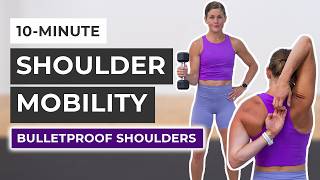
Lindsay Baumgren leads a 10-minute shoulder routine using light dumbbells and a broomstick or towel. Six exercises target mobility and stability: controlled rotations, overhead pass-throughs, wall angels, prone swimmers, and external rotations. The focus is pain-free movement and building resilience.
Chapters
Hi, I'm Lindsay Baumgren of Nourishment of Love, and this is your quick shoulder mobility workout at home. If you love strength training at home, hit subscribe to our YouTube channel. Or better yet, hit that join button and become part of our YouTube community. All right, today is all about the shoulders. It's one of the muscles we get asked about a lot. It can be prone to injury, and so we are going to set you up for success with six shoulder mobility exercises you can do at home. You can add these to your workout routine to take that joint through the full range of motion and keep your shoulders healthy. You can also do this if you're recovering from from a shoulder injury. We're going to have Rachel here. She's going to be offering some modifications. Show you can how you can do all of this standing. All right, all you're going to need is an optional light dumbbell if you want to add it. I have a broomstick. You could use a PVC pipe or a broom, whatever you have. Or a towel. Okay. So these are just a couple accessories you can grab from around the house to take you through this. And we're just going to flow through these six shoulder mobility exercises. It's really meant to walk you through them so you can add them into your daily routine or add them onto your exercise routine for shoulder health. Right. We're all about keep keeping our joints healthy. Okay, so we are going to start with shoulder cars. This is a controlled articular rotation of the shoulder joint. So we're going through a controlled range of motion. We're going to start with just the right arm. We'll go single arm first. So thumb is going to be up. I'm just going to raise my arm all the way up overhead. Now I'm going to flip my hand. So pinky leads and goes down to the ground. Big range motion. Back to the side. Thumb goes up. Arm is straight and fully locked out. Rotate. Pinky leads and goes down. We're going to do two more on the right. Big reach up. Rotate. Nice. So this is meant to increase the range of motion of the shoulder joint. Big reach up. And also increase strength and stability of the shoulder joint. Nice work. One more, I think. Did I say we were gonna. We'll do one more. One more for good measure. Good. Right, rotate. Nice work. Let's do the same thing on the other arm. I've started doing those, and, man, I do see a difference in my shoulder, like, just range of motion. Left arm. Thumb comes up. Rotate. Lead with the pinky the way down. Nice. It's a slow, controlled range of motion. They're called shoulder cars, which is controlled articular rotations. Basically just taking that joint again through its full range of motion. And again, that might change. For right now, maybe you're like out here and you're just rotating and going back. That's fine. And then maybe you'll improve and slowly get that arm closer to the ear. Rotate. We're going to do one more big reach up. I like doing single arm. It allows me to just focus a little bit more on the joint. But you can always do double arm where you take both arms up, rotate, flip, and down. We'll do one more with both arms big up, rotate, down and flip. Nice. That's move one, Move two. I'm going to bring in my broomstick. You could grab a PVC pipe or any type of stick. Rachel's going to use a towel. This is a shoulder overhead pass through. So I'm just going to grip this broom nice and wide. The wider my grip, the easier it will be. And I start with this right at my hips. Rachel's got her towel at her hip. I'm going to bring that broom all the way up overhead, and then I'm going to pass through. My head's gonna pass through. Arms gonna pass through. I'm gonna take it all the way down around and bring it all the way back. You go to the point that feels comfortable for you. You want this range of motion to be completely pain free. Right. You want to take the joint through a full pain free range of motion. That's what we're doing for the shoulder right here. Right. So you stop at whatever point feels good for you. If you want to challenge yourself, you would slowly start to move that hand in. Right. Trying to move your hands in. Right. I'm still pretty wide. Working on that full range of motion. All nice. Again, you go to the point that feels good for you. Arms stay fully extended on this opening up the front of the shoulder. You'll get a nice stretch through that as well, which feels really good. Front of the shoulder tends to be tight on a lot of us because we are hunched over our computers. Right. Driving all those things. We tend to collapse in. We want to roll those shoulders down and back. We're going to do two more big pass throughs here. Nice. One more big pass through. Through. Awesome work. Nice. I'm going to set that off to the side. We're going to hit the mat. All right. Rachel's going to and we're Going to go to the side. Rachel's going to come down into all fours. Okay. She's going to be on all fours. I'm going to step back into a high plank. You choose whatever level works for you. What I want is shoulders stacked over wrist. Okay. And then we're going to go right here and you're just going to drop your chest down towards the ground. And then now pull your shoulders apart from your spine. So you're basically activating. So you're dropping and then pulling apart right there. Right. We're targeting the serratus anterior. It's a big fan shaped muscle right here along my rib cage. Okay. Along the side of my rib. Right. That's key in helping the shoulder move and also pronation, which is pulling the shoulder blades away from the spine. Right. That nice, stable plank. Pull the shoulder blades away from the side spine. Drop the chest. Pull the shoulder blades away from the spine. Two more. Drop the chest. Pull away. Drop and pull again. If you really want to focus on that, taking it down to a tabletop is going to be easier. Keep those arms locked out. Drop, pull away, drop, pull away. Taking it back to plank is going to engage that core a little bit more. I'm going to come back to my back side. Now Rachel is going to take it to a standing position. You can do this against a wall. For the purpose of this, Rachel's just going to stay standing. All right, we're gonna do some wall angels. Or you can do these on the floor. So arms are going to come out to 90 degrees right here at my side. Palms are facing the ground. I'm going to tap the ground. Come up now go all the way back. And then right here I'm going to go big sweep overhead, big pull down. Sliding my arms. Nice. I have gravity working with me here on the floor. It gets harder if I go all the way up to a wall or if I'm standing. Nice work. But really you're just taking that shoulder joint through a nice, big, controlled, full range of motion here, trying to keep those arms connected to the mat or connected to the wall. Right, right there. Nice. This is really targeting the rotator cuff, the lats. It's opening again the chest in the front of the shoulder, but really focusing here on rotator cuff and lats. They all work together in that ch shoulder joint. Nice. Two more down. Take it up. Hands go all the way down. Slide the back of your hand all the way up. Slide it down. You'll notice that's where it gets really tricky and hard. To keep those arms connected to the wall or the mat. Take it down. Nice. Oh, work. We got one more move for you, and we're taking it. Oh, no. We got two more moves for you. Two more moves. We're gonna go up and over. I'm gonna go to my belly. Okay? So I'm gonna come to my belly. I'm gonna have a towel by me just in case. Rachel can do this without the towel. Rachel's gonna show you standing again if that's more comfortable for you. I'm gonna go face down on the mat. Hands are coming behind my head. I'm in a relaxed position right here. And now I'm going to squeeze. Activating my shoulders. Activating my back. Take my arms out. Palms are down. Now I'm going to flip my palms up to the ceiling. Rotate my hands around to my low back. Bring it back out to that T. Flip the palms down. Come right here. Relax. Now squeeze. Lift and squeeze. Take them out to that side tee. Rotate palms up towards the ceiling. Now to the low, back, back to the side, palms. Flip. Come back to that relaxed position. Squeeze up. Flip low back, T. Flip back down. Two more. Two more. Here we go. Up, Rotate out. Flip to the low, back, back to the side. Rotate down. Last one right here. Lift to the side. Rotate the palms. Nice work right there, you guys. Awesome job. Again, we're hitting this. Rotator cuffs and scapular. Rachel, you can stay with that. If you wanted to advance this, you could grab a towel, take those arms out in front of you, and go for a four full towel sweep. Side to side, swimming out right here. We call these swimmers towel swimmers. Boom. And add this into your routine. Very challenging move. Rotating that towel back and forth. Nice. We got one final move for you, and you can grab a light dumbbell for this one if you want to. You could always do this with a resistance band. External rotations. Take the weight in our right hand. Arm is bent 90 degrees right here. Simply going to glue this elbow in at my side. Rotate right here. Straight 90 degree angle. Bring it back in external rotations, right. Adding that weight, loading the muscle. Now, again, this is great for rotator cuff health. Great for joint stability of the shoulder. Just rotating out external rotations. You could do this. You could have a resistance band right there on attached to something. Pull it in, anchor it to a door. Anchor it to a door, Right? Resistance band. And then you would just simply do that same thing on the other side. External rotations, right. Nice. Stabilizing while loading. That's the goal. Right so you can continue to load that shoulder joint, continue to work through greater range of motions in a pain free, injury free fashion. So I hope you found these six shoulder mobility exercises helpful and you start incorporating them into your daily routine or your weekly fitness routine so you can stay healthy and have strong shoulders. Thanks again for following along and you can find more workouts@nourishmovelove.com thanks so much for joining me for that mobility workout. If you loved it, hit subscribe to our YouTube channel. You might also enjoy this mobility workout. I queued up right here. Or you can find my free at home two week strength program in this playlist right here. Have a great day.
More from Lindsey

Here's my winter arc 👇 #shorts #winterarcchallenge #strengthtraining #workoutplan

The only lunchbox snack that always comes back empty 🥨 #shorts #kindlingpretzels #proteinpretzels
Strength training is the foundation. #shorts #winterarc #strengthtraining #workoutplan

I’m not waiting until January to reset ... Are you? #shorts #winterarc #12weekplan


LOCK IN your Winter Arc: our 12-week program starts MONDAY ❄️ #shorts #winterarc #workoutplan