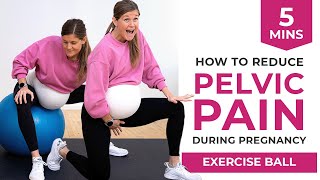
In this instructional video, Lindsay Baumgren of Nourish Move Love demonstrates three targeted exercises to alleviate pelvic girdle pain (also called symphysis pubis dysfunction, SPD) during pregnancy. She explains the anatomy of the pubic symphysis and why the inner thigh (adductor) muscles become overactive due to core instability and hormonal relaxin. The routine consists of three phases: (1) adductor activation – seated on a pregnancy exercise ball, the practitioner squeezes fists between the knees for 45‑second intervals; (2) adductor stretching – a wide‑leg seated position on the ball with a gentle drop of the shoulder to open the inner thigh; (3) myofascial stripping – using a kitchen rolling pin or foam roller to roll each adductor, performed in a kneeling or elevated seated position, emphasizing controlled breathing through discomfort. Each exercise lasts about 45 seconds with a 15‑second transition. Baumgren also offers practical movement cues (e.g., “move like a mermaid,” keep feet together, avoid single‑leg lunges, limit stair climbing) to reduce stress on the pubic symphysis. The video concludes with encouragement to incorporate these exercises throughout pregnancy and links to additional pregnancy‑friendly workouts.
Chapters
Hi, I'm Lindsay Baumgren of Nourish Move Love, and today I'm gonna walk you through three of the best stretches for pelvic pain. So it's called symphysis, pubis dysfunction, spd, pelvic girdle pain, lightning crotch. Call it what you want, it's pelvic pain during pregnancy. And here are three exercises that will help with it. So we're going to start seated on my exercise ball here. You're going to want an exercise ball. And then I also have a rolling pin you could use just like a baking rolling pin, that's like a muscle rolling pin and a foam roller. You don't have to have those. I'm going to show you how you can also use them. But we're basically focusing all about the pubic symphysis. So that is a small disc on the front side of your pelvis that gets irritated when you move unevenly. So think walking upstairs, walking up a hill, doing lunges or single leg exercises. If you felt that pain, you know during pregnancy, what it feels like. Right. And it's uncomfortable and it can be a nagging pain. So I'm going to show you how I like to deal with them. And, and today we're focusing on the adductors, which are my inner thighs or my inner hip muscles. Okay. And the reason we're focusing on them is because they're directly connected to the pubic symphysis and they tend to overwork during pregnancy. So our adductors are overworking to support our instability in our core and the additional relaxin that sets in so our adductors can overwork. So how we're going to do this is we're going to go through three phases of the adductors. We're going to strengthen them or activate them, and we are going to stretch them and then we are going to strip them. So the whole purpose behind this is to activate the adductors, because we do want strong adductors, but then we also need to lengthen them and strip them to create down to pull them away from pulling on that pubic symphysis disc and to create some length in them and to take a little bit of pressure off our pubic synthesis. So we're going to start by activating the adductors or inner thighs. So I'm going to be seated on my pregnancy ball here. I'm going to take two fists and I'm going to put them in between my knees and I'm just going to squeeze, squeeze and hold. Squeeze and hold for like a three second count to activate my adductor. So take your two fists, put it here. You could also use like a sponge ball if you had one of those, like a Pilates sponge ball. But we're just going to take our two fists and put them right here. And I'm going to squeeze together and I'm going to squeeze and hold. And I'm going to hold for 3, 2, 1. And I'm going to release. Now I'm going to do this again. I'm going to squeeze and hold. Hold for three, two, one, and release. Okay, so you decide how hard this is by how hard you squeeze for 3, 2, 1, and release. Awesome job. We're going to keep going here. We're doing each exercise or each stretch for about 45 seconds of work. Release, then a 15 second transition. So it's quick and effective. You guys, we're just going to fly through this. I really just want you to have these exercises as an arsenal in your pocket throughout pregnancy because they have helped me significantly with my SPD pain. 10 seconds left here. Okay, let's go ahead. Squeeze and hold. Hold for three, two, one, release. This is your final one. Squeeze and hold. Hold for three, two, one, and release. Nice. Now we're going to stretch the adductors. So I'm going to come into a little bit more of a wide leg seated position here on my ball. And I'm simply going to drop one shoulder as I push and open up and stretch that inner thigh. So let's go ahead. Right here. You're just going to drop and push, come back to center. Big inhale, exhale. Everything is dropping down and relaxing. Just opening up and stretching those adductors. Okay. So we activated them and now we stretch them. We're thinking about creating length in those inner thigh muscles, right. So they can lengthen and we can not have so much of a downward pull on that pubic symphysis disc. Right. Additional things you can do outside of these three exercises is they say to think about moving like a mermaid. So that means keeping your feet together. So avoiding single leg exercises like lunges, trying to minimize walking upstairs. So I'm not getting on the stair step or at the gym. Nice. We're here for about five more seconds. Nice. Let's do one more. Awesome job. And then the final exercise is stripping the adductors. Okay, so this is where this rolling pin comes in. And if you don't have one of these, don't worry. I'm going to show you how you could alternatively use a foam roller, but you could literally use like a baking rolling pin that you use for baking sugar cookies. Okay. So I'm going to take this rolling pin and this is something ideally I'd do with my partner. So I would be actually in a elevated seated position and have my partner, my husband, strip my adductors. But I'm going to do this to myself. Right. So I'm basically just stripping. I'm just pushing away, taking this, rolling it away, rolling away, stripping the muscle right there. So I'm going to do this on each side. It's actually kind of quite uncomfortable and become quite painful if you're doing it appropriately. Right. It's kind of like foam rolling where you have to breathe through it, or I guess you could say a contraction in our case for everyone who's pregnant here. Right. Just breathing through that contraction or that foam roll. And you're going to do that on both sides. Okay. So that's one way to strip the adductors. I'm going to show you alternatively, if you don't have the rolling pin, another way you could do it. Or if you want to add this to your foam rolling routine in the morning, take a foam roller. Going to be in a kneeling position. Kneeling position. And I'm basically just doing that same thing, but with a foam roller. I'm just rolling that inner thigh or that adductor muscle right there. More pressure I apply, the more it's going to get uncomfortable, the more I need to breathe through it. Right, Right. So I'm just kneeling and I'm rolling out. You're going to do each inner thigh, rolling out those inner thighs. This is meant to create length in the muscle. Take that downward pressure off that pubic symphysis disc that causes that pain. So those are my personal three favorite exercises for dealing with pubic symphysis or pelvic girdle pain. Like I said, call it what you want. Additionally, you can think about bilateral movements, so substituting lunges for squats, keeping both feet planted on the ground next to each other. The wider your stance, the more instability you have in your hips and with relaxing. So the narrower your stance, the less pressure you're going to have on that pubic synthesis joint. So you can think about moving bilaterally, keeping feet on the ground, avoiding lunges. Think about trying to minimize walking upstairs or uphill. Or for me, during winters here in Minnesota, avoid that shearing movement that you'll get on the ice. But those are some of the best ways to avoid that pelvic girdle pain. I hope you found this helpful and informational, and hopefully you can carry these three exercises with you throughout the remainder of your pregnancy. And I'm wishing you all the best on the rest of your pregnancy. Thanks for following along. You can find more pregnancy workouts and pregnancy informational videos@nourishmovelove.com thanks so much for following along with these three pregnancy exercises for pelvic pain. I hope you found it helpful, and if you did, I'd be so grateful if you dropped a subscribe to my YouTube channel here. And if you want more common stretches for pregnancy aches and pains like low back pain or sciatica, you can find those stretches here. And you can find all of our pregnancy friendly workouts in this playlist right here. Have a great day.