In this vlog, Coach Lindsey Bomgren explains the critical role of ankle dorsiflexion for volleyball players, especially those playing defensive (back‑row) positions. She outlines the biomechanical chain from ankle to hip that underpins explosive movement and notes that limited dorsiflexion is linked to injuries such as patellar tendonitis ("joker’s knee"). The video demonstrates a practical, quantitative assessment—the knee‑to‑wall test—to gauge an athlete’s ankle range of motion. Bomgren then walks through a series of progressive, functional drills designed to increase dorsiflexion in multiple planes: a pole split‑stance knee‑press, a toe‑elevated squat with alternating knee drops, a “crawled crab” walk that combines crawling and crab positions, and a weighted squat performed with the toes raised. She provides cueing, rep ranges, and progression tips for each exercise. Finally, she recommends complementary calf‑focused recovery work such as foam rolling and wall stretches. The overall message is an enthusiastic, instructional guide for coaches and athletes to improve ankle mobility, boost on‑court explosiveness, and reduce injury risk.
Chapters
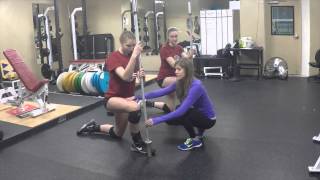
Hi, welcome back to vlog number three. Very excited to get back into some strength training with you guys. So I've had requests for talking about ankle flexion, specifically dorsiflexion when working in the athletic position of defense. So when we're in defense, right, you want to be in that nice athletic position, shoulders stacked over knees, knees over toes, ready to explode forward at any point in time or off to the side. But often girls can be sat back in the chair where they're not quite getting that range of motion up onto their toes because of limited dorsiflexion. So dorsiflexion, flex your ankle this way. Plantar flexion is when you point your toe. So we want to increase dorsiflexion. So there's a couple ways we can do that. And I'm here at the Raleigh Sports center in Maple Grove with the local club, Minnesota Volleyball, Minnesota Select. So super excited to work with some of the athletes and show how we can increase dorsiflexion. But before we jump into it, let's talk about the science behind it and why dorsiflexion is important. So there's a couple reasons it's important. Having a good stable angle is important because your ankle fires from your ankle up to your hip. And that's how you create the explosive movement. Whether you're in defense, moving forward, whether you're in the front row and jumping, it's that ankle to hip explosivity. So you want an efficient, efficient firing muscle, kinetic chain right there. If you have limited dorsiflexion, it can hinder that kinetic firing. And so it hinders the ankle to the calf, the calf to the hamstring, hamstring to the quad. Ultimately it can decrease the explosive movement. Another good reason is it's really important for injury prevention. Decreased dorsiflexion. So limited range of motion in that dorsiflexion area is commonly associated with injury of patellar tendonitis, more commonly known in the volleyball world as joker's knee. So it's not just important for the back row girls, it's important for your front row ladies too. So before we get into that, we're going to go ahead and measure dorsiflexion. So I have with me from the Minnesota Select Volleyball Club, Sydney and Jenny, come on in and they're going to show us how we measure dorsiflexion. So they're going to do the knee to wall test. So basically, come on in. They're going to go that way a little bit. They're going to press their knee towards the wall. They're going to find a place and they're going to press their knee towards the wall and see how much range of motion they can get without their heel leaving the ground. So you want to see how far you can get a gap between your foot and the wall and still get your knee to touch the wall. So we're good here. So I'm going to have her try and have Jenny try and back up a little bit. Try and go a little bit further. Okay. Now her heel's starting to lift, so she's losing that. So this is her marker. So you could measure from the wall to her big toe. And then you can slowly track that if you want to track the progress of your girl's door selection. So that's one way to measure it. So now that you know how to measure it, let's get into how to increase it. So we'll come over here. I'll have each of the girls pick up a pole, and they're going to place the pole. They're going to take a split stance down on one knee. They're going to place the pole outside their pinky toe. So right on their pinky toe. And from here, they're going to try and keep their whole foot stable and on the ground. And now Sydney's going to take her knee and try and press it outside the pole while keeping her foot on the ground. So I know it's common. You're like, well, knees shouldn't go over toes. We hear that all the time. But in this stable environment, this is a great way to increase dorsiflexion and range of motion. We're in a nice, stable environment. So here you're just going to go back again. You're going to go right into it. Lunge and right back. So you're going to just do this. I'd say you're going to do about 20 reps. So you want to get that dorsiflexion doesn't just happen in that straight down motion. It happens in that lateral motion, too. So you want to get that nice opposite side stretch and back. From there, they're going to drop the poles. They're going to stay down on the ground. Here. They're going to come into a squat position on their toes. So a squat position on their toes. So you can place your hands on the ground if you need to for stability. See how high you can get up on your toes. Up on your toes. There you go. So we're going to try and hold this. And then from here they're going to take alternating knee drops. They're going to drop one knee to the ground, try and get one knee to touch the ground while keeping that ball of the foot on the floor. And hold right here, come back, other knee goes to the ground. So you can see there's a lot of ankle range of motion going on right here. Really going to increase that range of motion for the ankle in all angles. Again, not just that forward motion, but also off to the side. So from here we're going to progress this move into a more functional move. A move I would like to include in your dynamic warm up pre game or in between. It's what I call the crawled crab. So they're going to walk out into a crawl position, knees hovering over the ground, shoulders stacked over wrists on all fours. I'm going to have you walk your back actually just like this tabletop position. So bring your knees in. 90, 90. There you go, just like that. And from here they're going to walk it back into a crab, walk it back, walk it back into a crab position. All right, Staying nice and tall, not letting, not dipping into their shoulders, staying nice and tall. Heels can be on the ground for this one because you're in a crab. And then you're going to walk back into that crawl position. So this is a really good range of motion. You're getting that full range of motion up on your toes here, walking it back into crab and coming back onto your heels. So you're getting that full range of dorsiflexion motion. So I Recommend Doing approximately 10 of these, going all the way out and back as one rep. So including that in your pre dynamic warm up pre game. From here, the girls are going to come up to a standing position and we're going to take this move to a functional training move that we can do at any point in time. They're going to take these weights and set them. They're just plugged in weights about hip width, distance and apart. We're going to perform a squat with heel or toes up on the waist. So get those toes nice enough on those weights a little bit farther up. There you go. And now you're going to try to perform a squat to the best of your ability. So it's going to be, it's going to feel a little funny. You're going to feel like you're falling back on your heels, but really trying to keep those toes up to increase dorsiflexion. So go ahead and squat. Take a couple reps here. Great. Awesome. You can see you're not getting that full range of motion. The goal would be for Cindy to eventually get down to where her hip meets her knee, getting to that 9090 squat position. It's difficult right now with the toes up, but this is a great one to increase. So you can start with just body weight, just like we're doing here, and slowly work up to adding weight in, like a back squat or front squat, fully adding weight to this. So this is a great training move to increase dorsiflexion. So these are some great functional moves. There's a lot of other great stretches you can do. Dorsiflexion is commonly associated with the calf, so foam rolling the calf, doing that up the wall, stretch with the calf. All great options too, to increase that range of motion. But these are some non traditional functional training moves for hopefully it helps you and your girls. Love to hear more about what you're looking for to train in your offseason. Thanks for tuning in and we'll see you at the next vlog.