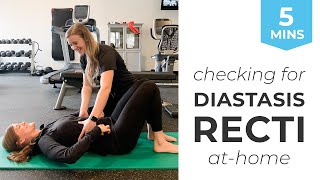
In this postpartum‑recovery vlog, host Lindsey (Speaker A) interviews Dr. Jenn, a pelvic‑floor physical therapist at Motion in Minneapolis, to demonstrate a hands‑on self‑check for diastasis recti and to discuss core‑activation strategies. Dr. Jenn explains that diastasis recti is a separation of the abdominal muscles along the linea alba, which stretches during pregnancy. She walks the viewer through a step‑by‑step assessment: locate the belly button, then place fingers about two inches above, at, and two inches below the navel while the client lifts head and shoulders, feeling for a gap (greater than two finger‑widths indicates a positive diastasis) and for the quality of tension across the linea alba. The conversation emphasizes that functional tension, not just gap size, is crucial for core stability. Dr. Jenn advises avoiding exercises that cause “doming” or “coning,” signs that the core cannot generate adequate tension. She then teaches a practical cue for activating the transverse abdominis: locate the hip bones, perform a “fake cough” to feel the muscle, then imagine a string pulling the hip bones together while exhaling, creating a visual that helps maintain engagement during core work. The vlog concludes with a recommendation to visit Motion for pelvic‑floor care and a teaser for a forthcoming Q&A on pelvic‑floor health.
Chapters
Hi, you guys. We are live at Motion, and I am with the pelvic floor physical therapist that I saw, Dr. Jenn. I saw her after I had Bella, and we just answered a lot of your pelvic floor questions, and that's going to be coming to the vlog later this month. But since I had Jen here, I thought, how cool of an opportunity to just show you guys live how you examine for Dr. Yep. And I'm going to let you introduce Dr.
Okay.
And talk about what it is, and then show me how to check for it.
Sure. I'm gonna have you go down on your back first. So diastasis recti, or Dr. Is when we experience kind of separation of our abdominal muscles. There is tissue that lies between those two abdominal muscles called your linea alba. And when you're pregnant, your body has to make room for your baby, so that linea alba gets stretched. And then after you have your baby, for some women, things kind of come back together. For others, that linea alba sees a little bit more stretched and lengthened. So to check to see if you have Dr. What you can do is you're going to kind of find your belly button first. So I'll be here, and then what I'm going to do is go about 2 inches above her belly button. I'm going to have her go ahead and lift up her head and shoulders off the table. And so what I kind of do is just find those two walls with my fingers. I just kind of go side to side. And right here, I feel two fingers width of a gap, but I feel pretty good tension across that linea alba. You can go all the way down for me, and then I'll go back down to her belly button. Typically, this is where I see the most separation. It just tends to be a little bit more weak in this area. I'll go ahead and have you lift up your head and shoulders again. And here I feel about two fingers as well. Just kind of going from side to side. Good. Tension across her linea elbow. And we'll come back down. Good. And then we'll go about 2 inches below her belly button. Go ahead and lift up. Perfect. And I don't feel anything here. So that's a way that you can kind of test on your own is starting 2 inches above your belly button at your belly button, and then two inches below your belly button. And you can kind of assess how big you think that gap is. And if you feel like your fingers are that linea elbow is nice and firm underneath your fingers. Or if you feel like there's a little bit more give there. Yes.
And so that was something I thought was really interesting that I learned from you. So I typically just, like a lot of people think that Dr. Is just about the AB separation 20. But the tension that you can generate across your lidia alba with your deep transverse abdominals placed into it.
Exactly. Yes.
So can you talk to that?
Yep. So we consider a diastasis recti positive when it's greater than two fingers. But again, it's just not all about that gap. It's more about the ability to generate tension across your linea alba so that your core muscles can work together when you're doing daily activities and you can feel nice and supported. Awesome.
And so exercises I should avoid if I have significant doctor Or I'm not able to generate tension or it is exercises to avoid.
Yes, exercises to avoid. So if she were to lift her head and I kind of see like, doming or coning here, where that tissue, the kind of force is kind of being generated through that linea elba, it might be an exercise that she's not quite ready for yet. It doesn't mean that she can't ever do that exercise, but it might mean that we need to adjust things a little bit or play around with that. It's something that's perfect for her at this time.
Yeah. Awesome. And speaking of core activation, can we do the one tip? Because this was the one tip I thought was really great for helping me work on healing my doctor personally. The hip bones.
Yes. So in order to find your transverse abdominis muscle, what you can do is find your hip bones here. You're going to go about one inch in, and then I want you to do a little fake cough for me. Perfect. So she's going to feel those muscles kind of pop into her fingers there. That's transverse abdominis. Then what she'll do is she'll take a big breath in through her belly, and then as she's exhaling, you want to imagine that there's a string attached to your two hip bones. And as you exhale, you're pulling your hip bones together with that string or with those transverse abdominis muscles. So we can go ahead and just show you one more time. Take a big breath in through your belly. Exhale. You're imagining those hip bones come together to activate those muscles, and you'll feel them kind of tighten up underneath your fingers. Yes.
That's been so helpful for me in.
All the core work that I've done.
Is just constantly thinking about bringing those hip bones together. A lot of times you hear just like, push your back into the mat or pull your belly button to your spine. But this is such a better visual, I feel like for me personally.
Yes.
And work on, like, holding that for a long time.
It's hard. It's really hard. Yeah. It's not necessarily something that we always think about, but it's just so, so important. Yes.
Thank you so much, Dr. Jenn. She is a wealth of knowledge, you guys. So if you're in the Minneapolis or Minnesota area, check out Motion and get in a pelvic floor appointment with Dr. Jen. And stay tuned, because later this month, we're going to be releasing the top 10 questions you guys asked about pelvic floor health, and Dr. Judd answered them. And it's awesome.