Diastasis Recti Workout 1: 10-Minute Postpartum Core (Beginner)
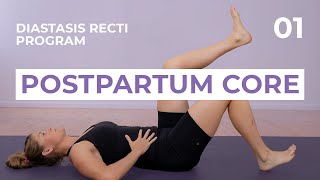
In this 10‑minute beginner postpartum core workout, Lindsey Bomgren (founder of Nourish Move Love) guides viewers through five foundational ab exercises designed to safely rebuild core strength after pregnancy, with real‑time assistance from pelvic‑floor physical therapist Sari. The session begins with a simple belly‑breathing cue, progresses through leg‑lift variations, heel‑slide to leg‑lift, alternating heel drops, a dead‑bug movement, and finishes with a modified forearm plank. Throughout, Lindsey and Sari discuss breathing strategies (e.g., “straw” cue, “blueberry” pelvic‑floor lift), how to sense proper muscle engagement, and how to scale each move up or down based on individual recovery stage. They explain cues for detecting readiness to advance, such as maintaining spinal alignment, feeling soft doming versus hard doming, and managing pressure. The video concludes by inviting viewers to a free diastasis recti recovery program and provides contact information for further support.
Chapters
Hi, I'm Lindsey Baumgren of Nourishment of Love. And today I'm coming at you with five beginner postpartum recovery ab exercises. And today I'm joined by Sari, my pelvic floor physical therapist, who's been walking me through these exercises, and she's going to help walk you through them, too. Okay, you guys, today is super simple. You need just your body weight and a mat. We're doing five exercises that I started with on my postpartum recovery. You know your body best, so I started doing these around two weeks postpartum. I'm currently eight weeks postpartum. You get to decide when it's best for you to do this. And we'll actually have Sarah start talking about when you know you're ready. But we're going to jump into these exercises. You have five moves. We're going to do them for around 40 seconds, and then you'll get a 20 second transition between them. But we're going to repeat each exercise twice. So you get two stabs at it and you can really master it. And Sari's going to guide us through when you know you're ready to scale up and move on to the next level. So let's jump right in. Okay, we're going to start right here on the mat. I'm going to come down on my backside, legs bent at 90 degrees, and basically we're going to just start with core breathing to get us set up for the first exercise. So basically, I'm on my backside, legs are bent at 90 degrees for 40 seconds. I'm going to take a big inhale, belly's going to expand, and as I exhale, I'm going to think about pulling my core together. So I like using my hands. We'll go ahead and start in three, two. Let's go ahead. So big inhale. And as I exhale, I'm thinking about my core wrapping around me just like shoelaces do to a shoe. Big inhale and exhale. I also personally like thinking about a string attached to each hip bone. Big inhale. Yeah.
Sometimes I'll think about having somebody pick up a blueberry with their vagina. So actually starting with a pelvic floor lift that carries up toward their belly button. So you're feeling everything dropping in.
So on the inhale, tell me. And then exhale. Picking up my blueberry now. Good. So you see how that belly button drew? Nice. And in. Big inhale. It's gonna be our last one right here. Exhale.
Nice. Good.
Okay, so we're just gonna do that exact same thing again, basically, and we'll talk you through one way you could possibly scale it up for me. That's gonna be lifting a leg. Is that a good scale up? Yeah. Love that. Okay, so that's where I'll go. I'll start with lifting one leg. If everything feels good, I could even go to lifting two legs. But I'll start with two heels on the ground for that first belly breath. And we'll go in three, two. Here we go. Big inhale. Good.
That's a nice abdominal expansion.
All right, next inhale and exhale. So why does lifting a leg up make it harder?
So that's gonna increase pressure. You're gonna have to use your core a little bit more to stabilize. When both your feet are on the ground, you're nice and solid. You're in a firm foundation. So I love these unilateral movements because you're gonna have to find your balance system a little bit more as well.
Okay, then we'll just stick with that. I'll do two breaths on the other leg, then big inhale and exhale. Good. Nice.
Aw.
We're gonna do one more here. So that's one way to scale up your belly breathing.
Love that.
Awesome. Okay, we're gonna move on to exercise number two, which is gonna be a heel slide to a leg lift. So I'm gonna start in that same belly breath in and out, and then I'm gonna slide one heel out and pull it back in.
And we're just gonna alternate heels.
Okay, so we'll take that big breath, big inhale, and exhale. As I breathe through that, I'm sliding my heel out, lifting the leg up, and returning. I'm gonna take an inhale. On that exhale, I'm gonna slide the heel out. The leg lift is the hardest part for me.
And if I were working with Lindsey right now in a session, I would be having my hands just kind of placed right on the inside of her hip bones here, so I can feel her belly drawing in versus pushing out. And that gives me kind of a sense of how she's managing pressure in this exercise.
Good. So I'm going to take two fingers and place them right on my hip bones, and it should be nice and taut right there. And then when I inhale, it's going to get soft. And then when I exhale, it's going to get nice and taut right there on my hip bones and lift. Nice and recover. We're going to do that same Thing again. Okay, so same exercise. If you were to scale this up with me, what would you have me do differently?
Yeah. So you could bring one leg up and do your reaching out and back. Just keeping this leg up without doing a heel side on the floor.
Okay, we'll start there. Big inhale, exhale. I'm gonna push out? Yep. And then pull in return to the mat, lift the other leg up. So again, you can always stick with those heel slides if that's where you're at maybe two weeks postpartum, wherever you're at. But then big inhale, exhale, and then you just scale up from there. Right. So we're just scaling up, and we're giving you beginner to advanced options. Big inhale.
And if this is too challenging, I might see that Lindsay is holding her breath or she's doing a really strong brace and her belly is pushing out. She's able to breathe through this movement. She's even able to talk through it. So this is a nice progression for her. She's ready for this progression.
Awesome. And recover. We're gonna move on to exercise number three. I'm gonna start with my legs at this 90 degree bend right here. And I'm just gonna drop heels to the mat. Alternating heel drops to the mat. And the larger my range of motion, the harder it's gonna be. Actually, what I notice most is the closer my knees are to my chest, the easier it is. The farther they are, the harder it's gonna be. So I'm gonna start somewhere in between. And we're gonna drop those heels. So my core is braced, and I'm just dropping those heels to the mat. Slow and controlled returning. This is where you might start to see some of that soft coning. Right? Yeah. It's gonna be the most pressurized exercise we've done yet. Exactly.
Okay, so you'll see just a little bit. It's hard with Lindsay's shirt on right here, you'll see just a little bit of kind of some rounding of the midline. I'm not concerned about that at all. That's called soft doming, which means that I'm able to push that tissue in. If it was hard doming, I wouldn't be able to push the tissue in. It would feel really taut. And what that typically tells us is that Lindsay would be working at max capacity. So there's a lot of pressure going on. The fact that it's soft is a good thing, I would say. Yeah. Keep going with this, Lindsay. You're doing great.
Awesome. We're gonna break, and we're gonna do that same exercise again. And for me, I just think about the farther I can get my knees from my chest. That's just how I'm gonna increase. You can even tell right now I'm feeling that a lot of intensity. So the regression is closer. The progression would be farther, right? Exactly. Okay, we're gonna go get in 3, 2, and 1.
Nice.
So I'm just dropping those heels to the mat one at a time. Slow and controlled. And I also think a way to scale this up is going from hands on the mat next to me. And then also I can lift my hands up overhead, creating a little bit again, less stability, right?
Yes.
Nice slow and controlled heel drops. This is one of my favorite moves to come back to. It just really focuses, like, forces me to focus on my core. And sometimes slower is harder. We want to slide through ab exercises, but slower is really harder here. We got about 10 seconds left on this one. See if you can maybe get those knees a little bit farther from your chest.
And if you want to start with this, but you're not feeling ready to do the full, you know, full time frame, you can always do four in a row or so. Take a break, Drop those feet down, bring them back up, do four in a row. So it's a shorter amount of time that you're in this 90, 90 position.
That's really good point. We're going to stay in that 90 position. I'm going to go to dead bug. Okay, right here. So it's going to be opposite arm, opposite leg is going to kick out. This is going to be the most advanced exercise we're probably going to do in this program. We'll go 3, 2, 1. So opposite arm, opposite leg extends. And again, this is all about range of motion, right? So the shorter my range of motion, the easier it's going to be. So I could keep this leg bent, and I could even just go here. And then I try to scale up to going farther. Right.
So you'll see there's a little bit more doming or coning as Lindsay reaches out long versus tapping her heel once again. That's nice and soft. You can see my fingers pressing in here. So I'm not concerned about that at all. This is a nice. This is a nice progression for Lindsay. Awesome.
Great. Nice work. You got about five seconds left here in this one. Then we'll take a quick break again. You could always shorten the time frame. Three, two. I'm gonna break. We're gonna rest, and we're gonna go right back into that this time. As I go through this, I want to talk about breathing, because sometimes when you're in these holds a position, people are like, well, how do I breathe through that? Okay, so for me, I like to think about breathing through a straw gently as I'm up here. Okay, so we're just gonna cue that. We're gonna get back in in three, two. Here we go. So I'm gonna inhale, exhale gently blowing through a straw with my lips. Come back together. Inhale.
Or sometimes I'll say fogging up a mirror. That's another way to think about it.
There you go. That's a good one. It's so funny how different cues are just gonna hit home differently for everybody.
And you'll see how a different cue might change the tissue across midline. So thinking about how your brain breathing with a variety of cues can change how you're managing pressure, which is super cool to observe.
Yes. Like, I was breathing, and someone said I was breathing through a straw. Someone told me that, and then they said, okay, now think smaller. Think juice box straw. And that juice box straw just hit home differently than a normal straw.
Nice.
We're in it for 3, 2. I'm gonna do one more, and we're gonna progress to our final move, which is the plank. So I'm gonna come up and over, and we're gonna start with a modified plank with my knees on the ground. Do you think forearm or floor or on your wrist is best?
Let's do forearm.
Okay, great.
I know sometimes postpartum moms have some wrist issues, right? You're using them all the time.
Okay, so I'm just going to start holding a forearm plank. You can join me. We're going to hold for 40 seconds here, and then I'm just going to have Sari talk through anything you like to cue in the plank.
Yeah. So I like to think about lifting your body up like there's a string between your belly button and your back, and that string is drawing up toward the side ceiling. So Lindsay might feel that her belly button is drawing in as she's imagining that string pulling up toward the ceiling. I like to look at her low back. I'm not seeing any sagging toward the floor. She's doing a nice job keeping this spine long.
Awesome job, you guys. Nice work. Hold here, and then we're going to take a quick break in about five seconds, and we'll talk about how you know when you're ready to progress up to a full plank. In three, two. Go ahead, recovery. You can sit it back. So if I'm feeling like, okay, that was good. I think how I started progressing up is I would start lifting one leg off the mat again. That instability as well. So we'll go to a three point plank. A three point plank. I'm just gonna shoot one leg back. An alternative. We'll go in three, two. I'm just gonna start holding one leg up, trying to really keep those hips square to the mat. Thinking about pulling my shoulder blades apart. Nice. Neutral neck. Gaze in front of me. Nice. I'm just gonna hold here. I'm counting in my head for about 10 seconds, and then I'm gonna switch legs and do the other side. The alternative would be to go up to an incline plank, right where I'm placing my hands on a chair or a bench going up to an incline plank.
And Lindsay's not lifting too high. If she lifted her leg up higher, you would see that she's really reaching through her low back. She's keeping her hips square, and she's just lifting up through that.
Glutes, right.
Nice.
Getting a little glute there too, which is great for our pelvic floor stabilizing.
Yeah.
I'm gonna switch the other side because we've got about three seconds for three, two, and one. Awesome. So those are your five beginner postpartum recovery ab exercises. This is a great way to start again. You can start whenever you're ready, and then we're going to actually show you how you can scale up to level two, which is the five advanced exercises. So you'll find this all in our entire free postpartum diastasis recti recovery program. Thanks so much for joining us. And we'll put all the details below this video. Have a great day. And you can find more workouts@nourishmovelove.com thanks so much for joining me for that core recovery workout. If you enjoyed it, I'd be so grateful if you dropped a subscribe to my YouTube channel right here. And if you want to access this entire free diastasis recti recovery program, you can find the whole program right here.
Have a great day.
More from Lindsey

Here's my winter arc 👇 #shorts #winterarcchallenge #strengthtraining #workoutplan

The only lunchbox snack that always comes back empty 🥨 #shorts #kindlingpretzels #proteinpretzels
Strength training is the foundation. #shorts #winterarc #strengthtraining #workoutplan

I’m not waiting until January to reset ... Are you? #shorts #winterarc #12weekplan


LOCK IN your Winter Arc: our 12-week program starts MONDAY ❄️ #shorts #winterarc #workoutplan