Diastasis Recti Workout 4: 10-Minute Post-Baby Abs (Advanced)
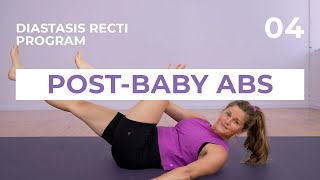
Lindsey Bomgren and pelvic-floor physical therapist Sari lead a 10-minute advanced core workout for postpartum recovery. The session uses breathing cues and imagery to activate your pelvic floor, progresses through leg circles and planks, and emphasizes that intensity should be temporary, not constant effort.
Chapters
Hi, I'm Lindsay Baumgren of Nourishment of Love, and today we're bringing you five advanced postpartum recovery, ab and core exercises. And today I'm joined by Sari, who is my pelvic floor physical therapist. She's gonna be helping us walk through these five advanced exercises, telling us when we're ready to scale up, how we can give it some cues to regress or progress each exercise. So I'm really excited about today's workout. If you've done our beginner version, you've walked through five beginner exercises. Now we're scaling up to advanced exercises as you progress along that postpartum recovery journey. So we're gonna go ahead and jump right into these five exerc exercises. We're gonna head right down to the mat, and I'm gonna start lying on my backside, and we're gonna start with some good core breathing again. But we're gonna scale up from if you've done our five minute beginner one. We started with heels on the ground. I'm gonna start with my legs at 90 degrees right. I'm gonna have a little bit less stability again. I'm gonna place my hands on my belly because I like to have that mind muscle connection. We're gonna do each exercise for about 40 seconds with a 20 second transition, and you'll repeat each exercise twice so you really get the hang of it. And Sari can talk us through how we scale it up or how we scale it down. Yep. So core breathing, we're gonna go big and exhale, pulling that belly nice and tight. I like to put my hands right here so they can mimic what my core is doing. Sometimes it's hard for me to make that mind muscle connection after having a baby.
It takes a while to find that deeper core.
So this is one of my favorite ways to do it, is this. I like to also have internal and external cues. So externally, I'm thinking about a marshmallow being underneath my back, and as I exhale, I'm thinking about squishing that marshmallow into the mat. And then internally, my internal. What's happening inside? I'm either thinking about a blueberry resting on my belly button, and I'm trying to squish it with my two ab muscles.
I love that together.
Yeah. Or I like thinking about a string across my hip bones. Another one I think about is decreasing the air between my ribs and my hips. Nice. We're going to do about two more belly breaths here.
And when Lindsay's expanding through her belly. I want you to also think about dropping your pelvic floor. So a lot of people keep their pelvic floor tight during all abdominal exercises, but we want those muscles to go through full range of motion with your breath.
That's a really good point. Let's go ahead and relax. And that's what I'm going to focus on the second time. That's why I like having two stabs at every exercise. So this time, as I walk through it, I'm going to think about lengthening pelvic floor on the inhale and then contracting it on the exhale. Okay, we go in three, two. Here we go. So lengthen and exhale, contract. And now I'm thinking about pulling that blueberry up with my lady parts.
And a lot of people say that's super counterintuitive. When I breathe in, I feel like I want to contract my pelvic floor. And I want you to think about what your diaphragm's doing. So when you breathe in, your diaphragm, diaphragm drops down and your pelvic floor drops down at the same time. So that's why we cue it that way, at least initially.
Nice. Always good to think about those internal cues that are happening. And if you feel like you're ready to scale this up, one thing you could start doing is kicking one leg out to a straight position. Eventually even working up to that hollow rock hold with both legs out. Nice. Awesome. Come to a nice rest and we're move on. Next exercise number two. I'm going to say starting here with the legs at 90 degrees, closer they are to my chest, easier it's going to be farther they are, harder it's going to be. I'm going to extend one leg out and draw two small circles with my toe. We'll go there in five seconds. So go ahead and set it up. Take that. Inhale, exhale, belly pulls tight. And here we go. Right leg's gonna kick out and I'm gonna draw two small circles and I'm gonna return it to that 90 degree. And then other leg's gonna kick out. I'm gonna draw two small circles. I'm thinking like a donut sized circle is what I'm drawing. And again going nice, slow and controlled here. And if I'm starting to feel like this is too much pressure or you're starting to see any of that, like really coming to that TP in the middle, I could always scale back to range of motion so I could just draw out A little bit. Keep that leg bent and just creating a little bit of motion with that hip. It's also really good for hip stability. Right. If I want to return to running.
Yeah. And I always say try to find a different strategy before scaling. So if this feels really challenging, you're noticing a lot of domain. That's not a bad thing. It's just feedback on how much pressure your system's managing. So think about a different cue that maybe Lindsey said, or a different breathing strategy and see if that changes how you're feeling in the exercise before saying, I'm not ready for this.
Awesome. Let's take a nice quick break and we're going to jump right back in. And again.
Yeah, you can think about it differently.
Or cue it differently. This time I'm really going to focusing on breathing through a straw as I exhale. So inhale, Exhale. Nice. Also really trying to focus on. It's really hard to cue the pelvic floor because we can't see it right. But I'm really trying to think on that. Inhale, lengthen, exhale, contract. So I like to think about the blueberry. Why is it a blueberry? Because it's just a small, little, beautiful piece of fruit. Could be an M and M. Right, There you go. I like the blueberry that's resting on my belly button. I'm trying to squish that with my abs. And then the blueberry that I'm also trying to pick up with my core.
Nice.
You're here for a couple more seconds. Awesome job.
And then we're gonna move on in.
3, 2, and 1.
Nice.
So from here I'm gonna go to holding one leg out. Legs are at 90 degrees. I'll kick one leg out. I take my opposite hand and push it into the knee of the opposite leg. And I'm just gonna push into this leg and hold there. So we're gonna start with a three second hold. And then I could always scale up to five seconds, maybe even 10 seconds, depending on how you're feeling. So let's go ahead and start there. So inhale, exhale. I'm gonn out and I'm gonna push the opposite hand in here. Now would you say neck stays resting or should my neck come up off the mat?
You could start with neck resting. If that's feeling easy. You could bring your neck up.
Nice.
And I love this, especially because it's actually working what we call the anterior chain system. So our oblique on the left side is working with the adductor. The inner thigh on the right side. And so it's nice to coordinate that system together because that works together as a system.
Let's take a quick break. That's a challenging one. I got 10 more seconds. I'm gonna go back in and hold for 10 seconds again. You can always start with 3. Progress up to 5 seconds, take breaks as needed. I'm really holding here. I'm pushing for three, two, and rest. We're doing the other side the next time through. Take a quick rest here. And so as we start to get into some of these more advanced exercises, the feedback I've gotten is people say, what if I'm starting to feel this in my lower back? What would you cue for that? And we'll go ahead and jump into our first move here and then we'll let you cue that. So big inhale, exhale. My left leg's going to kick out and I'm going to push into that right inner thigh. So if I'm starting to feel it's my low back.
So I talk about tension to tap. Sometimes with these harder moves, people are just racing maximally and creating a ton of tension. So the first thing I say is let's back off a little bit. Maybe work to 80% versus 100. And sometimes that will naturally just decrease how much tension is happening in the back. So thinking tension to task is the first thing. The other thing would be checking are you holding your breath during that? Are you breathing out through that straw?
Those are really good things. Yeah. To think about. And also, I know for me, I'm going to take that break again. We'll go back in for 10 seconds to hold for 10 seconds. Nice work. Five, four, three. You got it. And one.
Nice.
We're going to move on to a plank and we're going to go to a rolling plank. And as you're mentioning, as you were saying, that I think one thing for me especially, I'm like an all out person, Right. Like, if you've done my programs, you know, I love high intensity interval training. I love going at 100%. I'm going to start in a modified plank here and I'm going to go one leg up, other leg up, drop, drop. So this is a rolling plank. We go in three, two, let's go. So I go lift one knee, lift the other knee, return, return, lift, lift, return. This is one of my favorite ways that I started scaling back up to that full plank again. You can always add an incline here by placing your hand on a chair or a bench. But back to being that all out, 100% person. One thing I've learned with core and pelvic floor recovery, right. Is that it's not about being 100%. Even when I'm working on those internal pelvic floor contractions, I always want to go up to 100%, and then I turn on my glutes and other muscles, and that's not where we want to be sometimes. It's not always about going 100%, and.
I always say it's not forever. It's just for now. So that's hard for postpartum recovery, but it's. You're just scaling up for the small time period. Nice.
I'm taking a quick break, and we're gonna jump right back into that rolling plank. Okay. So jump back into that rolling plank. And I love that I've been using that phrase in my head like, it's not forever. This is just for now, right? We're here for three, two, let's go. So with the knee.
The knee.
So that's such a good phrase to think about, especially during this season of life, you guys. Especially for athletes, right? You're coming back. You want to be back 100% right away. This is not forever. This is just for now. Knowing that it's going to help get me to where I want to be. Right? Nice work.
It took nine months for your body to change, and then you pushed out a baby. So it's going to take some time. Right?
Which is why I love seeing a pelvic floor physical therapist. I've learned so much about my body, and that's why we wanted to create this program, was to share with you. I've had three babies now, and I'm still learning three babies later. Nice work, you guys. Right here, you're in it for 4, 3, 2, and 1. Awesome job. Nice work. You're going to want to sit back, stretch it out, because we're going to go into that full forearm plank hold. Okay? So again, this is all scalable, so.
I'm going to hold.
You don't have to hold for the full 40 seconds. Maybe you start with 10, then you progress up and you go from there. Okay, so we're going to start with the forearm plank hold for the first time through, and then we'll show you how you can progress it again a second time. So three, two, one. I'm holding here. I'm gonna give you my cues. I like to think about pulling my shoulder blades apart, pulling my toes towards my elbows, pushing my heel back, heels back towards that Wall behind me and pulling up on my kneecaps. Do you have anything to add, Sari? I love that.
And Lindsey's creating a nice, long neck here, so she has a little bit of a chin tuck down versus reaching up toward the ceiling. That'll be more comfortable in through the cervical spine, the neck.
Awesome. Good. And then here, if you were assessing me, what would you be looking for? If I was in a session with you? Yeah.
So I would be looking at your shoulder blades. If they're trying to kind of cave.
In or draw together.
I might be saying, let's try to bring those back apart, create a stable base with your shoulders. Looking at her low back here, is that dropping toward the floor? No, she's creating a nice, nice, long, neutral spine.
And I'm gonna break because that was my 40 seconds, and I was watching that clock still holding a plank. I'm eight weeks postpartum, so holding a plank for 40 seconds is still very challenging for me. Okay, I'm gonna get back in. I'm gonna do that same thing. I'm gonna show you, if you're ready, how we can possibly start scaling it up. Okay. So three, two. Let's go find that nice forearm plank. Get nice and stable here. And if you start to feel really good about this, you can start adding a hand reach away. So I'm just gonna tap one hand out and return it, and tap the other hand out and return it. And so that's gonna create some instability right in the core. We were talking about how we love unilateral moves, focusing on one side of the body at a time, so good for postpartum. Mom, why is unilateral training so good?
Well, especially if you want to get back into running. Running is a unilateral movement, so it's basically a series of single leg movements. And that really clicks when I tell people that, like, we got to take some time to rebuild that single leg strength and dynamic balance in particular for return to run. And then it also works your core system. That system is a stability system. So unilateral movements are all based on stability.
Awesome. I love it. Okay, well, that was our quick, advanced circuit. I'm already sweating a little bit because still, holding those planks is super challenging for me. And like I said, you take this program at what works best for you. And if you enjoyed this core recovery program, I highly suggest first checking out our beginner program. This is the advanced, and there's also ways you can advance that by adding a spongebob and a resistance band and you can find that whole program for our free Diastasis Recti recovery at Nurse Food. Love. Thanks so much and have a great day. Thanks so much for joining me for that core recovery workout. If you enjoyed it, I'd be so grateful if you dropped a subscribe to my YouTube channel right here. And if you want to access this entire free diastasis recti recovery program, you can find the full program right here. Have a great day.
More from Lindsey

Here's my winter arc 👇 #shorts #winterarcchallenge #strengthtraining #workoutplan

The only lunchbox snack that always comes back empty 🥨 #shorts #kindlingpretzels #proteinpretzels
Strength training is the foundation. #shorts #winterarc #strengthtraining #workoutplan

I’m not waiting until January to reset ... Are you? #shorts #winterarc #12weekplan


LOCK IN your Winter Arc: our 12-week program starts MONDAY ❄️ #shorts #winterarc #workoutplan