Diastasis Recti Workout 5: 10-Minute Post-Baby Pilates Abs (Advanced)
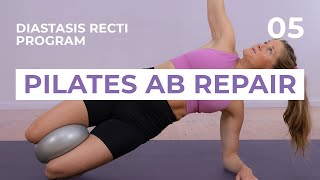
Lindsey Bomgren and pelvic-floor physical therapist Sari lead a 10-minute Pilates ball workout for postpartum core recovery. Five exercises progress from quadruped bird-dog to full forearm plank, with cues on breathing, pelvic-floor engagement, and when soft doming versus hard doming matters for your recovery.
Chapters
Hi, I'm Lindsay Baumgren of Nourish Move Love. And today I'm coming at you with five advanced Pilates ball ab exercises for diastasis recovery postpartum. And I'm joined by the amazing Sari, who is my pelvic floor physical therapist, and she's gonna help walk us through these exercises. If you've done our beginner Pilates ball ab exercises, then you are ready to scale up. We are gonna take things up a notch and really engage that core. And Sari's gonna help walk us through those cues. Are you guys ready to do this? Okay, let's go ahead and take it to the mat. So we're using a Pilates ball. It's a sponge ball you Amazon for under $10. We'll link it below in this video. If you don't have it, you could use a kids toy squishy ball or a throw pillow. Okay, so we're gonna go ahead and. Actually, I'm sorry. We're gonna start in a bird dog position. So I'm gonna come over. We've been starting with core breathing, but we're gonna challenge your core breathing from a different position. So if you've done our beginner videos, you've started with core breathing on your backside. Now we're gonna come over into a quadruped position on all fours, which is a little bit more challenging. To activate that core breathing, I'm gonna take the ball, I'm gonna place it under one hand, finding a quadruped position, shoulders stacked over wrist, hips over knees, and I'm go push one hand into the ball as I extend my other leg. So if you're coming out of pregnancy, you know you did a lot of bird dogs. Cause it's like the number one exercise they give you for modification. And now we're gonna use it postpartum as well. But we're gonna add this plotting ball for some instability and to help activate that core. So I'm take a big inhale. My belly's gonna drop. Exhale. I'm gonna push into the ball as I shoot one leg back.
Nice.
Inhale. Come to recover. Exhale, extend. And so what I'm thinking about here.
Sorry.
You wanna walk me through the muscles that I'm thinking about?
Y exhales. She's gonna feel her abdominal muscles drawing in. She's gonna feel her shoulder blades pulling apart, so creating a really stable base through her shoulder girdle. She's gonna feel her glute firing up on that right side and then also on the left side, that stability, that stability stance on the left.
Yeah, a lot of stability with this ball. You'll see my hand shaking over here. And that's totally normal, right?
Totally normal.
Doesn't mean I'm not ready for this exercise. It just means that I'm creating that instability and forcing all those small stabilizing muscles to work. We'll take one more. Your body figuring it out. Right. Reconnecting those mind muscle connection. Go ahead, take a break. We're doing that same thing on the other side. So I'm going to transition the platees ball over to my other side. I'm going to do the same thing. Opposite arm, opposite leg is going to kick out. And we'll start here in about five seconds. So go ahead, set yourself up. And we're going to let that belly drop with an inhale, exhale, push into the ball, shoot the opposing leg back. Trying to flex that foot and just keep that leg right in line with my hip. Right, exactly.
So you can see her hips are squared off. She's not rotating too much from side to side. If she is that, that's okay. Once again, her body's figuring that out, but trying to keep those hips level as she reaches.
Right. And with my breath, I'm thinking about that straw. Inhale, exhale. Flowing through a straw with my lifts. That's my breath. It's going to really help make that mind muscle connection as well. Got about 10 more seconds here on this first move. Moving through this breath exercise. This breath work is so important. Good.
You can see that belly button drawing up and in from the floor as opposed to pushing out as Lindsay exhales.
Awesome. And then from here, we're gonna stay in this quadruped position on all fours. I'm gonna take the ball and transition in between my knees. I'm gonna tuck my toes under and come into that bear crawl hold. And so my knees are just gonna hover off the mat and I'm gonna squeeze this ball. I'm gonna start with a three pound hold for the first time through. And we'll try and progress from there. So big. Inhale, exhale, Lift up and squeeze that ball. Hold for 3, 2, 1. Come to that recover position. Inhale, exhale, squeeze. So really activating the inner thigh muscles here. My core for me. I love this one. I love what you said about the lengthening and the contracting.
Yeah. So as Lindsey takes a break for a moment, when she comes down, you can see her belly expand. I also want her to feel pelvic floor expand and lengthen away from her body. So it's taking a brief break before it re engages. Yes.
We focus so much on contracting that pelvic floor. And it's also so important to learn how to lengthen it and take it through that full range of motion. I like that analogy you gave me that it's like a bicep contraction. If my pelvic floor stayed constantly contracted, it's gonna burn out really fast.
Totally. Yeah. And sometimes we'll see that with stress incontinence postpartum, that those muscles are just working overtime. They're super tense. So if people learn how to relax them throughout the day, they actually fire up a lot better.
Nice. One way to prevent leakage. Right. We're all for that. Awesome job. We're gonna do that same exercise again. This time I'm gonna try and hold it for a five second count. So we're gonna try and increase that endurance or that time under tension. So inhale, exhale, lift and hold. Hold for 5, 4, 5, 3, 2, and 1. Take it back down. And again, this is something you can just keep scaling, right? You can hold for 10 seconds. You can just try and keep holding that time under tension, making sure you're.
Breathing that whole time. Yeah.
Awesome. Nice work. This one is really challenging. Also feeling this. Definitely my quads, my inner thighs. Right. A lot of muscles working here. My shoulders are engaged. Really a full body exercise.
I love this one. I have people do this one a lot.
All right, last hold, you guys. Bring it up and hold. Hold for 5, 4, 3, 2 and 1. Nice work. Go ahead and recover. And now we're going to go back to our backside. We're still going to play with that time under tension on our backside. Right. This is your advanced version of the pilates ball abs. So I'm going to take the ball and I'm going to place it against one hand. Both hands are going to push. Legs are 90 degrees as I press into the ball, creating hip stability and core stability. I'm going to lower this heel. So we go in three, two, exhale, push into the ball, drop my opposing heel and lift it. Drop and lift. So now I can always take a break between. Right. So I could come back to center.
Reset, and you'll see some really subtle doming right here, barely visible. It's nice and soft, though. My fingers can sink in. So usually if it's soft, I give people the green light. Your tissue's not working to its max capacity, so keep on going with that.
It's so interesting Because I was originally told any type of doming or coning is really bad and you need to stop the extra. But that's not the case, right?
No. There's a lot of new research coming out now. That's what I initially learned too. And now in the past couple of years, we're noticing there's a difference between that soft and hard domain.
Awesome. We'll take a break and transition to like. So the hard domain means you could not get your fingers through. Exactly. And that would mean my muscle tissue is working at max capacity.
Okay.
Big inhale, exhale, push to the ball. And I like to think about it like we used to think about our core being so different from other parts of our body.
Right?
Yeah. But, like, if I'm trying to back squat 300 pounds. Yeah, exactly. I need to put load on. Right. So I'm working up. I'm starting with £50, but I'm going to £100. It's the same thing with our core.
Same thing. It's progressive strength training. Exactly. And we know that our bodies and muscles adapt to strength training and. Yes. So it's important in order to work our core.
So soft donating means my core is having load, but it still can support that load. Yes, exactly. That's a perfect way to put it.
Awesome.
Great. Nice work here, you guys. We got about 10 seconds left on this leg, and then we're gonna press that next exercise.
Awesome job.
We're on exercise number four. Moving on to exercise number four in three, two, and one. Awesome job. I'm gonna roll over. We're gonna hit those obliques. So I'll start on one side. We're gonna do a modified forearm plank. So my knees are on the ground, legs are bent at 90 degrees, shoulder is stacked over my elbow. As I lift my hips, I'm gonna squeeze the ball for three, two, one, come back down, tap the hips, lift and squeeze and hold. So modified plank hold. We'll go in three, two. Here we go. Lift and hold. Squeeze that ball. Two, one, Tap. Lift and squeeze. Squeeze for three, two, one. So here I'm not only hitting my obliques, I'm also hitting right here.
My.
Add my abductors. I really have to think about the muscles. Yeah. Eight weeks postpartum myself, so I'm still trying to process my brain and my body with sleep deprivation coming into play and squeezing the ball inner thighs. So I'm hitting glutes, inner thighs, and obliques. All really important because they work together. Right.
I love this one. For runners working that Glute med on the bottom. That outer glute. Super important for running, and this is a great place to start for strengthening for runners.
Awesome. Great. Let's take a break. I'm gonna keep that ball between my legs, and I'm just gonna come right over towards you. Same thing. Anything you would specifically cue here we can talk about in the next one.
Yeah.
Again, I'm gonna keep that shoulder stacked right over that elbow, and I'm gonna lift those hips in about five seconds. We're gonna lift and hold. We'll start with that three second again. You could progress this to five second. We'll go in three, two. Let's go. Lift and squeeze. Squeeze for three, two, one.
So I like the cue pushing down with your bottom knee to engage that bottom hip.
That's really good.
Sometimes it's harder to feel the bottom hip working. I feel like that really clicks with.
Some people instantly thinking about pressing your knee into the mat. That does help. It's so funny. Those cues just instantly make it that much more challenging. Awesome. Nice work, you guys. Getting that hip lifted nice and high. Creating hip stability too.
Right.
Because we still have that. I still have relaxed in my body while I'm nursing and breastfeeding, so still working on strengthening all those tiny stabilizing muscles that support me every day. Yes. Yeah.
And adding the ball is a nice way to do that with some extra inner thigh work.
Yes. And speaking of that, that's why we're gonna keep the ball. We're going to our final exercise, which is a forearm plank. So I'm gonna roll over into a plank position, but I'm actually gonna keep the ball between my legs. I've started adding this to my planks, and holy bananas. Doesn't make them way more challenging. Planking with a ball between your legs is harder. Why is it harder? Talk me through this. So we're just gonna hold a plank. Okay. I'm gonna start by holding a plank. And actually. And if this is too much, you could always take this up to an incline plank by placing your hands on a chair or bench. We're gonna hold here. But why is adding the ball between my legs harder? Yes.
You're creating a little bit more tension with your inner thighs by squeezing against something. So it's some more muscle recruitment because now your inner thighs are having to work against some resistance.
Yes. And everything is fired up. How do I know when I'm ready to start planking again? That's a great question.
There isn't a perfect number for any. I Usually say, let's try it. Let's scale up. Lindsay offered a nice number of modifications. Starting on your knees, then bringing one knee up at a time and starting there. If you feel like you're not noticing pressure, heaviness, hard doming, pain, usually you can try scaling up from there.
Nice. That's 40 seconds. And you guys, 40 seconds of planking is still really challenging for me at eight weeks postpartum. So I'm definitely watching the timer, and I was like, it's break time. Take my break. But we're gonna jump back in. This is your last time doing it. You're doing it one more time, and then you're done. Okay, so let's talk about some of those cues that differently for people, because sometimes, like I said, one of my favorite things I've learned is that sometimes you look at and you're like, oh, I'm not ready to plank yet. That means I have to stop. That's not necessarily the case. You might just need to change the cue.
Totally. Yes. Just changing your strategy. So thinking about how you're breathing a. Are you holding your breath and creating a really strong brace? Well, let's just try breathing through it. Maybe that'll make a difference. You can try thinking about a string between your belly button and your back pulling up toward the ceiling. Sometimes that helps engage the deeper core muscles. You can think about actively bringing your shoulder blades away from each other to create that strong, stable shoulder girdle.
Like, that little cue just instantly changes things for me.
Yeah, absolutely.
Nice work. We're holding for three, two. And rest and recover. Hoofta. All right, that was a solid, advanced core workout for me at least. And so I hope you found these exercises helpful. You can find this entire free diastasis recti Recovery program@nourishmovelove.com. have a great day. Thanks so much for joining me for that core recovery workout. If you enjoyed it, I'd be so grateful if you dropped a subscribe to my YouTube channel right here. And if you want to access this entire free diastasis recti recovery program, you can find the whole program right here. Have a great day.
More from Lindsey

Here's my winter arc 👇 #shorts #winterarcchallenge #strengthtraining #workoutplan

The only lunchbox snack that always comes back empty 🥨 #shorts #kindlingpretzels #proteinpretzels
Strength training is the foundation. #shorts #winterarc #strengthtraining #workoutplan

I’m not waiting until January to reset ... Are you? #shorts #winterarc #12weekplan


LOCK IN your Winter Arc: our 12-week program starts MONDAY ❄️ #shorts #winterarc #workoutplan