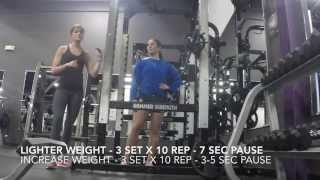
In this instructional video, Lindsey Bomgren demonstrates the pause squat—a squat variation where the athlete holds the bottom position for several seconds before explosively rising. Using national volleyball champion Ellie Duffy as the model, Bomgren explains the setup (bar placement, foot width, core tightness), the proper pause position (hip and knee at 90°, spine neutral), and cues to avoid common errors such as low‑back rounding. She describes the physiological rationale: holding eliminates the stretch reflex, forces continuous fast‑twitch activation while recruiting slow‑twitch fibers, and thereby enhances explosiveness—key for volleyball jumps. Bomgren also provides programming guidance, recommending lighter loads than a regular squat, 7‑second holds for three sets of 10 reps initially, and progressively increasing weight while reducing hold time to about 3 seconds. The overall message is that the pause squat is a simple yet effective tool to boost power and muscle recruitment for athletes who need strong, explosive knee‑dominant movements.
Chapters
Hi, I'm back here again. I'm with you, Foxy. Strength and nutrition. And again with me, I have Ellie Duffy, who is a 4 to 9 national champ, kind of the big deal in the volleyball world. Today I'm going to St. Paul, and so today we're going to talk about the squat and how there are several variations you can add to squat. However, one of my most favorites, one of my favorite variations is pretty straightforward and really good for increasing explosive movements simply in volleyball players is the pause squat. So the pause squat is basically taking the squat and just breaking it down. So at the bottom of the squat, you're going to hold that, hence what the name pause comes from. You're going to hold that spot up for a certain amount of time, anywhere from one to seven or 10 seconds. And then you're going to explode up on the hole. The hole being the bending position. So you can do pad squats with kettlebells, dumbbells. However, you're squatting. Front squat, back squat. For the purpose of this demonstration, we're just going to do the standard back squat. So I'm gonna have Ellie get in the rack here, and she's gonna just get into a good squat position. She's got the bar straight across the back, elbows nice and tight, back's nice and tight, core is tight. She's got her feet a little bit wider than hip width, distance apart, and she's gonna go down into that squat motion. So right now she's gonna hold in this low position where her hip is in line with her knee at a 90, 90 angle. And this is where she would hold. So she's holding, obviously for an extended period of time here. This is what we call in the hole, which in that bending position, then she's going to explode up and explosive movement upward. Okay? So I'm going to have her go drop back down into the hold. When you're holding right here, it's very important that all your muscles stay engaged. Common tendency is to lose focus here when you're in that hold position. And you'll dip into your low back, rounding out that low back and leaning forward. You do not want that. You want to hold in that pause position in a very nice, calm format. So again, I'll have Ellie explode up on the pole. Okay, great job. I'm going to have her perform this holding for five seconds. Ellie, go down into a squat. She's going to hold for 1, 2, 3, 4, 5, explode up. Okay, the importance of a pad squat and the reason you're doing A pad squat, you can go ahead and react. The reason you would do a pad squat is because when you go down into that pole and you hold in that bottom position, you are taking muscle and putting it to a whole other level, okay? So you have a stretch reflex and you go down into a squat position and you explode up. There's that natural stretch stress reflex. Same thing when you're benching. You have that natural bounce reaction in your muscles. You're taking that out and eliminating it. So you're going down, holding in that squat position, recruiting muscles. So your fast twitch muscles are engaging the whole time, but they're going to recruit your slow twitch muscles when you're down in that squat position, okay? So it's going to increase muscle, it's also going to increase explosivity because you're taking the stress reflex out. And obviously it's a lot harder to go from a stock position upwards than it is. You have momentum. So this is a great exercise. Again, for volleyball players. You move a lot from that explosive pattern, especially from a bent knee position, jumping upward. So another great movement, a simple variation you can add on some squats. I recommend starting with lighter weights. On the squats. You're going to be lighter weight than you normally would because it's obviously harder to get from that scalp position to the upward position. So lighter weights and hold for about seven seconds at the bottom. Again, you can do that for three sets, 10 reps. And then as you increase your weight, you can decrease your squat holding time so the pause time can drop down to three seconds. So that is a pause squat and a lot of great benefits to it. And a simple variation, you can add the squat.