You’re Not “Just Tired”—Your Mitochondria Might Be Screaming (Here’s How to Tell)
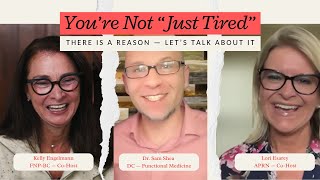
A 2026 YouTube interview (hosts Lori Esarey and Kelly) with Dr. Sam Shay about functional medicine approaches for chronic fatigue and related conditions. Dr. Shay shares his personal illness-to-practitioner story, introduces the Neuroharmony model (10 Pillars of Health) and a five-category lab framework (hormones, gut, mitochondria, environmental ‘weird stuff’, genetics), and gives a lay-friendly but detailed explanation of mitochondrial function, testing and how toxins/genetics interact with energy production.
Chapters
Foreign.
Welcome back, synergy listeners. We are so excited to have you here today with us. You're going to want to lean into this one. Today we are joined by a guest who brings science, strategy and even a little bit of humor to the world of functional medicine. Dr. Sam Shea is a functional medicine expert, a speaker and a stand up comic who helps people escape survival mode and reclaim their energy, their focus and their vitality. Known as the Fresh Friendly lab nerd, Dr. Sam makes advanced testing approachable using personalized lab work and genetic analysis to help his clients balance their hormones, heal their gut, optimize sleep and reduce inflammation. He's the creator of the DNA decoded program and the Neuroharmony model, two groundbreaking approaches that fuse precision based genetic insights with personalized nutrition and lifestyle coaching. After overcoming years of chronic fatigue, insomnia, digestive struggles, sugar addiction and anxiety himself, Dr. Sam turned his recovery into a mission to help others thrive. With over 25 years of experience in nutrition, science, mind body medicine and genetics, Dr. Sam delivers insights with warmth, clarity and his signature humor, making complex science both relatable and actionable. We are so thrilled to welcome him today to explore how our unique biology can become the roadmap to lasting health. Welcome to our show, Dr. Sam. We are so excited to have you here today.
Thank you. It's great to be here.
Your story is so, so powerful. I want to make sure before we get into anything else that you have an opportunity to really share with our listeners. Your compassion that you have learned and you've lived came from a place of pain. Right. And so we want to know more about that.
Thank you. My, my story, the, the, the, the, the arc is quite painfully familiar to most people who become natural healthcare practitioners. The details vary amongst individuals. But I just want to acknowledge my story is, it is unique to me, but it is not unique to the concept of the wounded healer and the I, I, I got into natural medicine the same way, you know, I got into comedy through tragedy. So the basically I grew up and I was very, very sick as a child. It started with my parents nuclear divorce, meaning that they, me and my sisters were caught in the blast radius of a really horrible divorce when I was 6 years old. My sisters were older and we all dealt with it in our own different ways. One sister basically fled the country as soon as she could. Another ended up in the hospital with a bleeding stomach ulcer. Another dived into books. I just escaped into video game addiction, sugar addiction, crippling insomnia to the point where it stunted my Growth and therefore I was an easy target for violence at school for about a decade and then an eating disorder, overeating and just, it all just kind of fed on itself. The insomnia, the bullying and violence and gas and, and, and the gaslighting at home and just. It was. And my parents handled it terribly. You know, each one, they would weaponize the children against each other. It just, it. The. My, my parents became more focused on getting back at each other as opposed to attending to the emergent needs of a damaged and harmed child in school. And I, my, my parents were more interested in medicating me into submission than actually dealing with what was going on. Because if they were dealing with what was going on, that would require them to have some introspection. The, the grand ironies of both of them were psychiatrists. And there's, there's a lot of humor in that and shall we say it's one reason why I got into comedy. And I just decided when I was in high school that I had to really take charge of my health on my own. And I was supposed to be the third generation medical doctor in my family. My father's father was a very famous scientist and he, a medical scientist and he's actually the founding director of the Fells Cancer Research center at Temple University in 1937 and he published over 300 articles in his career before he died from medical malpractice on the operating table, ironically enough in 1963. So I actually never met my grandfather and. But I took a hard turn into natural medicine and starting in high school and I just dedicated my life to natural medicine starting as a teenager. From there it was a very circuitous journey from a pre med, a holistic health practitioner degree to going to chiropractic school, then falling in love with functional neurology, to diving into nutrition and then getting an acupuncture degree and then training under an osteopath and then getting really, really, really heavy into functional testing and functional genetics and it all just. And then working with people particularly usually, I mean it's, it's just a reality that in, in functional and practice of functional medicine, 80 plus percent of your practice are women. And that's just across the board with the exception of a couple like male specific practices. Because generally the person who are the demographic rather who is engaging in functional medicine usually is an age 35 to 60 female who is concerned about their health in some meaningful way because there's a transition in their life. Either they're wanting to transition their, their hormones are shifting either because of pre menopause, they're in menopause, post menopause, they're wanting to, they're dealing with fertility issues or the, or trying to recapture their nutritional stores after they've given birth, or they're trying to shift their, their body because of their getting into a relationship or gotten out of a relationship and, or they're trying to start over after the kids have grown up and now they're wanting to start the new phase of life. And there's all these changes in their family life and then there's changes in their physical life. And this is the key word here, change and transition and the, whatever that is, you know, and, and there is, there is an ongoing, albeit stereotypical ethos, you know, like, you know, God doesn't come to practice unless he's being drag kicking and screaming or it's not getting up or shoulders falling off and duct tape ain't working anymore. Like it, there's, there's certain tropes that are true isms, not 100% true, but tropes are truisms. And I was putting together my models and frameworks. I, when I opened my first practice abroad, I worked with, I, I, I seem to have attracted. Middle aged females who were struggling with a mixture of chronic fatigue, fibromyalgia, autoimmune diseases, digestive problems, hormonal imbalances, and an autoimmune disease or two in the same person.
Sounds familiar.
Yeah, no kidding. And, and I was, and when I, and I, and I just listening through all of these yards and yards and yards of case histories, I realized that there was common maladies amongst everybody who had a chronic issue. Right, Everybody. And in fact I found that there were 10 specific categories of people's lifestyle to examine. And the people who struggled chronically were, with one exception, had a minimum of 7 out of 10 of these categories or pillars that were crumbling. It didn't matter which seven. It was seven plus.
Yes.
And what I realized is that these were the same people that they have. They all the same narrative. I have this, I tried this, this, this, this and this and this and this and this and this and this. And you can create a whole like staccato symphony just from and this and this and this and this and like it just, it's a drum line. They just kept repeating everything they've ever tried. But what I noticed is that they were trying things in sequentially, not necessarily simultaneously. And there was no roadmap to actually identify which of these, which of these pillars that they were actually crumbling, they should be focusing on. And the people who, most practitioners and clinicians, if they're honest, are really, really, really good. Really good at three out of ten, good at another three or so, not so much. Raing4. So what you're, what you get is, are people who bounce from one product practitioner or protocol to the next and they help, you know, up to three pillars at once. But that's like saying you sitting on seven or more tacks, you remove three of them, and you're supposed to get and feel better than your gas lit for not being better.
For sure. Yeah. What I hear you. Yeah. What I hear you saying to back up is that, you know, and we agree with you, I think Kelly and I have been in practice now, both of us, you know, right around 19, 20 years in our own functional medicine, integrative regenerative practices, and the majority of of people that come to the practice are women. And the second thing that we hear you saying that we talk about a lot is women have a lot of seasons. We have a lot of phases of our lives. Right. And a lot of transitions.
Opportunities for change.
That's right, baby. That's right. Opportunities for change. And we are complex.
Oh, boy. Here's another opportunity. Sign me up. So many opportunities. Abundance. An abundance of opportunities. Wow. That's right. Generous.
That's right. But it is unique that you are a male. Right. In this industry in which treats.
I do have a feminine side.
Yeah, but. And I love that. I love hearing that. But that connection, what I love about that is that, you know, most of, of our, our clients that come to us, they will typically choose providers of care that are women. And you have found it sounds like a glorious place where you offer probably a different distinct way of looking at things. Right. That can connect with them probably on a level we may not be able to. So this is going to be really fun to dig into a little bit more, huh?
Kel, you know, what I hear you say is you see these women that are stuck in survival mode, right? And they're trying all of the things that they know to try and oftentimes one at a time, and they're not getting the traction that they need to get to really fully reverse whatever they've got going on in inflammatory state. I can't wait to get into these things with you and hear, like, what is your approach to looking at those things, making them aware of what change needs to happen in what order to see the result that they want to see. So I'm so Glad you're here.
I'd be happy to. Look, I grew up, I was raised by a single mom and three older sisters and a nanny. And it's just like I've been around women my whole life and my, my, my sense, my sense is that it's also that it's not like I don't want to help men, it's just there's a, whatever it is that it's not, it's not as if I want, if I would have to focus more on the term like biohacking or entrepreneurs and just there's other, there's other kind of outlets and wordsmithing that can message to a more male dominated group, which I'm happy to do. It's just I haven't really done it. One of the takeaways for listeners and viewers is if you're going to work with a practitioner, find a practitioner who has a framework both for lifestyle and for labs. Now I'm going to show you mine and I happen to really like mine and I hope you do too. And whether or not you use mine or not is irrelevant. It's that to find a framework, not necessarily mine. If you find a practitioner that has no framework, good luck. Because it's gonna, it's basically guesswork, laissez faire, or it's gonna be this rigid thing. Like everyone comes into my practice, does this test. Now there is logic to that where if they just have developed a practice where 80% of their clients get 80% better from the, 80% of the info from, from these, you know, two, three labs, there's value to that where like here's, here's the core foundational thing based on the snitch that I serve, I, I actually have great sympathy for that and that, that has a, that has a plateau, that has a limit now. So one can find themselves in those practices. But then you may hit a plateau. And if you have a plateau, don't blame the field of functional medicine.
Right.
Like, look deeper. There's other frameworks, there's other lenses, there's other tests, there's other eyes on the same labs. And then with lifestyle, I'll share the 10 pillars. Labs are great. And you really need to have a foundation of lifestyle change in order for the labs to really, to really shift the results 100%.
100%. Yeah.
Otherwise it's just supplements for symptoms, you know?
Yes, for sure. And I want to go back to. I noticed as you said that about framework, that came from a place of deep passion and I sense some emotion in that. So I want to go back, and I want to ask the question is, where does that come from? Because you're very clear on this is if you're going to do this, this is what you need to do. Why do you say that?
Well, I. Look, I've been chronically ill for the huge, huge, huge swaths of my life, and it's not like it's over. I just got out of a moldy apartment six months ago as of this recording, and that. That moldy apartment really took me down. And so, like, I'm dealing with, like, I lost muscle mass. I was having wild mood swings. I was taking multiple naps a day. I even advanced MRI called NeuroQuant, and there's multiple cortical areas of my brain that have shrunk as a result, which is pretty terrifying for someone like me that comes from such an academic medical family. And so I'm in midst of my, you know, mold detox journey. And that I. That. That's a conversation for another one or five podcasts.
Well, we just actually had our podcast last month with Richie Shoemaker, and so we are fine.
All right. Yeah. Literally, the VIP molecule is in the mail at the moment. You know, so. Okay. All right, now, attempted to talk. I'm not gonna talk about. Okay, well.
That tangent. And I think it's really good to say, though, that that is a major cause of a shift in health and paying attention to your environment, because you probably thought you were doing all the things right. Right. And then you start slipping again, and you're like, why am I slipping? Why am I slipping?
Mitochondria test. I'll tell you, aside from losing weight, which was. Which is, like, bizarre because it's working out more, but still losing weight. And then I was like, something is wrong. I ran a mitochondria panel, which we'll talk about, because frameworks for. You know what? I'll use mold as references along the way. That's how I can thread that needle. Okay. Figured it out. Awesome. All right, well, so what happened was that I ran a mitochondria panel because I was like, I'm exhausted. I'm losing muscle. My mood is just absolutely in the wrong place. What is going on? I did my mitochondria panel, and look, I teach practitioners how to read mitochondria panels. I helped design in the last stages of the nutristat test, which is the largest mitochondria panel in the world right now. And I've given lectures and lectures on mitochondria this Is all to say, I know what's on the test. I read it and I burst out crying. I was like. I said to myself, I am literally dying. My mitochondria are retracting. They're dying. I am literally dying. And the only way. The only way that I am dying, given my lifestyle and my profession and everything that I do for my diet and everything, the only way that is even possible is I am being invisibly, actively poisoned. So then I ran an envirobiomics Swiffer test and then checked for mold and actinobacter and endotoxins, and all three came back super high. And I was like, oh, no wonder I'm dying.
I'm not laughing at you, but I certainly there too. Sometimes you just have to laugh when you're like, you're telling.
You're telling this to a comic. Like. Like, I'm the last person to worry about chuckling at macabre humor. Like, I am literally the last person you have to apologize to. I totally get it. If people ever watch, I have a free YouTube show, one hour YouTube show called NeuroSpicy. Neurospicy. Love Life and Comedy on the Spectrum. It's for free on YouTube. Just put in Dr. Samshay Neurospicy. You'll find it. I already mentioned that my parents are psychiatrists. I actually talk about it in the show, but it's actually a punchline. I may have ruined the punchline for people listening to this, but the macabre humor, the buildup of what they're doing and then the punchline of what they are, it's just like, what, you know. So, like, the macabre humor is definitely an art form. I got the results of my mitochondria test. Now, if I hadn't run that test and I was just someone who was not in the field of functional medicine, I could have chalked up what I was going through to, like, simple. Just, like, the stress of, you know, living life and running a business or whatever it might be. But if I hadn't run a test and I hadn't had an awareness of, like, I had a checklist in my head of, like, I'm doing all these things for my lifestyle and I'm going backwards. Yeah, framework, clearly, clearly missing information here. And I got the information, I was like, oh, cool, I'm dying now. I gotta figure that one out. All right, so. So this. These frameworks literally saved my life. Not just the. Not. Not just the people I work with. So when. When you Asked me before Laurie about, like, where is the seriousness of it? It comes from the seriousness of, like, this has saved my life, but also from a. More. From a. From another part that was a painful. It's like I went through what I call magic bullet therapies when I was just seeking one answer after the another. Just one magic bullet therapy after another, after another after another. And it's like, oh, if you, you know, you try, you know, try this meditation, try this exercise, try this diet. No, this diet. No bad. This diet. No, no, no, no, no. This diet for sure. No, no. Fifth time's a charm. That diet. I'm like, no, take this goji berry juice and snort it off the left nostril. That will absolutely help everything. So it's. And like. And I saw these people who were very sincere and very convincing that their magic bullet cured the thing. And I didn't understand why it worked for them. And they gave it to me and their precious magic bullet didn't work. And the answer I got when it didn't work was, well, you just simply need more of it. Use the right nostril next time. And it's. It just do more of it. And then when I figured out the 10 pillars of health, I realized why magic bullet therapy works for some people and fails catastrophically for others. So now I could understand both narratives. My narrative where it didn't work and their narrative where it legitimately did work. So, so what happens is that if someone's pillars only crumble to like 70 to 80% and but nine of them are holding up and you got one pillar that has a goji berry sized hole in it that is down to 30%. It's all goji berry from 30 to 80. And you snort on that goji berry juice, suddenly the one pillar that was lacking is suddenly up to 80%. You feel amazing. And then you start selling goji berry juice as an MLM downline, You make it a whole business. You start saying, oh, this is the one true Goji. You know, all that and the pillars of health finally explain that phenomenon of magical therapy. Now, what that means is that I can now analyze from the framework of 10 pillars and now select out the magic bullets as appropriate in combination and in synergy. There you go, you see, I fall back.
Synergy, name again.
Okay, yeah, in synergy with the other pillar, the other magic bullets, as appropriate to help rebuild the pillars in need.
And what you're really saying is there is no one magic bullet. What you're saying is that it is the Synergy of that. And in addition to that, it's a qualified healthcare practitioner who is educated. Right. And held to a level of expertise assessing, listening to the patient, listening to the client. Right. Hearing them, because that's 80% of the story. And then applying, doing the diagnostic testing to add additional information that you may or may not have after the evaluation and choosing the things that work for them. And so I know how important that is and I just wanted to go back for that reason is because there's a lot of people out there doing a lot of things. And it is important for the consumer of health. When you're really looking to align yourself with the right provider is to, to do your work, do your homework, investigate, ask really good questions and look for a framework. That's what I hear you saying. Look for a framework, pull it.
But there may be a magic framework. That's right.
Yes, that's right.
I think in the early days of practice development for Lori and myself, we came alongside of each other during education and we would go to our conferences and go to things and we would always have a list of patients that weren't getting better or they got better and they're regressing. And it's like we're lifelong learners. And I think in this field you have to embrace that you're not going to know everything even within your framework. There's always more to add to that layering effect of what we're going to get. And I think as providers we have to, we have to be humble and we have to recognize there's no way we can know everything. The other thing is building our network. So knowing when to send to a person that maybe has more expertise on.
Yeah, thank you. That's the other framework I hadn't shared yet. So another framework to double check someone if they're a good practitioner is know where their expertise ends. Where do they admit, yes, they do not that. That they're. That they are not the, the one true practitioner. So I mean, just as an example, like I don't work with infirmed, I don't work with children. I work with adult coachable teenagers and older. Keyword coachable. Yeah. I don't work with people who are younger simply because I'm not equipped for that. I have, I just, I've tried and just the triangulation between talking to kid, talking to the parent, talking to kid, you have to convince multiple parties to do the one thing and it's not, it's just not my skill set. But working with coachable adults and Also like, I don't deal with, with really severe mental illness, really severe addiction. Really like there, there's. I don't, I don't work with women who are pregnant. There are entire, entire specialists of specialists on this that I'm, it's. I don't work with cancer, but what I do do is that if someone has a lead cancer professional, a specialist, I'm the person that can come in as the lab support to look at the foundational labs, not the super niche cancer ones. Like I'm looking at mitochondria as such, looking at gut testing as such. I'm not the, I'm not the lead clinician there at all. So I'm, it's, it's, it's find a practitioner that really knows their limitations and yeah, you'll go very far.
Network.
And a network that will find you, that will find you the right person.
Which I'm more than happy to send off to. And exactly. Who is also willing and we teasingly say to play on the same playground too. Right? Because say sandbox.
Yeah, yeah.
You know, because you do, you do have to collaborate, right? There's, they have to be willing to, to absolutely collaborate. And you know, that's, that's knowing your limits and continually. I think one of the other things that Kelly and I did very early is holding ourselves to a level of expertise too and, and even calling each other out when maybe it wasn't necessarily like, you know, as we would begin to chat and kind of heading down a path of saying, have you thought about this? Have you thought about that? Really challenging.
Actually that's another framework. So I have a super nerd team that we meet once every two weeks for case studies. They love the suit. We have a super nerd team and that I would encourage any practitioner who's listening that you form a super nerd team of at most four people because you 15 if it's one hour every two weeks. Everyone can schedule that in the name of casework and learning. You should honestly, if 15 minutes per person is like, is like enough three. And what I would, what I recommend is like the three people have a common training but different specialties. So my three super nerds, my team of three, including myself, we all had a common training and met when studying under Dr. Kalish. And so but one is, one is like a detox mold expert. Another is a women's health medical doctor, Chinese medicine doctor. And I bring, I bring up all the rest with all of my niche obscure expertise is in functional neurology. I Mean anatomy is being a chiropractor, the genetics and just kind of broad spectrum handling a thousand metabolites at once just with all the broad labs. So between the three of us, like man, can we cover some weird stuff.
Yep.
And so having, having a super nerd team will not only accelerate your learning, but your, your clients will get better so much faster.
Yep. And we're so blessed to have that as well. That's what we do. You know, with our synergy team we have. And instead of just four people, we have practices. Right. And within those practices we have the, the multitude of different specialties within it. So whether that be an RD health coach, health coaches, as well as, you know, the functional nutritionist and things like that. And I do, I mean Kelly and I have really, really set our stake in the ground to say this is not negotiable. This is something that we do and we will continue to do to really hold each other. So I want to move into, because I so badly. I know we talked about some of the framework stuff. I want to go through that framework and then I'd love to shift into really the mitochondria because you spoke about chronic disease and the things that you really were challenged with. And at the end of the day, I think a lot of people are stricken unfortunately with chronic fatigue and chronic disease states. So let's go there and see where it takes us.
So for those just listening, I am sharing a slide, but I'll be able to, I'll speak in a way that will. The slide is supportive but not required. So when what we're looking at here is the over. What we're looking at here is the overarching framework called the neuroharmony model. And what that means is the neuroharmony model is the updated mind body system that we've got. Mind and body. But what I'm doing is I'm placing labs where they should be and it's right in the middle. The intersection of mind, body is chemistry, biochemistry. In fact, a molecule is like both physical and non physical. It's basically electromagnetics with some protons and electrons negotiating for airspace. So it's, it's an actual molecule is kind of like a bunch of them clustered together creating this thing is a physical thing, but really when you get down to it, it's kind of electromagnetic, non physical and it's also physical. It's both. So the meeting of mind and body is biochemistry. That is where lab testing comes in. That's where you fit lab testing into a mind, body model. Now what I'm going to show first is the 10 pillars of health, which is the mind, body portion. This is the. Then we're going one framework down, we're going to show those 10 pillars and then we're going to go shift into the lab testing framework. So the 10 pillars of health, this is, they all begin with a baby. There's 10 pillars. Brain, bowel, body, burst or burst, exercise, biotoxins, bionutrients, breakfast, bothers, bugs, bedtime, Brain, bowel, body, burst, biotoxins, bionutrients, breakfast, fathers, bugs, bedtime. And you can see there's even some sub frameworks in here. The basically brain is in the middle and that's because the hypothalamus is kind of the boardroom of the body. It's deciding from chemical, emotional and physical signals that are we under stress or can we go into a parasympathetic healing, health, long term repair state? And then there's three physical pillars, bowel, body and burst. There's three biochemicals pillars, biotoxins, bio nutrients and breakfast. And there's three mental emotional pillars, bothers, bugs and bedtime. So just going briefly through each of them in a bit more detail. Brain.
I don't know that we have. I would love to. I just don't know that we have the time to do all of that. I almost think that we would have to do a breakout session just to go. Because that's really good stuff and I love the way your mind thinks. Like I could ask a million questions about this, right? Yes. But I think what I hear you saying is that you, you listen to them because on that first slide you actually have that neuroharmony model of the mind and the body. You then incorporate the use of lab testing to fill in those gaps. And that diagnostic testing combined with the listening, you sift it through your filter of what are the areas that need the greatest and attention. Is that right? Am I following this?
Yeah. You take the most important pieces. When you run the pillars, you don't find what's wrong with each pillar. You prioritize which pillar is the most important. Everyone has the same 10 pillars, but nobody has the same order of priority. And I know because I've done heat maps, charted out, took like 20, 20 people. And I was like, what was the order of priority? Their pillars, none of them were the same. Now there was trends. Most the top three were usually they were sleep deprived, they had terrible breakfast and routines, they had some sort of massive stressor in their life. And They've got some weird weirdness with their toxic exposure or they were really deficient, like so there. And there was trends with exercise that was either they were fine on exercise or they were so injured or in so much chronic pain they couldn't exercise or they hadn't exercised in years. And now that was the first priority. So it's like exercise was usually priority nine or ten or one.
Right.
I don't know if you saw. I don't know if that's what you've seen, but that's what I've seen.
Yeah, for sure. And then your treatment plan is what you're saying, your treatment plan, what you deliver your deliverable to them, or your roadmap or your blueprint. Right. That we're talking about today, it comes out of that. Right. So from there it's working them through. Through that. And so is that, Is that burst section specific to mitochondria? I'm just curious.
Stands for burst exercise. I have to. I couldn't find a B word for movement.
Okay.
So it's just. I mean, you try to create a 10 point alliterative framework and not try to look. I put bio in front of toxins and bio in front of nutrients. I totally.
Yes. Well, I think I was reading it more of like that push Crash syndrome.
No, no, no, that's. We'll jump, we'll jump right into the lives.
Okay.
All right. So the framework on labs is there's five major categories of labs and there's benefits to lab testing. So the five major categories. And then there's just really quickly the major benefits of even considering labs, because some people are hesitant, because oh my God, takes time. It takes money. Well, the reality is that labs save you time and save you money across multiple domains. There's an upfront investment of time and money, but we're talking about long term saving time and frankly, energy and attention. You're gonna be saving all of that because you're not gonna be going down these, you know, magic bullet dogtail rabbit trails that are not going anywhere and you're not doing guesswork anymore. And honestly, the older one gets, time is the most valuable resource. You know, it's. You wanna figure things out fast.
And I wanna say something too, Dr. Shea, with time, because it's not just time and it's not just money, but it's also taking them down a rabbit hole that takes them nowhere because we didn't take the time of testing. And so that leads to discouragement, that leads to them going off plan, having an Objective measurement can make all the difference for them. Staying the course, right?
Totally. Data, I call it data digit data driven decisions to direct your care. And his last bullet point, saving you money because it prevents veering off track with just chasing a protocol.
Right. But you have the flip side to that too where you actually there are a lot of practitioners and I think we all can probably say that at one point or the other we have testing too early in the treatment plan or maybe not at the right time or maybe under the right circumstances. You know, it's having that provider of care who knows when it's appropriate to use the right test to get the answers that we need. So I think you have a lot of nuances with this that are really important. But I agree with you 110% that you gotta test. It's extremely important because you need metrics because you cannot manage what you do not measure.
So what I'll do is I'll share my five, my five point framework around testing. So there's five major categories of testing. Number one is number one not because it's the number one is just because it happens to be one on my framework it hormone testing. And there are three major types of hormone tests. Stress, resilience, sex hormones, thyroid and that's adrenal. There's adrenal testing, sex hormone testing, thyroid testing. And I'm giving a list of the different companies out there like Genova, Precision Analyticals, Doctors Data, they all have adrenal tests, hormone testing. The most popular one is Dutch testing. There are other competitors out there now. And then there's the thyroid testing, which is actually how I really got into functional testing in earnest because I had a patient of mine who was sitting in front of me with a full on goiter and this was in another country, so there were goiters there, goiter and had almost every single sign of hypothyroidism you can imagine. Trouble losing weight, disappearing eyebrows falling out, hair just exhausted. The bulbing eyes. A goiter, just for fun, a goiter. And she sat in front of me and said, well, she went to the specialist endocrinologist and they checked her TSH and he said her TSH was normal and that she was just depressed and needed to go on medication.
Yes, it's again another familiar story. Right? You're fine, your labs are fine. I'd add one more test to this if you don't mind or I would say blood sugar. Right, Blood sugar.
That's on the next, that's later on. Okay. Okay.
This is the first time. It's in the hormone category, right?
It's not. So it's not. It's in metabolic. It's a metabolic. It's next to the mitochondria. Now what you're saying, Leorie, I actually don't disagree with this is the hazard of making a framework. It's, where do you put the things that can cross two lines? So I don't object to what you just said. It's just your framework might be slightly different, but as long as you're covering everything, I'm fine with it. So with that, with that patient, it was one of the few times it was not angry at her, it was angry at the endocrinologist. And I swore to her through gritted teeth, I promise you I will find you a test that tests more than tsh. And that's when I found the company that did the consolidation of all the tests and found all these six different markers for thyroid. But you know, you want to run a thyroid test at a minimum. You want TSH free T3, 3, T4 antibodies to thyroglobulin and thyroid peroxidase. And like, yeah, versus three is helpful. Not in all cases. It's kind of nice to have, but like five, six markers at a minimum. So that's the hormone. Then we come to gut testing, which I break up to the big gut test, sibo testing and food sensitivities. Now, you've got lots of options here with gut, the big gut test. So the big gut tests, I mean, they check for hidden infections, whether it's H. Pylori, parasites, Candida, bad bacteria, viruses. The lay public will think of the word parasites in very broad umbrella terms. Oh, do I have parasites? And like technically, Candida is not a parasite, but they think of it as one. So you want to make sure your gut test has a broad spectrum of different categories of things. They also should check for normal gut flora or what's called commensal bacteria digestion markers, whether it's pancreatic function, fat absorption, immune system, gluten. You really want to make sure everything has gluten on it. Leaky gut or intestinal permeability, depending on whose terminology you use. And there's bunches of examples of these companies. The GI map from Diagnostic Solutions Lab, the GI effects from Genova Doctors Data is a GI360 gut zoomer from Vibrant. CDSA is kind of like the rotary phone of gut test. Still good, still operates. Just old technology, but hey, it works. A bunch of the companies have a cdsa, then you Got SIBO testing and this is called small intestinal bacterial overgrowth. It's cousin sifo, small intestinal fungal overgrowth. And there's some examples. Genova has a SIBO test Trio Smart has like the, the, the, the best one that I've seen so far, at least the most broad in terms of catching three different types of sibo. And then you've got food sensitivity tests which are looking at immune responses to different foods. And there's lots of labs that do this and they all, they all get to some weird pissing contest. My food intolerance is bigger than yours. You know, Cyrex has its opinions about ALCAT and about Vibrant and Genova vice versa. And just even Diagnostic Solutions lab has gotten into the food sensitivity game recently. I think within the past year or so. Everyone's, everyone's fighting over gut testing. But the most important one in my opinion is the brig broad gut test first. And if you want to start somewhere, you start there because a lot of downstream food sensitivities and even SIBO is just a function of poor function of the intestines in general, leaky gut. Even SIBO could be just poor gallbladder function because bile acids, the acid in the term bile acid damps down overgrowth. So like you can take as much, you know, slow release oregano oil as you want to to get rid of a SIBO thing, but really you want to fix things like the gallbladder. Sure, there may be other, many other factors contributing to co, but it's an example of how not all testing is created equal. Some things I believe should be tested first before others.
Right.
Or in command at a minimum.
Yeah, for sure. And I think with each practitioner I know again, once again, you know, Kelly and I have been working with our clients for so long and have so much experience, experience in that. But that took time to develop that experience and knowledge of knowing when to do what. And so, you know, I love that you, you know that you're talking about this and helping people understand that there's a lot out there. I mean the moral of the story, there's a lot out there and you don't need all of this. I want our listeners to. Because that can be.
No, no, no, no, no.
And, and they don't.
So yeah, yeah, so that we've covered hormone testing, gut testing, now we're covering mitochondria and brain, liver anemia, blood sugar. So here, so this is. Mitochondria is. Well, we're going to spend some bit of time on that mitochondria Mitochondria is a massive, massive topic. And mitochondria require like 50 plus nutrients to work optimally. And then it's dependent on breathing, oxygen, perfusion, the quality of your red blood cells can you deliver and all the things in the blood. How does blood sugar come in, all the neurotransmitters? Do we putting on the emergency system and shutting down the mitochondria in favor of. We're going to get a bit nerdy here. Anaerobic glycolysis for you Scrabble enthusiasts out there, or are we going to keep going with the efficient energy production of the mitochondria? Like there's so many things that influence the health and function of the mitochondria. And also is it, how much is it dialed up or dialed down in terms of production based on the current physiological state and the emergent needs of your life. So it is a massive topic. And the very relatively few practitioners really know how to navigate a mitochondria test. The reason why is the same difference between learning general anatomy, which I've done and taught. I taught across the nation, other chiropractors, how to pass their registration exams or national exams in basic sciences. And it's the difference between general anatomy and neuroanatomy that's the difference. The jargon, the words, the polyselogic. Polysyllabic. Wow, Polysilogic. That, that, that's a bad sign right there. My polysyllabic nature of. How ironic. I say that while I'm trying to say that anyway, the, the, the, the words make no sense when you're looking at, you're, you're just rattling. You can win a Scrabble tournament being on a first name basis with some of the metabolites on a mitochondria test. So the jargon jump is massive. And then you're dealing with a whole separate metabolic mil. You and I trained with Dr. Kalis for four years to learn how to not only read, but also teach mitochondria panels.
I want to make sure we get to it because I know how we have listeners that specifically are probably like what in the heck's a mitochondria? I mean just maybe they have learned that. But mitochondria, just to keep it simple is the powerhouse of the cell. Right? Keeping it super simple. Right. Keeping it super simple. But it is complex and it is. Look at that. Right? It can be very, very complex and probably way those that are listening.
But let me take exactly what you said. That's the Powerhouse of the cell. And let me make it simple. From there it's a factory. It's an electricity factory. So if you imagine a cell is a microscopic city. Now your mitochondria, depending on who you read, comprises 3 to 10% of your body weight. It depends on who, who, who's arguing. So that means that imagine any major city, let's take New York. Imagine 3 to 10% of the entire footprint of Manhattan is the electrical grid. That's how big and important this is. Now if it's an electric factory, all the entire metaphor works. You need specialized walls called sphingolipids. So if you have bad fatty acids, it's going to affect the walls of the factory. You need fuel delivered to the factory to burn. Protein, fats and carbs are delivered to the factory to burn to create electricity. Those three fuels are delivered by three separate truckers unions. The fatty acid truckers union, the carb trucker's union, and the amino acid or protein truckers union. And they're all paid in different currencies. The fatty acid truckers union is paid in carnitine, B2, glycine. Well, the long haul truckers are paid in glycine and magnesium. The amino acid truckers unions, they're paid mostly in B vitamin, mostly B6. And then you've got the carb truckers union. They're paid in like B vitamins, like poetic acid, chromium. There's a bunch of other things in there and if you don't pay them, then the fuel sits on the docks. So this is when you hear people like, oh, I need to help my carnitine shuttle. Which means their carnitine truckers union hasn't been paid to deliver the fat to the mitochondria to be burned to make electricity. Then you've got, so you got the delivery. Then you've got what's in the factory itself. Assuming you have good walls inside, you have machines that burn the things. Those are called vitamins. Inside each machine is a computer chip called mineral. Now this is why heavy metals are so dangerous. Because it's like swapping out a 2025 chip for a 1995 chip in a compute modern day computer. It might be functional, keyword might. And if so, it's super slow. That's why heavy metals can completely screw up the mitochondria. CoQ10 is the giant conveyor belt this entire thing operates on. If you look at a Coq10, the schematic says, oh look, a little dot of Coq10. No Coq10 is an enormous molecule. It is huge. It's kind of bonkers how big it is, but it is literally the conveyor belt that this whole thing is operating on. Then you've got the janitors who are putting out all the sparks that are flying off the burning of your fuel of protein, fats and carbs. When you put a log on a fire, it burns, but you've got sparks. And if those sparks get too big, you can start burning things outside the safe radius. And these sparks are called free radicals. Inside the mitochondria, the sparks that come off from burning are 95%. Blalock was the first person who really popularized that concept. You remember that book way back, way back then 95% of all free radicals are generated inside this factory. 95%. And so what you need are these really heavy duty enzymes that are the janitors called mn, sod, Glutathione, peroxidase, catalase. These three janitors are the ones to mop up all the sparks so the factory doesn't catch on fire. Then you got viruses, which are the thieves and vandals that come in and can take over, destroy, or otherwise just slop around the. Slop up all the whole machinery. Then you've got your garbage removal system, which is your lever detox capacity. Then can you remove the garbage that's generated from the mitochondria? You've got neurotransmitters, which are the signals from outside the factory phoning in, hey, we need this much electricity. You got peak hours, we got this, we got that. And it's dialing it up. You got inflammatory markers and you're like, how often does your factory catch on fire? That's a good number to know. Then you've got the thyroid. Now the thyroid is actually the teeth. The thyroid, sorry, mitochondria, is the business end of the thyroid. That's the thing that people. What does the thyroid do? It's basal metabolic rate. Okay, what does that mean? That means how much your mitochondria are burning protein, fats and carbs at their tonic level of electricity production per day. What happens is that the thyroid makes T4. And the metaphor I use, it's the four wheel car that pulls into the arterial superhighway, drives along and pulls into the mitochondrial parking lot of a cell. It makes that Transformers movie noise. And one door opens and becomes this arm. So now it's a T3 because there's three wheels because one. One turned into an arm. And that becomes the engineer. That button Mashes on the controls of the mitochondria to dial it up. So you need thyroid to activate and signal to turn up the mitochondria. I've seen it so many times. People have had perfect thyroid panels. And I mean, all of those markers that I mentioned, not just tsh, but they still have the signs of hypothyroid. It's not a thyroid issue. It's. Their mitochondria is not responding to the engineer button mashing on the control controls. It's not the thyroid. It's. You just caught them in that one, like, short window where the thyroid has. Still thinking everything. Oh, if I just, you know, keep button mashing, it's going to be fine until the. Until, like, the. The signaling has started to warp, and now it's affecting the thyroid molecules. So that's the best way to understand the thyroid. The mitochondria is the factory. But I do not know of anyone false modesty side, except myself, who's actually taken the time to explain that metaphor in real detail.
I love this.
I love the metaphor, I love the schematic, and I love the metaphor because I think anybody can really understand that very complex situation.
Right.
When you're explaining it in the way of a factory. And what I heard you say throughout all of this, without saying it explicitly, was that we have to work on the foundation. We have to detox and deload the body. We need to be getting in the proper nutrients. We need to be moving our bodies. We need to be getting extra or appropriate amounts of fatty acids in our diet. All of those things, foundationally are necessary to keep this factory, this mitochondria, working appropriately, to give us energy, to give us vitality so that we are resilient.
Right?
Totally.
So.
And then all of these sparks is accumulation of free radicals, which increases risk of disease. And if your cleanup efforts aren't greater than your sparks.
Yes, you're going to be diseased.
And so.
And here's. Now here's where we can tie in mold and all the other weird stuff. The fourth category is what damages the mitochondria easily. And this is what I call the weird stuff category of labs. We did hormones, gut, mitochondria, and company Weird stuff. This is mold, metals, environmental toxins, Lyme. What do all these things do in spades? Screw up the mitochondria.
Right.
In spades. Would.
Would viruses not be on that list as well?
So virus. So that would be. It's. Yes, thank you. It would be on this list. I just couldn't Fit it across the thing on the topic. Yeah. So now then, you've got. The fifth category is genetics. This is the thing I love dearly. I'm deeply, deeply, deeply involved in the genetics world. And here's how genetics relates to mitochondria. Your genetics determined how agile and resilient and robust those three janitors are. So I suffered with chronic illness my whole life when I ran my genetics. The panel that I run, we prioritize. The genes don't just give out. Here's 300 genes and here's 300 health tips. Hope. Good luck figuring all those priorities. No, we've prioritized the genes because not all genes are created equal. Spoiler. Methylation is not the priority. It's downstream of inflammation. Like, I super disagree with Gary Breck on this. I listened to his podcast and I was literally screaming into my podcast Mike, you know, when I get angry, I make a PowerPoint. So then I went on this podcast tour debunking what he was saying on that podcast he did in late December 23rd. So my. So what happens with me? Why was I chronically sick when everyone else with a similar lifestyle wasn't? Because I had. Of the top 15 inflammatory genes I had, 13 out of 15 were pro inflammatory. I also had MNSOD and GPX1 were bright red dots, meaning that my janitors were slow to non existent. Which means when I started to. Yeah, it's so many, so many opportunities, right? All those opportunities.
Exactly.
Oh my God.
So I love the way you're reframing that.
I love learning about the next new thing that is afflicting me that I now can learn and help others smile. Okay. Like mold. Oh my God. The education, getting on mold. Amazing. So worth it. Love the opportunity. Oh my God, I can just hear.
The sarcasm drifting from your.
Yeah, what's. What's the skill I learned in graduate school? How to smile and grind your teeth at the same time. Right. So this is the same thing with these opportunities. So with genetics, you know, once and I. Genetics radically changed my health. I'll give you, I'll give you just two examples. One, I was having chronic arthritic pain like an 80 year old man in my 30s and I did not understand why. And I was taking my one gram of fish oil, you know, according, you know, for years, over a decade, easy, one gram of fish oil. Then I got into genetics and I realized just how pro inflammatory I was. And then I learned this new concept called nutragenomics. Not nutritional dosing, but nutragenomic. Dosing, what does that mean? Nutritional dosing is I take a gram of fish oil, throw it, it's widgets into the machinery. Nutrigenomic is I take 2 to 4 grams and I now change the machinery. That's the difference. So what I did is I took one. One of many things that I did is I increased my fish oil. Don't go off people, don't take, oh, I just need to take more fish oil and I'm great. I'm not saying that it was one tool there that was really potent that I didn't know existed until I learned about it. One of about a half dozen that I learned from my genetics. So what happened was that I did these nutrigenomic interventions which are usually singular nutrients at higher doses that changed the genetic expression to make me globally more anti inflammatory which then made my joints not hurt anymore. But I didn't know about that concept until I got into genetics. The second major thing that happened is that I did a specialized genetics test that's now available in the States to check for your ideal diet. Are you ideally keto, paleo, Mediterranean or high carb of some shade of gray in between? Now I was having a perfect Mediterranean Portlandia diet where I knew the names of my farmers and their chickens and the quinoa was grown with by left handed monks on the picked on the harvest moon, you know, all that stuff. And I was eating, my carb tolerance is actually that of a low carb paleo bordering on keto genetically. And even though I was having this perfect Mediterranean Portlandia diet, I was having energy swings, mood swings, I was indigestion. I was just like, what is going on here? And then when I switch, within one week my digestive problems disappeared because I was switching to my genetic capacity. And there's nuances now in the genetics world. It's not just about variations, it's actually about how many duplicates of a specific gene. It's called copy number. Now that's a whole other podcast we should talk about genetics. But I'm sharing this all with you. Like all of these tests, they all matter. But the key is to have a framework to figure out what's the ones that matter the most for you. So you combine a practitioner with a framework for lifestyle, whether it's the 10 pillars of health, the triangle of health, the inverted hypotenuse of wellness, I don't care, as long as they have a framework for lifestyle and then a framework for labs. Mine are hormones, gut mitochondria, weird stuff. Genetics and then knowing all the subdivisions underneath, Lifestyle and labs. Combine those. Now that's holistic medicine, lifestyle and labs, frameworks for both. That's holism.
That's right. And then knowing when to punt or knowing when to bring up the team. Absolutely. Well, this has been incredible. Thank you so much. We have used every ounce of our minutes. We're right up against our next one. I mean right down to the wire a little bit, but we. This was really great. Thank you so much for your dedication. You can obviously tell how passionate you are about what you do and love it. I love the combination of the humor in. And I really, truly. I'm going to go back to that schematic. I might have to, might have to show it a few times if that's okay.
It has your name, which schematic, if you're into.
I love the. The mitochondria. Yes. Oh, yeah, yeah. Because I just think that was great, that section among other things. But thank you so much once again for your dedication, your inspiration. You're sharing your willingness to be here with us today and share your knowledge. It's been fantastic.
Yeah, I appreciate the opportunity. So as, as we finish up, I think you're about to ask me how. Yeah.
How do we get in touch with you? How do people connect?
Yeah, yeah.
So that's very, very straightforward. Just my website, drsamshay.com-r s a m s H A Y D R S A M S H A Y I'm not a stadium, it's not S H E A and there you can get. At the time of this recording, I'm still doing, you know, free 15 minute discovery calls for people who want to work with me directly. I've got links to my DNA decoded program. If they're wanting to really dive in and get their genetics through a whole kind of six month program where these integrated journey of how to implement all these changes for life. My YouTube channel. Just look up Dr. Samsha on YouTube. You'll find a couple hundred videos on there from other interviews, my comedy show and I just love teaching and educating and I really thank you, Lori and Kelly for providing an opportunity and a stage to teach and educate at scale. And it's like I love teaching so much and I'm so grateful for the people that really have created the platforms to be able to share information at scale to the people that need to hear it the most. So thank you very much for this opportunity. I really love teaching.
Well, you stay the course, keep going, keep going with what you're doing. And good luck with this navigating this mold thing. It's an opportunity. The Synergy Podcast is for general informational purposes only and does not constitute the practice of medicine, nursing or other professional healthcare services, including the giving of medical advice, and no doctor patient relationship is formed. The content of this podcast is not intended to be a substitute for professional medical advice, diagnosis or treatment. Users should not disregard or delay in obtaining medical advice for any medical condition they may have, and should seek the assistance of their healthcare professionals for any such conditions.
More from Lori



Does Estrogen Cause Breast Cancer? Dr. Felice Gersh on Hormone Therapy, and Risk.






Spirulina in the Morning, Chlorella at Night? How to Use Algae in Your Daily Routine