Opportunity Zone
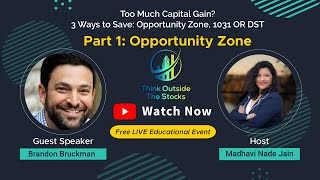
Brandon Bregman explains Opportunity Zones, a 2017 tax program covering 8,700 tracts and 35 million people. Investors get a 10% basis step-up after 5 years and can exclude gains after holding 10 years, but must reinvest capital within 180 days and pay deferred taxes by 2026. About $75 billion deployed by 2019, mostly through funds targeting accredited investors.
Chapters
Yeah, there you go. So let's get started. Hi everyone. Welcome. Thank you so much for being here. And Brandon, welcome to you as well. My name is Madhu Nade Jain. I am your host today. I'm the president and wealth strategist at Think Outside the Stocks. With today's topic, we have our guests talking about capital gain, which is an interesting topic. We cannot do justice to it in one session. So we decided to do three sessions. Today we will focus on Opportunity Zone and typically we think outside the stocks. We have every other Thursday our webinars are scheduled. But with this topic we decided to do kind of a back to back. So today we are going to talk about Opportunity Zone. Next week, Thursday, same time, we will talk about 1031 exchange, which includes the syndication, by the way, the TIC agreement, if you kind of know about it a little bit. And also we will talk about dst. And in the third session, which is three weeks from now, we will actually just have some case studies. I mean, you are welcome to bring your case studies and we will discuss on out of these three options, what's the best possible scenario for your case. So join us today, next week and a week after just in this continuation. Just a little bit disclaimer from our side, this is an information and education purpose only. We are not tax advisors, we are not lawyers. So we provide this information from a passive education perspective. So you can kind of keep on moving closer and closer and closer and wealthier with your information regarding the passive investments. You are encouraged to seek your own legal tax and any other professional advice that you would like to have for any investments. And also please note that if we do have examples today, they are just point in time and there are different multiple factors, market et cetera, that can impact those numbers. So please keep that in mind with that. Most of you do know me. My name is Madhavi Nadechen. I'm the president and wealth strategist at Think Outside the Stocks. I help in syndicated real estate investments. I bring vetted investments across the emerging markets in the country. And also I help with Infinity Banking System, which if you haven't heard, that's a very interesting kind of a topic and I would love to add more valuable information to you if you want. I can even send you some of the webinars in that particular subject. But anyway, coming back, I worked in my past life. I spent almost 17 years in IT industry and most of the time it's with big five consulting companies in project management. So I love that. That's the experience that helps me in what I do. Currently in my real estate journey, I have a rental bed port portfolio of single family, Airbnb multifamily. I'm active in multifamily as well as a gp. But truly, truly, truly my passion is the education. I love to bring this out of box, out of stock strategies to you guys. To passive investors essentially are really busy in their own work and they don't have time to go out and attend these conferences or spend so much money. So that's really my passion to bring you that truly free education and just make you move closer to that passive investor journey. And our guest today is Brandon Bregman. Brandon is focused on growing 1031 and DST business as well as adding investments to client. He also leads the effort, marketing effort and investment due diligence in insight 1031. He also spent prior to Insight he spent time with WES Chapman & Co. And many other areas as well. But he also serves as a board of repairs of the Bridge daytime homeless shelter in Milwaukee. That's very interesting, really interesting fact about you. And also it's on the board of Apartment association of SEA Wisconsin. He is from Milwaukee and he stays there with his wife and three children. So welcome Brandon, welcome again. Do you want to add something to your bio that I have missed?
No, that's. That's perfect. And that is a, that is a cheap plug for repairs of the breach. Love to get folks involved in that effort and we're doing a lot of work there between repairs and the apartment association to really build sustainable housing situations in Milwaukee. It's a huge need and it kind of spins into the conversation we'll have about opportunity zones. So no, well said. Thank you.
Oh, thank you so much for adding that, Brandon. So before we go ahead and jump into the today's topic, I'm just going to add a little bit brief about what Think outside the stock is. And trust me, this is just the two minutes that I'm going to talk about it and rest of this education is just completely. We are going to talk about opportunity zones. So with Think outside the stocks, my approach for investment, for investors is that, you know, changing that perspective a little bit, right? Like a, like a bird's eye view, not like a horizontal view, the bird's eye view to not just, you know, saving and investing but it's about growing, preserving, protecting and passing. So with the twofold approach that I have, you know, with the savings, making your savings better as well as efficient, which is quite naturally sitting in your bank Accounts not, not doing anything for you. So I try to make that efficient with inflated banking system with the guaranteed growth and protection and I also bring in that risk managed syndicated real estate investments and also this passive education for folks. So upcoming webinars of course, this is a three part series that I spoke about before and I am also working on getting some interesting speakers lined up. So with that, you know, to Brandon now and if you want to go ahead and start sharing your screen.
Thank you so much for that introduction. I think there's just, when I read and hear more about you and think outside the stocks, I mean there's just great, there's great alignment between the way that we approach this space as well and the way we think about, you know, not only opportunity zones but investing holistically. There's, there's really great, great alignment there. So this is really a good fit. Yeah, this is, this is really, we came up, we came up this idea what a few weeks ago to really think about, hey, this is, this is really in multiple parts. Like there's more depth to thinking about what you can do with capital gains than beyond what I think people traditionally think about. And we talked a lot about, God, opportunity zones are this, this great vehicle that could be valuable not only for our real estate friends. And that's where I spend a lot of time. And my focus is on investors that have gains in real estate and they really want to get passive, they want to get out of the real estate game, they want to get out of managing investments. And we think about how to do that in a tax efficient way. But going beyond that is really interesting. And we've started looking at more and more opportunity zones because the math gets really interesting and thinking about things that we can do there. So let's kind of get into maybe talking about what this means a little bit. I have my own disclaimers. Everyone read that quick, say yes, I understand this is for informational purposes. I don't know if this fits you or not. We always tell you, please, please, please consult with a tax professional that really understands not only these issues but has a good understanding of alternative investments as well and what those mean for you, particularly passive investments. It's a really good idea. It's a starting point for all these conversations. So please go do that. So what are opportunity zones? I think we hear this terminology kind of thrown around a lot like what is this stuff? What are we talking about? And actually my picture, and the picture on this slide is actually downtown Milwaukee and the spot where this is taken from is actually in an opportunity zone, which I find sort of interesting. It's a bit ironic or wasn't purposeful that we put that on there. But like that's a good fit for this slide. So what is sort of the history here? Opportunity zones are really impacting 8,700 different communities across America, around 35 million different people. And these are areas that they need your investment. Frankly. The poverty rate is higher, you can see on the screen, from 32% compared to 17% in the average census tract. Median family income is 37% below the average for those areas. And unemployment more than one and a half times higher in that area. These are areas that have been traditionally they've been under invested in and for a significant period of time. And we can really. I can speak to that from real experiences. Milwaukee, Wisconsin, unfortunately is one of the most segregated cities in the country. And the specific areas that need this help are very easy and clear to see to folks that live in southeast Wisconsin. So we see the need. It's evident when we look at it. And this is a way to kind of attack that and to put money into areas that really need it. So where does this come from? The tax cuts and job act passed in 2017 helped create the opportunity zones. And taxpayers can take advantage of these things through qualified opportunity funds. And I'll describe that, of course, in more detail. Some of the impacts already happening. So I pulled a presidential report from the end of 2019. 75 billion has already gone into this space in terms of capital. It's not a small number to think about. We got a long way to go. But man, what a great start to put that amount of money into these areas. You're racing an impact is that home values in these areas as of the end of 2019, this report are actually growing significantly faster than other areas in the country at that time. So that's a really great corollary and link to say, okay, is this working or not? And there are a lot of questions about that. If this needs modification. And I'll get into that a little bit as we go, but we are seeing some statistical evidence that this might be working. Research indicates that every million you invest in these areas lifts 20 people out of poverty they're receiving in that track. That's an amazing number and we would love to see that come to reality in this. So we really believe that if we're investing, my primary responsibility is all the things that we got done talking about before is preserve, protect and pass Is the same thing that I think about as well. But to add on to that, if we can do something good in these communities, all the better to be doing that as well. We can profit and we can do things good. So that's sort of the background. And what Opportunity Zones are, here's where they are. So they are literally everywhere. They're in all 50 states. And there are these small tracks of areas that are carved out as Opportunity zones. Heck, you might be seen in one. You don't even know it at this point. So they're everywhere. They're really federal led the way on it. And then states and governors really pushed on authorizing which one of these areas are OP zones and which ones aren't. So that's what's really driving these areas. And it is a macroeconomic thing in the way that we think about it. But again, just wanted some visual representation that there's a lot of these things and they're sort of everywhere. So all that's interesting. There's great social impact here. That's awesome. We love to do that. Why am I interested as an investor? Why is this interesting to me? And there's a couple things that are very interesting to us here. One, when we talk about tax deferral now, we'll get into in subsequent sessions the 1031 and what that sort of means. But in the tax deferral section of this, any capital gain that you have can be deferred through the Opportunity Zone. Any capital gain. So if you have a capital gain in stocks, you have a capital gain in real estate, you have a capital gain from selling a business, all of that can be used in Opportunity Zone to defer some of that gain. So that's a huge advantage. There is no other game in town that can provide this sort of deferral. It's a big thing. So some of the rules when we're doing that is, number one, after we sell or incur some gain, we we have 180 days to invest into into some sort of Opportunity Zone. Your basis will then be reset at zero. And those capital gains that you are expected to pay now, those can be deferred until 2031 or 1231, 2026. So it's an important point that I want to point out here is that these don't go away. These gains. This bill is going to come due. And I'll talk about what that sort of means at the end of 2026 and how you kind of go after that. But the advantage here is that those dollars that you had as a gain are Going to grow from now until 2026 in a deferred way. Right. Those money that you would have paid to Uncle Sam, instead, you're keeping it and you have a way in which you can help it grow through that time period. So very important point is not eliminated, it is deferred. Second thing that sort of happens here is your basis does increase. So after five years, your basis will go up 10%. So that's good. So it takes 10% of the equation off the table into what you owe. This has to be done by the end of this year, otherwise this goes away. This is a decaying. Think of this as sort of like it's kind of a decaying asset. If I think about it from a deferral perspective, what do I mean? The closer we get to 2026, the more these economics aren't going to make as much sense. So it's imperative to think about doing this now. And frankly, to be really honest, it might have been even a better move to do last tax year this conversation maybe six months ago. But that's neither here nor there. Here we are now, right? So now, now is the time to really be thinking about as you're resetting yourself for this tax year, what can I do or where do I want to be at the end of 2021? Because I want to take advantage of this 10%. It's important. The final thing here is that's the gain that you're bringing into the opportunity zone investment. What about the actual investment that you're making? What about the gains on that? So those gains can actually be eliminated if you held this investment for 10 years. Right. So after 10 years, the investor can receive full exemption for those gains on this investment. So again, two parts, two gains that you're thinking about here. The first is the gain that you're bringing into the equation that can be deferred until the end of 2026 and then stepped up 10%, which would help us then. The second part is if you're holding this for 10 years and most of the funds that we're talking to are doing that, you can eliminate that gain on that investment. So you can walk out of this thing at the end of, let's say, 10 years, you have no tax bill, it's completely unencumbered. You paid your prior tax bill already. Then you'll walk out of this in 10 years and you can go wherever you like, invest in whatever you want at the end of that 10 years. That sort of makes sense in terms of what we're talking about there any questions there right away you can drop some of those in the box on sort of what that means. But that's the basis of why it's sort of exciting is that especially when we talk about non real estate gains, there's something else that you can do.
I have a question here and maybe the listeners or viewers will get some help with that. So a couple of things to note. One is just an observation is the first of all that as you said, it's really important to know that this is the only type that can let you have that advantages of any type of capital gains, not just real estate, but really any type of capital gains. Right. And the second thing is that typically like a 1031, right. When you sell a house for a rental for 400k for example, you have to invest everything in here. Right. But in Opportunity Zone especially is just the gain that needs to be reinvested. Right. It's not that complete amount that needs to be reinvested. Is that a correct assumption?
Absolutely. So yeah, it's an important point that, that you made there. I was going to make it during session 2 or session 3. Good to make the point here. If you are thinking about this as a comparative to how to do a 1031 with my real estate holdings can do that. But you do have to invest the entire portion, your entire proceeds in that to get the tax deferral. Got to do it. So it's really important that. It's really important we think about that. So it opens up all sorts of possibilities that could potentially happen there. I mean you could think about what else can I do with my money, right. So I can actually provide myself liquidity in that equation where I can't do that in 1031 exchange. So we walk through that with folks in sort of a big way. Think about if you need liquidity in that transaction, you're probably not going to get it through a 1031 exchange, especially if you're thinking about passive assets. We know syndications are holding things for five, seven, ten years. Right. And we can't get out of that. So if you want a liquidity out, Opportunity Zone is an awesome place to be for that from a real estate perspective. And then you're absolutely right. Shifting back to other gains. And a real life example of this was last year we had some clients sell a daycare business and inside that business they had six facilities that were real estate. So part of that sale was real estate. We did a 1031 exchange with those items, but then they Had a huge business gain on top of that. And like, well, what do we do with this thing? Guess we're paying the tax. I'm like, no, no. We have other options that we can kind of walk down. So that was a massive tax bill that we were able to mitigate through these strategies. And it would be the same thing. If you're thinking about, as we talked about before the call, the stock portfolio, this is something to think about here. If you have stock gains that are called unencumbered cash and unencumbered account, huge opportunity here for you to be able to bank some of that gain right now and then to think about deferring the tax.
Thank you, Brandon.
Is there any other questions in the chat? Sorry, I didn't look at them.
I'll keep monitoring the questions for you and I'll plug it in.
Awesome.
Thank you.
Let me roll to. Okay, so before I start that slide, there's two options for you here and one, there's Opportunity Zone funds and vehicles to invest in. We'll get to that in a second. But there's absolutely. Actually, if you have a little bit more active real estate experience in doing that, there's absolutely no reason you can't do this yourself. So this is the Opportunity Zone. Do it yourself. You can do this yourself if you follow certain rules. There's absolutely no reason that you can't go and purchase a building inside this Opportunity Zone, renovate it and run your own sort of Opportunity Zone fund. You can do that. So the law allows you to do that. However, get into. There's so many rules to do it, you may think twice. But some of those rules in sort of approaching this, to maintain this yourself, and this is what funds are thinking about too, is you really have to hold the majority of your assets inside this qualified Opportunity Zone is a huge thing, right? So it has to be organized there. You have to hold most of your assets there. Variety of funds or forms that you need to fill out to do that and to organize yourself in that way into the Opportunity Zone. There are penalties if you fail to meet this 90, 90% standard. Goodbye gains and goodbye all the advantages here. So there are. There are ways. My point is there are ways to do it. There's filing requirements in the way that you set up. Your entity can certainly do that. The properties can be a variety of different things. I think it's important to sort of think about, I think, immediately when we think Opportunity Zone, we think real estate rehabbing a building. Not necessarily. So we watch some folks actually take A business and start it or put it inside an opportunity zone that qualifies. So we've watched others take a manufacturing company in the Detroit area that wasn't in an opportunity zone, actually relocate that business to the opportunity zone that qualifies as well. So it's beyond just thinking about real estate here. There's also an opportunity to invest in businesses in this place, in the space too. So that's something to think about locally. I've watched individual real estate companies actually open new offices in opportunity zones, and they're able to take advantage of some of these tax benefits as well, of having their office there. That's awfully interesting. So there's a whole world of advantages here that could kind of open up for you if you wanted to walk down this route for yourself. A great resource to understand what to do here. The IRS website's phenomenal in laying out what rules you have and thinking about doing this. And again, this might be beyond what we might want to focus on and talk about today, but I wanted to make. Make everyone aware and know that while there are some boundaries and rules for us to get by and definitely recommend working with a lawyer to do that, there are opportunities for you to be a direct investor and go straight to the opportunity zone. It's just a matter of meeting the rules and doing the standards, but having the experience in terms of investing in real estate, direct, completely an opportunity to do that.
You make an interesting point there. I did not know that the businesses could be placed in the positive zone as well. So if, if they were to do that, the investors were to do that, do they have to purchase the underlying real estate asset into the business? Yes.
Yes. And they would have to do a certain amount of modifications to that building as well to kind of meet the. Meet the requirements there. I mean, think about the spirit of the law for a second. I think there is a gap a little bit. I'll talk about this. Between the spirit of the law and the actual rules of the law are a little bit. There's allowed for a little wiggle room there. But the spirit of the law here is to invest in that community and improve it. And so bringing that business to the community, bringing that real. Buying that real estate asset in the community with that business and then improving that is definitely a requirement. But I think some of the most interesting opportunities we see in this space are funds and individuals sort of treating opportunity zones more like private equity than like real estate syndication. It provides tremendous advantages in doing that. When we talk about there's a firm that's putting broadband Internet in rural areas in the state of Maine that qualifies as an opportunity zone investment. So it's like it is way beyond real estate. Some of the possibilities here which we find fascinating. I mean you make yourself sort of a mini private equity fund or invest in that way that I don't think folks are thinking about either. Great diversifier holistically away from opportunity zones. What a great way to get invested in sort of private businesses in that sort of way through these vehicles. So I want to shift to. That's sort of the do it yourself option. That's advantageous. So if you got a lot of, if you got a lot of excitement about opportunity zones, go at it yourself. But what most people do is they invest in a qualified opportunity fund. So that's what most investors are going to get into this passively. It's the items that we're recommending at this point as well. So there's a couple things to think about in doing that. Most of the offerings we see in this space unfortunately are for accredited investors and we kind of say boo to.
That.
If we're not aware. The accredited investor criteria is two part one, a million dollars net worth excluding your home. The second criteria to that is if you're married, you have to make 300k per year for the last 2 years and reasonable expectation to make it for the this coming year. 200k if you're single. There are other requirements in there though that are starting to change. So for example, I'm a registered investment advisor. As of December of last year, I'm actually accredited regardless of my net worth. So it's important for investors to sort of look at some of those new requirements that are coming from the SEC to see if they qualify. But most of the time, unfortunately there's a barrier here and it's based around wealth. And so we see that all too often in this space. It's not a be all end all. We do see funds that aren't for accredited investors or for all investors. But it is a barrier. We don't like it and we love to soapbox for a second. I don't like these restrictions in doing this. I believe that the folks are definitely getting educated here on this call. And in general you're smart enough to invest in this stuff. You don't have to have a million dollars to tell someone that you're smart. So I think it's sort of silly. But nevertheless, most of these funds are investing in real estate. I know it is beyond that and I just said that and I harped on it and it sounds like a lot of fun. But most are real estate. It's simply what I think investors are comfortable with when they think about sort of these areas. So a lot of these are development opportunities. We see this more often than not. It's development opportunities in here instead of redevelopment. So we see new buildings going up in these spaces. As I said, funds can also be invested in businesses or environmental projects. We think that's interesting. We watched one firm put in a track of solar panels in the middle of Iowa. Thought that was really interesting project too. So all these things are possible, but again, it is. The vast majority of things we see are still based and centered around real estate. So here's the types of funds. Most of these things we see are pooled investments. And to be very straightforward. We're not a huge fan of those. I don't like blind pools. I like to understand and know the projects that folks are investing in. That's not to mean that these can't be very successful funds, because they certainly can. But that is sort of a kind of a stop point for us. And thinking about the blind nature of that is sort of a problem. So we got it. We're kind of troubled by that. The rest is other real estate that we see and then variety of other things as well. The best resource that I can give you is there is a director, a national directory of all the opportunity zones. They are all right here. All roughly 2,000 plus opportunity zones are listed here with links to websites. It is an awesome resource to do. We go through that resource once a quarter as a firm to look for new opportunities there and then perform our due diligence on it. But it's wide open for anyone to go and access and start to reach out to some of these firms and do some of that work, go after it. It's a lot of work. I won't lie to you. We've spent many, many months working through these opportunities. But they're there and available for you. Any questions on that slide or anything you'd add?
No, this is great. Thank you.
Yeah, I'm gonna erase my sloppy work here on the board. Get that off of there.
Thanks for providing that resource, by the way, for all the list of opportunity funds and cannot insist enough that having having an investment opportunity available is not enough. But that due diligence that you just mentioned about months and months of due diligence to verify and vet that investment is really important even for me when I bring in investments to My investors that vetting is such an important aspect of it.
Yeah, it's huge. And it's the way that we add value as a firm. We don't add value by finding these things. They can be found. We add value by telling you what not to invest in. Frankly, I'm cutting the bottom out of some of these items and that's what I want to talk about a little bit is sort of the due diligence. So what have we found in researching roughly 2000 opportunities own funds is experience really matters. Needless to say, whenever there's a new law or something of this nature, and I don't fault people for doing this, but there's fly by night sponsors that come into this space that have never done development before, that have never syndicated real estate before, that could barely spell opportunity zone a few months ago. Unfortunately, those folks come to us, come to this space. They do. There's a lot, $75 billion, a lot of money that's been dropped in this since 2019. People are going to show up. Right. And experience matters. So we're very much interested in funds that frankly have had experience investing in these type of areas before opportunity zones. And those can be found. They are out there. So we think experience is a big deal, especially in those areas beyond, beyond sort of real estate. 2. And I'm sure that, I'm sure this group's probably talked about this more than once, but the sponsor is just as important as the deal. And so us understanding who those people are, their track record, frankly, an audited track record is what I want to get put my hands on, is just as important as what they may be doing as a deal and where that deal may be and the certain parameters of it. These two things have to go hand in hand. And too often I watch investors skipping that step. They say, hey, these guys look good, everything's great. And then they focus directly on the deal. We watch this happen over and over again. Where is the deal? What are they doing in the deal? What are the projections of performance for this thing? On and on. Stop, go back and spend the time to really understand the sponsor, their track record and what they've done before. Right. It's really important and it's important here as well. But the deal is also important. So I don't want to under underemphasize this. So what we unfortunately see in this space is you'll start going through that website that I gave you and you're going to find a lot of development deals. You're going to find A lot of development deals that are for hospitality assets, not that there's anything wrong with those. But over and over again you're going to see new hotels being built on the edge of opportunity zones. Is that the most compelling opportunity in this environment? Probably not. Right. Is it the easiest thing for someone to do and live up to the letter of the law for opportunity zones? Absolutely it is. So I'd be very wary of those opportunities and really spend some time to understand those, regardless of sort of that Sponsored track record. Those make us a little bit nervous when we're thinking about the actual opportunity. And then we get a little concerned that, you know, at the end of the day, yes, I want to make a profit. Yes, I want to make returns, yes, I want to protect my wealth. But is that really to the letter of the law and is it following through on the spirit of this opportunity zone law? We tend to think it doesn't. So is that really improving the neighborhood to put a hotel on the edge of an opportunity zone? I don't think so. Right. So I really encourage folks that are interested in this space to really think about deals and firms that are living to the spirit of this law. Frankly, they're going to win. There's a tremendous amount of economic opportunity to be unlocked in these areas that we will make returns and we will do good for that space. So I very much encourage folks to think about that as they think about this space. And I think the other aspect that we talked about offline too, is you are going to be paying the tax in 2026. There is a bill come and do for you. So it's important to look at funds that offer you a liquidity out or pay that bill out of some level of proceeds, provide a distribution to do that. There are funds that will provide you a distribution to pay that 2026 bill. There are others that won't. And frankly, I don't think investors want to be reaching in their pockets to write another check to the IRS at the end of 2026. So if you can have the fund have a liquidity option to do that at the end of 2026, all the better and please pursue those sort of opportunities. And then finally, I do believe that we will see and these rumblings are starting already. There is a level of regulatory risk associated with opportunity zones. So we're already listening to the new administration say things like, maybe there's some tweaks to do here. What does that mean? I don't know. I have no idea what the tweaks could Mean, so it does open us up to some potential risks in that, and I don't know what those might be, but understand that they're out there. So keep that kind of in the back of your mind, too. As the winds of political change move and as we get more data about opportunity zones, there could be changes coming, and those could be advantageous or disadvantageous to us. We just don't know. I mean, watch. If you watch the news of what's going on with 1031 exchange right now or basis step up upon your passing, both those are in the crosshairs of this administration to pay for the infrastructure bill. So could we see something like that happen to opportunity zones? Maybe. However, at the same time, this is probably one of the only bills that we've seen get. Get broad bipartisan support in being passed. So there's definitely some interest across the aisle in opportunity zones and keeping these things moving. We will see what the future holds. But nevertheless, it is a risk that we could have regulatory changes. Any question on that slide? That was a lot. A lot of things or anything to add? Oh, you're muted.
Thank you so much. Yeah, I was saying that I cannot insist enough on that triangle of when you're vetting a deal, and that's what even I do is looking at the sponsor experience, looking at the location of the particular investment, as well as the deal structure, the property, the deal structure, and nitty gritty details of that. So that's kind of the triangle that even I look at. So in terms of the location. Right. I mean, the location, location, location is really the key thing of the real estate in terms of, you know, there's, you know, different parameters in terms of job growth, income growth, the, you know, access, etc. So how do you see these locations when it comes to Opportunity Zone? I mean, I can see that it's kind of distributed, you know, across the country. But are these still, you know, few of the good locations? When you do your due diligence, are you still looking at, you know, all those parameters that. Okay. Still it tries to fit into those parameters?
Yeah, absolutely. I think all those still apply in the way that you're thinking about due diligence. And that's going to really depend upon what is that project. We have such a diverse amount of projects here that are possibilities for opportunity zones. You really got to dig in and understand that. So, like, for example, is a solar deal in Iowa make any sense? What does that analysis look like? Right. Like you really need to dig into that area to try and Understand what that sort of means and what the economics are attached to that. That's going to take totally different work than thinking about multifamily in Chicago for say. It's a totally different thought process to kind of think about that or thinking about, you know, I'm going to invest in this business that's moving to Detroit. That becomes business analysis. Now we're talking about a corporate analysis associated with that. So, yeah, there's a lot of work here to do that. That could be very varied when we're thinking about due diligence. But yeah, I think the locations. The location is paramount. And if someone really wants to look at some of those hospitality deals, it's important to understand what does that mean. If I put another hotel in Milwaukee, do they need hotels? Well, we happen to need a lot of hotels. Actually, we're very at a loss for those. So that might make a lot of sense. There hasn't been a lot of new development in that area. So I would approach it the same way that I'd approach real estate syndication, if that's the asset class. If it's not, then it's wide open to think about business analysis. Or then we're thinking about something completely different when we're talking about maybe an environmental project. But, yeah, I don't know if I'm answering your question, but I think location is pretty critical here.
Absolutely.
And it's understanding too, what other investments are happening in this Opportunity Zone. I think that's really a critical thing to think about as well, is when I watch some of those investments in our backyard. There are areas here that need the investment in Milwaukee that aren't getting it. There are areas that need the investment here that are getting new capital flowing into them. I'm more interested in one than the other, depending on my risk appetite.
Right.
I can watch migration patterns here that make a lot of sense for you to be investing in the Opportunity Zone. You're following right along with it and it can be really interesting. Others are not. So, yeah, it matters a lot.
Thank you so much for answering that. Because I think most of the times, investor, when they think about Opportunity Zone, some kind of remote and underdeveloped area comes to the mind. But that's not always the case. Right. That could be in middle of a faster, faster growing city as well. So it just depends on, you know, where that that Opportunity Zone is located. Doesn't have to be that remote.
Yeah, I can't. Let me just hop back. I can't overemphasize that every One of these tracks that we're looking at is not in an area that is riddled with crime or is dangerous or is not getting the kind of investments that it needs. Every area on this map isn't like that. And frankly, those areas have opportunities to unlock as well as maybe for a little bit you're feeling a little bit more risky in doing that. But you know, look at some of these areas up in. And I don't know these areas specifically, but I'm just staring at it. This is not a decrepit area that's crime ridden in northern Minnesota. It's just not right. And so there are opportunities in these areas that, you know, don't necessarily fit. Maybe, maybe biases we have about it. I mean, the first time I heard about opportunity zones, I, my eyes went right to neighborhoods that I know here. And I'm like, man, I don't want to put dollars there. Yeah, I know they're not going to. I know people who put dollars there and it's hard to do the investments there. But that's not necessarily what we're talking about.
Thank you so much for clarifying such an important aspect of it.
So good. What I want to take you to next. So I think, and maybe this next step really belongs in session three of when you bring your examples of session three. So we'll talk then as opposed to offline, bring some of those examples and we'll kind of walk through what makes more sense. And then eventually we would take people through our processes here of taking you through our research on sponsors and deals and doing that due diligence. And then of course, we like to interview sponsors with clients. We think that's a fun time on a call to get principals of those firms on a call with potential clients answer your questions. So it's always good things. Those are sort of our next steps. And we think about if these opportunities are interesting to you and you want to dig into some of the research we've done. We're here for it. But I think maybe first step for us would be to go through sessions two and three and then go through some examples there.
Thank you so much, Brandon. I do have a couple of more questions sometime back that you were mentioning about when it comes to opportunity Zone. Right. The two concern people have is the one that you just address is about how remote is this location, how underdeveloped this location is. And the second concern is that 10 years hold, period, that it just gets locked up in for 10 years and you're talking about liquidity as compared to the 1031. Can you explain that a little bit in detail?
Yeah, exactly. So if you're. Let's imagine you're selling. Let's imagine you're selling stock for let's say $100,000. Right. Your gain on that is 50k. Right. So in that scenario you're not necessarily investing the 100k into opportunity zones to defer, you're investing the 50. So there you've created 50k of liquidity in that transaction and the R50k, you're right, is locked up for 10 years in these investments. 100% true. So it's more applicable probably not for stocks where we're used to buy second liquidity. It's probably more applicable to thinking about in comparison to 1031 exchange and that type of investment where there aren't liquidity options. I'm either investing every dime that I have from that property or I'm paying tax. Those are the only options that I have in that equation. Here you've created a different option where you only have to invest the gain and you can take that principal, invest in something else and create a liquidity there. So I think there's two kind of different ways to think about that. My mind's always on real estate and the 1031 investor. That's where I'm really referring to as there's liquidity there for them. If we're thinking about this, is there any way out for me in that 10 year scenario? No, there's not. So in that way there is illiquidity in the asset investment, but the planning going into it provides you some liquidity options.
Yeah, I mean if you have that 50% access to the principal that you originally had, put it in there. Right. That's a big thing because. And then on the rest of the 50% you would have anyway paid that capital gain taxes. Right. So a next kind of a follow up question on that. So if it gets stuck or you know, occupied for 10 more years, what kind of returns do you typically see? I mean, I know it's kind of hard because it could be a range, but what kind of returns do you typically see? I mean, is there any cash on cash opportunity or is it just, you know, wait period till you start seeing the cash on cash and you know what, at the end of the 10 years, what typically the equity multiple that you look at.
Yeah, it's all over the map. And on a lot of the development deals we're seeing, obviously there isn't going to be cash on cash Upfront or in the first two or three years, they're building something so there's no cash to be taken there. So we don't typically see that. I think a fair comparison if I look at this space holistically is it's very similar to real estate syndication type returns. So think like 6 to maybe 9% in terms of a cash on cash or preferred equity type return. And then I think IRS are ranging between 12 and maybe 20%. If we're talking about a development deal, we see IRRs in that sort of range. But we're sort of modeling for, when we think about kind of performing an analysis from the top down, we're modeling for about 8% cash on cash and then all in 12 to 14% IRRs. We're modeling for that over the course of the 10 years. And it seems to be a pretty middle of the road kind of estimate of what we're getting out of these investments.
Yeah, that's good to know because if you're not paying that, whatever the capital gain taxes like 50%, that money that you're saving on, then at least for next five years you're investing that. And even if there's a period that you don't get, especially for the development projects, that two to three years you don't get any cash and cash, but you have your pref, which you can get caught up for those three years that you lost. And then from there on you have that 7 to 9% kind of, you know, the cash and cash going on. So I think, you know, even for a 10 years, if something like this, the return are like that, I think it's a considerable amount to even consider. Even if it's locked up for 10 years.
Yeah, and I think 100% and I think the most important thing is to do this work up front is to put this in a calculator. And this is exactly what we do, put these numbers in a calculator. What is the opportunity zone going to return? How much are you going to invest in it? And then what are you going to do outside of that opportunity zone with that principle? If you're not putting it in there, what's going to happen with that money? Put that in a blender and see what numbers come out right of that sort of analysis and then it'll decide for you if this sort of makes sense or not more and more often. And this is probably over the last maybe quarter or so. We're watching the economics flip for this would be a good lead into next session. We're watching the economics sort of flip for the 1031 exchange investor, right? Where the passive options for them, the economics are being squeezed by lowering cap rates. And that's taking obviously the cash on cash out. You're smiling. I'm not smiling. This isn't fun. These lower cap rates and it's taking the economics out. So that becomes very interesting to subdivide that gain and to start thinking about opportunities on over there. And then once I unencumber that cash, I can take it anywhere. And the return patterns look much better when I'm talking about other alternatives. So that's becoming a huge play for us around the 1031 investors actually getting away from 1031, which is. I never thought I'd say that three years ago, but here we are.
That's really interesting. And I think in our third session, maybe that's a possibility. If you can have some numbers, we are going to look at some case studies. But if you have a case with existing numbers where you have that estimate comparison with opportunities on without opportunities on with 10 to 31, I'm sure you have that plan. I think that will be very interesting to watch and understand that aspect of it.
I think it would be fun if we turned on for session three, if we turn the calculator on live, if people want to bring those examples. We'll plug numbers in and what it says. We'll have some fun with Excel.
Absolutely. Please, folks, if you have more questions, please, you know, put it in your the QA box and we will answer that. I have another question. And this is always comes from, you know, the capital preservation perspective. When I have investments coming in, one of the, you know, biggest criteria that I look for my investors is the capital preservation. Right. So what is that risk and what is that, you know, the probability of capital preservation when they're investing in this areas which are underdeveloped or, you know, is it high risk? How much does that really matter?
Yeah, I think you have to, I think you have to look at the investment as standalone from the idea of opportunity zone. So I think you have to put it through the same filters you'd put anything through and then make your and make your decisions accordingly based on that, I think is very important. So in my opinion, and this is the way that we look at risk, we have a view on real estate. I'm not a fan of the hospitality development deals. I wasn't a fan of them before COVID I'm certainly not a fan of them after Covid. That's probably A very popular opinion. So we steer clear of those. In particular, we like the idea of very experienced sponsors that are taking a more private equity approach to this space. We tend to tilt towards that direction when we're looking at these investments. So that's sort of. I don't know if that answers your question, but I would put it through the same sort of criteria and think about it the exact same way you would anything else and then evaluate risk accordingly.
Yeah, thank you so much for mentioning that. And folks, if you have questions, please put it in there. I think we have almost come to the end of our session today, but if you, you know, I'm just gonna pop in this poll a little bit. If you guys are interested in just looking at how this opportunity zone or 1031 or anything else for that matter would work with Insight with Brandon, please, you know, answer that poll and you will also have a survey right after. Just mention that and we'll try to connect you and, you know, get connected and start working on this together. Brandon, before we go, could you just give us a quick kind of look into the next session, what's coming up?
Absolutely. I just want to take Rekha. Thank you. Nice session. Great information in the chat, how to contact the presenter. Right up in the, in the corner of my background is my. Is my contact information. So. So that's Derek asking that question.
Feel free to reach 414. If you can't read it, it's 414-882-8738.
We're straight. Yeah, maybe we need to make that bigger, more activities for our intern. But yeah, I mean, the next session, I really want to take folks through the 1031 exchange. So we'll walk through the top line sort of basics about how to execute that transaction, what the rules are, and that'll take you into sort of two passive options that can be available for that One is in syndication or called tenant in common is the structure for it. And the other is the Delaware statutory Trust that are very, call them clean options to pair with the 1031 exchange. For folks that want to get passive.
And sell some real estate, that's like a power packed session. We're going to talk about 1031. The syndication model is kind of little bit complex, right? I mean in terms of creating that 1031 exchange, but you can still do that and also the dst. So looking forward to that session. Again, thank you so much for being here, everyone. It's a weekday night, weekday evening, so I really appreciate you being here. And Brandon, I mean, really, thank you so much. Gratitude, really, truly that you are here not just today, but to other sessions to come and you know, add this valuable information for our investment investor knowledge. So thank you so much again.
Yes, thank you. Great group, awesome questions and look forward to the next session.
Okay, so Derek, I will send you the number, the contact information right after the. You know what, actually let's just go ahead and put it into the chat box. Do you want to do that?
I got it.
Perfect. So yeah, before we go ahead, I mean if you guys are interested in our free ebook which is how to think outside the stocks like top 1% of America, please scan there and if you want to have a strategy session with me, just point and scan there and you will get an option to schedule a session with me and we can talk together if you want. Brandon as well, thank you so much again for joining. Don't forget that this is not going to be every other weekend. Every other Thursday. We are going to be back to back Thursdays for these three sessions. Again, thank you so much and thanks, Brandon. See you in the week.
All right, thank you. Take care everybody back.
More from Madhavi

The "Holy Grail" Real Estate Strategy Most Passive Investors Miss | Featuring Glenn Hanson

Be fearful when others are greedy, and greedy when others are fearful. #shorts

Building Recession-Proof Wealth Through Mobile Home Parks & Self-Storage with Matt Ricardella

The "Holy Grail" Real Estate Strategy Most Passive Investors Miss | Featuring Glenn Hanson


Think Outside the Stocks: Breaking the Financial Fear Barrier with Liz Faircloth


Why Health Is Your Greatest Financial Investment | Chris Orestis with Madhavi Jain


The #1 Retirement Killer That's NOT the Stock Market (Most People Miss This)

EP47: Private Credit Explained: Stratus Financial’s Impact Investment Model | Brandon Interview