OutsideStocksBanking0422
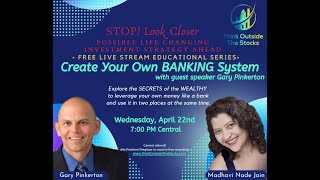
Gary Pinkerton explains how high cash-value whole life insurance can work as a banking strategy outside stocks. You can borrow against the policy to fund investments while your cash keeps compounding inside, get tax-free growth and dividends, and pass it tax-free to heirs.
Questions this video answers
May 3, 2020
Host: Madhavi Nade Jain (Think Outside the Stocks). Guest speaker: Gary Pinkerton (Paradigm Life).
Chapters
So we have this for folks who couldn't join us today. Welcome everyone. My name is Madhvi Nadesh Jain. I'm your host today and I'm the president and wealth strategist at Think Outside the Stocks. Today's topic is how to create outside the stocks banking system. This is one kind of system that I looked at and it was mind blowing to understand this and I started helping people recently with that. And Gary, here is our guest speaker, Gary Pinkerton from Paradigm Live.
Hi everyone. Hello. Nice to be here.
Thank you, Gary. Before we go in, a little disclaimer from our side. This is this presentation today is information provided for educational purpose only. We are not legal advisors, we are not CPAs. So please do seek the help that you need from your presentation. We are also giving these numbers which are just examples only. So please keep that in mind. Just general housekeeping. This is a one hour livestream and we will try to stay within the timeline but we understand that you will have number of questions and we are here to address that. All the participants are on mute for the duration of the livestream. If you have any questions, please do ask in Q and A, not in the chat box but in Q and A. We are going to address that at the end of the meeting. So just introductions about your host. Madhavi, it's me. I'm the president and wealth strategist at Think Outside the Stocks. It's a commercial real estate based company investment company and we also help in creating your own banking system. It's focused on mostly education and investments. I come from a strong IT background, 17 years plus in IT industry, mostly in project management with Deloitte Consulting. And I had to put a hard stop to my career about five years back and that's when I started looking into passive investment strategies and I started coming across a lot of them which was very different information that I typically had. And that became my passion to share with people to come bring this to light to community around me who hasn't been exposed to these kind of investments and just connecting them with the right resources. So that's basically my passion now. And in my real estate journey we have a portfolio of single family, Airbnb and also multifamily investments. So the big why that we talk about in Think outside the stocks, the big why the dream of America is now becoming reaching the financial freedom. And we have been talking about thinking about living the life of choices and not financial responsibilities. So just getting you closer to that dream day by day is what our purpose is to Keep that purpose in mind. We have investment objective. We look at investments which provide us above average growth. They have a little bit lower market volatility. They're truly diversified. They minimize your tax liability and you can take that money that you have saved and put it to your saving again and invest it. And these are truly passive because we understand that you are busy professionals. So we want to bring in the truly passive opportunities to you. Today's focus is we are trying to solve a problem. The problem about diversification. You know how we are limited availability to diversify our investments outside the stock market. And the typical plans that we have, the 529S or 401K, they have a contribution limit annually. They have limited options to invest into stock market. And they also have tax treatment either on growth or distribution. They have provide inconsistent returns. What we have seen right now, the volatility that we see in the market, it has made it highly inconsistent. And they don't provide any guarantees. The high fees associated with mutual funds and other kind of investments, they also cut into our returns. And if we want to have access to emergency money like the current times, we do not have a great access to it, a faster access to it. We also have limitations on withdrawals. For example, the retirement plans will have a limitation on age or the college savings plan will have restriction on the purpose and the asset protection actually turns out to be very expensive deal. And also the last thing is passing on the tax free wealth to next generation becomes tricky. So this is the problem that we are going to be talking about today. Today we have Gary Pinkerton with us from Paradigm Life. Gary, welcome again. And the great thing about Gary is he's been so gracious to spend his birthday with us today. So happy birthday, Gary.
Thank you, thank you.
Yeah, thank you, thank you. We really appreciate you spending this time with us. So Gary, as we spoke about, he lives in New Jersey and he has been practicing this perpetual wealth strategy since 2011. And the fun fact about Gary is Gary is a nuclear scientist and he actually, you know, he had his crew of 140 sailors on one of the nuclear submarines. Gary, my kids are very interested to know about that experience by the way.
Yeah, it had its moments. It was certainly exciting. It was a tremendous, a tremendous time. I enjoyed it, but love to talk to him about it. Always fun to talk old stories.
Well. And Gary's mission has been to improve lives of many people that he can help with this program of wealth preservation and growth. So Gary, I'm going to hand it over to you from here. If you want to go ahead and share your screen, let me just stop my share.
Well, everyone, thanks again for joining us and Mavi for inviting me to come over. This is something that you will soon. You'll quickly see, you'll feel it come through the computer screen. I think my passion to helping other people's other people find this path, and it's not just about the creating your banking system. It's about enabling the life that we can live. What I say, what I call your unique genius. Like, each of us has something that we would do if we didn't have to worry about financing our life. And Mahavi put it very, very succinctly there at the beginning, that what all of us in our circle are trying to do is help people find that path. And I do exactly what you do. For about 11 years, I've been investing in rental properties, both passively and direct ownership. I've been operating my own business. All of this after 26, almost 30 years as a W2 employee for the US government. I enjoyed that time, but I was never in control of my time. And I didn't have anybody providing financial guidance on how to get myself in a situation where I was in control of my time and my money. So I think it's important to know who's talking to you.
Right?
And we talked a little bit about that. So I won't go too far into it. I'll go way back, though. This goes back almost 50 years. I grew up on a dairy farm in southern Illinois. I learned a lot about work ethic. And I also had hair and I love cars. So you know a little bit about me now at this point. But the reason I bring this up is because where I grew up, everyone was an entrepreneur. There weren't. There were not Walmarts, there were not Lowe's and Home Depot stores, large commercial grocery stores, right? If you needed something and you didn't personally produce it, or the little guy who ran the small store in town didn't have it, somebody started a business to produce it. My dad and I started five different large businesses while I was in grade school and high school. And it was all because somebody in the community needed something. And all of our neighbors were doing that. And if you think back 250 years ago in this great country, that's what it was like. Our founding fathers and a lot of other people took some risks to come out to a wilderness and fight for survival, to create a country where they didn't have to live under oppression. And where when somebody took the effort and this blood, sweat, and tears to create something like their own business or their own product, they were able to keep it. Right. There's a rule of law that enabled you to do that. We kind of got lost in the Industrial revolution here in America, and then we got kind of dazzled by the bright lights of Wall street, and we got a little bit off track. And I don't think you'll find many entrepreneurs out there that are on those paths. Right. And they still exist. And you all are those types of people that want to have your money in a little bit different approach, and you want to go back kind of to the basics. And so that's what I knew as a child. But I'll tell you, I kind of forgot it a lot. I got distracted, because what happened was I was. We had our farm in the 1980s, and interest rates in America were 18% on the loans on our farm and eventually got the best of us, and we essentially were foreclosed. And I was living in a trailer on borrowed land, on our family's land, when it was time to graduate high school. And thankfully, I'd studied really hard because in the background, I wanted to be successful, and I wanted to have different options. And so I found the only place that would take me for free, and it was the United States Naval Academy. And these are my parents sending me off to the place. And then I chose, for many, many years, a W2 job that helped provide some financial security. And that was amazing. And like I said, commanding the submarine was one of the most amazing things I've ever done in my life, and I never would regret that. Near the end, though, I started to realize a few things. I started to think back to times like this and realized that one of the most amazing gifts we have is time with our children. It is time to be able to teach the future generations, the next generations, those lessons. And I thought back to, yes, there was a lot of poverty, there was a lot of stress in our household about how we were going to make our bills and keep our home. But there was also some tremendous times where my father was teaching me things about life, things about how to be successful, how to treat other people, and certainly work ethics. So I started to think about that. That I'm going away from my family for lots of time and many, many months on end, all to chase money so that my family would have material wealth. Not recognizing and starting to reflect on the fact that what I really need to do is pass to my children lessons That I learned, you know, sitting on my father's shoulders as a six or seven year old. So I made a change. And I also realized in that journey that I was a very patriotic person. Right. There's a lot of patriotic people and that's kind of why I was drawn in the military. But I also realized is that what I was really patriotic about is the idea of freedom, the idea of entrepreneurship. The ability to control your own financial future and your own family's future. Right. So that freedom, that financial freedom is really about getting back time to do what you want to do and putting tools in place to enable you to do that. So like Madhvi said at the beginning, that's what we're here to do. And I changed my life. I quit a pretty successful career, or I ended a pretty successful career early to go back and chase my real dream, which was helping other people achieve entrepreneurship. So what drives me is putting in place those things that enable you to achieve your financial freedom. And the thing that will destroy wealth or that will destroy your ability to hold on to money for not just throughout your own life, but also multiple generations is really two things. Number one is taxes. That's across the globe. The biggest thing that destroys wealth. And then the second is our own family. And I don't mean to be rude there, obviously I love my family, we just talked about this. And I love the idea of, of you being able to help your children and grandchildren prosper. I'm talking about not taking the time to educate our children and not putting in place tools that they can use to be successful. So you may recognize some of these gentlemen up here. So this is Cornelius Vanderbilt. At his time in the mid to late 1800s, he was the wealthiest man on earth. About 30 years ago there was a reunion of the Vanderbilt family at Vanderbilt University and there were no millionaires yet he was the wealthiest guy out there. His family lavishly spent money in the early 1900s. Lavishly. Mr. Carnegie, right, Carnegie was, you know, exceeded the wealth of Vanderbilt, had all of the steel mills, wildly wealthy individual. And he took a little bit different approach. And I'll talk about that in a second. And then Mr. Rockefeller and he then eclipsed all of these guys. So these were the three wealthiest individuals for about a hundred year period of time. And how did they end up? Well, oh, sorry, now I'm down here with Mr. Marriott and I'm sorry, Mr. Hilton and his famous granddaughter Paris. And this is just kind of a visual example. She's actually got a very successful business, clothing line now, but she was a little touch and go for a few years, I think you would agree. So taxes and family. The only descendants of Carnegie Vanderbilt that any of us I think know of is Mr. Hoover. And then of the others, I don't know any Carnegie's, but yet most of us probably are familiar with the Rockefeller center and the six generations of a very, very gracious, grateful, I guess I would say philanthropic charity that gives out hundreds of millions of dollars a year and puts on lots of large events. So six generations and so what's the difference? Well, it's interesting because Mr. Carnegie, who created most of the libraries in the US, the public library system in America and gave away lots of money, started one of the, you know, he became like the original individual to give away a tremendous amount of money in America. And he had this phrase that he who dies rich, dies disgraced. And I think that he had a good point, but I think he missed it because I believe that since then, for over 100 years, the Rockefeller family has shown that you can do both. You can teach multiple generations how to protect money from taxes and how to educate the next generation so that they can also do good in this world. I think you can have both, really, is what I'm saying. And a lot of wealthy families out there today would say the same thing. And I think it's possible to bring that same concept of teaching prudent financial education to children and doing good, teaching them how to do good in the world and propagating that goodness. I think we can take it down to my world, my financial sphere, which is the middle class of America. I can teach it to people like me. That's really what my goal is. So a few free things for attending here today. I participated in a book with Kyle Wilson and 30 other 30 just really amazing authors, a professional baseball pitcher and several other people that I think you would recognize and know. Great book. And I can get you a copy of that by just visiting here. And Madhvi will also have all the contact information. I did a little ebook that is called Perpetual wealth and it is specifically on this idea of infinite banking. A pretty short little book. And then this book, Heads I Win tells you Lose, is by my mentor and the CEO of Paradigm Life, Patrick Donahoe. The reason I point this out at this moment is because I want to talk just a moment about our approach to growing family wealth and setting up your financial life to be stable enough to go through periods like we've just seen here in these last couple of months. And we call It a hierarchy of wealth. And really it's just Maslow's hierarchy of needs adapted for specifically your financial life. And I use it every day with clients. I use it every year when I revisit with my clients or every six months to talk about changes they've made, what they're considering doing. And we put things in these different tiers of the pyramid. So our pyramid, kind of the premise here is that as you go up in the tiers, you go from a level that we'll talk about in a moment is a foundational level. And that's really the only one that's required to be there if you don't mind working every day for the rest of your life when you need money. And I'm not trying to say that negatively, a lot of people choose that path. Then there's a direct investing level and indirect investing level and a speculation level. And the difference in what causes things to go on these levels is, is a relationship between risk and how much control you have. So actually, it's not about the asset class. Everyone's going to think that I'm going to put the stock market up here, and actually I do put a picture of the stock market there, but not for that reason. It could be rental houses, it could be an apartment building here and this level. And in this level, it's about your involvement with the asset. And I'll talk about, I'll get into that here. So direct investing, that's things that you directly control, you have all control over. You have full insight into what's happening. And as a result, the risk is going to be far lower. So the number one asset we all invest in is us, right? We can have fabulous businesses, we can make great investment decisions, we can get a hot stock tip. But none of those things are going to compare to investing in ourselves and going out and adding value to the world. It brings ultimate security for our family. Listen, if you do things that are always wanted by other people, regardless of economic conditions, you're never going to be at risk. I don't care if your bank account's empty. I don't care if you just went through bankruptcy. If you have the about the ability to do something or make something that everybody else wants, then you're always valuable to the world and you will always be secure. Your family will be secure. And you know, Warren Buffett's Bill Gates, Facebook, you can take any company that's created as you understand, and it's created. And the original value came from the individuals, their ideas. Yes, there was a business. Yes, that business helped propagate things when the individual was not around, but it was the individual that created it. So certainly the most important thing ever to invest a dollar into. You can also directly own a business, right? You can directly own rental properties, you can directly own other kinds of assets. And when you do that, you make the decisions. You're always in the know about what is happening. There's one level that most of us busy professionals and probably everyone on this talk, including myself and Mavi, are in that group. And that is a group that recognizes that our income is a really important thing to our family. And it's a high enough income that it causes us probably to spend quite a bit of time focused on that to keep it working and to keep accelerating it. And so that is where our time is best spent. It's not best spent on managing tenants and managing other things like that. And so for often, from time to time, at least, and often in my case, I invest my money with other people that I have vetted out that I know to be ethical and that I'm facing here on this camera right now. And so you find out who you can trust and you learn how to vet their deals, and then you participate in that as a contributing financial partner, but not as an involved partner, right? So most of you understand indirect investing, but that's a level where you're giving up a little bit of control, which is why it's really important to know the person you're investing with, right? And then there's a level higher than that. And that level, okay, I put the stock market here, but it could be an apartment building. It could be a hedge fund or a mutual fund that buys apartment buildings. The one right next door to the apartment building that you're invested with, you know, with think outside the stocks, right? It could be the same neighborhood. Everything could be the same. It's just your involvement is different. So I point this out and I take some time to do that because I invite all of you to. To take a look at your own picture and kind of, where are the bricks in your picture? And this is a filter for investments that I really recommend you just kind of run your life through. Like, where is all of my stuff? If you're like most of America, you've got a 401k and an IRA and maybe some hot stock tips that you have in a brokerage account up here and very little savings and very little anything in the middle, right? And I know, I know most of you are not those people because you've met Mavi and you're either here already or you're looking to get here into some indirect and maybe direct investing. So what I talk about what my day job is, I participate in Tier 2 and Tier 3 heavily, personally, with my own family, and I provide connections like introducing people to Mavi that are interested in operating in those two levels. But my day job is tier one. It's foundational. So if you're going to go build one of these pyramids of Giza, right, and pyramids in Egypt, it's likely important that you spend a lot of time putting really good, solid bricks in the foundation. And again, if you have the foundation, if you have this poor little pyramid that never got finished, it's still a pretty successful pyramid as far as it made it. Right. It's pretty stable where it sits. So what do we put in the foundation? Like, what do we store down there? Well, the foundation is really about savings and protection, and I'll get into that in just a few seconds. But if we're going to put all of our family's savings in this foundation, four hard times like we've all just gone through here, let me tell you that in 2008 and 9, all my money was in the stock markets and I got beaten up royally, like 70% losses. And some of it came back. But it was this galvanizing moment for me where I realized that if given the opportunity, I abdicate all my responsibility and I give. I just stop paying attention to my own investments. So I wanted to take back a little bit more control. But it was more than that. Like, I. I can remember wondering what happens if the markets go down and they don't come back and I lose my job? And I kind of felt like a lot of people are feeling today in this correction. And this is not intended to be bragging at all. You know, two months ago, I happened to be in my life building up cash inside my life insurance policies to get ready for a few investments. I walked into March and April with a lot more money than I normally have sitting liquid in my savings. And I have a couple million dollars of protection and death benefit protection that, had I not created my foundation of the pyramid that way, just wouldn't be there. It just. I would not have thought to spend that much time on the protection side had I not been using it as my savings vehicle. And the reason I bring this up is because I learned in these last two months that there's an amazing thing that happens. And I finally get that overused phrase that China, the word challenge also means opportunity. I finally get that. Because if your mind is in the right place, when times of challenge come around and most people are feeling fear about, what if my employer doesn't bring me back? What if this small amount of cash that I happen to have is not enough to cover when the tenants don't pay or when, you know, my income doesn't come in? If you're not in a situation where that brings fear, all of a sudden, the landscape is just a huge field of opportunity. And it's been very empowering for me to be able to surge forward with my business, to be able to think about the next few years, and to hopefully, maybe even find some opportunities with real estate. So I get it now. Challenge and opportunity, they're the same thing, but they're enabled by you being able to have a clear mind. And you only have a clear mind if you're not afraid. Because we are still primal animals, and when shaken with fear, we don't think. And so I learned in the last couple of months, one of the biggest things I've learned is that having savings and protection, having a big foundation enables you to sail right through those kinds of environments. So when we're going to store money like that, where do we store it? Well, there's basically three places in life. There's pre tax money. I call that Congress's playground. Why do I call it that? Well, Congress has control of basically one asset, right? They can tax people, but that's a delayed way of bringing in money. They have control of retirement accounts. And it just so happens that almost all of America's wealth, hundreds of trillions of dollars, is in the retirement accounts. And so when we do things like do a tax deduction, under Clinton's era, we do a tax deduction, or a tax break. Under Reagan's era, we do a tax break. Under President Trump's era, we have to pay for those things somehow. And there's only one place that Congress can go to pay for that. It's like the famous bank robber, Willie Sutton. And I'm sorry if you've already kind of been told this story, but when Willie Sutton was tried and convicted, he was allowed to. You know, they had him talk at a little bit of a press conference, and someone asked him, a reporter asked him, why do you rob the banks? And Willie said, because that's where the money is. Right? And so I would say that that is why this is Congress's playground, is the only option they have today to get money to Pay for tax deductions, tax breaks and things like that. The next is post tax or after tax money. This is savings and checking and brokerage accounts. Right. So the only thing that you get taxed on there is the growth of the money and then there's tax free. And for me, tax free is life insurance. It could be today under current rules, it could be Roth accounts. Roth accounts are limited on access and they're also under the purview of Congress and subject to change. And we talk all the time about, you know, for example, for eight years before Mr. Trump it was, hey, you make too much money and if you're wealthy, we're going to take away the tax deduction that we had always kind of promised would be there. So I don't trust that Roths are going to be in this bucket forever. And so I don't put them in that bucket. So my question at the top was, what if you needed $80,000 to live on? If you take it out of the bucket on the left you have about 50, $55,000 based on your tax rate left over after you pay the taxes on it. In the middle you've gotten more than that because it's capital gains and you're only getting taxed on the profits. But on the right hand side you have all of the money. And so there's this idea that you should put your money in pre tax accounts while you're in your earning years and higher taxes and you're going to be in a lower tax rate when you retire. Your advisor in that situation just said, I'm going to help you be poor in retirement so you're not making any money and supposedly you'd be in a lower tax bracket. I would far rather pay the taxes today when I have an income to support making those payments. And then when I need to turn on a spigot, turn on a faucet to get money. When I'm retired and don't have money coming in, I'd rather be able to spend everything I take out, right? The money will last much longer. So I think you would agree with me if you had your choice and you could start over today. You put your money in a tax free bucket and I help people every day move money from the pre tax to the tax free buckets. So then I went and looked at, hey, there's different places where you can store your emergency money, right? You can store the foundation, different fashions. Probably the most popular is just a savings account because for 100 years in America they've been pretty safe. You can put them in IRAs and qualified accounts, and, you know, you could lose that money. People have learned that here the last couple of weeks. You can put it in your home equity as long as somebody will give you a loan to let you get it back out. You could put it in stocks again, it could be at risk, or you could put it in life insurance. And when I looked at how safe is the money, how liquid is the money, what rates of return would come, and then what is the tax benefits of it, there was one that scaled through all of those tests. And so I started thinking, hey, this is more than just a unique way to fund my real estate. And I'll show you how that works, too. It's more than that. It's a better way to build a foundation for my family's pyramid. So there are many, many great people out there doing tremendous services. Dave Ramsey is an example. Suze Orman's an example. They're helping people who have found themselves in a situation where compounding interest from credit cards are eating them alive. And they help them get back to a situation world. It's probably not really any of you in this situation, but if there is somebody there who's struggling with lots of credit cards, absolutely. I help people get clear of that every day. But who I like to work with is someone who's ready for the graduate course. And the graduate course is, okay, we know compound interest is powerful, and we know how to keep it from working against us. How about we learn how to make it work for us? And so now what we're talking about is a situation where instead of just, you know, building up money and spending it, building up some more and then spending it when you've saved it, you can do the same thing, but use somebody else's money during that period. And when you pay them back, you realize something unique happened. My money in the background continued to grow while I access the value of it by borrowing it from an insurance company. And the next time it gets better. And it's a mirror image of debt working against you, or, excuse me, compounding interest working against you. So, you know, here's a picture version of it. And what this is is saving $1,000 a month for 30 years, and it turns into a million dollars if you don't interrupt it. But if you interrupt it, meaning that you save it for four or five years, you spend the money, you save it for another car, and you spend the money, and you save it again and you spend it. Right? Or an investment in a rental property. And every time that you go back down here, you're resetting that compound interest clock to become the first five years. And it's not exciting the first five years. Right. It's a pretty flat curve out here. It gets exciting. We have to figure out a way in which to operate our family's lives in a situation where we don't have to permanently interrupt or frequently interrupt. Compounding. Mavi, you were telling me a great story about when this picture spoke to you at some point. You remember that conversation?
Yes. And, you know, this was the interesting part when I came across using your life insurance and compounding your own money inside with two principles. Right. That the money stays inside for longer time. So the number of years, it's advantage and it's accruing that interest continuously. And then there was the second part, which talked about that. Okay, so when it's time for you to buy a car or do a down payment to the house, borrow that money from the insurance company, not from your own policy. And my question was that why would I borrow from somebody else and pay that interest to somebody else? And when I looked at these numbers, and this is exactly when I say that, the numbers don't lie. So if you're borrowing, for example, 50,000 for 25 years at the interest of 6%, you're paying it down. So your actual principal is going down. And that's why if you're paying the interest in this slide, you can see it's about 46,000. But if you are actually earning interest in a compounded fashion on the same 50,000, this is that hockey puck chart which exponentially grows after the initial year. So in 25 years, that same 50,000. Because now your capital is increasing with the compound interest, the total interest is about 164,000. And it's incredible to see that, that how we can borrow from somebody else and still grow our money without having that break.
Yeah. Thank you. So this provides a really, you know, kind of in your face, large numbers that are compelling, and it's a great picture. And I think that you may have some questions about. Okay, Gary, go over that again. Go over that slower. Right. I'm going to show you an actual investing in an apartment building example that does this for you. And it shows you side by side using this approach or using cash. And I believe it paints as good or maybe a little bit better picture, but it goes through it a little bit slower than just showing it to you in one picture here. So write down, certainly jot down Your question in the Q and A there, if you have one about this, but we will go through it again and it may actually end up answering it. So it's important that we understand what we're talking about. The concept of infinite banking is storing cash in a high cash value life insurance policy, uniquely designed policy, and then you use that cash specifically. To be more accurate, you're not using your own cash, you're borrowing money from the insurance company and you're actually pledging yours as collateral. And so what you're doing is this net cash value is what's available still to borrow what has not been pledged. So I build up a little bit of cash inside my own personal banking system and it's growing at 4, maybe 5% with no taxes. I'll show you an actual example in a moment. And then you can borrow against it by taking a loan and you can buy. Okay, this is the doodad chart if you're familiar with Robert Kiyosaki. Right. So these are things that don't provide cash flow. I mean, this one will. If it, I mean, if it's your kids college, maybe it doesn't provide you cash flow, but if it's your own education, then maybe you get a direct cash flow out of it. Right. And this could be a business car. So I'll give it benefit of the doubt. For me, it wouldn't be, it would be a toy that I would play with. But then we find the cash flow from our life to kind of repay it. This is not my recommendation and I try to steer my clients clear of using their loans first for what I call doodads. Right. What I like them to use it for are types of investments. So maybe you buy a rental house, maybe you start a business, maybe you're doing some investing here in the different tiers and you can borrow against the policy, which would bring down the net cash value because you've used the value of some of it. And then I use the cash from these things to repay the loan, specifically use the cash flow from them as that tool to repay. So that's a little bit easier to learn how to do than finding extra cash in a busy life or in a chat, you know, in a tight budget to kind of repay over here. But even in this situation over here, if you buy a car and empty your checking account, then you're going to have to repay to refill your checking account too, if that makes sense. We'll go over a little bit more of that. So there's some key aspects of this thing. And again, I won't go too deep into this. This is the kind of thing that I go into in real good detail in a first one on one meeting. But it's important to know that don't just go ask anybody to do this for you. And the reason is because you have to have one structured so that you can contribute as much cash as possible into the policy. And Madhvi and I have had an opportunity to design a few together. And it's real essential and it's very easy to mess it up and not actually have it optimized as well. You want something that minimizes expenses, minimizes charges that are going to drain on the life insurance policy. You've got to have access to the money, right? Unlimited access to do with what you want. And then you need to be able to both reinvest the profits there, but but also be able to borrow money from insurance company, not have it put yours on the sideline. Some of you might be familiar with something called universal life insurance that actually puts the money kind of on the sideline and it does not have this internal compounding. So it's important to design it, right? Was really the point of that. If you are familiar with permanent whole life insurance, you might have some resistance to this, or you may have heard other people say that there's things, say things like your money's not that accessible. It takes a few years before you have access to all of your money, or there's high fees, or you're kind of locked into really high payments every year. And it's not flexible. And that's something that, it's a wonderful product. But it's the thing that was created in the 1800s called basic or ordinary whole life insurance. And that's the picture on the left. And what we do is we take something that's very heavily focused on life insurance or death benefit and we reposition it to the right hand side to be something that's much more focused on cash. The money's liquid and accessible and flexible for you to operate. And it still stays within that upper red IRS limit shown in this picture. And again in just a moment, I'll show you some actual numbers for an individual that I think will help put this into more perspective. Here it is. Yeah.
Just before we go back to the slide. So just for everyone to understand, the purpose here is to build that maximum cash value. So this, this, you know, there is two purposes with the life insurance, right? One is that completely the death benefit, the life insurance. But here the strategy is to build that maximum cash value. So you are, from the day one, when you're structuring this, you're structuring it in the right way. Right, Gary?
Mm. Absolutely. And these are even so, you know, the green section here, paid up additions. This is an option, or a rider, they call it, that you can put on your normal original policy. And that money is very liquid and it's very flexible on whether you contribute. You can do it one year and not the next year. And, you know, and kind of be very flexible in here with whatever your business or your family's cash flow supports. I'm showing like two thirds of the money going up here. I frequently. Not 67%, but typically 80 or more percent of the money is going up here because that goes back to the previous slide where we said, make it as efficient as possible and put as much cash in this position as you can and as little down here. Now, this is not wasted money on insurance. It does kind of say that here. But this money contributes to cash value just like the green does in the first couple years. It's very limited on its access, and that's why we focus up here. Very good point, Mavi. So here's a quick example. So kind of a middle person. This is probably one of the individuals that I work very frequently with. He's a male and in his 40s or 40 years old, excuse me. He wants to contribute $20,000 a year. He's making 150,000. He wants to put something like 15% of his money away every year. He wants to have a very small minimum and a very much 20,000 is the maximum. But he wants a much smaller minimum than that in case he has to not contribute the same amount every year. He's going to contribute for 24 years, and then after 30 years, we'll see the results of it and maybe he'll start withdrawing money to live on. I assumed he had a. He was in a 24% tax bracket and he had some hefty state taxes and then so 35% combined. And his insurance, he has a guaranteed component and he has profits or dividends that we're paying out as well. Just kind of typical numbers for what you would see today. Okay, so lots of numbers on this chart. I put green boxes around things to kind of key you into probably what's appropriate to talk about today. And really, I would say if you look at his contribution here, the minimum for this gentleman's contribution is about half of this one. So this was not quite as efficient As I would, I would make it. But it's kind of a middle of the road one, not optimized, but nice. And so he needs to contribute about 10,000 to this, 5,000 going to that blue minimum part. And all the rest is going into the green part. That is more liquid at end the. The very beginning. If you look over here at the cash value, so this is what the insurance company would project, very conservatively, would be available to use for your investment. Right? So this gentleman did not do a really large amount the first year. He did the same amount every year. And he has, you know, a decent portion of it available in the first year. And calling out a couple of other examples like it shows here on the side, by year six, in this example, he's got more available to use than he has contributed over the entire time. So he starts off with 70 or so percent here, has about the same amount here, a little bit more. But by year six, the limited access that he sees with part of it here is all back to him. And then every year it's growing substantially. So if you look here, if I do the math right, I think this is $300,000 worth of money here. If he contributed like this, and it's showing that there should be 435,000 plus, he's had all of this life insurance this entire time. And the life insurance is covered within this performance. It was already kind of covered by this. So that I'll let you start the numbers a little bit. You can take a picture of the screen or something. But this just gives you not really that optimized, but just a ballpark kind of, you know, average example of how we optimize these for more cash. Okay, so summarizing that a little bit, if we put it into a calculator. So this is the contribution, this is the cash, and this is the insurance, basically what I just showed you on the other page, but it shows you an internal rate of return. So this is basically what you would have to do in a savings account every year for 30 years to be able to come up with the same amount of money in the end. So if you think about 5.37 and all of the insurance already incorporated in that, it's a crazy thing to think about this being a savings account. Right. So just going back to this for a moment, if you have, you know, I'm saying that this insurance policy, this pretty generic insurance policy can grow without taxes. It can grow with no kinds of, no management fees or anything. And to have this amount of money after making those contributions, it would had to have done this in a savings account every year. But in a real savings account, of course there's taxes, right? And for this gentleman, a decent tax rate for his, you know, his 1099 interest he gets every year from the savings account. So you'd have to get 8.26% to pay the taxes and end up with that money. And obviously we're not going to get that in the savings account today. Right? So then he would find himself saying, well, I gotta get higher returns somehow. So he would probably go to an managed investment account. And ignoring the fact that that exposes the money to loss, he's now got both the taxes and the management fee. And now he's having to do 10.14% for 30 years with no down years. Right? That's never happened. As great as the tax stock market's been, it certainly have not done that for 10.14 for 30 years. And the other thing I want to bring you back to is we're talking about savings and protection. We're talking about using an insurance policy to emulate something, a savings vehicle where there is no risk of loss of the money. Right. Clearly there's risks down here. And clearly I'm not going to get this in the savings account. So this is not really intended to be an investment. I really shouldn't have compared it to a managed investment account, but I wanted to show you the power, what would have to be done and then pay for some term insurance as well to be able to have what this brings as a savings foundation down here. So now let's talk about the investing level. Right? Let's talk about, okay, we got money now what do we do with it? Well, Mavi sends you an email and says, hey, we have a great opportunity. Now, I'm not sure she would design one this way, but this happens to help my math out. So you just have to go with me. So this one's going to be a 15 year hold. That's not really that popular nowadays. But this is a 15 year hold. These are $5 million buildings. And I just picked these buildings out of pictures. I have no idea if they would really be 5 million. I don't know what city they're in either. But in my world, these are $5 million buildings. And I'm offering for a 15 year hold. I'm offering a 9.5% pref. Now, I'm not offering any equity here. And I just got one the other day that was a 9% pref with no equity. So this isn't that far off. But they didn't say I had to hold it for 15 years either. So I'm just, I'm kind of playing you a little bit here. So this is a 15 year hold, 9.5% investor return. And we're gonna, like I said, we're gonna hold it for 15 years. So we're gonna go and I have a line at a, at a commercial bank and I'm gonna get a 20 year commercial loan, $4 million, amortize it out, I'm good to go. And my question to you is, if you want to contribute your hundred thousand dollars, which way should you do it? You can just take the money out of your checking account, or you could use money that you have stored in your wealth maximization account or your life insurance policy, that foundation that you have down there. And. Okay, so let's look through the two options. So let's say you do the cash buy, right? So you have, you have $100,000 sitting in your checking account and you withdraw. You empty your account down here into the, into the limited partnership. And then as you know, part of my deal is that I'm going to pay you nine and a half percent preferred return. And so every month that means that I'm going to pay you $791.79. And when you get that back, you refill your tank with it, right? You refill your checking account with it. Your checking account was earning 1%, by the way. Pretty solid checking account, but you have taxes and I only have you in a 25% bracket. So you're actually making 0.75% every, every year on your account up here. Okay, so there's another option, but in this option, at the end of the 180 months or 15 years, I give back your $100,000. Okay, let's look at the other option. The other option is you had your hundred thousand dollars sitting in the life insurance policy earning 4.5%. And it was compounding uninterrupted. And instead of taking it out, you go to the insurance company, you say, hey, I would like to borrow your money and I'll pay you 5% for your money. And I want mine to just sit up here and grow. Now this is a point where a lot of people will say, Gary, 4.5% earning, why would I borrow at 5? And this gets back to what Mahadvi said, right? And I was the same way when I first looked at this. This doesn't make sense. Why would I do this right? Well, let's play it out and let's see why we would do it. It's compounding interest, right? This is the key. So if you choose this path, then the 791.79, you just use that to repay the insurance company. You just make that payment and it turns out, well, okay. And then you get back your $100,000 to when we're done. Right. So now why is $100,000 going back to us? Well, because this is a 15 year loan. I borrowed 100,000 from them. But this payment is principal and interest back to them. So after the 15 years, they have their 100,000 back. This deal is done. Right. So to be more clear on this side, after 15 years, I've, you know, I make 180 payments, 180 payments back up here. Over here, I've made 180 payments to the insurance company. And it just so turns out I designed it this way. But it just so turns out that $100,000 borrowed at 5%, 180 payments is that payment. So I wanted to make the money equal. So this guy's dumping it in his savings account or checking account, and this guy is paying off the insurance company. He's not putting anything back into his policy. His policy is just sitting here growing. Well, what happens? Well, on the left hand side, these payments growing at 3/4 of 1% is $150,000, 156,009. And you get your 100 back. So you have $250,000. Not a bad investment. Not bad. I'd take that today. Right. And then here's what happens on the other side though. I didn't touch my money. So what happens on my side is that $100,000 grows at 4.5% with no taxes. This is the power of the compounding that visual picture that Madhavi talked about a couple minutes ago, it turns into $196,000. And when I get my 100 back, I'm at 296, not 250. So 115% growth. And that's if all you're using the foundation for is this one investment. Right, but we're not doing that. I'm helping you set up your pyramid so that you also have your family's emergency money. There's you got your reserves for your other properties down there and you have opportunity dollars for the next investment. Right. We're not doing one investment 15 years, so there's going to be other money there. So what would happen if you were also storing just 50,000 emergency money in there as well. Right. Well, over here, you. You had 50,000, and I have no idea why I gave it 1.5% interest rate. I think I hooked this guy up. He shouldn't have gotten that kind of a return. Okay, we'll pretend this is a lower number. So he has about $300,000. But over here, the 50,000 was growing sitting in this same account. Right? Growing, no taxes. So it just amplifies the difference between the two when you've got other cash sitting in your personal banking system. So that hopefully maybe I went too fast through the numbers, but hopefully not too fast. And please ask me to go back and go over it again in the Q and A if that was too fast. But I wanted to break it down and do side by side so you could start to wrap your mind around that picture you saw, which was the hockey stick growth of not interrupting compound interest. So, Madhvi, over to you.
Thanks, Gary. That was perfect. I mean, to start with, I think a lot of us, the middle class, the way we are thinking about money is we are spending enough time just earning that money and putting into different kind of investment vehicles, but we are not looking at the bigger picture. So love that pyramid that you put together, which kind of gives you that, you know, just a food for thought. Just think about it from that bigger perspective, kind of a, you know, higher level perspective in terms of your family, what you're passing to your generations, and, you know, how you're gonna start thinking about putting all these pieces together. So that was great. And just using this life insurance again, as you said, as a savings vehicle. Right. And there is that guaranteed portion in there, the 3.5% that you're talking about. Different companies have different things, but that 3.5 is guaranteed. I don't think anybody guarantees anything. Right, Gary?
Nobody guarantees anything outside of the insurance companies. I mean, I agree with respect to saving money. Yeah, yeah.
And then with that guarantees, I mean, it's a. If you look at it, this is a savings vehicle. If you're putting that money in the bank, it's not going to be earning even like around a 1% or something these days. Nobody is even giving that. So that 3.5% guaranteed, which includes the cost of the insurance that's paid, been taken care of, and at any point, it's not considering, you know, the value that's been generated and plus the dividends on top of it. So what was interesting, Gary, what I put together, if you would like to stop the share.
Yeah. You know, one of the things, Madhvi, when you're bringing that up is I completely forgot to tie in my pictures of the three old guys from the 1800s and the early 1900s. But my point about Rockefeller and the six generations is that he recognized he was starting kind of his foundation and starting the second generation with his son around 1913 when the Federal Reserve and the US tax code was starting up. And he recognized what that was going to do to wealth. And the whole purpose of bringing it into the US was to kind of get rid of debt dynasties. And so he worked very hard to create trusts and life insurance inside those trusts. And essentially for six generations, his family has operated one trust, a charity driven trust, but it purchases life insurance on all the family members. And so, you know, I didn't tie that together. That yes, taxes is the 1 wealth destroyer. But the way to prevent that from happening is investing in tax favored assets, like real estate, coupled with doing so from a cash savings foundation that's tax free.
Yeah. And that kind of becomes like a family strategy, right. That build down whenever the new member is born. Just pull that in the policy and just go from there. And what's also important that you know, we discuss here. Gary, thanks for bringing that. The illustration about the investment, it was very visual and see that number side by side, very helpful. We can also remember that it's not just about the real estate investment. Right. When you have that savings vehicle for you which is earning you good amount, that 3.5% guaranteed plus the dividends, you can take that as the policy loan as a collateral, and then you can use it in any vehicle that you want. So even if you're doing stocks and you're doing great at it, you could use that money or in cryptocurrency or anything that you really want to do so that you have that improved irr. So this is the most thing that I like about it, but that you can literally use your money at two different places and it's kind of a turbocharging. It's like a rocket ship.
Yeah.
And then I quickly wanted to share the numbers. I'm a very numbers person. Right. So when I looked at it and I'm like, okay, so there is that guaranteed return that you're talking about. So what, you know, what is the history that shows? So I'm just going to look at some of the reference slides here that I have. So this is the history of dividends and this goes back to 1989. But come to Think of it, this insurance agent, carriers, they even go back like 100 years, 150 years. And look at the dividends that they have provided. It's been consistent. And what's interesting is around 2008, 2009, the dividends didn't go down. I mean they just provided that consistent returns. And these are the companies which are good to do your policies with. Right. The Mass Mutual and the Pain Mutual. These are providing that consistent dividend. So even if you have that guaranteed portion 3.5% the dividend has been provided historically. And you know, also in terms of the policy loans though it's a variable, it doesn't change that frequently. For example, Penn Mutual, I just pulled up the rates of the, the loan and you can see that it's just around 5% to you know, maybe 5.75, but it stays around that, that range. That's, that's one of the important aspect to look at. So I, I would encourage you. I mean this, this is a lot of information and that's, this is a lot of new information for all of you. So do you have any questions that we can address here? Please feel free to log in into the Q and A chat and I'm just gonna, you know, just tie it back. How in the picture in my mind is. Right, we talked about that problem. Let me see. I think there is a question is.
There's one in the chat box. Yeah.
Is the interest on the loan tax deductible?
This one makes me smile. So there is. You would think that everything is black and white. I have actually not found anything in the US tax code that is very black and white. I deduct the interest on loans that I use for business purposes, for investment purposes. I have heard of, haven't personally met, but I've heard of CPAs who have told their clients not tax deductible. There's a letter written somewhere in the 90s that it's not part of the tax code, but it's a letter, it's like a clarification letter I guess that said in general loans against life insurance or loans from life insurance policies are not tax. Tax deductible. Seems pretty cut and dry, right? Well, first of all, you're not pulling money out of your life insurance policy with whole life. So I'm not sure they were talking about whole life insurance when they said that. That's more of kind of a universal life way of handling a loan. And then second, you could say that money borrowed from your father in law is in general not tax deductible and that probably would be true too. But I deduct money I've borrowed from my father in law because when you have a CPA who knows what he's doing, he says I don't care where the money came from. The question is, what did you use the money for? So if I borrow from my father in law or borrow from an insurance company or borrow from a bank and it was for an investment or was for a business purpose, that's deductible, then the money is deductible, doesn't matter where it comes from. So I have always deducted mine. I've used four different CPAs so far as I've grown in my, in my portfolio and all of them have set, of course makes complete sense, that's the way we treat it. So hopefully that helps. But in the end you got to go ask a real CPA and if you don't like the answer, you know, get a second opinion. Just like if you were getting a medical procedure done and hopefully that helps.
Yeah, great question by the way. Thank you, Sachin.
Yeah, great question.
Second question, the Q and A. I don't know Gary, if you can see that.
I can, yeah. So should I just read it?
Yeah, let's just go ahead and read it.
So this is permanent whole life insurance. Do you advise going for this one or going for A and index universal life or IUL or variable? Universal life is okay as well. Looking at current market and in coming months market will go down more. Is it the tight or is it the right time to invest in IUL or variable UL at the moment or just going for permanent whole life insurance is the best and safest way. So if you remember, I didn't, I didn't talk about this too heavily, but there are a lot of problems with the universal life insurance. I'll call it chassis. So variable is just a version of universal life. Indexing is a version of universal life. My problem and our problem at Paradigm Life and anyone in the prosperity economics movement and any really long term life insurance agent will tell you that the problem is the ul, the universal life insurance structure and essentially the purpose. Let me go back just a little bit further. The purpose of life insurance is to push the risk to the insurance company who pools that risk among thousands of people your age and you know, age, gender and health. Right? Thousands of people just like you that they're insuring. And so when that one person gets killed at a young age or dies at a young age, it doesn't hurt the insurance company because that risk is pooled, and some people will die a little later than expected as well. But to the individual and their family, it would destroy them. Right. So the idea of life insurance is to push the risk to an insurance company. I mean, it's the same way with car insurance. Hey, you know, if I have an accident, I want you handling this for me. And we're willing to pay premiums to make that happen. Well, universal life insurance is a process of pulling some of that risk back to ourselves. And what I mean by that is you have the ability to adjust the premium that you pay into the insurance. Why is it that universal life insurance can be illustrated to perform better than whole life insurance? Well, it's because you can lower the premium and make an assumption that the performance is better with the indexing or it's better in the market with the variable policies where you're really putting your money in the markets. You can just say, listen, I'm going to assume it's going to perform at 8%, and it looks a lot better than that whole life insurance policy at this moment. But historically, they have not done so. History is that universal life insurance came out in the early 70s. Lawsuits started causing insurance companies to not want to represent that anymore. So they created variables that made it into the 90s and 2000s that got a bad name in a lot of lawsuits. Now we're into indexing. It's starting to get those same kinds. And there's some great articles in the Wall Street Journal and several magazines that talk about that here in the last couple of years, because again, it's now in its season of policies blowing up and having problems with it. I guess my biggest thing is to say that this is the foundation, right? This is a replacement for your savings vehicle. It's a safe tank, a place to store wealth. And the most important aspect of a safe tank is that, no kidding, when you lift the lid of the tank and you look inside, the money is still there. So that's true for savings accounts in America today, and it's true for a safe in your house. You go open the safe in your house and, you know, theoretically, the money's still in there, right? And it's true for whole life insurance. They've never lost a penny for anybody back into the 1800s. I was just as kind of an interesting example. I was meeting with somebody yesterday. She's 37 years old. She's been paying $90 a month into a universal life insurance policy since 1990. And she said, I've got $1,800 cash value. Is that good? And we went and I said, well, $90 a month stored in a metal box in your house would be $11,000, $11,800 right now. And she was really mad at me. You know, she's like, I've only got $1,800. Why is that? Well, fees and costs of universal life insurance are tremendous. And that coupled with the fact that most people under fund them, they don't put enough in because you have the option to pay less into your premiums. That takes away, that pulls back the risk from the insurance company in that if you pay below what we say the target premium is at any point, or you miss a payment, or you're late for a payment, or you borrow too heavily against the policy, then we have the right, you are relieving us of the responsibility of keeping your life insurance policy in place. So I'm in the process, I'm in the, in the business of teaching people how to borrow very heavily against a policy, how to use it heavily. And I don't want something that, you know, making the phone calls that, hey, your life insurance is falling apart because it didn't perform like we thought it would. Again, I want to go back to whole life insurance has never lost a penny for anyone with any of these mutual companies we represent since the 1800s. And, and you know, I care about my reputation and I care about your families, so I don't use universal life markets aside. That's another great point you make. But I wouldn't go there personally.
And Gary, this is one thing that has been important for me as well, because I saw this Iuls and people buying Iuls not realizing how much cost is really going towards that life insurance part of it, and especially towards the later year of the policy, how it just starts eating up the value. And even if there is one year flat or a couple of years flat, which can happen like this year, how it can take that value of the cash value in the policy and start pulling it down. So for me, one of the top reasons I want to start doing this is start telling people that why IUL is not right and there are no guarantees and the whole life, at least the 3.5% is the guaranteed. So there's the safety and the guarantee and IUL does not have that. So that's, that's one of the driving factor for me personally to deter away from the Iuls and bringing the thought and the process to the whole life policies. I hope that answers.
Yeah, Great points. So question this one. I also love this one too. Bless your heart. Rekha, you said if I'm pronouncing that right for someone who is 50 plus now, does it still make sense to have this kind of setup? And I'm smiling because I was just talking to a gentleman who is 60 and he says, I wish I had thought about this in my 50s. And I said, sir, I agree with you, but the people in their 80s say that about their 70s. And I was talking to a gentleman who was 70 and he said if I was only my son's age at 50 when I knew about this, I would be all set. It would be better when. When you were 30, but not that much better. I think you would be really surprised when you design a life insurance policy that's focused on the cash and not the death benefit. See, here's the thing. What causes a life insurance policy to not perform well is when you have a massive amount of life insurance associated with it. And when you de emphasize the life insurance and you emphasize the cash side of things, it really takes the risk away from the insurance company pretty heavily. And that results in not being a big difference if you're maybe not as healthy as you want to be and have the greatest rating or have an age difference. So performance on a healthy 50 year old. I'm 50. I just started the huge policies on myself and my wife and the performance on that was like 4.2%, 4.3% projected performance. The ones I started when I was 40 years old were 4.5%. So I mean, it's just not big difference. If you have a 25 year old child or niece or nephew, then yeah, maybe theirs will project at 5.2, 5.3, something like that. But we're in the 4 to 5% range regardless. As long as we're healthy, reasonably healthy, it's a great, it works great at all ages. Great, great question. And there was one more from Monica. Oh no, Monica just thanked us. Well, thank you Monica.
There are just a couple of questions from my. I mean, I know the answers to it, but I think it will help people online with those questions. So one of them is, you know, we talked about the usage of it, right? We talked about how we can invest using these policies. So what are the other usage of this particular vehicle in terms of, you know, replacing or 401 or 529? Would, would you be able to discuss that a little bit?
So I was reading Kavitha's question and so the other possible Uses of this as comparing it to like a 401k or other kind of investment or how could we use this other than just real estate? Was that really, was that your question?
Yeah.
Yeah.
Okay.
So, you know, again, this is a liquid source of cash. So if you, you know, if you think, what can I use the money that I have sitting in my savings account for? It's pretty wide open, right? And it's the same for this. So I have, I have used this to remodel my primary residence. I've used it to purchase vehicles, used it to take my family on a memorable around the world trip. My clients have used it to fund education. I'm using it to fund my son's education. It's a tremendous replacement, by the way, for 529 plans. 529 plans. I have a lot of problems with 529 plans. Having grown money in them for many years, getting ready for my kids to go to college. One thing is I got to make sure I actually spend it all on college. One of them has a scholarship and I may, I have to be very careful. Then I'd end up with money that I'm going to be penalized to use when my kids don't need it for college. The other thing is that we call it college savings. And one of my fundamental things that I try to teach my clients is that you cannot save money in the stock market, which goes back to kind of variable universal life insurance. You cannot save money in the stock markets. I learned this when I was 13 years old, 14 years old. We're at risk of being foreclosed on. Our farm, we tried to get it sold. This beautiful young family that we just fell in love with, and we were so excited for their future, came to see us two weeks before it was time to close in the property. And a week after we had sold all of our equipment, the first farm with, and all of our livestock was gone. We were boxing up that day. They show up in tears and say, we don't know how to tell you this, but we've lost our loan. And we had just, we had stored the down payment money in the market, and there's a little bit of a correction and our money's gone. And that galvanized me in my teens to the recognition that if you have money that you actually need, money that you need to be safe or save, has to be somewhere where it's safe. I mean, I can't even imagine my son or daughter, you know, gets, gets into Harvard and his down payment money for his college is corrected, you know, in March and April of this year. And I have to say, listen, let's think about the state school because we were saving money in a place where I now realize it wasn't safe. So that's one example. Is this an amazing alternative to 529s? Not to mention that your children have a wonderful opportunity to learn financial education, to realize they need to repay money that they're, that they're taking out of vehicles. Love it for that. It's a tremendous comparison to tax free banking inside your or tax free growth inside a Roth type account. Right. It's permanent tax free money growing for your family, yet it doesn't have all of the restrictions on contributions. And you talked about some of those in the introduction slide. So I thought that was a really great summary on that side too. But listen, like you said, if you have expertise in investing in markets, you have expertise in commodities, alternative currencies, buying raw land, or you want to start a business. All wonderful aspects of using this source.
Thanks, Gary. And Kavitha, I have a question. Wasn't that 4% guaranteed portion, did that change?
It did, actually. Great question. You caught me when I said three and a half. Right. So in 2020, in January of this year, the federal government, as they do every five to ten years they have, they require each insurance company to change and start using uniform mortality tables. So as the life expectancy for Americans change over time gets longer, they say, okay, now you have to use, I think we're on the 2011 tables right now, or maybe we're on the 2018 tables, I forget. But we're always a few years behind. But we changed to new tables. And because life expectancy is longer, the guaranteed amount of, of increase in cash value is slower because insurance companies essentially collecting dollars, protecting them from loss, adding a guaranteed increase every year and then adding some profits, that's kind of gravy. But, you know, so they collect dollars and they add money to it every year so that they get it to that death benefit at your death on time. Well, when they stretched out how long you are from life expectancy, 35 year old used to be, you know, 40 years or 50 years from death. Right. And now they're maybe 60 years from death. What's a longer period of time? They own, they grow it at a slower rate. So now the federally required number is three and a half, not four. So that's, that's why that changed. Kavitha.
Thanks for sharing that, Gary. Kavita has another Question. Is it a good college saving account for kids? Is it better to set up a policy for a child or is it better to set up an adult's name? I pay my daughter for my business every year. I would like to direct some of these funds into the policy.
That's awesome, Kavitha. So when you say about set, it's a wonderful product and you probably heard me talking about the 529. It's wonderful for that. It's wonderful for teaching the kids. I do the same thing for my children and my business and whose name it's in. It has to actually be owned by an adult for the first, until they're 18 years old. Children cannot own life insurance until they're 18 year olds. And then you can transfer the ownership to them or you can keep it and they can start their own life insurance policy or you could start one that they own but that you know you will be the owner for that for until they're 18. And I store my kids money in there and the money that they earn from me in my business. So think about this. If you're an extremely successful high income earner like most of the people on this webinar are, you're in the 32% tax bracket, 37% tax bracket. And then there's, you know, if you're not living in Texas, which most of you are, there's also state taxes and so you're in a pretty high tax rate. But your children have $10,800. Thank you, Mr. Trump. After 2018, that they can earn with no taxes. Right. Zero percent tax rate. And then they're in like a 10% after that. Right. So my children earn at least $10,000 every year. So because they're older teenagers. Right. They're actually doing a lot of work every day for me. And so it was going to be at 37 plus New Jersey state taxes. It goes to zero percent tax for the family and it goes into a zero percent vehicle. So one of my fundamental rules that I teach my children and anyone else that'll listen is if you ever find tax free money or after tax money in your hands, put in a permanent tax free vehicle and keep it there, you'll follow the Rockefeller story there, the Rockefeller's lessons there. And then I saw one other question there too, about capital gains.
Yes.
And if capital gains on the policy occurs on the loan, excuse me, how is it taxed? So there is no tax on policy loans. So you're not taxed on money that you bought from the policy. So let's say you've contributed $100,000 to a policy and it's now worth $200,000 and you borrow all against all 200,000 of it. There's no taxes associated with accessing that money. But I'm not sure actually that's what we're talking about here. If capital gains on a policy loan. Oh, no, that is what we're talking about. So I think I answered the question. And so there was $100,000 of that. That was profitable. And it's not actually capital gain. But you think of it that way from real estate, I could see that. But there is profit, right? There's, there's earnings inside this policy. You can access the value that using a loan, never pay tax on that. And then when you pass away, it's similar to what real estate does when it steps up in basis. When you hand it to your children at death, your policy pays out tax free to the children.
Yeah. And unless you get access that cash directly, and then again till the basis that you have contributed to, there is no tax on that if you're trying to that cash directly. But if you're doing in terms of policy loan and just think about it as a distribution in terms of loan, and instead of paying the taxes, you're just paying that, you know, the person, the interest back to the policy on the policy loan. So that's, that's the way I look at it. Makes it little clearer for me. So, yeah, great questions and Kavita, great perspective by the way. So looks like we are at the end of questions. So I'm just gonna just connect it back to my original problem that I started the, you know, we started the presentation with. So this is the solution, right? The high cash value life insurance policy. That's your bank. That's the way you're protecting, you're preserving, and you're passing on your wealth. So it's kind of giving you that high level perspective. So the number one thing that you have to keep in mind, that you're using the compound magic. And it works as long as the two conditions are satisfied. One, that you're keeping your capital inside, you're not touching, you're not touching it. And it's growing with that interest for many, many, many years. So that's the principle, that's really, that we are using it. And if we have to have the limits that we are talking about, about the 401 and the 529s, all these contribution limits, it's really up to you. What that limit that you're going to set it what how much premium you're going to pay in and how much goes towards the cash value based on the face amount, the death benefit of that particular policy. So you're setting your own limits. So that's, that's the way to connect back that how there are no limits then there is a tax free, tax free growth. So inside the policy, that interest rate and the dividends that they're tax free. If you're not accessing it directly or accessing through the loan and you know, thinking about those as distribution, those are tax free to you too. And there's no limit on this, that, that distribution. And the key part is that this, these loans are accessible to you pretty quickly. There is no approval process, there is no credit chip. It's, it's pretty much I think accessible to you in four or five days. Right Gary?
You know they continue to improve on that. When I, 10 years ago when I started mine, I got a paper check in the mail and had to deposit in the account. Right. And then Automatic Clearinghouse was available for about three years ago and we're down to probably two days. You make a request and the money's in your checking account in a couple of days.
So yeah, that's the key in terms of emergency or if you want to move on the investment really quickly, that two days access is a key there. So there is no time or age limitations on this access either or purpose. For example, the 529 plan that we were considering as an alternate putting money in here, even if you don't use that money for the educational purpose, you could pretty much use it on vacation if you want to. So there is no, no age limit that, oh unless you are particular age you can cannot retrieve it or there's a particular purpose you cannot retrieve it. So there is, there is that, that added advantage there. And another thing is that it's automatic, automatic asset protection. So it, whatever stays in the life insurance policy, the cash value, it's, it's protection, it's protected. Right Gary, can we touch base a little bit on that?
Yeah, so that's state specific but to the extent at which, you know, maybe there's a case in one state where they have some precedent that somebody didn't get that kind of protection and I'm not really familiar with any of those. I actually, I do have a 50 state list that I can, I can share that, talk specifically about it. But vast majority of the states will protect money in life insurance cash value and certainly the death benefit. But the cash value is what we're talking about. If you stored cash in there, they will protect that because it has been established for the benefit of another individual. So if I get life insurance on myself and it's for the benefit of my wife or for the benefit of my children, then my children or my wife, they haven't harmed the individual. So in every state I'm familiar with, the judges have not attached that asset to the creditors. They have not given access of that to the creditors. Because my children and my wife didn't harm that individual. I did. I'm the one who was, you know, the judgments against.
That. And in case of like if, you know, my kids are applying for college and does that count as an asset? Because you know, one of the problems that we face that, you know, the assets get calculated and the scholarships get impacted or the grants get impacted.
Yeah. I don't know how many of you have gone through that process. I've gone through it. Oh my gosh, is it. It's comprehensive. They have you put all of your tax information from your, from your, your 1040 form. Right. And then you have to add in all these things that you got deducted out of that, all kinds of retirement accounts, all of your, your savings and things. Your child then does the same thing with all of their assets. And. But there was one thing for both of us that was not counted and that was money that we had in our life insurance policies and money that our child has in his life insurance policy not counted. And I'd always heard, and shame on me for repeating this without checking, but I'd always heard that the Ivy Leagues version. And I want to say it's like CCS or something like that. It's not. FAFSA was different that you did have to include it sadly for going to Harvard or Villanova or something, but we filled that one out too and it wasn't included there either. So I was amazed because, you know, 80% of my son's money, his, his money is in his life insurance policy. Not counted.
Yep, yep. And that's a great point, Gary, thank you. So again, you know, the last point is passing on that tax free wealth to the next generation. Which, another perspective. And remember that if you have policy loan outstanding at that point it just gets deducted from the, that the benefit that's passing on. But that what, whatever is there, that's tax free. And as a bonus, we looked at how we can use the same money at two different places. So you start growing inside without not interrupting that compounded growth and take a policy loan and turbocharge your investment. So whatever vehicle you're investing into from real estate, the stock market, whatever you are investing into, that's a great way. So that's, that's kind of just connecting the dots there how this solution, the high cash value life insurance policy is a solution to that. Just moving on. I think we have addressed most of our questions. Yeah. So the last request is spread the knowledge when, when I got to know about it and this is the, the purpose behind Think outside the Stocks is, is when I got to start knowing around these investments and savings vehicles, for example multifamily investments and this life insurance policy. I just couldn't stop myself from spreading this knowledge. So please spread this knowledge if you know somebody could help with this. It's best to go viral and you know we have a lot of upcoming events too. Do join to register and join those, those events as well. Like, like Gary already mentioned that there's bonuses the book downloads that Gary is providing. You know I love the book the heads Ivy and tells you Lowe's too. And then there is a bonus that we are going to have a wealth strategy consultation with me and Gary for those who are interested in attending so we can look at your particular scenario and see how it works for, for you. You're gonna have a form survey right after. So if you're interested in just knowing that getting that strategy session in just shoot me an email or complete that form or a text on my cell phone. Our website is www.thinkoutsidethestocks. easy to remember. Please go ahead and subscribe and join our community so you can keep on getting what the new education events that we are coming. There is also Facebook community. This is where you can get in touch with us and we have actually an upcoming livestream education event coming up. If you are thinking about withdrawing the 100k with the CARES act and you're thinking that oh this is maybe not for me. I would highly encourage rethink your strategy Gary. And this is one of the ways we can get that 100k and we can put into the life insurance and put that money to work and take it out from that 401k jail. Right?
That's right. That's right. When we were talking about those three buckets, you know and I said if you were starting today you'd probably put it in the tax free bucket knowing what you know today, 25 years ago I didn't know any of this stuff and I have money in that position and it's a tremendous opportunity to get the money out of that bucket.
If you're thinking that it's not for me, just rethink your strategy. And we have Scott Maurer who's coming on May 2nd. I tried to keep it on Saturday. I know a lot of time it's tough for you to attend the weekday live streams. So let's talk about how you can with the CARES act or otherwise. Also how you can invest into alternate investments without taking out a loan or a penalty on your retirement account. So that's upcoming. Again, thank you so much everyone for joining and thank you so much, Gary for your time. I think people are wishing you happy birthday too and that's so sweet.
I feel so warm with this crowd. Thank you so much for spending time with us.
Thank you for sharing your birthday with us. Really appreciate it. Thank you. Well, everyone, thanks everyone again.
Bye bye bye.
More from Madhavi

The "Holy Grail" Real Estate Strategy Most Passive Investors Miss | Featuring Glenn Hanson

Be fearful when others are greedy, and greedy when others are fearful. #shorts

Building Recession-Proof Wealth Through Mobile Home Parks & Self-Storage with Matt Ricardella

The "Holy Grail" Real Estate Strategy Most Passive Investors Miss | Featuring Glenn Hanson


Think Outside the Stocks: Breaking the Financial Fear Barrier with Liz Faircloth


Why Health Is Your Greatest Financial Investment | Chris Orestis with Madhavi Jain


The #1 Retirement Killer That's NOT the Stock Market (Most People Miss This)

EP47: Private Credit Explained: Stratus Financial’s Impact Investment Model | Brandon Interview