Webinar on "Investing Passively in Senior assisted Living" with Vinney Chopra
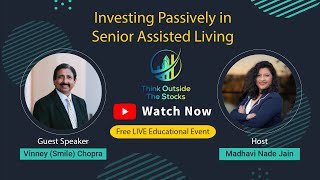
Vinney Chopra and John Rusan present a case for passive investment in senior assisted living, citing 10,000 people turning 65 daily and the asset class's resilience through 2008 and COVID. Their model builds single-story campuses in 12 months, stabilizes in 3-7 years, and targets 54-56% operating expense ratios with break-even occupancy around 55-56%.
Chapters
Just start my slideshow.
Okay, perfect.
So there you go. So today we are going to talk about investing passively in senior assisted living. And today we have such an honor to have our guest speaker, Vinit Chopra here today and his partner, John Rusan. He wants, he wants to stay in the background. But you know, I'm just going to call you out, John there. So from, from CEO from Moneel Investment Group and Monil Senior Living and many more of these companies. So Vinny and John, welcome, welcome to Think Outside the Stocks.
Thank you, thank you. Madhavi, it's a pleasure.
Thank you and thanks for joining. And I'm your host. Most of you know me. I'm Madhavi Nade Jain, president and wealth strategist at Think Outside the Stocks. I am helping investors with the two fold approach and we'll talk about a little bit about me. But today is all about the senior assisted living. So we'll keep on focusing on that. So little bit disclaimer before we go ahead. We always have that. This webinar is for education purpose only. It's not a legal or accounting or investment advice of any nature. This is not an offer. This is not an offer to participate in the investment as well. This is just an information only. If there is an investment in future.
There'S going to be a separate investment.
Webinar and there'll be a PPM provide you that offer. So this is not an offer. The information provided here is, you know it's based on the time factor, right? So it's, you know, if there is, there are numbers, you see that's based on time factors. So the accuracy of it is based on that time. So please keep that in mind and please, please consult with your attorneys, financial advisor or CPAs for any legal matter, investments or anything that you want to particip henceforth. Right. So with that, most of you know me. I'm Madhavi Nade Jain. I'm the president and wealth strategist at Think Outside the Stocks. I live in Austin, Texas with my husband and two kids and with my past life, I have worked in IT industry for about 16, 17 years, mostly with top five consulting companies and in project management actually. And that kind of helps me to bring in my experience from the IT industry, the analytical mind from IT industry to think outside the stocks and help you guys in my real estate journey. We have a real estate portfolio based on single family homes, Airbnb passive as well as active investment in multifamily syndication deals. And if you truly call me my True passion is about educating. I love educating the strategies that I have found which is kind of out of box strategies. I love to bring it back to open to investors like you and help your money do two jobs at two different places. So the way think outside the stocks helps. It's a twofold approach. It's a twofold strategy for maximizing not just growing but maximizing your wealth. One is a better saving systems with Infinity banking system because believe me or not your money sitting in the bank account is just your stagnant money. It's not doing anything for you. So I help creating an infinity banking system where you could be kind of act like a bank for yourself. And the investment strategy which is a high growth and tax efficient using syndicated real estate investment which is completely, completely passive. Also offer the data driven education and with the education we have almost every two weeks Thursday we have this educational series going on. So please join continue joining this series and we also connect you with different resources, lawyers, CPAs, estate planning attorneys, etc. So just keep that in mind. And before we start about today's webinar, today's topic I do wanted to just highlight on what the upcoming events are with things outside the stocks. We will talk about supercharging your tax savings in commercial real estate with cost segregation with Yona Weiss next week. Next week. Next Thursday. Actually this is kind of missing that alternate weeks. We are doing one next week. We are also doing if you are a high net worth individual, if you are 5 million plus net worth. We are doing a special webinar on 25th of February using Infinity Banking system with premium financing. Premium financing is a way that you can borrow somebody else's money from bank by creating kind of an arbitrage and it's really fun strategies kind of supercharged, turbocharged kind of a strategy where you can continue investing in the investment that you want to continue and use somebody else's money to fund this Infinity banking system. And on March 11th we will talk about you know the the CPA, the tax strategies with attorney from Anderson Advisors and then we will talk about what is your best option to invest from a retirement account. There is so much confusion always about you know if it is SDIRA, if it is Solo 401k if it is QRP what's really the best thing for me. Right. So that's the answer that you're going to get on March 25th with Scott Maurer from Advanta IRA. So that's just a little bit spill about me and I'm Gonna introduce our speaker today. I am so excited about Vinny here today. I love three things about Vinny. Three things stand out when it comes to Vinny, right? First of all, his smile. He's known as Vinny Smile Chopra for a reason. I mean, you can see him. I mean, look at that smile. It's so contagious, right? So that's the first thing people notice about him. And not just the smile, but that contagious personality, that enthusiasm. That's the first thing. The second thing is Vinny is truly like a dedicated husband, father. He's such a family person. When you speak to him, you'll realize that, you know, he will talk about his kids, his wife with such love, joy and pride. So he's truly a family person. I love about that. I mean being such a busy and you know, such a successful syndicator. He's just truly so connected with his family. And third thing, he is truly, truly passionate about the financial freedom, being mentored to people and bringing that financial freedom to their day to day life. So really, you know, he is an investor, he's a syndicator, he's a author of a best spelling, best selling book. It's nationally best selling book and we'll talk about it in few minutes. He's an, you know, he hosts four, not one, but four podcasts and he's dedicated to multifamily education and he's been investing over 40 years. And the key thing about Vinay is he started with like $7 in his pocket. When he came to this country, he started with $7 and now look at his portfolio. He has over $400 million in portfolio. So that's incredibly inspiring. Vinny, it's such an honor for us to have you here. You have a portfolio of about 4,500 units and with such a, you know, such a widespread asset classes in senior housing, multifamily and the hospitality. It's such an honor for us to have you here. So I'm just gonna give it to you from here. Just pass the baton to you and please, please take away.
Oh, thank you. Thank you so much, Madhvi. I appreciate that. I want to thank everybody who is able to join tonight and those will be to able probably watching. We had very good registration. A lot of people will be coming on as we started. It's been recorded also. I just saw that, which is fabulous. That way would you be driving the slides?
I can stop my sharing and you know, you can start while you're doing that. I'm just going to introduce why we're talking about senior assisted living today, right? So I like the three things, right? I talked about three things about winning, three things about senior assisted living. Number one, it's about the silver tsunami. I mean we look at the statistics, do we know that about 10,000 people are becoming retired, 65 plus every single day. And if you look at the age around 1900, the average expectancy of age was about 48 years. So they were expected to live about 48 years and in 2020 it's about 79 and it's growing from there, right. So people are living longer and they're running out of the retirement money. So they're looking for really that affordable option, good options. So that's why we are focusing on senior living. That's the first thing. The second thing, I love Vinny's motto which says, you know, Vinny and Shahid, they're partnering on the senior assisted living. They say spoil the generation. That spoils spoiled us. I love that. I absolutely love that. I mean, you know, think about it, 2008, a lot of people lost their retirement income and they had to move out of their homes, right? They had to downsize. Where are they going to go? I mean Vinny and Shahid here trying to create this luxury and best of amenities kind of places which feels like a home for them. So it's, it makes you that feel good kind of investment that you're doing for something for the generation who really pampered you. And number three, and the best part, it's like a low turnover investment, right? So people actually move in here to stay in as that, that's their home. They're going to live there for, you know, really long term, unfortunately, you know, till the end of the life, that's where they're going to be staying. So that's kind of a permanent, more permanent resident that they're looking for. So that's basically why we like the senior assisted living. And today we are just going to talk about the demographic shifts in usa, why this market, how these returns are safe and sound, what type of different senior assisted living are there and what Vinny and Shahid and John are focusing on and why are they focusing on. We will also talk about the big elephant in the room. That's the COVID impact.
Yes, yes. I would like to just share that. Of course everybody's known about me. Our partner Shahid Imran came from Pakistan. He was 17 years of age, very, very gentleman, very nice person. And he was selling actually medical supplies to senior assisted Living and nursing homes and things like that. But guess what? He was so he was crying when he will come home because the kind of you know smelliness and what they were feeding and things like that. He said that I will never bring my mom or dad to these places. So that's why he sold his business and nine years back he started perfecting the system and that's what we are in now. And John Ruson is also our partner. So myself, Shahid Ji and myself and like you know Madhu was saying she's very kind. She you know the book I wrote a couple of years back, you know became top seller around the world actually. Thank you everybody. If you would like to you know look at it you might really enjoy the process. How I take step by step very nicely how to find deals, what to talk about, how to analyze and things like that. We also converted it into Spanish and it's in Kindle edition and also in the audio version also. And we are doing hardback now too. We were talking about it today again I have been interviewed by lots of great shows. Many of you might know these almost 200 plus shows and so on. And then this is my second book which also if anybody would like to see I have been a positive person most of my life. So positivity brings profitability and. Right. Timely. We are writing our third book which should be coming out very quickly now. Senior Living Investing Made easy. So please look out for that and also if you would. And then this is where we are. You know about Moneel is our kid's name Monica and Neil and Madhya was saying I'm really Kanchan and I have been married 40 years. 4 0. We have been living in the Bay area. We live in Black Hawk California which is Danville Blackhawk Country Club. And the good part is our kids Neil and Monica very grounded And Neil went to Berkeley. He did his electrical engineering, computer science, EECs they call it. And Monica went to UCLA did political science and MBA like me. And then she's now VP of operations and marketing Director and very much involved in the business. My wife is involved. She's the VP of investor relations. And then we have Ana Martinez our VP of finance and John Rusen right here VP of academy where I teach also we have lectures like thousand lectures we have at any rate. So this is like Moneel which is Monica and Neal our kids name investment group and Moneel Senior Living our new company. And then this is Imran's company Build Senior Living who has done 23 successful communities he's built and about 450 million. So total we are close to a billion dollar. And our goal is, by the way, $2 billion more in the next 10 years. So there'll be about 3 billion together. We have good goals and we want to really do good for our seniors, just like Madhavi said. But let's go here just to give you an idea. Our portfolio, we built 88 units in Cape Coral, Florida. We'll be showing you a little movie on that actually in a second. We built it for 12.3 million. We got an offer for 19.4, but we didn't sell it yet. We're going to actually buy it ourselves from the previous investors. This one is sold, this one is sold. And then the next one maybe if I do like this. Yeah, there we go. And there are. Because Imran lives over there in Michigan, he kept on building lots and lots of these in Michigan. And now we are going all over usa in Virginia, in Texas. We are coming to Austin also, by the way, and then also Houston and Florida and Arizona, we go all over. And then to California where I live right there. Then these are some of the things that we have been purchasing in my company, Moneel Multifamily Communities. We just bought in Austin right there. 34,750,000 right in near to the domain in Austin. September 16th of last year we closed on it. 308 units. Then we bought 52 million in Orlando, Florida. Then we bought 35 million right there. Can you so much I just open it. And now it's going to open that.
And I just wanted to, you know, add a note there that, you know, the reason we are sharing this experience about Vinny and Shahid is just to show you how strong of this background is. So when we are trying to educate, you know, when he's trying to bring in that education about senior assisted living, it's a concrete education because this is coming from experience. This is not from the books. It's coming from the actual education, from the experience. Right. And you know, in future when we, we will have some investments for you. This is the kind of quality of investments that we will be bringing to you. So just wanted to highlight there while you're opening that presentation.
These are the things so that you could kind of see what we are talking about. I have done, we have done 34 syndications in which I've been the principal, I'm on the loan qualifying all active syndications and very few any other. You know, the key principles with me at all so we do 506B, which is private offering. Must have relationship with the investors like Madhviji and all. And then up to 35 sophisticated investors we can get in this deal. That's what we have done to 34 of them. 34 of them. And then we are also doing this one now too. $50 million fund we are starting for senior assisted living and the whole shebang like we do, which we are starting very soon. Different than crowdfunding, definitely. I want to say that our minimum is $100,000. Because we don't want everybody who wants to put 5,000, 10,000, 20,000. We have thousands of people in just one deal. We believe in having very limited number of investors. So that they can talk to us, they can go there, we can meet with them. And then we have weekly, no, not weekly, quarterly investor meetings. Everything very nicely done. We've been doing it for 14 years now like that. And then we cater to your needs and make sure that you're fully aware of what's going on at the with your investment and everything. And so different than crowdfunding. And then this one is you have full access to syndicator like me and Madhviji, who will be right in the middle with the fund of fund organizer. Enables you to buy institutional level assets. Literally. Right. Like the Austin deal. Literally. I got 2.68% interest rate. It's the cheapest money you can ever, ever, ever get. And that's 30 year amortized, three years of. And then 10 years fixed loan, 2.68%. So we have very good bandwidth to get very high loans. Big big loans at a very lower price. That's how Fannie, Freddie, they have special rates for the people when they reach in that 20, 30, $40 million loans. You know, like that accredited investors, most of you already probably know accredited investors are 1 million net worth, not including your primary residence. Or you are making 200,000 single or 300,000 annual income as a joint in the family for the last two years. And sophisticated investors are the ones who are knowledgeable, who are already knowing financial knowledge. And then they can taste understand the risks involved. That's what SEC ruling says. SEC securities and Exchange Commission ruling. And that's why I wrote this letter. I mean the book. Because I really believe in syndication process. I wouldn't be where I am if we didn't pool the money together from relatives, friends, people, high net worth people, things like that. So investments can only be made through interview and private placement. Memorandum for special deal. We are not Selling any offering whatsoever right now at all. Nothing. So we are 100% SEC compliant. Full access to the syndicator property, regular updates which is quarterly and we pay quarterly also dividends or cash flow preferred rates we call it. And we bring pride to each community. That's exactly what we do. I mean every community we have purchased, we bring value. With the cafes, with the media centers, with dog parks, I mean, you name it, you know, all the things and we are doing now Lakes at Renaissance is the property. We have already done so many new things there. But let's go here to $31 trillion in retirement funds. But why assisted living? Oh my Gosh, that's almost 23 minutes. So let's go here. 10,000 baby boomers are turning 65. Like Madhviji said right there. Please look at this graph right over here. We are in the 2021. See how steep it's going to go for the next 30 years. For next 30 years there's no stopping the demand for the housing for 65 plus and 85 plus. I'm 68, I'm 68 myself. So my fellow citizens, I'm so much passionate about next 20 years, 25 years. I'll be totally immersed into this market. We are 65 plus 56 million people, which is kind of older stack actually it might be even larger now then it's going to as you know, in 10 years, 74 million of us, then 82 million, then 88, then 100 million, it might even pass that 100 million, you know. And then this is 85 years of age, 6.7 million to 20 million. So the demand is immense for need driven, we call it need driven because that's where the supply and demand is. So the demand is there and it's going to keep on increasing more and more and more. But if we kept on the same pace of construction and providing these facilities will have a big deficit. Big, big supply shortage. And that's where we are really talking about why we are so excited about it right there. Please take a look at again facts around senior housing. 2 million Americans will live in senior care communities by 20302 million doubling from 2016. So it's an exponential demand. And then 58% of the current communities are only 17 years of old. And then 25 year old is 32%. Almost 1/3 are pretty old. And as you know, with the new laws and new things with COVID happening and all that. But I won't go over each and everybody but please take some time when you get the slide deck or like that. You can really, really see the biggest thing is we've been chasing multifamily and I'm sure you might have already invested in them all these years, 40 years we could say. But the stabilized senior living outperforms apartments any time of the day. And it's been doing it for many, many years and it will keep on doing it too. So the returns are pretty, pretty darn good. And let's just go here. Why senior living again? In the crash of 2007 and 8 the senior assisted living didn't even go down at all. Even the apartments took a dip as you can see 18, 19% going down in that 2007, 8 and 9, then coming back up and so on. But senior living just kind of stayed. And same thing with our Covid effect also in 2020 the senior living is a need driven thing. So it really didn't go down and now it's going to come back up again as you will see. So overall success, overview of the success is the market research and regular review. We do it before we do any kind of assisted living. We do capture rate, we do feasibility studies and then we have right from start conceptual design to site selection, to operational costs, to planning and zone approvals. We do everything in house. That's who we are. And then team building and planning, financial feasibility, modeling, everything. We do it program development, construction, we work with our own gcs, we get the permitting, construction, management, everything is done. And then when we about 70% built we start hiring executive directors and leasing agents and all so that we can do advertising in the media, in print and websites are up so that we want to be 50% occupied the day we open the doors at our facilities. So that's how we do it. We have a very, very.
Can I interject and ask a quick question? I think it will be very interesting to find out when you're doing that market research on the location or where are you going to put that senior assisted living. Can you elaborate a little bit on that? Do you do that also in house or you have third party or third.
Party, third party feasibility studies? Of course. But we do hire outside company we have been dealing with. There are a lot of great consulting companies by the way and they do research for $10,000 or something. We pay and they do all the demographical studies and the networks and they go and find from every assisted living which is in that area. Right Madhviji? And they find out how much they are charging, what are they, how old they, what Are their services and then the net worth of the seniors in that age group. It's a huge study, about 130 pages long maybe. And then it tells us we can build it. This is the capture rate. The demand for the next five, ten years is these many units. And we construct only 10% of the hundred percent. Because see, when we do 6 to 9% a month, it takes us to get the ordinance changes for that piece of land which we buy at a six month closing. Actually we don't buy the land right away. That land is worth zero to us unless we get the permits. Right. And the jurisdictions and all. So it's an outside company. Yes, we do our internal and then we ask the outside company.
Thank you so much for sharing. Because we especially when people are trying to invest in real estate and single family market, right. The level of research is done by the person. So that's not that in depth research that's being done. Right. So it's kind of helps to know that how data driven your research is, how, how do you identify. So thanks for sharing that.
Thank you. Thank you. Because see, we spend millions of dollars before we raise the money from our investors. Because investors are only brought in once we have all the permits, all green lights, everything. Because it's no reason for us to bring the investors money in and then sit on it. Right. And use the investors money to pay for permits and architectural and all that. And land. We don't do that. We spend our own money and then we raise money. Then we build it in about 12 months, 12 to 14 months maximum. We build the very, very beautiful, we call it Taj Mahal. Very nice thing and Covid. I do want to say to all the audiences, we had zero Covid effect, zero deaths in our facilities and we are managing 14 of them right now. But the key thing was we locked down and we had CDC standards. We had zero corona death and zero. We didn't let the children could see through the window and all and the birthdays were also through the window. But now we have a very nice plexiglass unit which is right there in our centers where the children can show 14 days of non Covid reports and then they can come and meet with their parents like that. It's a little bit more detailed, but that's just. I wanted to say cap rate. We just kind of leave them. Let's go to this one now. I want to really spend some time on this slide right there. John, are you there? Can we have John also talk?
Yes. So I'm here Yes.
Yeah.
You want me to go over? Yeah. This slide really kind of shows an overview the five types of senior housing. So a lot of people bundle senior housing into one, but there's actually five main types. So starting on the left is more choice driven and as you go further right it becomes more of a need. So you can see where we're at right at assisted living and memory care. We like this space because it no longer really is a choice. It's more need driven and this need is only growing stronger as you could see with the demand. And we really like this sector because it's right in the middle. There is some licensing but it's not like it would be federally. It's not as hard. And then the average stay is great. It's, you know, it can be two plus years for our residents. So it's right in the middle of a great sweet spot to be in, surely.
Thank you, John. I was going to say that the skilled nursing are the nursing homes, the rehab centers, the medical equipment, nurses, doctors coming in and out. So in the right side is where most of the deaths have come by the way, you know, in the senior homes and all and maybe some of the assisted living. Not in our communities we have had zero death. But you're right. Thank you so much, John. Then the other one I wanted to share was this one. This is a spectacular chart we put together what it is that we have been chasing. Moneel investment group, my company have been chasing 29 times these communities, 4,500 doors like you see that right there, right. So we've been buying B plus right now because we can raise a lot more money, millions in just few days. But we've been buying C, C plus value add, where there is income potential is lower, Concessions are low to medium. Delinquency is low. Covid has really hurt us, the C class properties big time and we were chasing working class. But as compared to newly built assisted living, it's class A plus. Its income potential is higher because you are charging about $1,200, $1,300 here we charge $4,400. Of course there are more expenses. It's five star dining, lunch, dinner and breakfast, five star cook to order with the sous chef and everything. And we'll kind of explain in a second, concessions are zero. This is a need driven market. That's why it's very stable to invest in this side of the multifamily as compared to this side. It's amazing. Delinquency is 0.0 delinquency even during COVID because it's need driven. And we look at three months, three years of rents up front because we don't want our seniors to go from place to place to place. So we take care of the medical records, due diligence we call it. And then also the rent, you know, which comes from their family, from their revocable trust, from their. I think it's called home reversion or something, you know. But it's a non working resident. That's the big part. This is where the jobs you working class, if they lose a job, they have to leave us. But this one average stays almost over two years, two 24 months to 30 months. And then we can take the assisted living into memory care if the need goes to when they have some Alzheimer or things like that. But if they get really really sick then we don't have medical equipments or anything. We just have one nurse as per the state requirement. No doctors or anything. We definitely have to send them to the hospital right there. Then maintenance is zero because brand new different maintenance. So lots of great things happen on this side. We just wanted to say, and I know Madhviji mentioned that, that you know, this is the safest place to park your money. And that's why we are very, very fortunate. We are give in a spoil the generation that has spoiled us and give them very nice facilities to you know, live in. And we would love to show you. Oh my gosh, it's the second time. But that's okay, no worries. But let's go here. I will just take you to now over here you can have tax benefits, huge tax benefits. We construct the buildings in one year we can build Taj Mahal. As a matter of fact I'm going to go out right now. It's in the presentation time and I would love to share my screen and take you to a little video. I think that'll be amazing. Please see if you can hear me out right there. So this is what we built.
And this is a ground up, right?
Yes, totally.
Oh, Kate's newest premier independent assisted living and memory care facility. I'm Amy Hannah Eckenrode, Community development manager and I would like to invite.
Hampton.
Manor of Cape Coral features the only 77,000 square foot one story facility in the area.
So we duplicated all over. This is what we.
As you enter the facility you are greeted by two comfortable sitting areas. And behind our grand waterfall is the formal dining area for independent and assisted living residents. All award winning meals are created just for you by Chef Larry d' Aluisio and are served restaurant style. With three gorgeous garden courtyards. Residents can enjoy our in ground swimming pool, putt putt golf or the beautiful rock formation waterfall. Our stylish beauty salon will have you looking glamorous in no time. Our activities calendar keeps you on schedule and in the know. Our luxurious spa allows you a tranquil place to unwind and de stress. The club room is designed for some hearty pool or card games. And right around the corner is our private library. Enjoy afternoon snacks and entertainment in our poolside bistro or a relaxing conversation in our sitting room overlooking the waterfall courtyard.
Foreign.
The modern theater invites you to indulge your senses in a delicious bag of popcorn and your favorite movie. The spacious sunroom invites you and your guest to take in an afternoon of conversation or perhaps a puzzle or card game. Our activities room will be filled with Indo games, trivia and arts and crafts projects for creative minds. Or enjoy watching a game show or the daily news with your friends in the social lounge. We offer 89 spacious apartments featuring private or courtyard views, kitchenettes and equally spacious restrooms. And the ability to control your own room temperature. Whether you like a studio apartment, our one bedroom apartment.
I think it'll be great for us to get back into the PowerPoint right there and right there. And also Madhviji, you have some questions for me too?
Yes, actually, you know, first of all, just this looks incredible. It looks like almost like a resort, you know. And I volunteered in senior assisted living before and sometimes it actually feels sad the kind of living they have there for themselves. Right. Especially thinking that that's where they have to live for almost rest of their life. So incredible. I mean, you know, things like, you know, movie theater and spas and the courtyard, just so much of open space. So love what you have put together. Vinny, I have a question about, you know, when it comes to compared to multifamily. Right. Because that's the asset class it commonly get compared to. What's the cost of managing this? I mean, you know, when it comes to like percentage wise. Right. What percentage is that cost? The expense to maintain this facility. And that leads to my second question. Integrated is what's that? Breakeven occupancy. Where does it need to sit to actually start cash flowing?
Totally. I would say to answer the first question, lots and lots of loan people. And the banks, when they talk to us, they can't believe how much lower price we can build it. First of all, we can build for 15 million this beautiful one story, we only build it over 5 to 7 acres of land, no less than that. And then we don't go second story, third, fourth, never, never. We will never go. We only want our seniors to go out in the open courtyards and enjoy planting the vegetables and flowers and all that and really enjoy the swimming pool, the putt putt golf and the waterfall function and all those things. So single story. The second thing is they don't understand that we can build it for 15 million which is going to cost. Other people are building at 20 million, 22 million literally. But we have figured out a way to do it. Secondly, we can run the operation also at about 54% of the cost. Usually they tell us, oh no, it should be 75% of the revenues to run this for five star dining. We spend so much money into food budgets and everything. It's just that we have kind of perfected the system. You could say that's why our cost is low. We need about 55% to 56% occupancy to break even. To break even. So it's a very good thing that we are able to kind of thanks to Shahid Imranji who has worked very hard to reach those numbers.
I think after that 23 different investment going through that, I think that's where you kind of have that processes kind of settled in and you know how to optimize that. So thank you for sharing that. Shahid unfortunately couldn't join us today. He is traveling. I wish he was, he was also with us.
But incredible.
I mean just this luxury at that cost and especially for them. And then compared to the market, what's the, you know, the rate that they are paying to this kind of facilities. Right. Is there a difference in there?
Vinny, so glad you are saying we are not charging 12,000amonth or 10,000. In California, where I live, I've shown it to my builder friends and other people we will be building here. But they say, Vinny, anybody will pay 10,000amonth to 12,000. It's like a resort and everything is included. Daily living care, you know, from the caregivers, the nurse and then of course all the meals, the laundry, the linen, the transportation, the usage of all the facilities, everything is included in 4400 to 5400 by the way, per month. So we go for the middle section. We don't go to the rich, rich, you know, numbers and very similar to what other assisted livings are charging beautiful in a facility or community for the same price or maybe a couple of Hundred dollars more. That's all.
Yeah, yeah.
And then the associated question to that, who really pays for this? I mean, are they able to afford that four thousand dollar a month, you know, after the retirement, especially when their retirement is deplet. So who is able to, you know, who's paying for it? Is it, you know, some support coming from government or is it their relatives? Is it them themselves? You know, reverse mortgage on the house or something? What are they really doing to pay for it?
Good point. It's a three way thing. Children are paying maybe about 25, 30% revocable trust or living trust, we call it, or long, long term care insurance or reverse. Was that the house you were saying?
The reverse mortgage.
Homes? Yeah, those are the different ways, you know, that the, our seniors are paying and our facilities, you know, that's where we get them. Exactly. But like I said, you know, we are kind of in the middle range and it's quite common, you know, even to have independent living or assisted living at your home just by yourself. You have to have a caregiver who will come and cook, who will help in dressing or bathing. In our communities, we get seniors from the, I think the radius is about 30 miles. That's all, 30 to 35 miles. That's where we bring our community, where there is a strong need. And then lots and lots of seniors who can afford, they like to live closer to their in children and grandchildren. So that's where, you know, they are migrating now from the cold areas to, you know, I mean into the Virginias, into the Florida state, then California, Texas and then Missouri, we are building over there. Then Arizona's and all that, right?
Yeah, yeah, I notice all the warm climates, huh?
Yeah, yeah, exactly. You know, I mean, you know, they like to be. And these are all the things we just mentioned that amenities include. Everything on the left side, everything in the middle, and then everything on the right, all included for that 45 to 5,500, depending on the level of the care, you know, that they needed. Yep, yep. So we're very, very happy and very proud that we could bring this, you know, to all of them. And please, you know, if you will, please go ahead and scan this. You know, any of our esteemed group of investors are there, please scan it with your phone. You'll be able to reach Madhvi right away. And that way we can even do another seminar. As you can tell, we didn't show any numbers. We didn't show anything at all. But next presentation, what we do, if those people who are Interested will go over the more numbers and what kind of returns and what kind of things can happen. So I'm here to answer all the questions there might be.
Yeah, yeah.
So there are some interesting questions and also I have launched a poll where you can mention your interest if you're interested in investing as Vinny's indicated. So there are like different type of investments that we will see. We are not doing investments, you know, in this webinar we will have a complete separate investment webinar. So just show your interest if you are interested so we can send it to you. Again, these are 506B deals. What that means is that we cannot put an investment in front of you unless we know you, unless we have that previous connections. We take SEC regulations very, very seriously. Both Vinny's team and think outside the stocks. Me too. So unless we have that established relationship. I have talked to you, I've understood your way of investing. I will not put this in front of you. So even if this deal will happen in the background, you will never get.
To know about it.
So just let me know if you're interested in finding out about it. So with that, let me jump to the question again. We are going to take the questions which are related to the education only for today, not the investment purposes. So you know, let me go ahead and just kind of call out these questions. Vinny. So the first question we have from Jay, very interesting question. Can you compare the 506B syndication model to a private performance based fund?
Surely. See private fund some people call a specific offering, some say blind pool and some say fund. So actually SEC has the regulation D which gives you the exemption that we can file. 506 filing they call it, which is for the people for accredited only. You have to be verified accredited to be in the 506C like crowdfunding for example. Or if some people are talking to you about you will get 12% or 15% they can advertise. So that's the 506C fund they call it, for example. I'm starting one like that, right? I have one already, but I'm starting another one now for all these different things. Now when you say ppm, PPM is needed in both. Private placement memorandum is needed in 506B but 90% of the money is raised by 506Bs by the way. You know, but there are some other groups that are able to raise 5 or 6 C. More regulations, more different things. Only accredited investors can invest in 506c by the way. So to get our up to 35 sophisticated investors, which not everybody's accredited. Right. Not everybody's got million dollar net worth, excluding your home. And then also, you know, making money also 200,000 or 300,000. So that's how I can kind of distinguish the two. Yeah.
Thank you so much. And then Felicia asks, where do you find the operator for the business? So I think it's. Everything is in house, right?
It's all in house. We have, you know, the manuals, everything we perf. And then we have our executive directors who start recruiting, we say, because every single city we are opening it, we are all will be interviewing lots and lots of great executive directors, of course, leasing agents and caregiving people, individuals and all, because we train them for six weeks on our own training. Our caregivers cannot just come and come to work tomorrow. No, no, no, no. They have to be totally taught what our standards are and everything. And that's how we perform. And we give them more money than regular people. So we give them A$1,50 more so that they become a really good solid part of the community. And the residents like it because that's the element they want. They want respect, they want dignity and they want somebody who's really, really careful, carefully helping them live their golden years, like we say. So we are very, very particular about those things. And our response time is one third the state response time, by the way. What that means is if a senior needs some help and they pull a chain in their apartment right in the unit, our time to reach their nurse or caregiving is one third. So this is very, very exciting for us because we can really hang our hat on it. So we've gotten awards. We were in the Florida news, actually in the governor's office because we started doing the plexiglass with one of the unit always. We build it as a self contained unit in our facilities on the memory care side. So we were able to just keep it separate and bring the families together through the plexiglass. And then the air was blowing on this side, different air and different air on the inside. So it is a very cutting edge we have instituted in Michigan also. Hampton Manor is our brand name, Hampton Manor. So you can just Google us in Michigan. You'll come across everything. And then Florida, then Williamsburg, all over the place. And we are now looking at locations in Texas, you know, and we just bought two pieces of land over there. Well, in the. Under the loi stage in Missouri also. So St. Louis, we are coming there also.
What I like about it is it.
Almost feels like a family that, you know, people who are residents there, they're staying as if they're home. People who are working there. Because you're taking care of both the residents and people who are working as well. Right.
So no working at all. See, because these are non working residents. They are about.
Yeah, I mean the people who are healthy.
Yeah, yeah, yeah, yeah, yeah. Totally. The caregivers. Yes, they're totally. We have like 55 to 65 caregivers. Wow. For 80, for 88 residents, it's a 24 hour operation. Right.
Incredible. So love that. And when you're talking about the multiple locations that you're coming in, so you know our audience, should they expect anything coming from you in near future in terms of both multifamily. Because I launched the poll and people are interested in multifamily as well as senior assisted living investment. So can you just give us an idea about what that outlook looks like for 2021? Are the deals or not?
Totally, definitely. Actually we'll be syndicating quite a lot actually almost 200,200 million every year for the next 10 years. So let's kind of share about it. We are already looking for multifamily in Austin. If somebody's got a great deal, 35 million to 60 million, please reach out to Madhviji and then we can. If it's an off market deal or if any of the investors want to sell that, we are in market to buy that. We're also looking in Kentucky. No, not Kentucky, Indianapolis, which is the highest rent growth has come about and into the Tennessee's. So we are also looking for multifamily which we buy B class in A minus areas. Then we are also doing the build ups. We call it only three years it takes us to build the community like we just showed you. It's starting from the ground breaking. It takes one year to build it, then we stabilize it and then third year we sell it. Right. You know, so we are also. We were selling them to REITs. REITs have given us so much like first right of refusal letters because they love our communities and what we built. So now Shahidji and I are forming our own REITs, small REITs. So we purchasing all this communities that we are building. So which is very exciting new business for us then also I have partners in the hospitality. So we'll be buying two or three hotels we bought Hilton Garden in. So that will be other opportunity we'll be syndicating later on in the third quarter to fourth Quarter, because vaccination has to go out and the travel has to increase for us to kind of get back in that game. And then we, you know, so syndication wise, will be coming up with some stabilized assisted living projects, which we'll be purchasing. Some will be ground up like in St. Louis. You know, we'll be coming out with that one soon. And then we'll be coming out with. Oh, we are also building actually multifamily from scratch townhouses and apartments. So that's our fifth one. So we have a lot of things coming up.
You're keeping busy this year, huh? So interesting when you're building the senior assistant housing and you have the stabilized. Right. First of all, I want to bring attention to our audience. That typically multifamily deal is five to seven years, but here the period is little bit less.
Right.
It's about three years or, you know, around that area. And also the returns are higher than the multifamily. And when he just went in detail why that is higher. So the question I have is that when you're building it from ground up, are there phases of investors? Typically when there's a phase one where you don't have the approvals and things like that, some phase one investors come in and then there is a phase two when the approvals are in. And now it's about time to start building. So is there different phases or is it just one phase of investing?
Just one. Just one. Actually, Shahid and I put our millions into the first phase, so we don't bring investors at all. But then once we get all the permits, everything is green light. That's when we raise the money within two weeks. We usually sell out in two weeks, always. And then though that investor's money for the first year, we build from ground up. So it's dirt, we call it. It's dirt. So it takes us about close to 12 months to build the beautiful, magnificent building like you just saw all the way. Like in Williamsburg, we are building six courtyards. Six courtyards. And I think similarly in our Palm Bay, Florida, also, it depends how the whole structure and the land is. It's usually is about 5 to 7 acres of land, no less than that, because we want it really spread out and only one story. We never go second story. Never ever.
Yeah, that's what's giving that openness of feeling. So one thing I want to bring it to attention again to my listeners, our viewers today, that when it comes to development project, typically that risk is that during that phase one, where the permits are Being, you know, applied for and you don't have that permit. So that's why typically I see the phase one, phase two, but looks like, you know, Vinny and Shahid and John are taking that risk up for the, for the investors. So by the time you see the development is, it doesn't have to go. So for a new development, the risk is kind of mitigated, I would say. So keep that in mind when you are trying to invest in this kind of facilities. Yeah. The next question I have is when you're looking at both type of investments ground up, where you have that equity play plus the cash on cash, and then you have the one which you and Shahid are now moving into, which is the stabilized property. So it's kind of selling from one end, buying from the other end.
Right.
So what is that?
The annualized returns, the IRR kind of changes.
What does that look like?
Very good point. Very, very good point. Actually, the first phase is only three year old. The reason we kept it was because first year, it's dirt. There is no money to give out as cash flow and everything. That's why our investors, we tell them 12 months later, when you put the money, 12 months later, as we are ready to stabilize after construction, we have cost segregation benefits. Huge in the second year because as we get the occupancy certificate, we are able to cost seg. So our investors get high preferred returns. I can't tell right now how much, but that is in the second and third year. And then at the end of third year, we give them a preferred return also of the equity gain. So It's a short three years. But we have a choice for investors to 1031 into the next project. So they.
You read my mind. Both the questions. You read my mind. I was going to ask you about the cost segregation and 1031 as well because you know, when you have this kind of returns, the taxes, it just gets slapped.
Yes, yes.
So thank you for addressing that. So can you give us an idea that what kind of cost segregation benefits do you see? And by the way, people, we have next week, Yona Weiss coming in and talking about cost.
He's a great friend, Yona, you would love him.
So he will talk about what exactly happens and why you get that tax benefit. But Vinny, would you elaborate on, you know, suppose I invested or my investor invested 100k into it, what kind of paper losses? That's what you get, right. It's not actual losses, but it's paper losses. So you can write off whatever you can apply for this year and can carry over the next year the losses so that your income kind of is less taxed. Right. So for 100k, what level of, you know, what kind of paper losses do they see?
Segregation is the biggest bonus. It's so amazing. Like the property we bought for 35 million, right? Matviji, 100,000. Our investor on K1 got minus 61,000. Same loss of 61,000.
That's almost 60.
That's a lot. That's a lot. Yeah. That's the same thing in the assisted living. Because we are furnishing, we are doing all these things. So the losses are huge in this deal also. So second year there is a phantom loss, just like you said, it's making money and we are giving cash flow. But the loss, passive loss or if some people are active loss, then it's passive, active, the same, Right. Like you like that. But then the best thing is after third year they could say, you know, we don't want to take that gain of whatever it is, 35 or 40% gain, we will take that hundred. Now it's 140,000. We'll put it into the next deal then the velocity of that. They could do it two, three times and never pay taxes until the end. But in the meanwhile, our investors will keep on accumulating the passive losses. So by the time they sell and get that huge gain. I'm not a cpa, I want to say that. But it can cancel out, you know, so all that gain is going to be there. Now when we buy after third year, our model calls for just like a stabilized multifamily. So it's going to be five to seven years.
Okay.
In that one. So three years in the first part, build up and then five to seven in the next one. Returns are pretty darn good. I mean, you know, again, anybody who's interested, please let Madhviji know and we'd love to come back as soon as even a couple of weeks from now. Or, you know, we could even do a special seminar, you know, webinar. Only those who are interested. May not be just Thursday, you know, we could do another day. Yeah.
And what, what.
I'm also planning to kind of bring in this like a sample deal, right? So something past investment.
So we bring everything which we have done and then what we'll be doing. Exactly.
Yeah.
So thank you so much for that, Vinny. I have a question from Rekha here which says that does Medicare pay for this when it comes to.
Yeah, they do pay. I Know, residential, you know, assisted living, which are just like the houses and not big, big facilities like that. In our case, we have just stayed away from Medicare and things like that. So majority of our, you know, seniors come from the area right there and they are able to pay that 4400 or 5000, 5500 through those three different things I talked about, you know, in our facilities. But definitely Medicare. I'm not, you know, I'm not taking one. But I'm sure there are ways to find out from the local government how much they will, they won't pay for everything. I think it has to be certain portion comes from here, certain portion comes from here, certain portion comes from, you know, from the seniors living trust, I'm told, savings and reversion of the home, things like that.
So in case of multifamily, we often see the bad debt, right? That's called the economic vacancy where people actually are staying in the facility. And in Covid where we have seen that a lot that people are staying it but not able to pay. Have you seen that happening in the senior assisted living?
Not at all. Zero. The thing is, I mean the way we have designed the model, our seniors actually show us financial to live there for three years. So which is different than in the conventional multifamily because we only ask them how much they are earning, right? They're earning two and a half or three times the rent. Then we give them the least, right? In our senior assisted living, it's a month to month lease because we don't know how their health will deteriorate or not deteriorate. So it's a month to month. But our average stay of the senior is over two years. Once they come into our community, they don't want to go anywhere. And actually the children tell Shahid Ji, you know, my mom and dad gained weight. See a lot of time when you are in the 80 and 85 year or 90 years or hundred years of age, you lose weight. But because of the best foods and sous chefs and all the pampering we do, I mean we feed salmons and clams and shrimps and all the good stuff, you know, so that's where we really take a lot of good care of our. And it's the camaraderie, it's the social element that makes them live longer life and more beautiful life, you know.
Do you take advanced booking?
I mean, you know, I would.
Look at that. It looks like a resort, right? It looks like a vacation place. So, you know, thank you so much for Doing that for our senior living and because our seniors are, are, you know, sometimes impacted by this recession and all the different kind of troubles. So just to provide them. That's such a beautiful facility that, you know, they can be in, their families can visit. That's absolutely incredible.
And there are private dining halls. We have usually four dining halls in our communities. Private dining halls too, where the kids can come, children can come, grandchildren can come and do celebration of birthdays and anniversaries for mom and dad, things like that.
That's really nice. We have another question and I think it's the last question. So I really appreciate everyone staying here. I mean we have almost 75% audience that stayed back till. So. So it's been a weekday. I really appreciate you guys hanging on till the end. We have such good questions. And look at that enthusiasm. Look at that energy Vinny is bringing.
And even, you know, after he's had.
Almost 13, 14 hours of in his day already. So tremendous. Vinny. So Jay has a question. Success stories with other senior living company collaborations.
So do you collaborate with other living?
We don't actually. So sorry. Because we are so busy with our modus operandi. And we are going for 2 billion like I mentioned in the next 10 years. So that's 200 million each year. We are very focused in looking at different, different locations. Some people have given us their assisted living and they want us to convert them and things like that. We just basked on some four story ones or they were half done. So we don't really take any build up structures at all because we want to build them on five to seven acres, you know, so that's the big thing and only one story. That's why.
Yeah, yeah. Thank you so much. So I have another question actually in the chat window. Very interesting question. And meanwhile, if you guys want to just, you know, just provide your feedback because Steven says, wow, I mean I think this was after seeing your video. So if you want to respond, I know I cannot unmute all of you. So if you want to respond on looking at these facilities, what you felt about it, what's that one thought, that one word that comes to your mind, please, please share that in the chat window and qa. We would love to have that feedback. So Derek says that how can I get started doing this strategy in my backyard? I think the easy answer is that find a property or find a land or something and bring it to the attention, to Vinny's attention. But I will let you answer that question.
You know, I would love to say that I know in my webinars that I've done, few people have reached out to us. You know, we got 10 acres land here, 15 acres land there or something like that. It doesn't work because we go by data driven. We have so many points of data and it's all there. So we do very, very methodical, you know where the capture rate is going to be. Because we don't want to spend time in looking through the pieces of land that somebody has. We look for the land in the locations that we decide that there is a strong need and then we go. We have brokers in almost every state and we only deal with the land brokers. So they give us and then we deal with the sellers and we are buying this piece of land. You're not going to believe it for 575 group sold us 7.4 acres of land because they were compassionate and they really wanted something like this to be built there. We bought 12.6 acres of land for $991,000. So our land value has to be less than a million for us to build it for 16 million. 15 or 16 and keep the price down. That's why we are very picky on choosing the locations ourselves in the cities and all.
Yeah, yeah.
I'm sorry, Vinny, more questions are coming in.
Sorry.
If you have the beer, we have the time. No.
Questions.
You know, I love that, you know, your participation. Love, love the questions. I asked so many questions from your side, you know, just to bring in more light to this whole topic. It's pretty complex topic. Right. So Jay is asking wait list for how long to fill a property? I believe that he meant that for an investment. When it comes in, is there a wait list or how long does it take to fill that investment?
We start actually going into the media and print media and websites and calling on, you know, when we are 70% built. So 70% is built. It's seven acres of land and we build it not in the warehouses or anything. Never ever, not in the commercial centers. We try to find the land in between the single family homes, you know, so that it's a homely atmosphere. That's why we want. Right like that. So when we are about 65 to 70% built, we start advertising and start doing due diligence and taking applications for the seniors. Who decides about their parents, millennials, their children. So they want their needs have driven. I mean they are lot more cutting edge. They know what's out there. So they're wanting lot more and more for their parents, you know, right away we are fully occupied within nine months, usually seven to nine months after we open and after that we don't have. It's only if some senior moves out, then we have to get somebody in. Otherwise we have an hour's average stay, like I said, is about over two years. Two years.
And around you, I mean, are there any new facilities of this same similar quality building in or how does it look like? I mean, if there's. There are not too many of such a high quality facilities available, they wouldn't want to change. It's not like apartment rent. The apartment across the street is giving you more concessions or it's giving you more facilities or giving you more amenities. Does that happen a lot?
You know, it does not. I mean, that's exactly what we find. Our seniors give notices from the old and dungy, we shouldn't say the word, but that's what it is. They save for the same price. If my mom and dad can live in this great facility. But of course, you know, we don't take all of their residence. But again, there are some new products which are two story, three story, four storey because they are more focused on the profitability and we are too. But at the same token, our goal is to really spoil the generation so that they can really get out. See in the second story, third story, seniors, mom and dad, they look through the window. That's all they do all day long to look at the compound or wherever or traffic. But in hours they go out, they go into movie theater, the social lounges, they go to the library. They bring their own books also and furnish and all. And then they have, you know, places in the, you know, billiard rooms and things happening in the grand piano in every facility. We bring outside groups to dance and folk dance and all. And then they have some good singers and themselves and dancing at nighttime. So it's a wonderful community spirit so that they can really enjoy that.
So I would love to visit.
I'm sure other people are doing it. We don't know, but we are just building one story with courtyards.
The important thing is that there is no turnaround happening more frequently, right?
Like yeah, not much. Not much in our communities.
Yeah.
So Rekha says amazing projects. Thanks Rekha for that feedback. Love Vinny. Vinny G's passion and his dedication. Would love to get more information about the deal. So please, Rekha, go ahead and if you have missed out the poll, just go to www.thinkoutsidethest and file in joining our investor inner Circle So you get exposed to this these days because this will come and go and you will not even know unless you have that relationship. So please keep that in mind. Everyone. Ethan says great presentation. Thank you so much Ethan. Steven says can you utilize 1031 funds? Very interesting question. So you have 1031 going into the next deal, but can they bring in 1031 funding?
But you have to have very FT 1031 like a million dollars or $2 million into the deal because we only need 4 million. That's all we need to bring this very beautiful, magnificent because we are taking loan of 70%, 75% on our own names, Shahidji and myself. So we only need and we, you know, so 1031, it has to make sense. We cannot take hundred thousand, two hundred. It has to be minimum of one million, one million. But once you put money, I mean 1031 again is a tax deferred, as you know. Right. But if you bring your money from your retirement funds, Roth IRAs, 401ks, checkbook control, EQRP, all those good things, then it's a tax deferred anyway. Right. So but we do give the chance to our investors who are in our ground up for three years at the end middle of third year or end of third year when we are ready to sell, we ask them how many of you would like to do 10:31 to the next project. So you could put cash in one time or sdira and anything. Then of course it's different anyway. Right. But if you put cash first time then that will result into 1031. If you want to go to the next project and next project then you can take out after six years or nine years and have a hefty, hefty, you know, tax difference. Yeah.
Thank you. Thank you so much, Vinny. I think that answers that question. Stephen Jay has kind of, you know, feedback on his question. Just kind of a bouncing question. Thanks. Was asking regarding companies that staffs. I think this was about the collaboration that he was mentioning about asking about companies that staff specialization in active senior care, not limited to location. So when you hire someone could come from those companies hypothetically or one of those franchises owner could be an investor for, for an example. Does that make sense?
Point.
Very good point. See the thing is we are looking for about 55 to 65 caregivers. Now they have to live nearby. They have to live 10, 15, 20, 30 miles from the facility for them to come there and work and be available and everything. Like in Covid, we wanted to make sure they are fully adhering to the CDC standards. Their temperature was. That's why we were able to have zero death and zero Covid activity. Because we have to make sure we have the most stringent standards of the employees coming in. And then we have full training we give them. Even though they might come from the background of assisted living, caregiving from residential or something, we want them to adhere to our standards and we teach them our whole softwares and everything and then train them about compassion and what we believe and what they, you know, they will be rated on and they're, you know, all those things. So I think we don't. Maybe we do look into some consulting companies who can bring very vetted caregivers. And we do know for sure we get involved, right. At about 70%, 65 to 70% built, we start building the teams because it's not easy. You can't just open the gate and not have the backdrop of all these caregivers ready to. As the parents are brought.
Right.
We want to make sure that they are totally fully taken care of and settled in their unit, in their apartment. Get to know the new climate, acclimated to all that, all those things. Yeah, yeah.
Very, very great answer, Vinny. So essentially, I mean, I think this.
Is why the cost is kind of, you know, kept down to.
Right.
If you're investing in, you know, getting these people, that's kind of the added cost too. Right. And very great point that, you know, you need to have the staff, you.
Know, all the staff on board their.
Training done by the time the first day the door opens because you cannot be without the caregivers. Right. So the next question I have, I mean, you know, I'm just having more questions than I think our audience to get their total. But you know, that just helps our audience too. So the question I have is, you know, during the COVID time, did you had to like spend more time effort, add additional staff to kind of disinfect and you know, all that like PPEs and stuff like that. Was there any kind of, you know, extra.
We did not leave any expense. We were not worried at all. But we were disinfecting. We were doing everything as the CDC told us. So even when the caregivers will go in and washing all of hands and making sure as they enter the facility in the morning or in the nighttime, there were precautions, everything done. That's why we have zero death and zero Covid the positivity. The other part was that even with the plexiglass rooms, we had disinfections we bought machines to make sure that all those rooms on both sides were fully disinfected before the next family came in. So we are very particular about all those things. Yes, yes, yes. Elevators. We thankfully. Oh my gosh. I mean, that's where the problem also came quite a bit, you know, with the elevators for going up and down in our communities, we have zero elevators. So that helped.
Yeah, that's, that's, that's. Yeah, that's a great point. So nothing left behind, right? I mean, no compromises. Absolutely no compromises. So love that. I think with that we have come to the end of questions finally. Great questions, everyone. Thank you so much for your great participation and overwhelming response today. You know what I love about it and what I believe in it, right. We think outside the stocks. I help creating that kind of a wealth maximization blueprint. It's almost like you follow what people have done before you. I mean people, you know, wealthy people of America and bringing those strategies to your life. And I love with Vinny and Shahid and John, what they have created is a blueprint. So I love that, you know, you take that blueprint, you know, that works and it's kind of keep on repeating and it's beneficial to the residents, it's beneficial for the investors like you. So if you are interested and you know, we will have that webinar where we will look at that sample deal. We will have the webinar when the actual deal comes as well. So if you are interested, you know, if you have missed out the poll, just go to thinkoutsidethestocks.com and file that form or just send me an email@infothinkoutsidethestocks.com and Vinny actually have a giveaway his book that he mentioned earlier. There is a Kindle version that, that he can give away. So if you want that version, if you want Kindle book, please send me an. You know, just, just send a subject smile.
We love to give you both of them in Kindle. Yay. Yes, everybody.
So please send an email to info@thinkoutsidethest.com again it's info@thinkoutsidethestocks.com with a subject smile on it and we will make sure that you get that. I have to do that, Vinny. I had to do that and we make sure that you get that book. So I really, really appreciate everyone hanging until here. I appreciate Vinny, your presence and John, you too. You kind of stay in the background. But you know, I'm so inspired by you. For folks you don't know. John is in his early 20s and he's.
Yes, John. With John, the camera won't turn back on.
So I tried to originally, but it won't hurt me at the issue.
Yeah, I like that serious picture. I like that.
He's the model. He's the model.
Yeah. So he is an athlete, actually. And he is. He's been partnering with Vinny and he's.
House hacking in his house.
Looking at doing more syndications. He's my VP of the Academy and partner in senior living and very proud to have him on, you know, with us. Yes.
Yeah. Yeah. And then that brings in that Vinnie's flavor, too, that, you know, he loved mentoring people. He loved kind of growing this knowledge across tools. So thank you to both of you, such an honor for joining, I think, outside the stocks today and hope you have a great evening and everybody else, hope you have a great evening and great weekend, too. Thank you so much for your patience being with us for almost 25 minutes over, but we had so many questions.
Thank you so much from the bottom of our heart. Thank you, Madhvi, for you know, bringing such great, you know, education to your esteemed group. And I really appreciate, I'm humbled for you to inviting us and we would love to answer any questions and come back anytime you want. Yeah.
Thank you.
Absolutely. Thank you so much, everyone. Have a great day and stay connected. Every other Thursday, next Thursday we are coming. And then after that is every other Thursday with all the educational, educational webinars. So thank you so much. Have a great one again.
Thank you again. Bye.
More from Madhavi

The "Holy Grail" Real Estate Strategy Most Passive Investors Miss | Featuring Glenn Hanson

Be fearful when others are greedy, and greedy when others are fearful. #shorts

Building Recession-Proof Wealth Through Mobile Home Parks & Self-Storage with Matt Ricardella

The "Holy Grail" Real Estate Strategy Most Passive Investors Miss | Featuring Glenn Hanson


Think Outside the Stocks: Breaking the Financial Fear Barrier with Liz Faircloth


Why Health Is Your Greatest Financial Investment | Chris Orestis with Madhavi Jain


The #1 Retirement Killer That's NOT the Stock Market (Most People Miss This)

EP47: Private Credit Explained: Stratus Financial’s Impact Investment Model | Brandon Interview