E10 - The Internal Recruiting Gap For Black Professionals
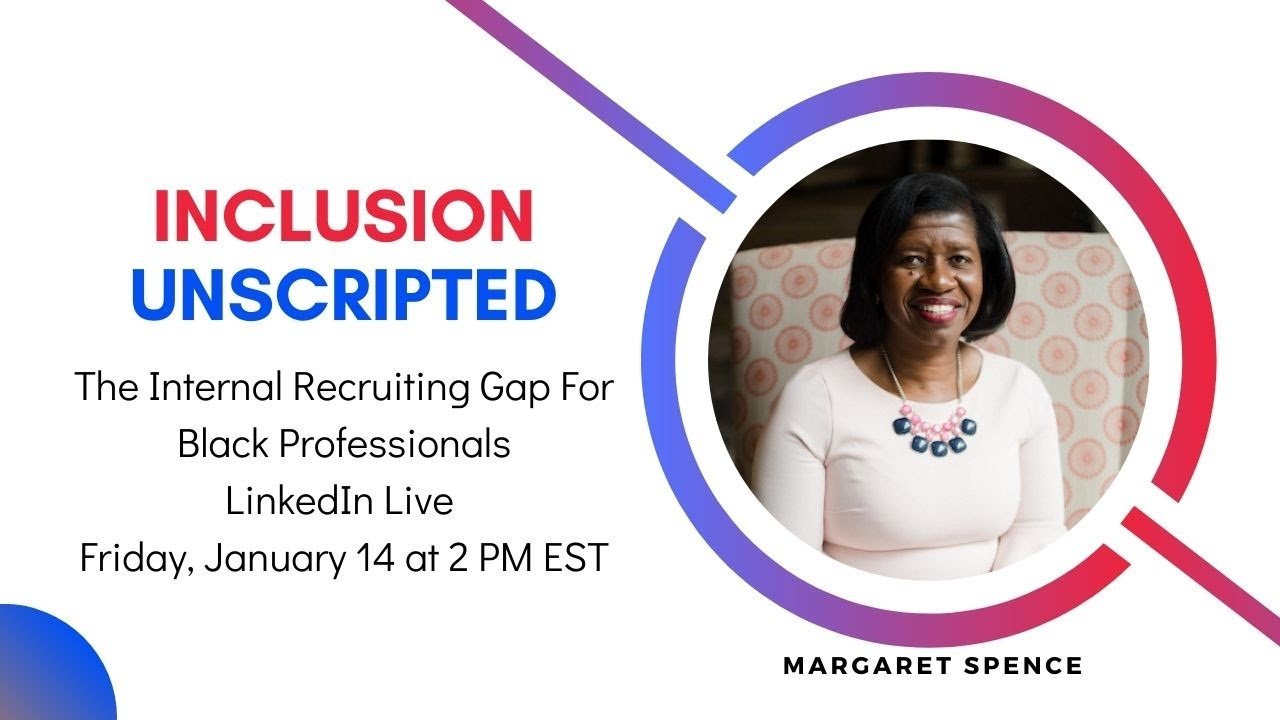
Margaret Spence identifies the internal recruiting gap that keeps Black professionals stuck in their roles despite being qualified for advancement. Most companies lack transparent processes for matching employees to open positions, leaving workers without growth conversations or clear career paths. Managers often block advancement through favoritism and lack of training, but Spence outlines concrete fixes: transparent career ladders, manager training, dedicated internal recruiting budgets, and holding leaders accountable for talent development.
I'm getting back up on my feet. That you should.
Hey, I love that music. Oh my gosh, I just love that music. Hi everyone, welcome to Inclusion Unscripted. My name is Margaret Spence and I am the host of this weekly livecast and podcast. We are live streaming to YouTube, LinkedIn, and Facebook simultaneously., and I'm so excited that we are here today. So let me tell you a little bit about Inclusion Unscripted. Have you ever said to yourself, I wanna talk about diversity, inclusion, equity, equality, belonging, thriving in the workplace, but I just wanna have the discussion. I wanna say things that haven't been said before. I wanna say it bolder. I want to say what needs to be said without the filters of fear. Oftentimes we can't say what needs to be said because we're afraid of the repercussions, of the aggravation of the whole ecosystem around what we have to say. So Inclusion Unscripted was founded based on the premise that we don't have a script each week. We talk from the heart. I talk about diversity, inclusion, women's leadership development, career advancement, empowerment, and we have raw discussions about these topics. What needs to be said is what needs to be said. There is no other way to put it. So this week's program is something that's near and dear to me. It's near and dear because I see this as a pivotal issue within the talent cycle. And so we're going to talk today about The internal recruiting gaps for Black professional. The internal recruiting gap. A lot of organizations are willing to talk about how they're going to get talent in the door, and you're willing to talk about how you're going to retain talent. But what we are talking about today is internal recruiting and upleveling of Black professionals.. And I didn't go with women. I'm not focused on gender per se. I wanna talk about Black professionals in general. So for those of you who don't know who I am, who's, who are joining for the first time, my name is Margaret Spence. I'm the founder of the Inclusion Learning Lab. We are, um, a process and system that drives inclusion within organizations. We look at how do we change diversity and inclusion with advocacy, with research, with education, and with action steps, clear steps that organizations can take to move the needle. So we're not into lofty policies. My team and I at, through the Inclusion Learning Lab, we work on on-the-ground results that organizations can see quickly. So let's dive into this topic. Most organizations do not have— let's not talk about, you know, Black professionals first. Most organizations do not have an effective internal recruiting process, meaning if I have a skill set and there's a job open, there's no real way to match that skill set effectively. There's not a way for me as a professional in most organizations to say, "I think I want to be up-leveled here." There really isn't a solid process that I can build my own ladder, not the ladder that the organization gives me. So if I talk to professionals that I coach, I will hear them say, "Well, you know, they've given me this ladder.", and nobody's really asked me about the ladder. They just gave me the ladder. So most organizations are there to give individuals, once you've started working for them, here is the ladder that you should climb within the organization. That's generally what's done. No one really says, wait a minute, there are some positions out here that maybe you should be educated on so that you could try to advance into those jobs. Or better yet, just generally asking individuals as a part of the process, as a part of the stay conversation, asking individuals, what do you want from your career overall? What should we be doing to empower you to move ahead? Those conversations generally don't happen at the manager level. So oftentimes an organization will build processes at the supervis— at the, at the higher level, the regional managers, the directors, the business unit presidents. You'll build your strategy there. But the people who block advancement the most are the supervisors and managers at the lowest level of the leadership ladder. And so we don't spend enough time going to that ladder in order to empower growth for regular, ordinary, every employee. But when it comes to Black professionals, we actually fall off the flat earth of talent management. See, the earth itself is round, but when it comes to talent development and talent management, the process for Black and brown professionals is like a flat earth. We either sit on the earth or we fall off the side. And no one really cares if we're falling off the side. And that's the part that just drives me insane because people don't care about the Black professional experience, the Black and brown professional experience within their organization. They don't care. The fact that we are in the organization feeling like we cannot advance, we cannot move forward, we are stuck where we are, isn't a top-of-the-mind discussion. It's not a top-of-the-mind discussion. And when we have the discussion, the, the conversation can be taken one way or the other. The conversation could be, yep, Margaret has come to talk about her career, or Margaret is not ready to to wait her turn, or Margaret is just not in line with where we're headed. So the challenge for organizations that I see is this internal recruiting gap. So let me point out some frustration because those are frustrations that I see when I am coaching Black professionals and, and brown professionals. This is what they come to coaching with. And I think it's important that organizations hear what their employees aren't willing to say to them upfront. So number one that comes to coaching is, "Nobody wants to have a conversation about my growth. They don't wanna have solid conversations about my growth." That's the first thing I hear. The second thing I hear is, "I've asked for a promotion over and over again, and I'm being told to wait my turn. That's the second thing that comes to coaching when you're talking to Black professionals. The third leg is, I don't feel that I'm being prepared for anything other than the role I'm in. Leg number 3. Leg number 4 is, they told me that I'm the best at this, and because I'm the best at it, I should keep doing it. Leg number 4, right? The next part is when I applied for an up-level position, I was treated like a pariah, like if I should not have done that. How dare I want to ex— to, to try to go somewhere else in this ecosystem. And so I was made to feel inadequate when I asked for the growth. The next part is I was, I was told to make a plan for my advancement, but after I wrote the plan, there was nothing else because the plan was the box that the leader wanted to check so they could say to their peers, "Yep, Margaret has a career development plan." But the career development plan didn't have a process. I've asked— the next thing that comes to coaching is, "I've asked for mentors and I can't seem to get any mentors." That's the next little jumble that arrives at the talent development spot for Black professionals. And then I applied for the job over and over and over and over again, and I was told no. And the no didn't have a good caveat because the position was given to someone who was selected They went through the process of interviewing me multiple times. I had to prove my worth, but in the end of the day, they gave it to the person they wanted to give it to. So that's what Black professionals come to, um, coaching with, because they're frustrated with your work environment. Your place of work. And so they're looking for advice and guidance. Should I stay with the organization? Should I go? Should I start looking? What should I do? So generally, depending on the circumstances that somebody comes to me with that, I may say give it one more shot. But if you've gone to the well 4 or 5 times and you haven't gotten an advancement and you are duly qualified for that job, then I say it's time for you to go where you're valued. That's my advice. But I think I want to turn that table a little bit and talk to HR about internal recruiting gaps for Black professionals, which is why this program is here today. This is why I'm doing this, because I am tired of coaching Black professionals who are good. See, here's the thing. When I— when someone comes to me for career coaching and I will say to them, okay, tell me all of your skills before I ever give them advice. I send them away, make a list of your skills, and then give me the job description for the position you're wanting. And let's line it up. Let's see how qualified you are for that position. Because one of the, one of the challenges that Black professionals have to overcome is the fact that we're not seen as qualified for the position at the beginning. So the first step in identifying the gaps for even the, the Black professional is saying, prove to me that you're qualified. That's what I do in coaching. You, within your organization, already know that the person's qualified. You already know this. This is not an unknown factor. You know that they are qualified. You know that they've checked all the boxes you've given them to check. So if I have an individual who comes to me to coaching and they say, yep, I have every skill set required. And I'll say to them, okay, go and talk to your leader about how do you advance in this organization. And the biggest issue that happens is the ambiguity around advancements. The ambiguity, the downright hurdles that you have to jump through to figure out what positions are in the company, Where can you go with those positions? Where does that position lead you to? What are the clear requirements for that job? I feel one of the clearest messages that you could have for Black professionals in your organization is, this is how you advance here. This is what this looks like. Here's a set of requirements that you have to meet for this position, and here's how you meet them. The ambiguity around advancement has to end in order for us to be pipeline ready. So let, let me pause. In order for us to be pipeline ready, meaning that we are ready to enter your advancement pipeline, You cannot make this process so hard. You cannot make it so that we have to climb over every desk, every room, every process to figure out what it takes to move up. Okay? We cannot have— we can't, we, we can't be asked to jump over every mountain to figure out the basic thing. Here are a set of positions that you might be qualified for, and this is how you make this advancement step. And here are ways that you can do that. But before we can even get there, as an organization, you need to be training your managers and your supervisors what internal recruiting is. Why it is imperative that we not hoard talent, that we do not say to people who want to move up, you cannot do that. One of the biggest issues for in the talent cycle is the fact that managers and leaders take advancement personally. If I apply for a new job, it's like I've personally taken a knife and stamped you in the chest with it. Because that's how personal managers take the fact that somebody wants to advance. It's like my advancement is a personal aside to you. And so here we are. We, we as organizations have to do a better job of training managers, line managers, frontline managers on managing and frontline managers on spotting talent. We spend an awful lot of money recruiting externally. We also need to allocate money to internal talent recruiting. Internal talent recruiting needs a budget. Internal talent recruiting needs a team. There has to be a team of people who work specifically on internal recruiting. We cannot just say we are throwing our money to get Black talent in the door on the entry-level positions or the management or leadership positions, but then we leave the people who are inside the organization to die on the vine. We cannot continue to do that. We cannot continue to allow talented people to sit in the same desk year over year without any guideposts on how they move from point A to point B. We just can't do that. We, we can't. And so as we move into 2022, as we come now, next month is Black History Month. And organizations are looking, oh gosh, we want to do things around Black history. I make a suggestion to you today that we actually look at how we manage internal recruiting as an initiative that we take on during Black History Month that actually continues throughout the year. Internal recruiting will save your organizations hundreds of thousands of dollars because there are talented people within your organization who are stuck on the advancement ladder, who already have the institutional knowledge, the institutional know-how that you overlook every day to bring in people who have no institutional knowledge, and then try to get them up to speed. It's imperative that we take the lens of opportunity and shine it on the Black and Brown professionals who have spent 5 years or more in the same role. We have to look and say, if somebody has spent 5 years in the same role, why are they still there? That's the question. Why are they still stuck in a position for 5 years? What is the growth? So let me, let me say something to all of you who are doing DE&I work. We have our work is diversity, equity, equality, inclusion, and belonging. But the one work that we are not doing is thriving. That is the work that none of us are doing. Let me say none of us. I'm doing that work. There is diversity, equity, equality, inclusion, belonging, but people must be able to thrive in the organization. So if you are doing DE&I work and you're doing DE&I talent work and you're a DE&I recruiter or an inclusive recruiter, or you're in HR, what does it take for people to thrive in your organization? And thriving means that you spend money on your internal recruiting program. And yes, thank you, um, Shelly, for, for saying this. Let me post it online. Ongoing training and skills has to be done internally to ensure that we are a choice when promotions are being done. This is true. This is exactly it. If I don't know the skills I need, you get to tell me that I'm not ready. So that crazy cycle that we live in where we get to tell people, you're not ready, you're not ready, is the thing. But but then you hide how I get ready. So you get to continue to perpetuate the fact that you don't have any Black talent. And then you sit in meetings and say, well, we don't have any Black talent that are ready. That are ready. That's the quote, that are ready. But the biggest question that HR has to ask itself and talent acquisition and talent development is what does it take for people to thrive here? And when we are at our best, when we as an organization is at our best, what does it take for Black talent in your organization to thrive and grow and advance and earn what they should be earning? That is the question. Organizations have to ask this question because guess what? I, for one, am tired of you saying that people aren't ready without giving them a guidepost, a road, a roadmap to say, "I can get ready. I can get ready." So it's not just diversity, equity, quality, inclusion, belonging. There is another leg to this, and it's called thriving. You know, there's a lot of people right now talking about, um, Jedi, where they're bringing in justice. Well, fine, let's talk about justice, but within the organizational context, the word is thriving. Black professionals want to thrive. When you Black professionals want to thrive. We want to grow. We get angry when we watch our counterparts moving up and we are still stuck. We get angry. You know, I'm going to actually play a little video. I'm going to try this because I'm going to try this for the first time and just to see how it comes in. Well, I'll see how it comes in. Here is, um, let me see if I can get it to play. Um, let me see if I can get the video to play. Um, let's see if I can get— I'm going to try to see if I can get this video to play because it's super important to what I'm talking about today. Um, it is extremely important. I graduated top of my class in business school. I lead a team of over 100 people, and since I joined the company, my department has increased revenue by 35% year over year. Also, I make 18% more than her. It's time to close the gap on pay equality. Let's all do our part. So that is the other half of the issue. That's the other half of this. When we don't get advancements, we have a pay equity gap. That's the result that occurs when we don't have an effective internal recruiting process. When that's missing, When we say to people, you're not ready, and thank you so much for posting this. When we deliver a message, you're not ready, you should be provided an individual development plan to get them ready and identify how to get ready. Yes, and individual development plans are the key tool in the internal recruiting process. But here's what I would say to you. An individual development plan in writing means nothing if there isn't legs and teeth and process and roadmaps and individuals who are going to support the IDP. You could give an employee an IDP, and a lot of organizations say, "I've given— our Black professionals all have individual development plans." Yet a Black professional can't get an appointment with the manager to learn about an up-level position. Yet there is no coaching being provided to that Black professional. Yet there are no skillset evaluations being provided to that Black professional. Yet there are no true development opportunities and mentorship and sponsorship that is being provided to that Black professional. And yes, this is it. You're giving someone an individual development plan that doesn't have a timeline. Absolutely. We want more from you. And I started this year off by saying we want more. We are not willing to accept the excuses anymore. The it's already on the train. We've already built our leadership pipeline for the next 5 years, and we'll figure it out in 5 years. We are not willing to wait any longer. 2022 is a pivotal year for Black professionals. Honestly, this is going to be my mantra for the next 11 months. We must learn to manage our career more effectively, but we must hold organizations to be accountable for the development of Black professionals. We must hold them accountable. You know, I want to share because I was on LinkedIn. I saw a posting from the Hartford and they did a graduation class on their Black professionals graduation class and they posted it out there and they put out a few things. But they are one of the companies that are tackling the idea of, um, you're not ready with actual solid process. They're giving their, their Black employees the ability to learn about positions that are available within their company. Because the first hurdle to overcome with internal recruiting is that me as a Black professional, I don't even know what the jobs are within the organization because the job descriptions are are so ambiguous. I look at it, I'm not really sure, and I don't have a way of connecting with the person who's in the role to find out if it's a role I would even want. And so when the individual development plan is done, I don't even know what I should be picking as my roadmap. I'm picking the roadmap that's actually being given to me versus one that I've explored within the organization. So part of it is just having these mini roundtables where you bring different roles to the table and allow Black professionals to experience what the role would be. You know, a lot of organizations have employee resource groups that are dedicated to Black professionals. Internal recruiting should be an integral part of an employee resource group that is targeting Black professionals. It should be a part of the, the ERG process for all disadvantaged groups. But specifically today, I'm focusing on Black professionals. If you have an employee resource group and the employee resource group is not tackling internal recruiting gaps, they need to be. It is essential that that happens, right? And I agree. Thank you for posting this. Individual development plans are one component of the professional development system within an organization. Thank you, Dr. Wilkins, for posting this. Yes, it is one part, but the organization must have the continuation. And here's the thing, If you put out an individual development plan, if you say to your organizational leaders, your managers and directors, we're going to make sure that every professional in our organization has an individual development plan, and we're going to keenly focus on Black professionals, that process needs to be evaluated over and over again. It's not a set it and leave it. It is an evaluation, a continuous evaluation of this development process. What do our Black professionals need to have career success here is the question. What do our Black professionals need to thrive? But what do they need to know about the development process that they don't know now? We have to ask, we have to continue to ask the questions. Um, great, um, contribution here, thank you. As a recruiter and talent sourcer, um, I make it my responsibility to educate my hiring managers of the necessity of inclusion and intentional sourcing of diverse talent pools, both internally and externally. Yes, thank you for posting this. Thank you. It's, it's a global job, but here's the other thing that I think we need to be comfortable with is having courageous conversations with our Black professionals about where the gaps are. Be willing to hear what they have to say. Bring them together and say, how could we improve this? Where are we falling short? What aren't we doing to make this work? We have to be willing to do that. Right? And so I have a person that says, anyone who posted internal recruiting gaps for white professionals, if you listen to the very beginning of what I started with, internal Recruiting gaps exist for every single part of the talent cycle. When I started this program, what I said was internal recruiting gaps occur for every professional in an organization. Most organizations would rather go outside and recruit in than develop their internal talent, period. This is an issue. Internal recruiting is an issue for every organization, and it is the one area of HR that we do not do effectively, whether you are white, Black, Asian, LGBTQ, Hispanic, or any other demographic category. The, the internal recruiting gap for women is even greater than it is for men. So even if we go gender and go lower on this list, if we say between men and women, the internal recruiting gap is huge, then we say, okay, how do women advance here? How do they thrive here? How do we get them ready for advancement? The reason why a lot of organizations have all white men at the top is because they don't have an effective internal recruiting strategy. That's it. So yes, Gloria, thank you for bringing that to the table. It is a necessity for every professional in every organization because people are sitting in jobs on the vine. They're sitting in jobs on the vine dying. Their talent is just sitting there wasting away. Somehow organizations have become okay with that status. We cannot be okay with this. And here's the thing, if I have spent 10 or 15 years with the company, you didn't have a talent strategy 15 years ago when I started because talent strategy wasn't a thing, right? You didn't have a process for up-level development because that languaging wasn't in the languaging vocabulary 20 years ago. So if I started with your organization when I was 22 or 23, and now I'm 43, you need to go back and look at me for an internal recruiting opportunity. So what I'm saying here is I'm strictly focused today on Black professionals, but this is a topic for every part of the spectrum. It's not a singular process. It is a global process and an opportunity that we miss. We miss an opportunity to empower our people to feel that they can grow with the organization because we forget them on the vine. We forget them. Think of this. If you're sitting in an organization, and you are being, quote, groomed for this higher level. You've been sitting there being groomed, and then the higher level position comes open and they go outside and bring somebody in. How does that feel? See, the one thing that employees want from every organization, whether you're Black or white, is you want to feel valued. I cannot feel valued if you are not willing to empower me to grow and thrive in the organization. I can't feel valued. So let me close today with some solutions. In my last 5 minutes, let me leave you with some solutions. Every person in your organization needs to understand the positions that are available. That's the first place. We need to not give people our ladder. So let me say that again. We need to not give people our ladder. We need to not give them our ladder. We need to give them all the ladders so they could see where they could go. We need to recognize that sometimes people are stuck in their own way and they don't have the self-confidence to move up, or they don't have the self-confidence to raise their hand. And so we need to be willing to do internal coaching so that people see their potential. As an organization, we must be willing to train our leaders, our managers, our line frontline supervisors on stay interviews. One of my mentors, Bev Kaye, wrote an entire process on stay interviews. Stay interviews is not, I'm getting ready to quit. Stay interview is, what do you want from me as a leader and how can I grow you and groom you for advancement or even to be the best person within the current role? We need to have that education for our frontline managers. We also need to evaluate what are the legs that are on the individual development plan? Where am I going to go once you've given me the individual development plan? Where do I go next? What is my opportunity from here? We need to talk to people who are in the ecosystem. So we need to have discussions with our individual subgroup professionals and say, "What did we miss about the uplevel process?" But here's the key thing that we have to do. We have to hold leaders accountable for the development of people. People development has to be an accountability process. Managers, supervisors, executives must be held accountable for developing talent. HR cannot develop talent. HR can build systems. HR can build courses. It is the manager's responsibility to develop the talent. It is the manager's responsibility. We also need to end what I call tap on the shoulder advancement. You're my friend, I like you, you're good. You're the mini me. So I'm gonna tap you on the shoulder and allow you to advance. And oh, because you're able to play golf with me or go out to coffee with me, or I like you better than the rest of the team, you're my favorite. We have to stop favoritism advancement. We need to level the playing field, especially for women. But we need to focus in on what we do to Black and Brown professionals, because we are dying on the vine. And we are sitting there year over year, not advancing. And if we make a commitment to diversity, equity, inclusion, equality, and belonging, We also need to make a commitment to how people thrive in our organization. We need to make that commitment. Thriving needs to be a part of the languaging that is used when we talk about diversity and inclusion. It must be a part of what we talk about. And keep in mind, so that I set this, put this stake in the ground, Diversity is not Black. It's not. Diversity is everyone. It's race, it's ethnicity, it's age, it's neurodiversity, it's parenting, it is LGBTQ status, it is married, unmarried, it is commuter versus remote worker. It is all of that. Diversity doesn't have a single line because you could be in an excluded category because you are a single mother, um, who is being looked at differently because you don't have babysitting and you can't work till 9:00 PM. And that's the reason why they're excluding you from the internal recruitment process. So diversity doesn't have a singular lens. It has a multitude of lens, and we have to look at it through the multitude of lens, and we have to ask ourselves who is being excluded from the table. So I hope that this live has allowed you to focus a little bit better on internal recruiting gaps. Internal recruiting gaps are what is keeping us from having a diverse pipeline and diverse people in our upper-level leadership. And if we are going to do something effectively this year, we need to have the courageousness to have the conversation about how we develop talent and how we uplevel talent and how we fill the internal gaps especially for Black professionals. So thank you for joining me, um, on this LinkedIn Live. I've got a couple comments. Um, thank you for posting this. I've also seen in my profession when people feel that they've been overlooked, performance drops as well as turnover rates go up, and there be— it becomes a revolving door. Absolutely, because people leave organizations who they don't think will ever value them. That's why they leave. They leave leaders who don't know how to develop them. And if you're looking truly at your talent process, you have to be willing to say, we've never adequately trained this leader to develop people. So instead of solving your diversity and inclusion problem, your real issue is the fact that you haven't developed the talent of the manager to effectively manage talent and grow talent. And we tend to wanna go fix our DE&I problem when the reality is we have a manager problem. We have a supervisor problem. That's where our problems lie. But we are off to fix DE&I and we wanna bring more people of color into organizations where managers do not know how to lead. They just don't know how to do it. They don't know how to lead. So thank you for joining me. Visit our website inclusionlearninglab.com. I am live every Friday at 2:00 PM on LinkedIn, YouTube, and Facebook. Again, our single goal is to create inclusion and have powerful discussions about how we empower everyone in the workforce. How do we make everyone feel included? And how do we make sure that everyone has the same opportunity as the next person? Thank you for joining me. See you next week. And we'll be back next week for our live.
Safe and sound. And when I fall, you tied a rope to me. You're blessing me every day. I was down with an illusion, like a sparrow with broken wings, but now I shine with your reflection on me. I'm getting back up on my feet.
That Thanks everyone, see you next week.








