E11 – Why Can’t I Be Angry? Emotional Suppression Is Microaggression
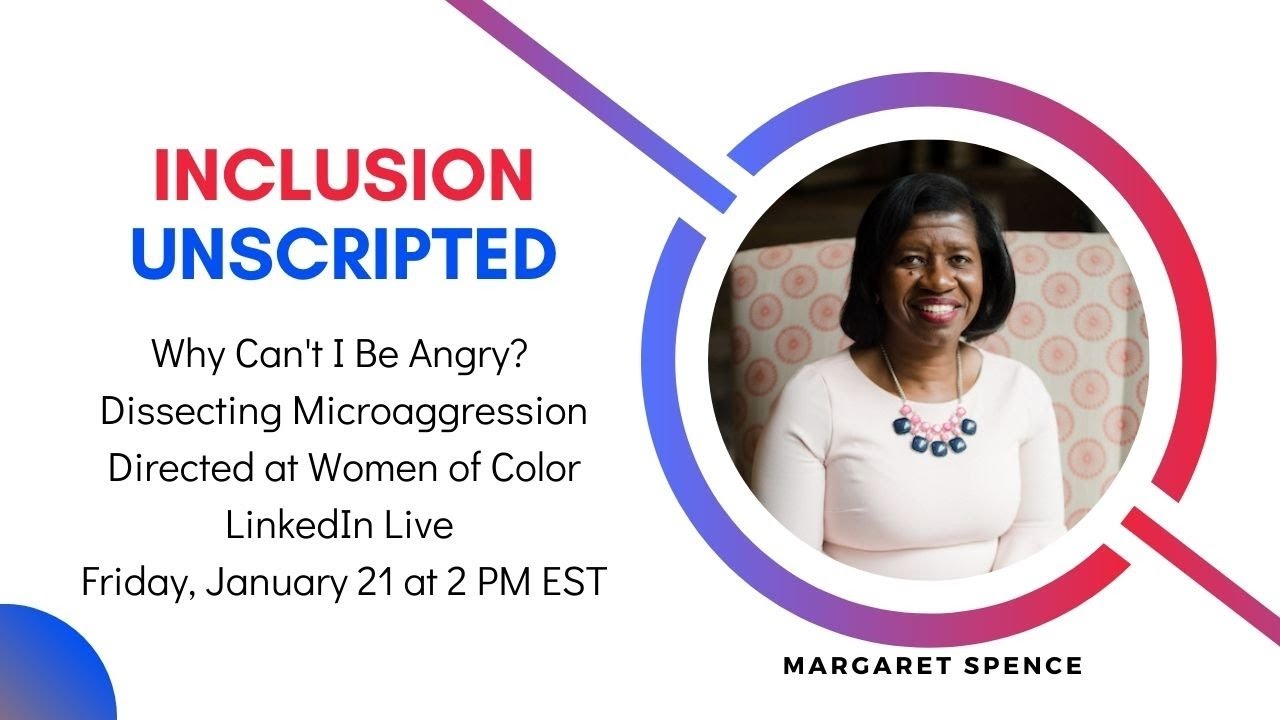
Margaret Spence explores how Black, Brown, and women professionals face retaliation for expressing anger at work, framing it as microaggression. She breaks down four types of subtle bias with personal stories and discusses the health costs of constant emotional policing in toxic workplaces.
Chapters
You're like a circle that floats around me, keeping me safe and sound. And when I fall, you've tied a rope to me. You're blessing me every day. I was down with an illusion, like a sparrow with broken wings. But now I shine with your reflection on me. I'm getting back up on my feet.
Hey everyone, welcome to Inclusion Unscripted sponsored by the Inclusion Learning Lab. My name is Margaret Spence and I'm so happy you're here with me today on our normal Friday show at 2 PM Eastern time. So let me start off by telling you a little bit about Inclusion Unscripted. Have you ever wanted to say what needed to be said about diversity and inclusion? Have you ever wanted a safe space where you could just discuss, um, women's leadership development, diversity, inclusion, equity, equality, all the parts and pieces that go together to make us a whole person, a whole organization, whole people? So Inclusion Unscripted is just that. We talk about topics that aren't always, um, warm and fuzzy, and I bring to you content and information to help you think differently about inclusion. We don't write a script. We don't come all prepared in a cute little box. Um, I come from the heart and I'm here to give you a lens about diversity and inclusion. So for those of you who don't know who I am, my name is Margaret Spence. I am the CEO and founder of the Inclusion Learning Lab, and Inclusion Unscripted is our weekly podcast. The Inclusion Learning Lab is here to offer advocacy and training around diversity and inclusion. So thank you for joining us, and I'm so happy you're here. And if you have a moment, you can, um, check out our website, inclusiononscript— inclusionlearninglab.com. So looking forward to that. So today's hot topic, and I'm bringing this one today, um, with a lot of heart attached to it. So I'm going to be raw, personal, and downright, um, clear about this one. Um, cause this one has hit home for me and it's hit home for me a couple of times. And I felt that this was a topic I needed to talk about because I can't be me, um, if I'm not truly me, if I'm not fully me. So today's topic is, why can't I be angry? The emotional suppression in the workplace that happens for Black and Brown professionals. Why can't I show up and share my lens of anger with you? Why am I relegated to not being angry when something happens to me that I feel is offensive or I feel crossed the line? Why is it that from an emotional standpoint, Black and Brown professionals aren't allowed to share their emotion? We can't share anger, disgust, frustration, infuriation, sadness. Um, we can't share any of that in the workplace without worrying about the retaliation that will happen to us. We can't even share it in spaces that we occupy that are professional spaces. And we can't share it in spaces where we often think that our white allies are our friends. We can't, because when we express our anger, we are treated with additional disrespect where people then say, "Why did I respect you?" That's the double edge of the disrespect. Or they come with, "You're an angry Black woman. You're an angry Black man." Or, "You're an angry Hispanic or angry Asian person because you've spoken up and said what needed to be said in the moment that it needed to be said. And so instead of allowing us to express our anger, validating our anger, accepting that maybe you made a mistake through your lens, what ends up happening all the time in the workplace is that the table gets turned onto us instead. And so we are not only putting up with your anger, and putting up with what you've done to us, but then you're asking us as human beings to shut down our emotion of anger. You're asking us to shut that down. You're asking us to not come as our full selves to the table, and we can be upset because we have valid reasons to be upset. And so I've been harping on and on in every episode about psychological safety, but I— but today I want to unpack emotional suppression and emotional micromanagement as well as microaggression. Excuse me, microaggression. And when we call out the microaggression, it's never welcomed. It's always either I get a tearful person bawling their eyes out at the other end of whatever, or I get this annihilating, um, conversation around the fact that we called it out. And so today I want to unpack this personally and professionally because I think that if I don't unpack it, I'm gonna volcanically erupt. Honestly, over the last several weeks I have encountered massive amounts of microaggression, um, in some work that I was doing as a volunteer. And I sat back and I thought, if this were happening to you, how would you react to what I was saying? How would you react? Would you discount me the way that I was discounted, or would you accept that maybe I felt I was wronged. Or maybe you would say, hey, um, what you're saying is valid. What you're saying is valid. Maybe I should have handled it differently instead of coming at me with the aggressive nastiness. So I'm speaking today for every Black person that's been at the other end of aggressive nasty because we have called out microaggression, because we have called out bad behavior, because we've called out what we felt was an injustice, and then we have been asked to suppress our emotions around it. No, you don't get to do that to us. You don't get to do it. You don't get the license to say to us we can't be angry. And within the professional spaces of our work environment, I am at the end of my rope getting phone calls from Black professionals who are feeling that they are in a microaggressive, unsafe environment. Every time I do one of these podcasts, I get 10, 12 people reaching out to me to say, Margaret, this is happening to me right now today. And it is an emotional weight to be in that space. It's an emotional space, emotional weight to occupy that space.
So why is it— when did it—
let me, let me back up a little bit. When did it become okay to label our being upset about something as being an angry Black person, angry Hispanic person, angry Black man?
When did we accept that title? When did we accept that? At what point did we accept the fact that we could not express our own emotion? So if You have done something to me that is not appropriate. You know within yourself that it is not appropriate. You know that the way you responded to me, the way you treated me, the way you made me feel, the way you discounted my experience, the way that you talked about me in front of me and behind my back, you know that all of that was inappropriate.
But if we respond, we are treated with disdain.
Let me shift even to women. When a woman is on a team, not a diverse woman, any woman is on a team, and the team leader, whether that team leader is another woman or a man, and you treat a woman with microaggression, When you treat us with microaggression, what exactly are you saying to us? Little woman, go away. Be quiet. Don't express yourself. Don't say what needs to be said. Just be silent. You know, my grandmother used to say to me, be seen and not heard. And so I lived with that, being in a room, being seen and not being heard. Now as an adult, I refuse to stand in that place. I refuse to stand in that place. You know, it is an emotional weight.
And yes, Mary, thank you for putting that in.
It is an emotional weight to not be able to express my emotion in the moment when I felt it, and I have to now sit back, go home to my family and try to process the emotional baggage that my workplace put on me.
I have to go figure it out somewhere else, right? I have to go figure it out somewhere else.
It's not okay. We will no longer accept the label of anger. We won't accept that label of angry blank. Angry woman, emotional woman, angry Black woman, angry Black man. We are not starting now accepting that label. I'm sick of it. I can be angry because here's the deal: if, if something happens to you as one of our white allies, you get angry, you are pissed off. And you show it right then, because I've been in meetings where the men in the room have melted down to the point of where I've been like in shock that they melted down that way. And nobody said Joe is unhappy or Joe is angry. They just said, you know, we sort of maybe we rankled his feathers a little bit. No, you made him mad and he expressed it.
So why is it so different when a Black person or a woman or a person of color expresses themself because they feel that what happened is not right? Why is that done? You know, there's multiple forms of microaggression, so let's unpack them a little bit. The first one is just plain old microaggression, where you are verbal, nonverbal, your attitude, your size, your modality when we walk in the room, your body expression shifts because we've walked in the room, or the things you do behind our back that you think is okay.
But then there is this microassault. Where it's done intentionally. It's done intentionally to break us. It's done intentionally, right? It's where you set out to make us feel inferior. And there are lots of managers and leaders out there who do that deliberately to chop us down because you are insecure with your own position. And so in order to find your security, you try to find your insecurity on the backs of Black people and women. Unacceptable. Your insecurity, you need to go deal with it. Don't take it to us. Not gonna happen. So that's the micro-assault that occurs for us as Black people. It's where you question our ability, you question our competence, you come with, "Oh, you're so smart." No, damn it, I had to be smart to get in this room because you wouldn't have let me in the room if I wasn't smart. So stop discounting us with this micro crap. Yes, I'm angry. I'm angry because I'm up to here with it.
As a professional, I'm up to here with it.
There's the micro insults that happen where you— oh really, that happens in your area?
Yes.
It's the micro-insults that are like little tiny daggers that, that, that attack us. Little tiny daggers that slam into us every day and we have to take it. It's the reason why Black people have high blood pressure, diabetes, cancer, everything else, because we're putting up with the crap in the workplace and we're internalizing it and we're taking it in and it's affecting us because we can't speak our emotional truth.
To you.
That is it. We cannot speak our emotional truth. And then the next part of it, which is so, so assaulting, is the microinvalidation that occurs where you invalidate our competence. You invalidate our competence to everyone so they don't think that we are doing a good job. The microinvalidation of our experience, of what we bring to the table. And I'm over that too. Over it, right? Where you act like we're invisible in the room, where you act like we haven't said what needs to be said. Damn it, we've earned the right to stand in these rooms, and stop acting like we don't. We've earned it. We did not get in your rooms without being the best, because you had opportunities after opportunity opportunity to eliminate us along the way, and you eliminated tons of us who were just as good as we were. But you picked based on the fact that you expected us to be quiet in the room. You expected us to not say what needed to be said. You expected us to validate your crap, and when we don't validate it, you then invalidate us. That's what happens. And I am over it. And this inclusion unscripted is from the heart. It's from the place.
I am done with this nonsense.
And it's been allowed to permeate. It's been allowed to happen, and no one calls it out. You are allowed to invalidate us, and you do it in such subtle vigor and you do it with such vigor that we have to accept it, and we question our own emotional wellness because you are constantly assaulting our competence. Why do we have to do this? When we come in the room— let me rephrase that— when you let us in the room We came into the room because you thought we were the best. That's why we came in the room. The reason why you keep us there is because you darn well know we're the best, and you're trying to make us feel mentally that we're not good enough. And so we have the opportunity to say to you today, we are good enough, and you need to get off of it. You know, we talked about, um, Reverend Al talked about in the, in the eulogy that he gave for George Floyd, take your knee off of our neck. No, let's talk about this in the professional sense. Take your microaggression off of our emotions. I get to be angry. I get to be upset. I get to call you out for your BS. I get to do that as a person.
Not as a Black woman, but as a person who has felt that you have violated the tenets of my space.
That's what I get to do. I get to do that. And you don't get the license because I'm not on the plantation. You don't get the license to tell me that I can't do this. You don't get the license. See, the license was up by our forefathers. Our forefathers put up with the microaggression. In 2022, you don't get to do it to us. All of these things that are going on out there in the world— I mean, the Florida governor is making a law so that we don't make people uncomfortable with our history. How dare you? And there's lots of you who think that's okay. How dare you invalidate us and continue to invalidate us over and over and over again? What do you want us to show up as, docile little dogs walking in the room? I have a Yorkie. I expect her to bounce and jump. I expect her to be a dog. I expect her to do all the things she's supposed to do. So why is it that I cannot have an expectation built around me that I can speak my truth in the room that you let me into. Why is that? Why is that? Why do I always have to fight for— to express my own emotions? Why do I have to fight to express my emotions? Why do you pit us against each other so that you can invalidate my emotions? Why is that? And here's the thing, HR people, you guys, you validate this bad behavior because when employees complain about this microaggressive, microannihilation that occurs every day, you discount the fact that we are here complaining. You discount it. You act like we're crazy. Well, Margaret, it didn't quite happen that way. Yes, it did. I saw it. I felt it. I felt it. And if I felt it that way, it is rational for you to hear me say it. Give me a voice to say what I feel. Don't invalidate me by saying, oh, well, that's not quite what I think they meant.
I don't think they meant that.
No, if the person does the same thing over and over again, I'd be totally crazy not to think that they meant it the first time. We have toxic managers who lead teams who are toxic. They apply microaggression and downright microassault to an entire team, whether they're Black or white or purple or green, they apply this. And if we as people who are doing the work of human resources and talent management, if we do not call out managers who are microaggressive, who are annihilating their teams, then we are the ones who are in cahoots with this behavior. We are in cahoots with the behavior. We cannot say, yeah, we know that manager does that aggressive behavior to his team, but we get now, because people are quitting, to add this Great Resignation title, and we get to hide behind Great Resignation. No, your lousy managers have been assaulting the people that work for them, and they have been doubly assaulting the Black and brown people that work for them, and they've been triply assaulting the women that work in their teams, and been microaggressive and micro-annihilating their team, and you as the organization have allowed them to perpetrate a crime over and over and over again on the team, and you expect us to show up, smile, because that's what makes you comfortable. And when we talk about it, you get to label us. That's the truth. But I'm saying today, you don't get to do that anymore. I'm not gonna let you do it. I'm not gonna let you do it. I am not gonna allow you to take away the one thing that makes me a human, which is emotions. The one thing that makes me human is emotions. You don't get to take away my emotional well-being from me. Me as a person, and you don't get to take it away from me as a person of color, and you damn sure don't get to take it away from me as a woman. Period. We gotta do better. We cannot allow this to continue. We can't allow you to say you don't really see me and you invalidate me. You know, one of the reasons why Black professionals struggle to advance in the workplace is because of the narratives that's been built about us with the team and the leaders. The emotionally told narrative that's been built about us. That's what's happening. We can't move up because somebody Some insecure supervisor or manager created a narrative about you and they've sold it to the whole team. So when your name bubbles to the top for a promotion, only thing people remember is the nastiness that's been told about you behind your back.
That is another form of microaggression.
Taking credit for my work when I do it is microaggression. When I work on the team and you invalidate the contribution that I've made, it's microaggression. When I do the work around a particular project and you attempt to take the credit for it behind my back, that is microaggression. And I don't have to put up with it because I don't need anyone.
I don't need you to validate me.
I need to call you out and say what needs to be said. So am I angry today? Hell yes, I'm angry. Hell yes, I'm angry. Because sometimes everyone needs to see this side of us. You need to see it so you understand it. It's been suppressed, it's been bottled, it's been pushed down. But I'm not gonna give myself a heart attack on account of you. I'm not gonna do it, and neither should you. As a Black professional, as a woman, as a brown professional, we have to call this out what it is. We have to call it out. Why would you want to take away my, my being as a person, my ability to express fear, anger, insecurity, anything. I have the right to express all of that. What you are supposed to do as an ally is listen to what I've said, not come back with an answer, because I didn't ask you for an answer. I asked you to hear me first. And we cannot continue to allow people to do this to us. Yes, we need a paycheck. Yes, we need to work. Yes, we need to be on the teams we're on. That's not what I'm saying. What I'm saying is, if this is happening in your workforce, if this is happening in your workplace, if professionals are being targeted, then you need to stop it in its tracks. Because if you do nothing about it, you validate the bad behavior. And if you validate the bad behavior, you show me that I don't matter. That's the reality. That is the reality. That is the reality for people of color and for women, because what happens to us also happens to women. It happens to women, and it's not about us being able to speak up in a room That's not it. It's the guy on the team that takes the credit for the work that a woman did, or the guy who takes my idea and runs off with it, or the one, the manager, that questions my competence when he is incompetent. That's what this looks like. And every organization, every organization knows where the incompetent managers are. And because they are the key revenue drivers, they get to stay in place with their incompetence, microaggression, and downright nastiness to their teams. That is the truth.
That's the truth.
They lead the revenue charge, and because they're the revenue generator, they get to do whatever they wanna do. So why would employees want to work for you under this schema? Why would I want to work for you under this?
If I am having to go home and be so emotionally sad because of what I've had to put up with during the day, is that okay with you?
If I'm so emotionally scarred by what you have done to me all day, Is that okay? Can you live with that? We cannot effectively do the work of diversity and inclusion right now without stepping back.
My father is 93 years old. My dad, he's sitting in the family room right now watching TV. And he was fixing himself a meal when I started this podcast. He is active. He is doing his thing. I consider him to be my roommate. But here's something he said to me yesterday. He was watching the news and he said to me, "I thought we had fought this fight so that you wouldn't have to fight it." That's what my dad said to me, and that burned a hole in my soul because he said, "I thought we had fought this fight. I thought we had laid groundwork for you all not to be doing this." And he says, "It's been 92 years of fighting, and it just seems like the playbook just got nicer, but the playbook is the same playbook that I encountered before in my life." So imagine for a minute that my dad has seen so much in his 93 years of life, so much in that time.
And from his lens, he feels that we are still fighting.
So the reason why I started on Inclusion Unscripted and the reason why I haven't had any guests yet is because I've had stuff to say.
I felt the need to say things that many of you are afraid to say, because if you say it, you're gonna get fired. Well, nobody can fire me. It's okay.
You could choose not to hire me, but you can't fire me. I get to walk away. So I've come here to call this out because I want to help you find your voice in this. I became a grandmother on December 13th. My grandson is a little over a month old. And I looked at his face and I haven't met him yet because of COVID I'm gonna eventually go to meet him. And I looked at his face and I thought, after my father said, "I didn't think you guys would have to have this fight." After my father said that, I thought to myself, what am I leaving for my grandson? What work environment will my grandson walk into in 21 years? Will he still be treated with disdain because he is a Black man?
When my grandson applies for a job, will he still have to figure out if he's good enough even though he's been taught ancestrally to be the best?
Will my grandson still have to ferret and fight to get a place and a seat at the table 20, 25 years from now when I may be here or long gone? Will my grandson be able to walk into your work environment provided that you've created diversity opportunities and you haven't become extinct like the dinosaur Will my grandson be able to walk into that room and feel that he belongs? Because here is what I am training people on now. Here's what I'm training people on now.
My dad fought for diversity. My dad fought for diversity. My dad was one of the first Black contractors on the World Trade Center build. My dad, first Black contractor on that build in New York City at a time when Local 780— and I'm old enough to remember this— Local 780 in New York, which was the cement plasterers and cement masons union, would not allow Black people in the union. And you couldn't get a union card in order— you had to have a union card in order to get onto a job site. I remember going with my dad to go to Local Union 780.
It was down—
downtown Gramercy Park, New York, and it was upstairs from a funeral home. And my dad took me all the time upstairs to the funeral home to try to get his union card so he could work on the World Trade Center.
Emotions.
I was a child walking with my dad to try to get him a union card, and today I'm fighting for me to have a voice in this workplace for people to take a crap on me because they think they can. That's where I come from. We were a double dose.
We were immigrants and Black when my dad was trying to get a union card.
And I'm looking now, years later, And I'm saying, I'm still fighting for the union card, except the union card looks different now because you've dolled up the union card. You've made it look cute. You've made it look cute, but the playbook is the same. The playbook is the same. Back then, you didn't want us to be able to speak our truth. So we marched in the streets. I remember going to the burning of the bra event in New York with my mother when we were trying to get women's rights. Title IX passed. Gloria Steinem did a burning of the bra event. I went with my mother. This is the shoulder you all stand on because many of you weren't around then. That is within my lifetime. And right now, within my father's lifetime, he's watching the rights that he fought for getting turned back under this garbage of critical race theory. So basically what's happening is my grandson will still have to fight for voter rights. He'll still have to fight for a, for a seat at the table. You'll still not hire enough Black and brown people in your organization, and you'll figure out ways to make it cute and sexy so that you could still do what you always have done. You know, Brené Brown said a thing.
She says, you know, when the men own the stadium, the stands, the bleachers, the concession stand, and the ticket stand, boy, we have a fight.
But in the, in the place of Black people and women, they know that this world is becoming more diverse, and so this fight is about that.
You know, I picked up a book, it's called Between the World and Me, and I picked up another book this week. Because I felt the need to read. The other one was The Black Friend on Being a Better White Person by Frederick Joseph. I picked up both of these books, both of them, and I'm reading them because I had to renew my own spirit in this process. I was forced to renew my own spirit. If you are a white ally, specifically, when you exhibit microaggression, I need you to learn how to check yourself. And when I respond to you as a Black person, as a brown person, as a Black man or a Black woman or Asian or Hispanic or Native American, when I respond to you, or a member of the LGBTQ community, when I respond to you, don't take it personal. Listen to what I have to say.
Hear me.
That's all I'm asking of you. I don't want you to invalidate me again because you invalidated me the first time.
You invalidated me the first time. If you see microaggression happening, microaggressive behavior and you're on that committee or you're in that team or you're in that room, I want you to call it out.
I want you to find your backbone and your strength to say, this is not acceptable. When mental models are being formed about me as a Black woman, as a woman, as a man of color, as a woman of color, when you hear someone annihilating my reputation, I want you to stand up for me. I want you to stand up for me, but I want you to not do it once. I want you to do it consistently.
I want you to do it all the time. I want you to say it over and over again.
This is not right because we cannot change the system we're in without you.
We can't change it.
We cannot change this system without you.
We just can't.
Next week's show that I do next Friday at 2 PM is going to be, can we trust you to be an ally? Next week's show, that's what we're going to talk about. Should I trust you to be an ally?
And how do I build trust with you as an ally? So I want to thank all of you who joined me live.
Um, I'm going to pop up some of the comments. Thank you so much, uh, Shirley, Anita, Mary, so good to see you. I gotta come back up to Boston to see you soon. Jeffrey, oh my gosh, thank you so much for supporting me. Tamisha, Yvette, Tony Steadman, oh my God, Tony, Tony, Tony, thank you, my friend. You are an amazing role model to follow, and thank you for this today. Yvette, Um, Crystal, um, Carrie, Carrie, Carrie, Carrie, my friend Carrie Crosby. Thank you, Carrie Grooms Crosby. Thank you so much. Um, we continue to do the work. All of us continue to do this work. And I just want you all to understand that today I spoke from the heart because what is happening can't continue.
It can't continue.
We have to do better. We have to do better. We must do better. And we must ask our allies, if you truly want to be our allies, to support us. And HR, boy oh boy, HR, we need you. We cannot continue to do this without you. Yeah, Carrie, I'll share the books again. So the first book is Between the World and Me. And let me take the banner down. I'll give you a funny, funny story. My, my son, who's a lobbyist, he did a— so this is the first one, Between the World and Me. Amazing book. Well worth reading. My heart lifted, my heart sank. Toni Morrison says this should be required reading for everyone. So my son took a picture of books he wanted his son to read, and one of the books was on Malcolm X. And this was one of the books that he took a picture with his newborn and said, these are the books that I want to impact my son. And so I ordered that one because I didn't have it, and then I saw this come up in my Black book reading line, and it's The Black Friend on Being a Better White Person by Frederick Joseph. This is an amazing book. It's an amazing book for us as people of color, but it is an even more amazing book for our allies. I'll tell you, um, one of the— I'll tell you just one of the chapters. He says, we can enjoy Ed Sheeran, BTS, and Cardi B, and get along. Certain things are racist even if you don't know it. You can't— you could at least try to pronounce my name correctly. And today I butchered someone's name multiple times and I feel horrible for that. Um, it isn't a fad, it's my culture. So your friend is a racist, what should you do? And no, you can say no. You shouldn't say yes. And No, I didn't get hired by affirmative action. I came in the door because of what I know, because I'm the best. This book is amazing. It should be required reading. So thank you guys for joining me today. I so appreciate you. Next week we're going to talk about being good allies and how that needs to look. And thank you for allowing me to unpack this today with all of you. Thank you.
You're like a circle that floats around me, keeping me safe and sound. And when I fall, you tied a rope to me. You're blessing me every day. I was down with an illusion, like a sparrow with Broken wings, but now I shine with your reflection on me. I'm getting back up on my feet. That you showed up.
Take care everyone, have a wonderful weekend. See you next week.








