E13: The Placeholder Burden "Being The Only One"
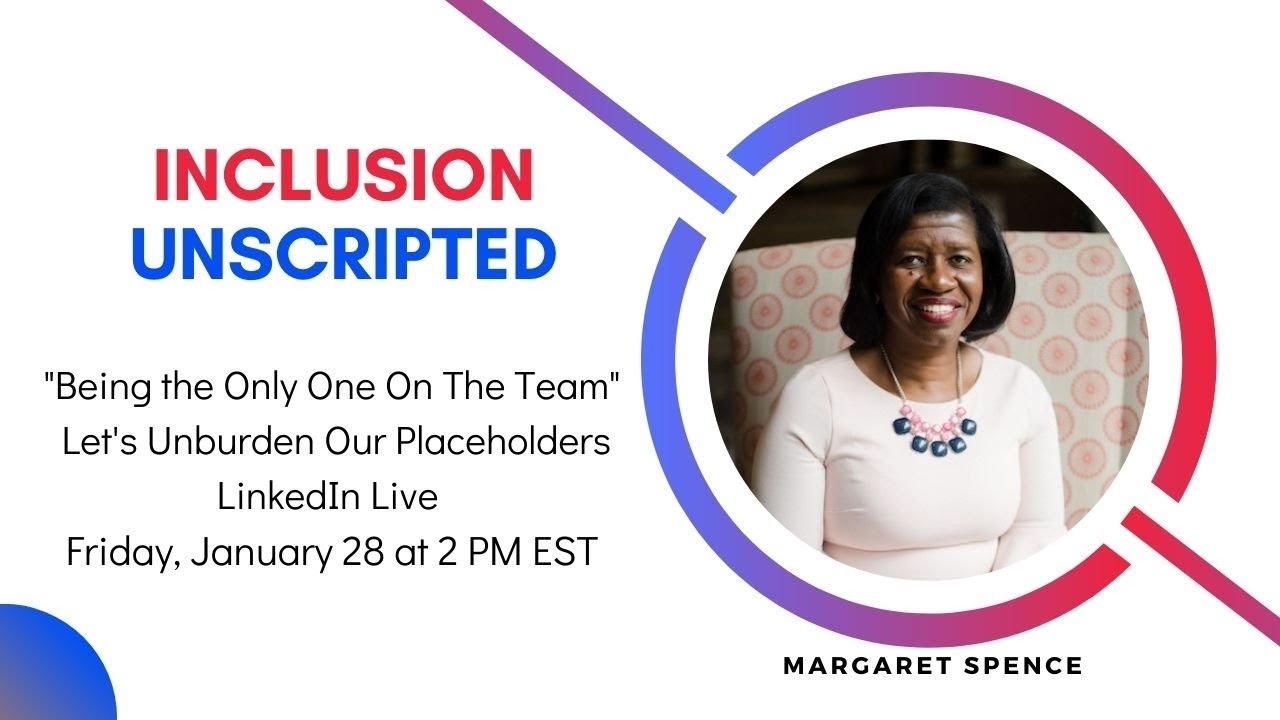
In this live episode of Inclusion Unscripted, host Margaret Spence (founder of the Inclusion Learning Lab) defines and dissects the "placeholder" syndrome – the condition where a single employee represents an entire demographic (e.g., Black women, LGBTQ, immigrants) within an organization. She traces the origin of the placeholder model to talent practices of the 1960s‑70s, when affirmative‑action policies created a one‑person “opportunity” that was expected to hold a space for future hires. Spence explains how this legacy produces cultural taxation, constant proof‑burden, and a forced separation of skills from ambition: organizations value the visible skill set of the placeholder but deliberately limit their upward drive. The conversation expands to generational placeholders (immigrants, first‑generation college students) and illustrates the personal toll through anecdotes about Spence’s own family. She argues that modern DEI and talent‑strategy initiatives fail because they never address the underlying placeholder framework. The episode ends with a call to action: map every placeholder in an organization, ask why they remain, and redesign talent pipelines to enable thriving rather than mere visibility. A free webinar “Do No More Harm” (Feb 2) is promoted, and future broadcasts will focus on Black History Month and Women’s History Month.
Chapters
Hi everyone, welcome to Inclusion Unscripted, our live recording every Friday at 2 PM Eastern time. I'm so excited that you're here. Thank you for joining me live, and for those of you who are watching this in the replay, um, thank you for listening to the live program. Let me just give a little brief introduction. Inclusion Unscripted is a weekly live podcast where we talk about diversity and inclusion, women's leadership, issues around equity and equality, hard, tough questions in the workplace that don't often get discussed. We don't have a script, we don't write a script, we have a topic. I normally speak from the heart. And what I want to ask you to do is to be open to hearing the message. Inclusion Unscripted means that in order for me to be fully me and for you to be fully you, we have to be fully ourselves together. We have to be included. You got to hear our voice. We want to know that you understand and see us for who we are. We deal with professional subjects, career topics, and we focus in on clear solutions that need to be implemented. And we try to give a voice to what is happening on the ground in the workplace, in the communities that we live in. And how do we as a group, as a community, create inclusion for everyone? For all of you that don't know me, my name is Margaret Spence. I am the founder of the Inclusion Learning Lab, where we put on webinars and courses and training programs for organizations around diversity and inclusion, and also really honing in on women's leadership development, talent acquisition, and talent development. If you want to know more about the Inclusion Learning Lab, visit inclusionlearninglab.com for more information there. So before I wrap up the infomercial part of this, this live event, we have a live webinar that is going to be next Wednesday, February 2nd. The topic is Do No More Harm. It is about elevating and evaluating and analyzing talent strategies that fail as we build talent strategies around diversity, equity, and inclusion. I'll put a link in the chat and we'll have that available for you if you'd like to join us for that. It is a free event.
So today, Inclusion Unscripted, we are going to talk about being a placeholder.
And that's a topic that when I said the name placeholder to a friend a couple days ago, and she said, "I've not heard that before." So I want to really talk today about when you are the only one in the organization, on the team, doing the work, when you are the only one and you are representing an entire generation of people because you are the only one. And so maybe we haven't had the word placeholder used in a long time. The placeholder word was pretty was pretty there for a long time, and we talked about being a placeholder. And so I wanna really define what a placeholder is. So if you've beaten the odds, you have gotten to the top of your game, you have been hired in the organization, you've been elevated to management or leadership, and you are the only leader within your category that you identify with, in the organization and you are the lone voice for your entire community, you are a placeholder. If you are a Black woman and you are the only Black woman in leadership, in executive leadership, you are the only woman, um, Black woman on the team, you are a placeholder.
If you are the only woman on the team, no identifier.
I identify as a woman. I am the only woman on the team. I'm on a team with a lot of men. You are a placeholder. If you are the only Hispanic on a team with a lot of people who are non-Hispanic and you are representing the Hispanic community and you are the one that is called on to translate every time there is a Hispanic customer in the room, you are a placeholder. If you are a Black man and you have been hired and you have been empowered in, in the sense of empowerment, and they've given you a promotion and you are leading a team or you are leading others and you are the only Black male on the team, You are a placeholder. If you are a member of the LGBTQ community and you are the only one that openly identifies, and you may have others who are not openly identified, but you are the only one that openly identifies, and when they are LGBTQ issues in the organization, you are the one that everybody comes to and asks you the questions, and the uncomfortableness of that, you are a placeholder.
Placeholders in the '60s.
So let me give you context. In the '60s, during the Civil Rights Act, when the Civil Rights Act became law and organizations were looking at affirmative action and equal opportunity was the terminology that was being used in the and early '70s. The idea was that we were going to give people an opportunity. And so those of us who are minorities and women took those opportunities to go into the organization. We took the spot and we went into the organization. When we got into the organization, we knew that we were holding a place for others to follow. We had to be at our best, whether you are a woman, a Black person, Hispanic person, an Asian person, um, LGBTQ. For our LGBTQ brothers and sisters, that's a whole different issue, right? Let's talk about race first, 'cause I'm gonna get to the other part of this. When it comes to racial category, you knew that you were given the opportunity to hold a space so that the organization could feel comfortable with someone who looked like you, who showed up like you. And so we were asked in the '60s and '70s to assimilate into the organization. And by assimilate, what it meant was help the organization feel comfortable about you in your category. And that went for women too. Help the men on the team feel comfortable that a woman is on the team. And there were lots of articles. If you go back through the archives of newspapers, you will see the conversations that were occurring then in the '60s and '70s '70s around Black women entering the, the workforce, around Black men coming into the workforce, around women coming into the workforce.
There were attacks against each category.
For example, there was a whole attack that nobody even remembers now because it's so far removed, that there was an attack around, well, if you're a woman and you're a mother, you shouldn't be in the workforce. You should be at home taking care of kids. And so when working mothers showed up in the workforce, we were there to hold the spot so that another working mother could show up in the workforce and feel comfortable. When it came to the LGBTQ community, they held the spot, but they held the spot in silence because they could never come out and say, "I'm gay." They could not come out and say, "I'm gay." That was not a thing because the fact that you revealed yourself as being gay, you probably got fired instantly.
So they became silent placeholders in organizations.
That was the foundation that, that we are actually addressing now in 2022. See, oftentimes when we unpack talent strategies, when we unpack talent acquisition and talent development strategies, and we go out and we say we're building talent management and talent strategies, and we're gonna create organizational pipelines that empower people who don't look like the normal. When we say that, we often don't realize where the current talent strategy was built. The current talent strategy that we are still grappling with in 2022 was built in 1967.
That's where it was built.
That is exactly where it was built. 'Cause there was the mental model of June Cleaver staying home with the kids and cooking. And there was the mental model that Black people weren't efficient and sufficient. And there was the mental model that the members of the LGBTQ community could never be themselves. So that is what we are building on.
And so over the years, systems and processes have been created to, quote, level the playing field, but we never went back and address the original placeholder syndrome that we have, we cannot move forward.
And so as we are in this crossroad of talent strategy, talent development, diversity and inclusion, everybody wants diversity and inclusion. We have to understand the foundation that the blocks and bricks and lumber have been built on.
The foundation that this has been built on is, is based on placeholders. And so we never actually left. No organization has ever, has actually ever left the placeholder syndrome or the placeholder process from the 1960s. We've never actually left it. What we've done is found new ways to package it, new ways to talk about it, new ways to identify it, new buzzwords to add to it. What we have never done is gone back and said, how did we build the process we are reaping today? Because here's the thing that I know, right?
My granddad was a farmer. Right?
And if he planted potatoes, you put the little slip of potatoes into the ground, that potato comes up in a while, okay? If you plant an avocado tree, you put the avocado tree down in the ground, it may be 5 years before you get an avocado off of that tree. What we have is a talent strategy that's been built on 60 years of stuff. That's what we are, that's what we're working on.
But we are still thinking that we're working on a new strategy, a new process, a new push.
We are actually, we have never actually addressed the original problem we had. The first problem, the first problem is we built a talent strategy based on placeholder principles.
Let's give one person an opportunity.
And then we went to all the categories. Pick a category. We went to them and we said, we're giving you a spot. And then we convinced all of the underrepresented groups that they were getting an opportunity. And then we incentivize that opportunity, and then we weaponize the opportunity, and then we scarcity context the opportunity, and then we slice the opportunity and diced it.
And today we still have an organizational issue where we don't have enough representation everywhere, and we still have companies that only have one person, one person in this role, one person in that role, one person in the other role.
And we are still trying to fix talent strategies when the problem we have is that we have a placeholder mentality within the talent process. That's it. I could end this now. I could, I could wrap this up right now.
We literally have a placeholder problem.
And if you are the placeholder, let's flip the switch a little bit.
If you are the Black woman, the Black man, the Hispanic man, the Hispanic woman, the Asian man, the Asian woman, the member of the AAPI community that is the only one, or the LGBTQ person that is the only one on the team, you have the cultural taxation of representing your entire culture. And the conversations in the closed walls of organizations go something like this: You know, we gave Margaret an opportunity. She was the best person for this role.
She was the best, right? She was the best.
But Margaret screws up something, and then the discussion becomes, did we make the right choice giving Margaret this job?
Did we make the right choice? I don't think we made the right choice about Margaret Spence, because the thing with being a placeholder is that you constantly have to reinvent your place. Every morning you reinvent that place because the place is not secure. That's the diff— that's the thing with placeholders. Your spot, wherever you are in the organization, is not secure.
You are constantly having to go back every day and prove over and over and over again why your spot is important, why you are the right candidate for the, for the, the role.
Because it seems honestly, for people who are underrepresented in an organization, we are constantly having to prove our worth and worthiness over and over and over again.
And there's never a conversation that goes, Margaret, I think you've done an excellent job. You are solidly in this role, and we recognize that you may need some grace in how you develop. And if you make a mistake here, It will not be viewed negatively against you as a person or your group as an entire category.
We never have that discussion. And we don't train managers how to have that discussion with individuals who are placeholders. And here's the other part that is even more telling is that we never ask the placeholder, what are the challenges of being a placeholder.
So we don't have that discussion either. So more or less, individuals who are holding the place, who are holding the category, who are sitting in the category, are on their own. They are resilient because they keep showing up, and in the back of their mind, when am I going to screw up? And lose my place in this line.
That's what goes on. And so for all of you out there who are building talent development and talent strategies and talent acquisition processes, I wanna pause you a little bit and ask yourself within your organization, where do we have the placeholder syndrome showing up?
At what level, at what jobs, at what roles do we have the placeholder syndrome where we have people who are the only one who are being culturally taxed to hold a place and prove that everybody else is worthy? And you could say to me, Margaret, we don't make people prove that they're worthy.
Yes, you do. Yes, you do make them prove that they're worthy. You make them prove it over and over.
Let me tell you how the proving process works. The person is given a, um, a review, an annual review, and a lot of organizations are doing annual reviews now. Why you do it in January is beyond me. To me, you do the review at the end of the year and you give the person the opportunity to set a 12-month goal based on the calendar, but who am I? I'm just a general person talking, right?
Okay.
So now you're doing your review and the person gets their review and they think, okay, I've contributed, I've done a lot. And there's always a negative that drops onto the review that we have to now go back and justify. We have to go back and say, but that's not really what happened. Let me tell you what happened. And then we spend another 30, 40, 50 hours, 2 hours, 3 hours trying to prove to you that what you put on the review was not correct. That's the truth.
So we're still having to prove our spot all the time.
Here's another way that we have to prove our spot. We will watch other people come into the organization and we'll watch them quickly get promoted.
Nobody has ever come to us and said, hey Margaret, do you want this role? Would you like me— you know, we're thinking this role is going to come open in 6 months. Do you want this role?
And if you want this role, here's some steps that I'm going to work on to help you get ready for this role because I think you're the right one for it. So we don't get a lot of that. We don't get a lot of that as placeholders. Because the idea is we are supposed to bring our skills to work but not our ambition to work. Let me say that again. When you are a placeholder, the idea is that you bring your skills to work, not your ambition to work. You are the best at what you do.
You are the best at what you do.
Because they wouldn't have made you a placeholder if you were mediocre. They wouldn't have made you a placeholder if you were mediocre.
Wouldn't have happened.
So, but at the same time, they want you to sit in the same role because your skills are excellent, but they do not want you to bring your ambition in the door as well. So you get to come in the door with your skills, but not your ambition. I'm gonna let that sit out in the ethers because that is what happens with placeholders. We come with our skills, but not our ambition. And so the organization wants our skills. They want to say they have Black and brown people and LGBTQ people, in the ranks. They want to show our pictures. They want to know that we're contributing to the bottom line, but they darn well want us to not be as ambitious as we want to be. And so your leaders sit around trying to make sure that we are not as ambitious as we could be.
That's the truth. That is the placeholder process. That is the placeholder process.
And this happens so much with women.
Let's not even talk Black and brown.
Let's just talk women. If I am a white woman, brown woman, Black woman, any shade of woman, we want the skills that the women bring to the table.
Because honest factor, there are certain skills that we bring to the table that a man will never bring to the table. Truth. Let's not lie about anything. Remember, this is Inclusion Unscripted. There's no script. I don't have a script. I don't have anything I'm looking at.
I am talking to you based on knowledge and understanding of the granular aspects within the workforce.
So As a woman, I show up, I have a goal, but your leaders get to add a dimmer switch to my ambition. And you do that by saying, Margaret, you're not quite ready yet. You know, with that skill set, we need a certain type of person for the sales role.
We're looking for a characteristic. Okay, we want a culturally fit person, or the The best one that I hear is, "We want the most experienced person." And that becomes the jade and the shade of blocking my ambition.
Because I now don't, because you don't qualify. And here's the thing with talent. Nobody asks anyone to qualify what they've said. So if you say, "I want the most qualified person for the role," and you pick the same white guy over and over again, right? What is the qualification that he has that you were looking for? And HR folks, we don't ask that question.
We fall back into the narrative of the most qualified person.
If I ask you to unpack those two, those three words, the most, four words, the most qualified person, if I ask you to unpack it, you would go, well, you know, it means, and that, da da da da, 'cause you don't even know what the most qualified person is. You have no idea what it is. But placeholders, women, people of color, underrepresented groups, get to try to navigate and figure out how they're going to attach their ambition to your most qualified lens. That's what happens.
We get to decide how in God's land do I attach my ambition to the most qualified lens within this organization. So as I said it like a few minutes back, the original sin that we are fixing in the talent strategy and talent acquisition dynamic is the fact that we have a placeholder problem that we never fully evaluate and we never fully map the placeholders in our organization and then ask ourselves, why is this placeholder sitting here? Why is it that this person is the placeholder? Is it because The person has so much skills that we don't want to lose them. We don't want to move them. We don't want to develop them because we don't have a way of attracting a talented person to sit in that seat. So rather than empowering this person of color and/or this woman and/or this member of the LGBTQ community, we would rather have them as a placeholder because that checks our lack of experience on hiring people.
That's it. That is the secret sauce. You know, McDonald's has a secret sauce on the burger.
That is the secret sauce of talent strategy.
I just gave it to you all for free. That's it. Because your employees—
here's the thing that I want people, all of you doing the work of DE&I, I want you guys to hear this, hear this clearly. We have fought for diversity, we have fought for inclusion, we have fought for equity, we have fought for equality, we have now fought for belonging.
What we have never fought for is thriving.
People who come into the organization, even if you are a placeholder, you must be able to thrive.
Must be able to thrive. You know, some of you have picked up this Jedi thing about justice and equity. There is none of that if I can't thrive.
If I am the placeholder in the organization, I am the one that you get to say, yep, this woman, this Black person, this brown person, this person of the Latin community, this person of the Asian community, this this person of the LGBT community makes me feel comfortable enough to come in the door.
Because here's the thing with placeholders: we are there because the organization at some point felt comfortable with us.
They felt comfortable that we wouldn't rock the boat. They felt comfortable that we wouldn't go off the reservation that they're building for us. They felt comfortable enough that they would build an island around us and we would stay on that island, and they would infest the, the outer banks of the island with shark and alligators.
And we as the stakeholders, as the placeholders, would stay put on the island and they would not have to do anything to us except place us. That's the truth.
And so what happens, what happens is people come into the organization and we find ways to turn their lights out so we could keep them on the island.
Truth. And so you will have organizations that you will run around that organization.
If you did an org chart, and not an org chart of the leaders, an org chart of the humans, every single person that's there, you would say, yep, this department has a lot of placeholders.
This department got even more placeholders.
And so, like cream on fresh milk coming from the cow, we get to rise, but only as far as you want us to go, because you're never, ever, ever going to focus on our ambition. You are only going to build your strategies around the placeholder syndrome that was the original sin from 1967.
That's what we're gonna do.
That is what we are going to do.
That is it, right?
That is what we're going to do. We are going to build our placeholder process based solely on the fact that we want people to be visible, but we don't want anything else. Because we're uncomfortable, and we've let a few people in because we're comfortable with them. And thank you, Michelle, for putting the wonderful chat in. And yes, this was the thing: bring your skills but not your ambition. Yes, bring your skills and not your ambition.
And this is the truth. This is what We have to address. We have to address it.
We cannot just say we have placeholders.
We can't say we have placeholders.
My mother was a housekeeper when she made the decision when I was a baby infant to come to the United States to be a housekeeper. And she left me behind with my dad and my grandmother. And when I came to the United States, I was a placeholder for her dreams.
I was a placeholder for my mother's dreams.
She knew that if she came and had an opportunity, I would have an opportunity. That was it. So immigrants, which is a whole category that we don't talk about in HR, The immigrant population are all placeholders.
Our parents come to the United States to hold a spot for us.
And then we come here under the ambition principle of we are going to be able to build our skills and we're going to be able to rise because our parents came first.
When you talk about first-generation college students, They are placeholders for their entire family. We're gonna pour our entire heart and soul and finance and body and everything into this one individual that's gonna rise for our family.
They are the placeholder. And when they get a job and come into your organization, when I am a Black woman, Black man, Hispanic woman, Hispanic man, Asian man, Asian woman, um, Latin woman, all the categories. When I come into the organization, I have already been a generational placeholder for my family.
See, this is how this works. I have been a generational placeholder for my family.
For me, I'm a generational placeholder for my mother. My late mother. I am a generational placeholder for her.
My son, I have two of them, one is a lobbyist.
He's one of the few handful of Black lobbyists in this country. My other son is a cybersecurity developer.
He's in tech, another place. Both of my sons are placeholders in their industry. Because finding a cybersecurity developer who's Black, hmm, not easy. A software engineer who is also a cybersecurity developer who is Black, not so easy. Placeholder. He's holding a spot in the organization he works for so that they could see his skills, they could see who he is, and they can develop him. My older son is a lobbyist. How many Black lobbyists do you know? Not many. He's a political consultant. He rides around with all these famous politicians. He had Cory Booker do a video for me last election cycle.
That's where my older son is.
But within Florida, there are a handful, maybe 10 Black lobbyists, and they hold a spot waiting to be fully accepted. That's how this works. That's how this works. But when I am holding the spot and also holding my generation, and I'm also holding my people, and I'm holding everybody on my shoulder, it is emotionally psychologically and physically draining. And when you as an organizational leader don't understand the placeholder process, then you get to build talent strategies that do not really include me, the underserved.
I'm not talking Black or brown or white, I'm talking underserved women.
And here's the other part about being the placeholder. For Black professionals, especially, and Hispanic professionals, if we rise, we are also the checkbook and bank account for our whole family.
So we have taxation going on on us as professionals, emotional taxation, and then we come into your workforce and you get to take our skills and not our ambition. Because our ambition was riding on the fact that our grandmothers and our grandfathers and our forefathers did something to allow us to have the first opportunity. And our placeholder was because generationally we feel that we have to be good and we have to be more than good enough. We have to be more than good enough because We are holding the place for our generation.
And we want to make sure that when we show up in the workplace, you see us fully. You see us fully. And you see us through the lens of, I've given Margaret an opportunity.
Where else can I help her take her ambition?
The question that I always ask every time to organizations and to individuals.
What do you want and why don't you have it now? That is my coined question. I wrote a book on it entirely for women. So the question is now for all of you in HR, all of you in leadership, all of you out there who are doing this work, Okay.
How do you evaluate fully the placeholders in your organization?
How do you evaluate fully the placeholders in your organization? How do you do that? How do you build a talent strategy that takes into account that historically your organization has existed and built your talent process on a one-person opportunity platform.
That is it.
You have built your entire talent strategy on a one-person opportunity, and then you get to instill in us that we are fighting for the one position. And then we as people fight against each other because we are fighting for the one position.
And then you make it so that scarcity is where our heart is.
And we fight with each other. We dig each other's eyes out for the one position because we are placeholding for our whole generation, but we are also financially placeholding for the entire community that we are a part of.
And so this is the, this is the root cause of why talent strategies are in turmoil right now. We never addressed the foundation, the concrete that this talent process was built on. So I challenge all of you to look at your placeholders. Every organization has it. Some of you have it in your DE&I director.
That is the highest level person in the organization that looks Black, or you have a system where women are relegated to one role, or the highest level woman in your organization is the VP of HR, Chief HR Officer, diverse, or the Director of HR. That's the highest woman in your organization. But beneath that, you have women who have had first rung promotions that was the end of their entire process.
That is it. So we cannot build talent strategies without addressing the original sin.
I call it a sin. The sin of being a placeholder.
That's the easiest thing to do, and it's not hard. You guys know where all the placeholders are, but you've never done a good evaluation of why the placeholder is in the space and why the placeholder is still in the place and how long the placeholder has been trying to leave the spot.
Because just because you planted me doesn't mean I get— I don't get to grow. Let me say that again. Just because you planted me in your organization does not mean that I don't get to grow. If you plant me as a placeholder, fine, that's your talent strategy. Placeholders, if you are planted more than 5 years, build your resume and get out of there. Y'all don't want to hear that because Margaret's not supposed to say that because she's a consultant. But if I am saying to you that you are a placeholder for 10 years, for 20 years, What is the purpose of that?
How much money have you personally left on the table because you are a placeholder? How much money have you left on the table because you are a placeholder? How much have you left on the table because you are a placeholder?
That is the hard discussion that we often don't want to have.
So I thank all of you for coming to this event today.
We have an upcoming webinar called Do No More Harm: Analyzing Why Diversity Talent Strategies Fail and Why the Fixes That You All Create Don't Work Either and Why You Always Get Blamed When They Don't Work. It's February 2nd at 2:00 PM Eastern. I'm gonna drop the link to register for it into the chat. Please register and come. It is free. Thank you for all for attending. Thank you for the great feedback. Tamika, thank you. This is good. Michelle, thank you. And Jeffrey, thank you as well. And Maxine, thank you as well. So we are going to continue this discussion next month is Black History Month, and the following month is Women's History Month. For the next 8, um, broadcasts that we do on Friday, we're going to talk about career development for women and for people of color. And I'm going to unpack every single week a process that I think we need to go and look at because our talent strategies cannot be built upon bad foundation. We have to go back and dismantle the foundation and then build the process based on a solid ground built on equality, equity, inclusion, and also built on the ability for individuals to thrive. Remember, I don't wanna bring my skills to work and not my ambition. So thank you all for joining me, um, and thank you for showing up. I'll see you next Friday at 2:00 PM. We're also gonna have a career challenge for 28 days for Black professionals here on LinkedIn. So I appreciate all of you for coming and being a part of the broadcast today.
And I have to say, great participation.
So thank you again and visit inclusionlearninglab.com if you want to know more about our training programs.
You're like a circle that floats around me. Keeping me safe and sound. And when I fall, you tied a rope to me. You're blessing me every day. I was down with an illusion, like a sparrow with broken wings, but now I shine with your reflection on me. I'm getting back up on my feet. That you showed up.
Thank you again, everyone. Have a wonderful weekend. See you next Friday. Take care, stay safe. Bye.








