E14: The NFL Is Corporate America
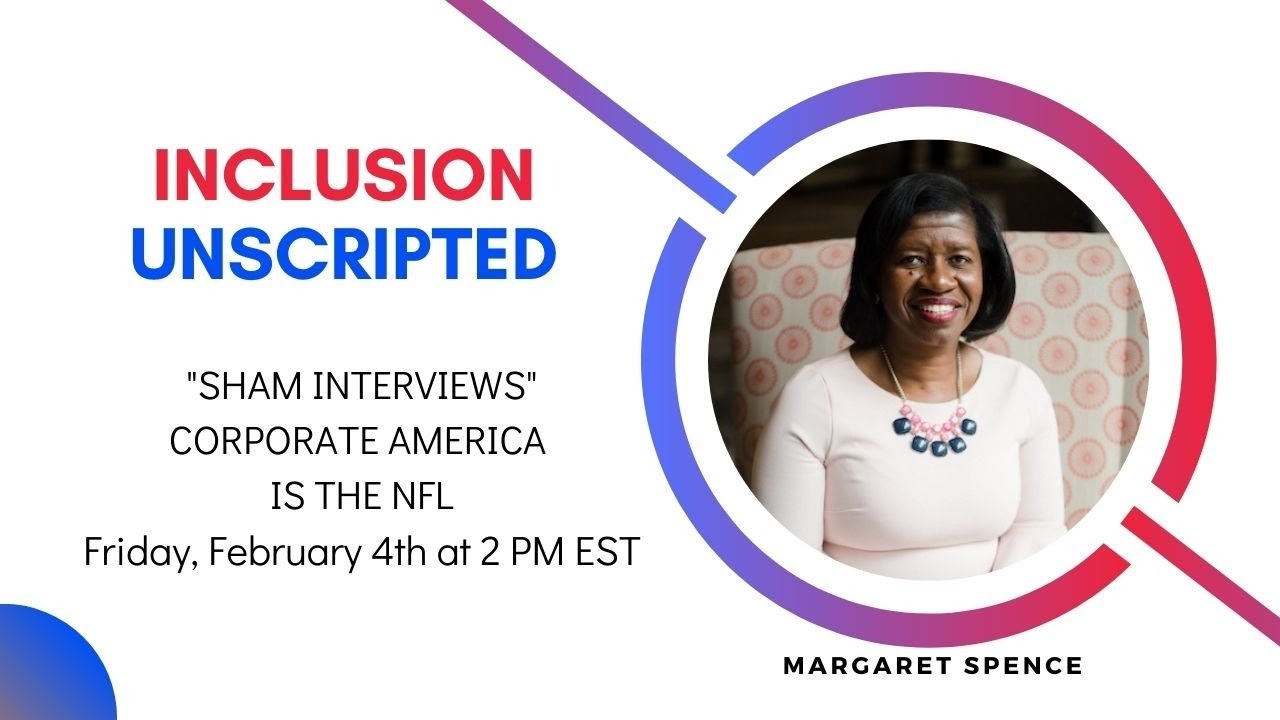
In this unscripted episode of the weekly "Inclusion Unscripted" podcast, veteran DEI consultant Margaret Spence celebrates 23 years as an independent consultant while using the high‑profile NFL racial‑discrimination lawsuit (Brian Flores vs. the NFL) as a lens to critique corporate hiring practices. She recounts her own entrepreneurial journey, describing how she built a consulting business from scratch with the help of a single client and her children’s labor. Spence then details how HR and recruiters conduct tokenized, "sham" interviews that give the appearance of diversity without genuine intent to hire, promote, or retain Black, brown, and women professionals. She introduces the concept of the "glass cliff"—assigning marginalized leaders to under‑resourced, high‑risk, or controversial roles that set them up for failure—and outlines three archetypes of such assignments. Spence critiques the language used in DEI work, arguing that terms like "most qualified" mask bias and that unconscious‑bias training is insufficient. She challenges affirmative‑action narratives, highlights the emotional toll of the "angry Black woman" stereotype, and calls for a shift from merely achieving diversity to creating environments where people of color and women can truly thrive. Throughout, she offers concrete calls to action for HR, recruiters, and leaders: stop tokenism, re‑examine hiring language, address virtual‑work‑induced career black holes, and prioritize equity over belonging. The episode ends with a rallying invitation for listeners to enact real DEI work beyond symbolic gestures.
Chapters
Hey everyone, how are you? Margaret Spence here. Welcome to Inclusion Unscripted, our Friday live podcast on LinkedIn, Facebook, and YouTube. Um, thank you for joining me today. I am so excited. Um, to be here and so excited that you're able to join me today on Friday and you're spending your Friday with me. And if you're watching the replay later on in the week, uh, so happy you're here. So before I get started, let me tell you about Inclusion Unscripted. This is a weekly live podcast where I bring cutting-edge topics to the table, unscripted, without A Script, where you get to hear from me from a perspective of a woman doing diversity and inclusion work with extensive experience in HR and coming to you unscripted with diversity, inclusion, equity, women's leadership development, and career advancement for people of color. That is the goal of Inclusion Unscripted. That's why we're here every Friday at 2:00 PM, to be unscripted, to say what needs to be said in an unfiltered format and giving voice to what goes on in the corporate workspaces. I give tips, advice, and I talk about hot topics. So first, It is Black History Month, and we are kicking off Black History Month with topics about Black professionals in the workplace. That's the start. The other big thing— and I should be standing, I was trying to do this standing today, but I decided to sit down— um, this is my 23rd year as a consultant. 23 years. I, um, can't even tell you how I'm embracing that. I haven't had the wine yet, I haven't celebrated that number yet, but I tell you what, inside I'm celebrating. As a Black woman, I left corporate America 23 years ago. I have not looked back. I have embraced this journey with all of the valleys and the peaks and the crazy and all of it. The mistakes, I own them. The happy parts, I own them. The joy and the shadows and all of that, I own it all. It has been my journey, and I can't say enough, um, how appreciative I am of the clients who believed in me as a Black woman, who gave me opportunity when there was none. I tell this story, and I think it's important that you all hear my beginning story. When I left my corporate risk management and HR role to go out on my own, I picked up the phone and I called a gentleman in Miami. His name is Tony Abella. He's with Arthur J. Gallagher. And I said to him, I said, Tony, I'm going out on my own and I have no clients. Um, I've decided I'm quitting this job cause I can't do it anymore. And I'm going out on my own. And I picked up the phone and I called Tony and he said, Margaret, come down to my office in Miami and tell me what you think you're going to do. And honestly, I did not know what I was going to do. I had no freaking clue. So anybody that tells you that you're going to jump off the corporate cliff with an idea and a parachute, they're lying to you. I jumped off the corporate cliff. I called the one person I knew who could believe in me. And I called Tony Abella and I said, "Tony, I need a client." And he said, "Okay." I didn't even know how to price my services. I had no idea what the heck I was doing. I was going out to be a consultant, and Tony said to me, "I'll give you a client. I'm going to make some calls. I'm going to call some of my clients and get you a client." And I said, "Okay." And he says, "What do you want to do?" I said, "I want to do risk management consulting. I want to maybe consult on HR. I want to make this work. And he picked up the phone and he called a gentleman by the name of Abe Finkelstein. And Abe hired me to be his outsourced risk and HR manager. And that was my first client when I started this business 23 years ago. I had a, um, 5-year-old son and I had another child getting ready to start high school. And I, um, went out on my own. And I have worked with some of the biggest brands in the country. I have impacted HR and risk management for some of the leading organizations in the country. They have been my clients. And for them, I am grateful for the opportunity. I am grateful that they believed in me and that for 23 years— and let me give you the interesting story. I have one client who has been with me for 23 years. I have one client. For 23 years, I have been their outsourced director of risk and HR. For 23 years, this client has never left me. They are always there. Um, shout out to Don Elliott, um, an amazing man that runs a phenomenal company down in Miami. And so when I thought about today's topic, first off, I'm celebrating, so that's not gonna stop. I am celebrating this journey, and, and in celebrating this journey, I have made it my mission to help other consultants who want to go out on their own to learn what to do. Because let me tell you, there was no Facebook, there was no Instagram, there was no Twitter, there was no LinkedIn, there was no— barely an email, right? When I started, I had a website. I give you a funny joke, I give you a funny joke because I have to give a shout out to my two kids. So I went out and I bought a list of client and customers. You buy the mailing list and you put it into a spreadsheet, and then you print the little labels, right? And then I went to Office Depot and I made a brochure in, um, Microsoft Publisher, and I wrote all the information of everything I wanted to do on that brochure. And I had my kids come home from school every day, and their only job was to put, uh, stamp and labels on the trifold brochure that I was going to mail out. That is what my kids were doing. I had my 5-year-old kid on child labor working on building this business. And both of my sons have gone on to amazing roles in their career. And, um, I can tell you that they tell me about the stamp licking and the— and it wasn't the stick-on stamp that we have now, it was the stamp licking. So they had a little a little plastic thing with a sponge at the end, and they would have to lick the stamps and put them on the envelope. And then eventually we got a bulk mail mailer, and we would put them in, and I would have my kids sorting the mail by zip code, and we would bulk mail out our seminars and training programs that we did here in Florida. Um, and I would have my kids sorting zip codes so we could do our bulk mail every Thursday so our potential clients could get it on a Monday or Tuesday. And I built this business not on my last name but on my first name, in honor of my mother who came to this United States when I was a year old to be the housekeeper for one of the most prominent company families in this country and gave me the possibilities that I stand on. And I think it's important that we hear my story. I don't apologize for my success because I earned it in every trench, every corner. And my clients hire me because I am the best at what I do. And every day I'm learning and growing and becoming the best. So today's topic hits home for me. It hits home in such a hard way, um, for me as a Black woman professional that I don't even know where to start with this one. But I'm gonna start. I'm gonna unpack it because I think it's necessary. So the topic of today's podcast, besides me celebrating And I really should have music and be dancing, but that's beside the point. The NFL is corporate America. Hello! Hi, corporate people! The NFL is you. You know, if you are living on the planet, you know that there is a class action suit that's been filed against the NFL for racial discrimination in hiring, and it is moving towards being a class action. It is moving towards being a class action. And I honestly, when I wrote this, I said, you know what, every corporate company should be on that class action list. All of you. Yeah, yeah, yeah. I'm not parsing my words today. Remember, this is Inclusion Unscripted. I don't have a script. There's nothing here except what I wrote to post this podcast. This LinkedIn Live. Now, you know, as an HR person, and I'm gonna talk to HR first, you know, as an HR person that you have participated in the sham interview of Black professionals. You are my people. I'm an HR person. You are my peeps. I've spoken at enough SHRM conferences and led enough mega, mega speaking things at SHRM and multi-conferences at SHRM So I feel really empowered to talk to you people, HR, my camaraderies, my people. You've led sham interviews, you've participated in sham interviews, you've utilized Black professionals to meet your goals, to check your box. We've had to participate because for us, we didn't even know what opportunity was. So the fact that we got the interview, we're like, oh my God, I got the interview. And we come to your interviews with a whole heart, fully prepared. We show up fully prepared to be in your sphere, and you let us down because you're willing to participate in this tokenized sham interview process when you really have no intention of hiring us, retaining us, or promoting us. And you— and, and I'm gonna read something else because I think it's important that I read this to you all too. So let's— let me read that part in a second. But this is something that this lawsuit This class action lawsuit calls out, you know, we have our own Rooney Rule in HR in corporate America. We just haven't given it a name, but the name we give it is bring us some more diverse talent. That's how we term it. Make sure the slate is diverse. And well, so you as the recruiter, let's go to you guys, the recruiters. You go out and you recruit the best Black and brown candidates on the planet. You dig up every rock to find us. You spend countless hours combing LinkedIn, poaching us, or attempting to poach us from our current employers. And when you do that, we come over, we participate in your fraud. We participate in your fraud. We do. And so we participate in the fraud. I wore my Dolphins necklace today, right? And for all of you that don't know, I live in Florida, right? Dolphins thing is down the road. I was a Tampa Bay fan, not a Dolphins fan, but it's okay. But I'm in Florida, I'm supporting the home team. Whichever one of the home team gets to the top, I'm there. And you all know, HR, back to you, that you've given us a glass cliff to fall off of. You've given us a glass cliff to fall off of. You know it. So let me give you some scenarios that how this plays out. There's a high-level position in your company. You have no internal Black candidates prepared. But you have the chosen one in the wings. You got the chosen one in the wings. So you go through the process of this executive search, and many of you will hire a search agency and pay them thousands of dollars to maintain the fact that you don't plan to hire us. I mean, I don't even understand this. This is psychotic, right? It's psychotic., and then you'll go through this multiple layers of interviews. I have a friend that was just applying, and when I say a friend, a young lady that I was coaching just applied for a job, and for 7 weeks they interviewed her. 7 weeks, multiple interviews at layers and layers and layers of the organization, only to say in the end, well, we decided to go with the internal candidate. Well, why the heck didn't you make that decision in the first place? What did you— what did you want, comparison? Or did you thinking you were gonna have buyer's remorse? That you take an individual through the emotional stress of 20 interviews— yes, 20 interviews— only to say, thank you for coming to the party, it's been great, we are going with the internal candidate. Who applied for the job. Really? That's what this class action is all about. That's what this is all about. Brian Flores has said what every Black and Hispanic and Asian and, and Native American candidate has thought. He put it in a legal document to sue the NFL. And many of you have had discrimination lawsuits filed by your employees or filed by your candidates that you've been able to settle out of court under the quiet with non-disclosure agreements. So we just don't know how corrupt your hiring practices are. That's the truth. That is the truth. That's what I'm talking about today. So let me tell you, um, there was a post on LinkedIn earlier today, and I want to read you the post, and then, um, at the end I'm going to share the post with you. Um, the post was put out by Tara Jane Frank. She's an equity strategist and C-suite supervisor— C-suite advisor. And this is what she said, and I'll read it because I think it's important that you all hear it. A glass cliff. So when you hire us— when— so let me back up. You don't want to hire us, so you give us the tokenized interview, and then you do hire us, but when you hire us, you give us the worst assignment. You give us the setup for fail. Because here's the thing about the Miami Dolphin NFL, um, Brian Flores' suit. What he is saying is, uh, you hired me and then you wanted to pay me to lose. And he didn't just say this when he filed the suit. There's actually several interviews of him saying this to the Miami press, saying, um, I'm not gonna, I'm not gonna lose, I'm not going to lose, you hired me to win. Because for us as Black professionals, we are hired to win. We are hired to win because what we know— in last week's show, I talked about being a placeholder, holding the place for others. If you didn't hear that podcast, go back and listen to it. I'll share it when this is over in my feed. We are placeholders for the next person to come. So we don't come into your organization to screw it up. We come into your organization to build it. Better. We come in to bring our skills, and you would not have given us an opportunity if we weren't better than every other candidate that you interviewed, because you don't hire mediocre Black people, right? In the corporate side of the hiring process, when we come to maybe, um, you know, the lower end of the hiring process, you'll say, I want everybody. But when it comes to this level that Mr. Brian Flores is being hired, you are expecting us to be the best. And when we show up as the best, you create a glass cliff. It's no different to the glass cliff that's given to women CEOs. Prior to now, a woman CEO was appointed to a Fortune 500 company that was already fallen off the cliff and then when it fell off the cliff, the woman CEO got blamed, i.e., Yahoo. Truth. Lots of articles written about that, right? So let me tell you what the glass cliff is. A glass cliff is an assignment in which a Black leader gets promoted into a role that the company leaders do not expect to succeed long-term, and they require borderline heroics like acts of God to be successful, right? There's several types of glass cliff assignments that are given to people of color. The first one is the unimportant role. The company may feel pressure to create or maintain a specific role that's not so important in the company, so it has no power, no resources, and insufficient team, and then the Black leader is put in charge of it, and when it fails to show progress, they're— they are scapegoated. I.e., the diversity director role in your organization. Yep, that is an unimportant role that everyone feels pressured to create You underfund it. You don't give it a team. You give it no resources, and you hope that the baby drowns in the bathwater. Oh yeah, I told you this is unscripted. Unscripted. This is unscripted. The next type of role is one that is impossible. The challenges are great. The tools are few. The goals attached to the job have a 50/50 chance of being met. If the Black leader succeeds, they are rewarded with praise, but not money or opportunity. Hello, corporate America, you got an NFL problem, right? And if we fail, we are labeled a failure in the organization. And your career gets on a steep decline while a white male leader can fail multiple times and get opportunities to try again. Hello, HR, talking to you today. I'm talking to you, Corporate America. You got an NFL problem. All y'all got an NFL problem. And the third type of role is a controversial role. A Black employee is asked to lead a body of work that is inherently difficult and comes with built-in resistance. The work may be counterculture and come with high reputational risk. If the Black employee doesn't have incredibly strong relationships, they will not be successful. Since relationships are often the only force to overcome the cultural barrier that you've given us. And there you have it. And I want to thank— because this is not me— I want to thank Tara Jane Frank. Connect with her on LinkedIn. She posts some amazing stuff. This is her work. I'm taking no credit for it. This is what she wrote this morning. This is it. And then when I complain about these impossible things you've given me, you call me the angry Black woman or the angry Black man, just as they are doing to Brian Flores right now. I was on a call a week and a half ago And the leader on the call said to me, it was the same day that the Supreme Court decided to take up affirmative action. And the leader said to me, "What do you think about affirmative action? 'Cause I know you're on the other side." I don't know what side I was supposed to be on, but that was his caveat to me. "I know you're on the other side." What do you think about affirmative action? Well, here's the response. Your daughter is the only one that will benefit from affirmative action. It will not be my daughter or granddaughter. It will be your daughter. Because the Civil Rights Act benefited white women more than it benefited Black women. Let me get that straight. Because organizations got to say we're diverse because we have a lot of white women in our midst. You got to say it when the reality is you have then shut out Black women, um, Native American women, Asian women, Hispanic women. You shut us out, but you get to claim diversity because the law goes for all of us. The law was not meant just for Black people. So my question is, if there was no affirmative action, if there was no Civil Rights Act, would we still be standing in the line that says Blacks only? So as you claw back the rights that we are trying to get, as you claw it back, Would you have ever created an equal playing field if there wasn't a law? Would women have been included in the workforce at the level they are without the Civil Rights Act and Title IX? No, they wouldn't have been. And somehow in this mix, we are okay with sham interviews, and the terminology, "I hired the most qualified candidate." Yesterday I did a webinar and I talked about languaging used to describe men, the language used to describe women, and the language used to describe diverse candidates. If you are building a diversity and inclusion program, and you want to stop your sham interviews, then you have to go not to the unconscious bias training that you all are doing. You need to stop that and start listening to how people describe the people of color in your organization. And you have to go and really start working on changing the languaging because there is a language of progress. There is a language of potential. There is a language of possibility. But for Black and Brown professionals, you don't give us that language. You give us the most qualified candidate. You tell us we gotta be so qualified and we aren't ready yet. And then I'm telling you, let me pause for a second because there was something else I posted on LinkedIn today. There was an article by HBR about the angry Black woman. Let me tell all of you this. Let me go back to the angry Black woman a little bit because I'm a student of history, right? Because I grew up— I came to America when I was 3, but I grew up in the Caribbean, and they actually taught me history. They actually taught it, so I learned it. The very first book my dad bought for me when I was 5 years old was Before the Mayflower. That's the very first book my dad bought for me and was about the slave trade from the beginning till when, till 1840 or '50. And I read that book as a kindergartner because I was a ferocious reader and I was pretty smart for a 5-year-old. Yup. So here's the deal. We are no longer, as Black women, going to allow you to give us the angry Black woman label. You see, you gave that to our slave ancestors because you wanted to silence them, and so corporate America picked it up as the angry Black woman. And you want to stop our emotions. You don't want us to show you our emotions because our emotions scare you. But guess what? It is, it is untenable for my well-being to shut down my emotion because you're uncomfortable. Untenable. Not okay. I can't shut my emotion of anger down when you invite me to a sham interview and you don't give me the job over and over again. You give me the list of things I'm supposed to do, I do all of them and I do them better, and you still don't offer me the job. Corporate America, you are the NFL. You are the NFL. Uh, Brian Torres could— Flores could be suing you. He could be asking for class status, class action status against you. This is the truth. This is the truth. So we sit around and we want to say we're building diversity, we're building inclusion, we want women. Let me, let me pause for one second and talk about— talk directly to women on this. You walk into an organization, and when you walk into the organization, there aren't any women in executive leadership. Let me tell you what that says. It tells me as a woman, whether I'm Black or white, Hispanic, Asian, any category where I'm checking a woman, it tells me as a woman that my voice does not matter and I will never be heard. If I walk into an organization and I cannot see a woman in leadership, I know my voice will never matter. And if I only see one woman in leadership, then I know that there aren't enough opportunities for all of us. And I know instantly in my mind that you are going to pit us against each other and build out the scarcity mindset within our mind and our heart. And we will fight with each other at the lower level for the crumbs that are being thrown at the lower level. And we will fight and scratch each other's eyes out as women, stab each other in the back, because we are fighting for the scarcity that you have created in your corporate environment. That's the truth. Nobody wants to say the truth to all of you. But hey, if you join me on Friday at 2 o'clock, you're gonna hear the truth. Eventually, as I said, I'll bring some guests on, but I'm not there yet. I'm not there yet. See, this is the truth. Women are suffering from the Rooney Rule too. Because you bring us in, you interview us, we get all emotional because, you know, y'all think we emotional creatures anyway. We are all emotional and we are all this. And you bring us in, we go home, we tell our families, our friends, everybody, and they're all rooting for us. And if you're Black, you got the prayer circle going because you call up the prayer folks and you say, pray for me to get this job. And the prayer circle gets going, and the people get down on their knees hoping that we get the job. Because y'all don't even know what it is that goes on in the Black community when it is that we, we do the SOS to our community to say, I have an opportunity to get a job. The prayer circle starts, the girlfriends club dial up, the sorority sisters kick in. We all come together because we're pushing this one woman forward. And you HR people take advantage of our emotions. And we are resilient because we end up dialing back up the prayer circle when we don't get the job to pray for us. So we continue to do this stuff. We have to call the prayer circle back up and we have to say to the prayer circle, give us strength, put hands on us, cause we gotta go back into this fight again. White folks, that's what we go through as Black people. I'm talking from personal experience. But for you, it's a game. It's a game to do the sham interview. It's a game to do the tokenized garbage. If you don't want us, say it, because we want to be where we can thrive. I keep saying to all of you doing diversity and inclusion work, Stop doing diversity and inclusion. Start asking the organization, how will Black people, brown people, Hispanic people, Asian people, LGBTQ people, and women thrive in this organization? Don't do, oh, we want diverse people. No, heck no. We are moving from diversity. We are moving to thriving, not belonging. Because we've had to belong. We've had to belong, and our prayer circle got us through trying to belong in your organization. Our prayer circles, our girlfriend circles, the Hallelujah Club, the church ladies with the pretty hats is who have helped us get to where we are right now. There's going to be a fight about the first Black woman assigned, appointed to the Supreme Court. And let me tell you, I am locked and loaded for that fight. Complete. Because Black women will not be annihilated by the system any longer. I will not plant my seed in an organization that cannot water it and help me grow. And that's the work. For all of you doing D&I work, stop asking them how diverse they want to be. It's obvious they aren't doing that. So if I bring my diverse people in this door, how will they thrive here? That's the work. My father is 92 years old. He will be 93 if God spares his life on March 1st. When my dad was born, he couldn't ride the bus. Okay? When my dad was born, there wasn't a real bus, but he couldn't ride it. When I was born, the Civil Rights Act was passed. I became a grandmother in December, and my voice got even louder because my grandson will not enter this corporate world. And the Lord above will spare me to build a foundation that he will walk into so that he does not have to walk into your foundation. That is my goal right now, because I do not want to see another Black professional have to be runied We don't need a Rooney Rule. We need you to see our possibilities and our potential. We want you to see that we have done everything we could to be perfect for you, that you give us the opportunity for equity. Equity, meaning you pay us, you give us the right jobs, You advance us and you empower us so that we can empower our community. So you don't get to say, "Oh, everybody gets a fair shot." No, we don't start off at the same place. We'll never start off at the same place unless we stop doing the makeup work of D&I and start doing the core stuff. So here's how I want to leave you guys. I want you all to go into your organizations and I want you to ask yourself, how do people thrive here? How do people of color thrive here? How do women thrive here? How do we enable, how are we enabling sham interviews? How are we enabling tokenization? Let me tell you, a, a, one of a young lady that I'm coaching, she reached out to me and she said, I've been sitting in this desk for 8 years. Let me give you this psychological stuff. She was not a person of color. She says, I've been sitting in this job for 8 years. I've given it everything. I've done so much stuff for this organization, and she was referred to me for coaching. And she said, their position came open that they've been telling me that they are grooming me for, and our director got up in the meeting and said, Sally Sue is leaving and the position is coming open and I'm giving the job to Jane. No interview, no opportunity to apply, nothing. This was not a woman of color. This woman was white. And she sat there in it, in the meeting, feeling like her heart had fallen out of her chest. When she called me, she described it as a tightness in her chest. She felt that her hope, everything that she had put her life work in, had just fallen out from under her. And for an hour and a half, I coached this woman through tears and anguish. She was not okay, but she held it together in that meeting. And she called a friend who knows me, and the friend referred her to me because she knows that when a woman is in crisis with their career and you have my number, you can call me. And I'm not like the other folks who want a checkbook at the end of it because so many women are in crisis right now. And I talked to her through tears of anguish and anxiety And she said, 'What could I have done different, Margaret?' And I said, 'Nothing. It's psychological abuse.' I recommended that she go to counseling because I felt that she was so close to her own existence that it was scary for me talking to her. This is what corporate America is doing to employees. This is what you're doing to them. This is the pain that they are experiencing on top of COVID on top of everything else, on top of trying to live with a mask, with vaccines, with this, with that, all of that. They're trying to live. They're showing up. One of the things that I'm gonna say to all of you is that career black holes are being created because of the virtual work environment. You are leaving people behind who you didn't notice before, and now they're at home and you get to pretend that they don't exist. We're gonna have to talk about that one day too. It is not okay. It's not psychologically safe for us to continue to do sham interviews, to say, "I have the most qualified candidate." HR people, please remove the most qualified candidate from your vocabulary. Please just do that for all of us. Because I don't, if I ask you to describe the most qualified candidate that you've hired, that stayed for a long amount of time, you couldn't give me the core skills that made you hire them. You hired them based on some gut instinct, right? You hired them based on a gut instinct and they checked the box and the team liked them. That's really why you hired them. But I'm leaving all of you with a simple thing. If I cannot thrive in your organization, If I can't thrive, if I can't see my way clear in your organization, there is no reason for me to be there. You know, Mika Brzezinski on MSNBC, she says, "Know your value." Know your value, right? That's what she says. I say to all of you, what do you really want from us? What do you really want from us as Black and brown professionals and women? And I don't ever leave out women because just as much as we are pained as Black professionals, women are also experiencing the garbage. Because you know you will sham interview a woman and hire the guy you want to hire because he's blessed. We gotta get away from blessed hiring. Or blessed promotion, or the chosen one. And we've got to do the deep work to unpack the inequities in our organizations in order for us to move forward. We have to do it. So thank you all for hanging with me. Thank you for all of you who put things in the chat. Um, thank you for everything and the absolute support that this LinkedIn Live on Fridays is having from all of you. And I want to thank— I'm going to try to remember his name. He featured my podcast today and I was beyond excited. Gabe Leo, I'm probably saying his name wrong, but Gabe, thank you for featuring our podcast on LinkedIn today. That was an amazing milestone for me. And I'm so, so, so happy, um, Gabe, that you were able to, um, feature my podcast and highlight me. So for Black History Month, what are you all gonna do differently? What are you going to do differently? Don't put out the Black History statements. Save them and go into your organization and do the real work. That's what we're asking you to do. That is what we are asking you to do, the real work of diversity, equity, and inclusion. Join me next Friday at 2 o'clock Eastern. I will be here. We are gonna have another hot topic, and maybe by then, um, the president might have appointed the first Black woman to the Supreme Court, and we will talk through that as well. Remember, remember, for all of us, you are important to our journey, and we cannot succeed without all of us uplifting each other. There is no exclusion here. We need allies and partners to lift us up, and I would ask all of you to lift us up together. Thank you. See you next week. Take care. You're like a circle that floats around me, keeping me safe and sound. And when I fall, you've tied a rope to me. You're blessing me every day. I was down with an illusion like a Take care everyone, have a wonderful weekend. See you next week. Bye.








