E19: Professional Gaslighting and Disrespect Is Our Normal
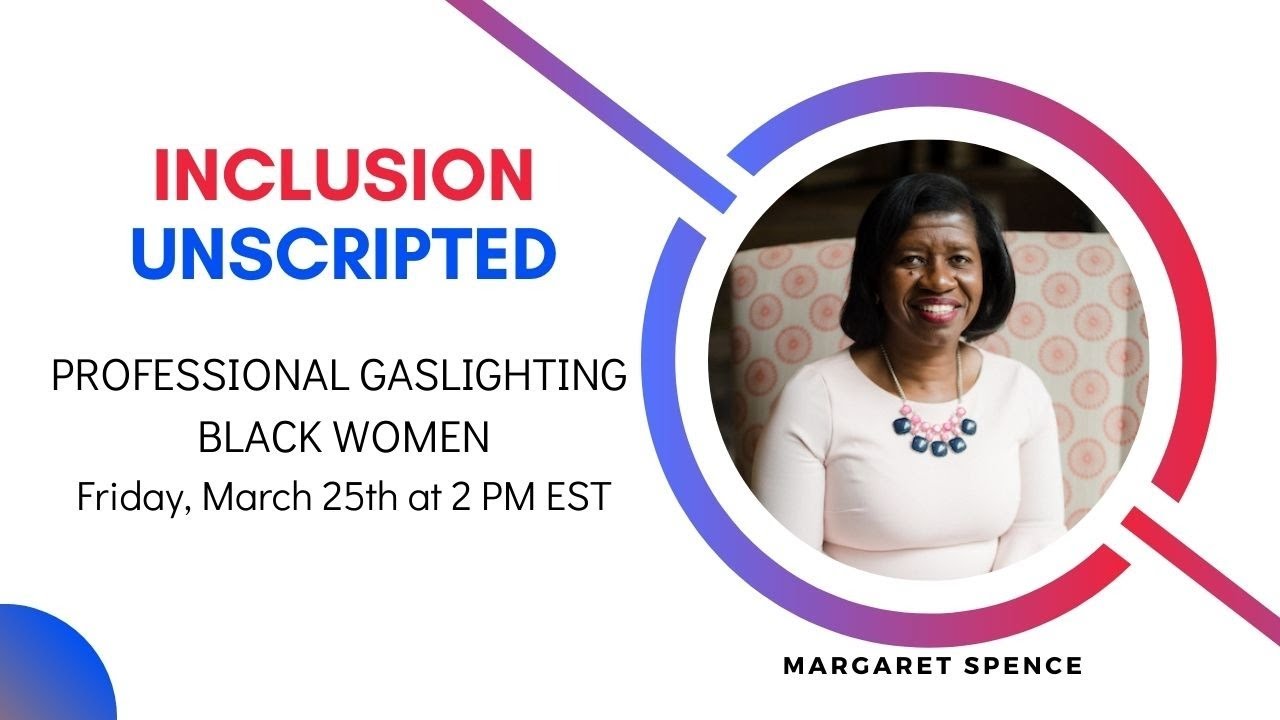
In this episode of Inclusion Unscripted, host Margaret Spence delivers a candid, impassioned monologue about the pervasive professional gaslighting, microaggressions, and systemic disrespect that Black women face in the workplace. She frames the recent Senate hearings involving Justice Ketanji Brown Jackson as a mirror of the daily experiences of Black women across all organizations, describing how even senior consultants are gaslighted and labeled aggressive for speaking up. Spence announces the launch of the Inclusion Learning Lab community, a safe space for DE&I practitioners, HR professionals, and Black employees to support one another. She shares personal anecdotes, historical context of racism against Black women, and calls on white allies and organizational leaders to intervene, set policies against gaslighting, and hold managers accountable. The episode offers concrete advice for Black women: re‑evaluate career fit, set firm boundaries, document achievements, and develop exit strategies. Spence also recommends key readings (Minda Harts, Frederick Joseph, etc.) and urges HR to treat complaints seriously, implement anti‑gaslighting policies, and stop treating Black women as “toilet bowls.” The talk concludes with a call to find personal “Cory Booker” allies, upcoming webinars, and a hopeful note on empowerment and self‑worth.
Chapters
Well, hello everyone, how are you? Margaret Spence joining you today on Friday, my usual hour where I'm here for Inclusion Unscripted. Welcome to Inclusion Unscripted, where we are here living diversity and inclusion, not just creating it. We're not talking about diversity and inclusion, we're living it. Inclusion Unscripted is my weekly podcast at 2 o'clock Eastern time, live on LinkedIn, Facebook, and YouTube. And in Inclusion Unscripted, I discuss things that maybe we don't want to hear, or maybe we're uncomfortable to talk about. But I'm here to show up every Friday to be bolder, than we expect, to challenge the norm, to say what needs to be said, and to build a more inclusive work environment for everyone. So this week we got a couple things on the, on the schedule. This week we're going to talk about microaggression, Judge the Honorable Judge Jackson and what she went through this week as a Black woman. We're gonna talk about the fact that we are all Judge Jackson. Every Black woman that is working out there in the world right now has had this week that she had. So we're gonna unpack that. Today. We're going to talk through it, but I want to, um, really point out why I do these weekly podcasts. Why is it that I come here every Friday to talk about a topic that may be so uncomfortable? I feel that we need to start having honest conversations about diversity and inclusion. Honest conversation about the experiences that we go through, not only as people of color, but as women, as human beings in this world. And thank you guys for joining. You know, let me say, let me start off by saying this: Black women are not okay this week. So all of you employers out there, who have Black executives in your rank, who have Black women in high places, who have Black women in your regular employee lists. We are not okay. So let's not lie to the planet and say that we are okay, because we are not okay. At many points this week, I've been on the verge of screaming at the top of my lungs. And for all of you who know, my dad is 93 and he lives with me. And so throughout the day, I will pop into my kitchen and I'll come out of my office, pop into my kitchen, and I'll say, "Hey, Dad, what's going on?" And it never fails. He's watching CNN, MSNBC, Bloomberg, something, okay? And I'll say to him, what, how are you feeling? And he will begin to express his anger as a 93-year-old. And what he'll say to me is, I didn't think we would still be here. And so I hear that every day from my dad. My dad says, I didn't think we'd still be here. I thought we would be in a different place. Place, but we're not there. And so today's conversation is honesty. Today's conversation is my real experience. Today's conversation may be very uncomfortable for a lot of you. Honestly, if it's uncomfortable, you can dial out now, but I am talking to every Black woman out there in the universe right now. I'm talking to us because what Judge Jackson experienced is what we experience every day. And here's what I know, even at my level as a consultant where organizations are bringing me in to help them build DE&I, I am still gaslighted I am still faced with microaggression. I am still— there is still an attempt to demoralize me as the consultant coming in the door. So if I'm dealing with it as the consultant coming in the door, what the heck are the line employees going through? How does that work? And we, we can't We can't not deal with this anymore. We gotta call this out. So today, that's what we're doing. But before I get into the meat and potatoes of today, I want to share some huge news with all of you. We are— on Monday, I'm letting this baby go. Um, I— on Monday, um, we are launching The Inclusion Learning Lab community. It is fully built, as you can see if you're watching live, you can see it on the screen. The community is fully built. It is here to, to be a safe space for those of you doing diversity and inclusion work. Because what I figured out and what I know from the work that I'm doing every day, there is a gap between the work you're doing and the strength and perseverance, as Judge Jackson said, the perseverance that we need to get up every day and do the work of DE&I. This work is the hardest work. It is the most siloed work. It is the most thankless job in the organization. Thankless, because there's always a matter of blaming the person doing the work to build DE&I. So we have created a community, a community for us, HR, risk manager, anybody, DE&I professionals, anyone doing the work of inclusion. Can join the Inclusion Learning Lab community. And what we're going to do in here is create a safe space to support, educate, nurture, and build the diversity community, especially the women and Black professionals who are tasked with taking on the stress of creating an anti-racist work environment. Because that's the real work that we're doing. We're trying to dismantle the system that you all have gotten comfortable with. So this has been my work for a year to pull this together, to bring it here. And so today I want to introduce it on my podcast today. Inclusion Learning Lab Community. So Monday we launch. We're going to throw the ore out. I'm going to stop my perfectionism. And yes, I'm a perfectionist. I always want it to be perfect. We're going to stop the perfectionism. I'm going to launch it, put it out there for people to join and come in and begin to do the work within a community that is safe for us to do the work. So having said that, let's talk about today. Here's a thing that, that is— that happened to me recently. I spoke up about something I felt I needed to speak up about. I, I raised my voice in an arena where I was being paid as a consultant. I raised my voice and I said, what you're doing is not right, and here's why. And I was emotional about that. Raising That Voice. At the end of Raising The Voice, I was accused of being aggressive. I was accused of being loud. I was, I was, I was, I was accused of being intimidating. I was accused of being downright inappropriate for raising my voice against something that was being done inappropriately, that would have landed horribly for minority employees and would have affected their psyche. But when folks are in their own little bubble and they live in their bubble and they hire you to do DE&I work and they really don't want DE&I work— at least not everybody wants it. We have to really recognize that. No, not everybody wants When I raised my voice, I was told that I was intimidating. How do you be intimidating when you're raising your voice on something that is factual? When you're giving the lens of your own experience? And after the incident, I was professionally gaslighted. Yep, happened to me. It did. And so when I watched Judge Jackson this week, I had already been there a few weeks earlier. I had already been there. I had already watched white women attack me as a Black woman. I watched the female senator who couldn't stand up to her male counterparts attack a Black woman who was more qualified in the morning when she got out of bed than this woman who was asking her the questions. Because if you're dumb enough to ask me what is a woman, then you really shouldn't even be sitting in the seat you're in. But everybody has their agenda. But this is what I figured out: because we have normalized aggressive hateness, aggressive hate, we have normalized it. People think that it is okay to come after us as Black women. They feel it's okay to come after us. And it doesn't matter whether I am the CEO, the executive, the consultant. As long as I am a Black woman, there is a— there's an immediate attraction to come after me. Immediate attraction. It's like you, you just sit back and you wait for the opportunity to gaslight us. And it makes you feel good. And, and here's what I know. Let me, let me say this in the most gentle way I can. White women will do this with a smile on their face, but other races will pick up where they left off and come after us in the same way that that our white counterparts do. Somehow we've gotten it in our heads that we can take a crap on Black women and we're supposed to smile, we're supposed to feel, we're not supposed to say anything, we're not supposed to push back when we feel that we are wronged or when we feel that the situation that we're in is not correct. We, we are, we are not supposed to do that. And so one of the things that happened this week is our honorable Judge Jackson was forced to sit in silence. She couldn't say anything that would make them feel intimidated. She couldn't say anything. She had to sit there and suck it up, right? She had to take it. She couldn't do anything about it, unfortunately, because if she had pushed back like Judge Kavanaugh and had a boo-hoo-hoo moment, we would have been labeling her the angry Black woman. So I've been labeled the angry Black woman for raising my voice, but I'm not angry. I'm just pushing back against a system that's been built to eliminate us, and I'm just pushing back against a system that's been designed to marginalize us. I'm pushing against a system that's been designed to make us as Black women feel that we are not enough. You know, a few weeks ago I did a program about being enough, and I talked about how we have to recognize that we are enough. We have to recognize that we are enough. But here's what I know from watching these hearings this week and having to turn away from them and come back and say, how do I support this sister? What prayer do I need to say and send up for her, because right now it's prayer that she needs. What I realized is that there are women out there in your workforce right now going through this, and there isn't a bench of people standing behind them. There isn't a set of folks showing up to help them. There isn't anyone standing up to them. So if you are a white ally, are you brave enough to stand up for Black women when you see and know that we are being taken advantage of? That is the question. Are you able to stand up for us? But it's not even that you stand up for us, it's are you brave enough to stand up for us? Are you able to take your capital and put it on us? You know, I was on LinkedIn last night and Karen Fleshman Esquire wrote a thing and I shared it and I wanna read it for all of you. She said, I yearn for white women to be in solidarity with Black women. Imagine how powerful it would have been for Senator Blackburn to check her colleague's racism and misogyny instead of inflicting harm too. Let's unpack that for a second. If you see someone inflicting harm on me and you stay silent in the room, you're just as complicit. In my psychological trauma as the person who issued it. So how do you stand in the room knowing that I'm being inflicted with pain partially because I'm better than you, partially because I'm good at what I do, partially because it's better to demoralize me than empower me Partially because you're insecure that a Black woman can show up smart. So here's the rest of the discussion. I had a discussion around being perfect. That was the discussion that got me into trouble, okay? The discussion that got me into trouble was being perfect and not ready. That was a discussion that got me into trouble. Right, because today is an honesty day, because I honestly don't care. I'm discussing this because I think it needs to be said. Every Black woman, from the time you are born, your parents tell you you have to be perfect. Every Black boy, from the time they are born, the parent says you have to be perfect, because you have to be perfect when the cop stops you. You got to keep your hand on the steering wheel to keep him from killing you. You gotta be perfect, right? For a Black woman, we have to be impeccable. And even when we are perfect beyond the shadow of doubt, you still find a way to stab us in the back and stab us in the heart at the same time. It doesn't matter how perfect we are. It doesn't matter. And, and Judge Jackson proved today that perfection doesn't get us anywhere when it comes to respect. It gets us to the places we need to go. Think about this for a second. This woman went to Harvard, got an undergrad degree, went to law school, got a law degree. Then she went on to have a storied career, one that is beyond impeccable. Was she perfect to every single letter? Nobody is. But she led a life that led her to today. And somehow in that life that led her to today, that perfection that her parents told her— see, here's what my mother said to me when I was 5 years old. She says, "Speak good English because if you don't speak good English, they won't let you in the room." This was 1968. She said to me, "Make sure when you walk in, you put your chest back. Keep your head up. Look high," she said. "Don't look down because when you do, it tells them you're inferior. So look up, look in their eyes. Don't be afraid." That's what my mother told me at 7 years old. 1970. My mother then said, "Be perfect in school. Read all the books." And so I read every book I could read. She says, "Be an A student." So I did that. She says, "Now build a career." And I've done that. But still, Despite the fact that I've written 3 books, I've had a 23-year consulting career, a 38-year insurance career, people still feel the need to gaslight me. So it doesn't matter how perfect I am. What did I tell my kids? I told my sons— I have 2 of them, one is in tech, the other one is a lobbyist— I told both of them Be perfect, as perfect as you can, right? Because that's what we are told. Because you will not hire us if we are not perfect. You won't hire us. You won't trust us with your process if we're not perfect, because what you will say is, I'm looking for the most qualified candidate. I'm looking for an imaginary Black person to take on this role. They gotta be perfect, they gotta have the right credentials, they gotta come from the right school. They gotta come with all of that to come into the sphere and be a part of your life, your community. But here's what I know. We trust you with our lives because when we take your jobs, we come there not to get your psychological trauma, but to be empowered. And instead, what happens to Black professionals, especially Black women, is you disempower us and then you gaslight us, and then you make us think that we're crazy. You make us think that we are crazy, right? You say things like, well, that's not what we were thinking, that was not our experience. Give us grace. Give you grace? How you giving us grace? That's what you say. And so this week I watched a wonderful woman with a beautiful family, an amazing husband, a daughter who looked at her through the eyes of love and empowerment, being torn down to the point where my hero Senator Booker had to come in and say what need to be said. Let me tell you what else Karen, um, Fleschmann said. She said, every day in workplaces across America, white women treat Black women just like Senator Blackburn treated Supreme Court nominee Katonji Brown Jackson. We inflict harm and we observe our white colleagues harming Black women and we do nothing to intervene. These patterns persist even in women's rights organizations. The result harms all women. Although women are graduating from college at higher rates than men and entering the professional workforce at higher rates than men, the United States is the most dangerous country for women among wealthy countries. Not by a little, but by a lot. Across every measure, most dangerous for Black and Indigenous women. Women in the US have the lowest life expectancy rate around— among Western countries, and our life expectancy is diminishing. White men make up 30% of our society, let— yet hold 62% of public offices. If the majority of white women would empower all women, all women would have better lives. Our country would be safer and freer for everyone. And so here is what happened that I think a lot of people missed. There were lots of other Democrats on that stage. In the last 2 days, and none of them stood up like Cory Booker did. None of them stood up like Cory Booker did. Cory talked about the eye look. You know, we do— we walk into a room, we scan the room, we look for somebody that looks like us, we hope that they are okay, and we walk up to them and we give them the look. We don't even need to say hello because we got the look going on. We do it. It's a part of our psyche. We acknowledge people by a nod. Good to see you're in the room with me. We acknowledge it by a nod, but we also know when we walk in these rooms, these executive rooms, when we walk into those rooms where there are none of us, that no one in that room will fully protect us. We know this. We know this, that you will not fully protect us because you are not brave enough to stand up for a Black woman. You are never brave enough to stand up for us. That is the truth. That is the truth. Black women will have education, we will have experience, and we'll apply for jobs and you'll tell us, oh, you're not quite qualified enough. But you will hire someone that is beyond incompetent and you will promote them and then ask us as Black people to train them, to make them a competent, and you will expect us to do it with a smile on our face. That's the experience of Black women in the workforce. You will microaggress us every day. You will say nasty underhanded things. You'll come to us with your aggressive tone. You'll send us emails that are red and highlighted and underlined, right? You'll do that and you expect us to sit back and take it. And if we dare to open our mouth to speak the truth, then you decide to come at us because we are not allowed to speak the truth. But let me have an honest discussion about this part because I heard someone say this on MSNBC. Let me tell you where this aggression against Black women comes from. Let's unpack this fully today. Back from the days of slavery, you demoralized Black women. When we were on the slave ships coming across, you raped us. When we came across and we had our children, you snatched them out of our arms and you sold them. When, when you wanted to demoralize the Black men, you took it out on us. When you wanted us to be subservient, you took it out on us. And so in our DNA and our culture, in our DNA, in our culture, is a standing, a standing spot to demoralize Black women. It is baked in our cake. It is baked in your cake. It's baked there. And so when we get into the workforce now, years later— let me back up. When we were going and when, when the march was to get voting rights for women, Black women fought to get voting rights for women. We stood there during suffrage. We did all the things, but we didn't get it because the white women that, that were there, they got it. Because in the end, once they got they needed, they walked away from us. See, this is how this works. This is the foundation that we're building on. Let's be honest, this didn't start today. What happened to Judge Jackson didn't start this week. It started back hundreds of years ago, and we've been building the blocks on that nasty building forever. We've been building the blocks on that nasty building where Black women are the doormat for your microaggression and your professional gaslighting. And so you couch it in, oh my God, I love, I love you. No, you don't love us. What you love is what we bring to the table. We love the production that we bring. I've said over and over, weeks and weeks, that you want our skills but you don't want our ambition. You want our knowledge but you don't want to groom us. You want our knowledge but you're not willing to empower us. You want our knowledge but you're not willing to walk the walk so that we feel whole as women as we walk down the road with you. This is the truth. This is what nobody wants to say. I'm sorry, guys, I can't butter this up anymore. Organizations allow Black women to be demoralized every day because you don't see us as humans. You don't see us as full humans. You still see us as partial humans. You will see a Black man and say, yep, we'll let him in, he's threatening but not so threatening. But when it comes to Black women You have a, a vision and a mission to chop us down to nothing. I cannot tell you how many women reach out to me on a weekly basis to tell me about the absolute horrid conditions that they are working in and the managers and leaders that they are working for. My inbox, my DM on LinkedIn is filled with that information. I get this every week, and some weeks I'll send a calendar link because I feel so horrible for what that woman shared with me in my, in my message, and I'll say I'll give you an hour on my schedule. Every week I have at least 3 to 4 conversations with Black women who are sitting in, in situations that has taken them so far down that they are questioning their current competence. They're questioning their mental health. They're questioning just their worth because the organization allowed the leaders to demoralize the Black women. This is the truth. This is what's happening. This is what's happening. So we've got to stop this. I keep saying every week, stop it. But we have to call it out. We have to ask you all to be braver. We have to ask you all, when you see it happening, when you know it's happening, don't pretend like we're crazy when we come to you and say this is happening to us. Don't pretend like we're crazy. You know, when I was sitting in my issue a couple weeks ago, I pulled out Minda Harts' book, Right Within: How to Heal from Racial Trauma in the Workplace. I think this week, after what we watched with Judge Jackson We all need to pull this book back out and read it. We need to pull this back out and read it because the gems of empowerment that's in this book can't be lost. We need it. Here's what I know: there isn't a Black woman this week who is okay. There isn't a Black woman this week that is okay because I'm not okay, and I know my friends aren't okay, and I know that my white women friends aren't okay either. So let me not say that every white woman doesn't support us. There are women who genuinely support us. But there are so many who don't, and there's so many of other ethnic races that also feel that they should take a dump on Black women. It's not just white women taking a dump on us. Let's be honest here. Let's be honest. Let's be honest. Let's be honest. So here's— there's two books. One for HR folks I want you guys to read: Diversity Is Not Enough. Diversity Is Not Enough. We got to do more work. For all of you who are trying to figure out how to be our friends, how to support us, read Frederick Joseph's book, The Black Friend, on being a better white person. I like to give people books. So let's talk about solutions. Let's talk about what are we gonna do as Black women to survive this crazy. Let's talk it through. First off, Black women, this is all about you right now. We need to understand that we are not here to be punching bags for our organizations. Your job title is not worth the psychological trauma. We need to empower ourselves. The Great Resignation, as they're calling it, it should be called the Great Re-evaluation. We need to re-evaluate what we're getting from the organization, because if we're giving and we're not getting, then we need to evaluate where else we need to go give it. That's the first thing. The second thing is we need to learn how to set boundaries without an emotional cry. We can be angry, step away, come back and set boundaries for these folks. Set the boundary. Because what's happened so often, because we've been taught to do this, we've been taught to be quiet. To let it run off of us. But it's not running off. It's stuck in our body. It's stuck in our brain. It's stuck in our heart. It's the reason why we have heart disease. It's the reason why we die young. It's the reason why we have cancer. It's the reason why we have diabetes and hypertension. We need to set boundaries for these people who are demoralizing us on a daily basis. Set a psychological boundary against this bad behavior. But let me talk to you guys in HR, okay? HR leaders, stop acting like Black women are crazy when we come to you to complain. HR people, we are not crazy. Put the human back in HR and understand that if a woman comes to you 100 times to complain about the way her boss is treating her, that it's real. It's not a fantasy. It's not something that she thought up in her brain. It is really happening in the moment for this woman, and we need to understand it. That is what we need to do. HR, you folks that hire people, need to stop allowing women especially Black women, to be gaslighted by incompetent humans who shouldn't have been managers and leaders in the first place. That's what you need to do. And organizations who are setting DE&I policy, you need to set a policy on gaslighting, and you need to set it firm. And when somebody gaslights somebody else, you need to fire them. And it doesn't matter how high up in the organization they are, get rid of them, because their judgment will affect the ability for the organization to exist. That's it. That's, that's it for the organization level. Train your managers. Let them understand that Black women are not their toilet bowl. They don't get to crap on us every day. HR, this is on you to fix this. Because we cannot fix it as Black women working in this environment. And you guys know, every HR leader knows the incompetent, morally bankrupt managers that are working in your midst. You know who they are, but you let them stay morally bankrupt to annihilate women and Black women specifically, and we need to stop that. And here's the thing, if you are the HR person receiving this bad behavior, pack your skills and go somewhere else. You don't deserve to be crapped on every day. Here's what I said to a group for the last couple days: write down the 100 things you've accomplished in your role, bone up your resume, and figure out where you can take your skills where you are appreciated. Do that. I charge you to do that. When we start walking out of organizations, that's when they'll realize that they have to deal with this. They have to deal with this. You may not find another job in a month or 2 months or 3 months, but don't stop looking. And make— when you are looking for an opportunity for a company to work for, Ask what their process is about dealing with inappropriate managers. What happens if a woman complains here? What happens to her? What will you be doing to empower my success? What would it look like for me to be successful here? What has other Black women experienced working here? We gotta hold these organizations' feet to the fire. And we cannot continue to work for organizations that will never value us. See, if the— if your leader doesn't value you today, he's not gonna start valuing you in a week or 6 weeks or 6 months. But we sit in that thinking that that is our only choice. It is not our only choice. When you leave a bad relationship behind, you often say to yourself, why did I stay so long? Because what I found over here is way better. We as Black women need to learn how to manage our careers more effectively. We gotta walk out of this. We cannot sit in it anymore. We cannot allow ourselves to be psychologically traumatized every day. We can't wake up in the morning with knots in our stomach thinking, I don't wanna be in this place. I've been there. When I quit my job 20-odd years ago, I didn't want to get up every day to go into that office. But here's the thing, ladies, here's the thing: you are a whole person. When you are being demoralized at work, that environment that's created at work is coming home to your personal life. It's coming home to your children. It's coming home to your family. It's affecting how you operate as a person. We've got to value ourselves more than the organizations we work for. We have to. We are more important than the company. I'm not telling you to quit your job, give up your paycheck. What I'm saying to you is evaluate why you're still there. The question is, what do you want and why don't you have it now? And it is not the organization's why, it is your why. Why are you staying where you're not valued? What is it about you that feels that bad behavior is appropriate and acceptable? What about you? Because here's what I know, especially for HR people, and I know you got a whole family to support you. Support. I get it. But you can't— I, I've been a single mom. I've been the mom with the money. I've been the one bringing home the money. I get it, God, I get it, I get it. But that doesn't mean that you don't create other options for yourself. It doesn't mean that you don't create other options for yourself. Build other options. Look around and say, what can I do with my skills? Where can I go? I put my arms around you and hug you right now, but you cannot stay in an environment that is torturing you every day. You can't do it. You can't do it. And we don't need to play the race card anymore. Um, we don't need to play the race card anymore. We don't need to allow people to demoralize us. We need to say, my value and my worth is more than this, and I'm going to set a target date to go out the door. I'm going to set a target date to go out the door, and once I set my target date, I'm going to create an environment within myself that I can get the next opportunity. That's what I'm gonna do. That is what I'm gonna do. That is exactly what I'm going to do. We have to get ourselves ready because if we sit in this uncomfortable unhappiness where we are being demoralized, gaslit every day, we cannot be our full self. We can't be and live in our purpose. You know, my— one of my business partners, he says we gotta find our purpose, our why. You know, we gotta create our why. Inigo, that works with me, Inigo says we have to find our why and we have to find our purpose, because if we don't find our purpose and our why that we cannot be fully ourselves. And I cannot be fully me if you are not fully you. I have to be able to live my possibility, live my purpose, live my empowerment. And if a part of me is being psychologically scarred every day, that doesn't leave room for me to grow and become the person that I was intended to be. The universe and the gods did not bring us to this place to put up with demoralizing behavior. Here's something else that I'm going to say. Our ancestors, our ancestors went through hell to give us the opportunity to stand where we are. Our ancestors expect us to live on the grounds that they've built, which means that we do less and less of hell and more and more of things we love. We gotta learn how to leave faster and know our value quicker and not allow people to take advantage of us and be willing to walk away. Just walk away. And yes, the entire planet is on your shoulders, but make a plan to walk away. Your psychological health can never be replaced. It can never be replaced. Your being cannot be replaced. COVID has taught us one thing, that we get one life. One life, and we get to live it now. Because we don't know what's going to take us out. Find your happiness and find a job that will empower your purpose in life. Don't sit in it. That's my message today. That is my message. Become the best version of yourself. Thank you, Inigo. Work is just one of the pillars, but if work is the most horrible pillar, let it go. You're worth more than that as a woman. You are worthy. You are enough. You are built to bring your gifts to the table, not to have your gifts demoralized. So I want to thank all of you for joining me today. This has been a tough week. This was a tough conversation. But one of the things that I left yesterday and the day before with is nobody's gonna steal my joy. Thanks to the honorable Senator Cory Booker. He recorded a video for me about a year ago. My son is a lobbyist and he did a video telling me about my son and how much he loved my son. And so I absolutely love Cory Booker and my son knows it and I've told him. I called him and said, "Oh God, you gotta tell Cory that I love him." Completely, 100%, want to give him a hug. Find the person who is your Cory Booker, because if you're going to sit in a demoralizing world, you need a Cory Booker on your side. Find your Cory Booker, ladies. Find the person who's going to tell you that you're worthy and you could be better and you could get better and you could find better. Find that person. So thank you guys for joining me. We have two things coming up. We have a webinar coming up on Thursday, What If Diversity Succeeds? And we're gonna have a launch party for the Inclusion Learning Lab community on Tuesday. So I'm so excited about doing that. So thank you all for joining me this week, and I will see you all again next week. Take care. <LYRICS>You're like a circle that floats around me.</LYRICS> Keeping me safe and sound. And when I fall, you tied a rope to me. You're blessing me every day. I was down with an illusion, like a sparrow with broken wings. But now I shine with your reflection on me. I'm getting back up on my feet. That you showed up. Take care, everyone. Have a wonderful week ahead.








