E20: HR Team Has No Diversity, But Its Leading Diversity
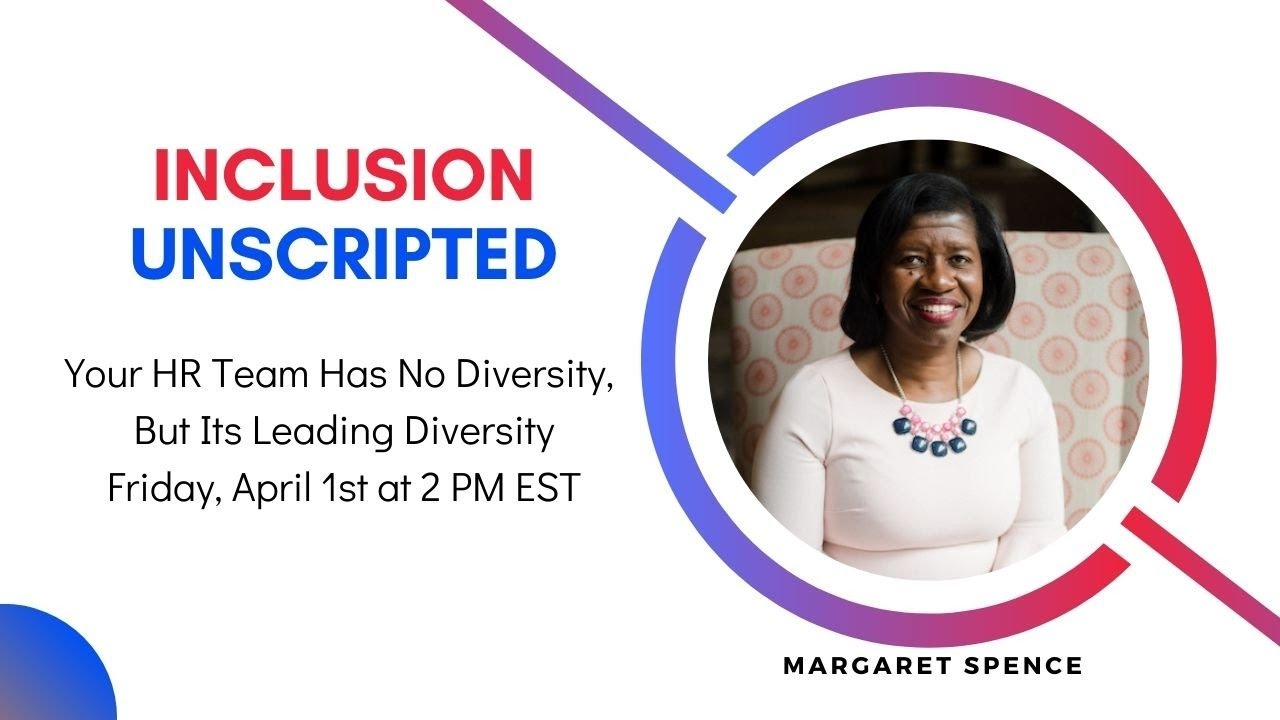
In this live‑streamed episode of Inclusion Unscripted, host Margaret Spence (founder of the Inclusion Learning Lab) argues that diversity, equity, and inclusion (DE&I) should not be housed within Human Resources because a non‑diverse HR function cannot effectively champion DE&I. She cites the SHRM "Together Forward: The Journey to Equity and Inclusion" survey, which reveals stark gaps between Black and white HR professionals’ perception of discrimination, incivility, and organizational commitment to racial equity. Spence also shares demographic data showing that the majority of HR leaders are white, with limited representation of Black, Hispanic, Asian, and LGBTQ professionals at senior levels. She explains how a homogeneous HR team leads to blind spots in talent acquisition, policy making, and employee support, and why this undermines the organization’s broader DE&I goals. The episode offers concrete recommendations: recruit diverse talent into HR, develop internal career pathways, partner with organizations like NAAAHR, and ensure DE&I reports directly to the CEO/COO rather than HR. Spence also promotes the newly launched Inclusion Learning Lab community for DE&I practitioners. The talk concludes with a call to action for HR leaders to diversify their own ranks before expecting to drive organization‑wide inclusion.
Chapters
You're like a circle that floats around me, keeping me safe and sound. And when I fall, you tied a rope to me. You're blessing me every day. I was down with an illusion, like a sparrow with broken wings.
Hello everyone, welcome to Inclusion Unscripted, our Friday program, every Friday at 2 PM, live on LinkedIn, YouTube, Facebook, but but this week we are streaming to Twitter. Haven't done that one before. We are streaming to Twitter today, so I am pretty psyched. Um, I want to thank Kirsten for giving me the oomph to go to Twitter with, uh, today's feed. So for those of you who have never tuned in, especially for my Twitter followers, I've never tuned into Inclusion Unscripted, we are here every Friday at 2 PM Eastern to talk about diversity, equity, inclusion, women's leadership development, all things HR. And we're here to challenge the norm. This is an unscripted program. There is no script that I write. I sort of plan what I'm going to say, more or less, but there isn't a script. What we try to do is disrupt the norm, put a new voice in the arena so you hear a different perspective.
You hear my view really, which is okay. For all of you that don't know me, I'm Margaret Spence.
I'm the founder of the Inclusion Learning Lab, and this program is sponsored by the Inclusion Learning Lab, and I'm super psyched to be here. Before we get started on today's show, which today's show is pretty interesting, I'm doing today's show, the topic is HR teams without diversity, managing diversity. So this doesn't necessarily apply to an HR organization of one where you're the solo HR person. You're the solo HR person, there's not a whole lot we can do. You're the solo HR person, right? What we're talking about is huge organizations, multi-locations who have maybe one HR director of color. That's the topic for today. We're going to stick a pin in this and we're going to come back in a minute. Let me tell you a little bit about Inclusion Learning Lab and a little bit about who I am and what I do. For the last 23 years, I've been a consultant. I've worked in the risk management insurance HR space intersecting all of that. We do women's leadership development, diversity and inclusion, as well as strategic HR leadership development within organizations. That's enough about me. You want to know about me, go to LinkedIn, Margaret Spence, I'm on LinkedIn. Happy day. Inclusion Learning Lab is a brainchild of mine that I launched in 2020. We put up the website in 2021 and we are full bore.
We are a year old.
I can't even believe we're a year old. Inclusion Learning Lab is a year old. But what is most exciting right now for me, is that we have launched a community for diversity and inclusion leaders. I want to share it with you. This is our community. It is not a Slack group, it is not a Facebook group. This is a community built specifically for D&I managers, leaders, allies. Within the community, We have an Inclusion Cafe, which is where we get lots of learning. We have webinar cohorts, student cohorts, lots of ability to network with your peer cohorts within the community.
This is our new thing.
This is just launched. Our register link will go live today so you can join. There is a free portion of the community that allows you to have our webinar cohort replays. We did a webinar yesterday, which will be live in the community today. How do you build success as a core principle for your DE&I program? So this is the Inclusion Learning Lab community, and you can visit the website inclusionlearninglab.com. You'll see a tab for community. We're finishing that up today, and the button will be there for you to register for the Inclusion Learning Lab community. So this is the first part, and so much for the infomercial piece. Let's get into why we're here today. And why we're here today is to talk about HR departments with no diversity. And when I put the topic up yesterday, I had a couple people go in and say, wow, um, you're really gonna go there. Yep, I'm going there today. Um, the reason why I'm going there is I want to share, um, some data that was released by SHRM, and I think This report is going to be telling of why I feel that this discussion needs to happen now. If you have an HR department of folks doing talent strategies, talent hiring, and there's no diversity in the HR department, how do you fully advocate for diversity? How do you know what I need when you have nobody on your team telling you What is important to me as a diverse person? I've had a couple interesting phone calls from HR leaders recently that are trying to figure out how to implement DE&I in their program when their entire HR team has no diversity. And what they were thinking they needed to do was far from what needed to happen. And the big thing that came out of those discussions that I had is HR leaders not feeling fully comfortable advocating for DE&I. But here's the core thing that we're going to get to today. Core principle: diversity and inclusion is not an HR function.
Yay, I said it.
Diversity inclusion is not an HR function. Diversity and inclusion should be reporting to the CEO or chief operating officer for the organization. It should never be reporting into HR, ever, ever, ever. Because here's the thing, D&I is not just an HR issue.
It's a customer issue. It's a marketing issue.
It's a, um, talent acquisition issue. It is a customer market trend issue. It is how we reach and how we show up in our marketplace.
It is not an HR function.
The challenge is a lot of organizations have pushed DE&I into HR because they honestly don't want to hear it in the other spaces. That's why it's not in the other spaces. But diversity and inclusion cannot operate under HR because if it operates under HR, the HR biases that are already built into the role of HR kicks in to the diversity role. The diversity role is then hampered by the HR department. So DE&I should never report to HR, but a lot of you do it.
If the diversity person—
and if you're going up to a diversity director level, and so let me back up, let's not get off topic here, let me, let me back up a little bit. If HR is the one managing diversity, then you need a team with diverse people, period. That's it.
Let's agree on that.
If you are the diversity director, manager, leader reporting into HR, your effectiveness is already watered down. So let's have that discussion. If you are reporting in to any lower level beyond the CHRO, you're ineffective because there's too many layers for you to communicate to in order for you to be effective. So that's the second part, right? The third part is one of the study that I'm going to share in a second that I think is very telling as to why I brought this to the table today. HR sees diversity differently when you're not diverse.
Truth. You can put in the chat, Margaret, you're just being an agitator.
I am not being an agitator. HR cannot see diversity without being diverse the way that I see diversity. In the HR role. Prove my point. Let me prove the point, because maybe there's a lot of you that may be saying, uh, what is she talking about? How, how could she be talking this? Um, what, what is Margaret rambling on and on today about? So this is a study that was done by SHRM. So I'm gonna bring it in and take myself out of the equation. What SHRM found in their report, and let me go back and start with the first part. What SHRM found in this report, it's called Together Forward: The Journey to Equity and Inclusion. This was a survey of HR leaders about how they see diversity. That's the first thing that I want to help everybody to understand. So basically what SHRM did was they went out and they spoke to HR folks, and what they found is 49% of Black HR professionals feel that discrimination based on race and ethnicity exists in their workplace. Only 13% of white HR professionals and 21% of 21% of all HR professionals agreed with that statement. That's the disparity when you don't have a diverse person on the team.
See, I'm not making this stuff up.
See, when I come to these things, I come really prepared. Here's the second part of the SHRM report. The, the second part of the SHRM report is when surveying all HR professionals, they felt that there was rude, um, incivility comments exist in the workforce. Oh, 47%. Only 44% of white HR professionals felt that way. 61% of Black HR professionals felt this way.
So when it comes to, is the organization doing enough for diversity and inclusion.
And I know a lot of you will be listening to this on the podcast without the video, without the benefit of video. So I'm going to read it through so that everybody hears it. The question that Sherm asked is, my organization is not doing enough to provide opportunities for Black employees. All HR professionals surveyed said 41% agreed with that number. Of the white HR professionals, only 35% agreed that the organization was not doing enough. 68% of Black HR professionals felt that the organization was not doing enough to provide opportunities for Black employees. Okay, um, this is real. Um, this is real. This is a real issue, and I think we're having a little bit of issue, um, streaming to LinkedIn, um, but we're gonna keep going and we're gonna try to continue, um, streaming to LinkedIn. So LinkedIn is having a little bit of problems right now, so we'll, we'll figure that out in a second, but we're gonna keep going. So 37% of, um, Black and white workers. Okay, we are back live on LinkedIn. LinkedIn had a little bit of issue and we're back on LinkedIn, so thank you for your patience today. Okay, so when it comes to, um, when it comes to HR saying that the workplace discourages discussion about race 30% of white professionals said yes, the organization discourages it. 45% of Black professionals said they discouraged it, 33% of all. So this pattern, this highlights what Sherm saw in their discussion. Basically, Sherm then went on to talk with HR folks about racial inequity and what they saw from a racial inequity standpoint as an HR professional. Okay. And what they found is Black HR professionals felt that there was a massive amount of racial inequity in the workplace, whereas white HR professionals did not see it.
So here begs the question.
I didn't make this data up. This data came directly from surveys done by SHRM, and they interviewed HR professionals, and they interviewed them based on demographics, and they came up with this data. So we come back to today's question. If the HR team has no diversity, How do you advocate effectively for diversity, especially when based on this report you don't even see the issues the way that I see them?
You cannot see the issues the way that I see them, right?
You don't see that there is a problem within the process. So if you, if you take the report done by Sherm and you dive in a little bit deeper, okay, they basically asked Black employees, white employees, and all workers the question, do you feel respected and valued at work? Okay, Black employees, 33% said they did not. All workers were at 20%, 18% for white employees. Managers don't support conversations around race, 45% of Black employees said they don't support it. 38% of all says it's supported. 34% of white HR folks said it's supported. Workplace discourages conversation about race. 33% of all workers said they did. 45% of Black employees said they don't. 30% of white HR folks said they do. Workplace not doing enough to promote racial justice in the world itself outside. 54% of Black employees said they don't, 29% of whites says they do, 33% says they— of everyone said, yeah, they sort of do that.
So this data is clearly saying something different.
But the most telling data is that 49% of Black HR professionals feel that discrimination based on race and ethnicity exists in the workplace. And only 13% of white HR professionals agree.
That is a massive gap. So if your role is supporting the DE&I function from the HR desk, and this is the lens that we are seeing things through, how in the planet do you actually support DE&I when you don't see it and you aren't able to see it the way that we see it. There is a difference.
I will say to someone, I feel that this happened and this was discriminatory, or I feel that this was microaggression, or I feel that this was gaslighting, or I feel that this was that.
I'll get other people saying, well, Margaret, I don't really see it that way. I'll have spirited discussion with one of my team members, Inigo, And I'll say to Inigo, I see it this way. And he'll say, no, no, no, no, no, you don't understand. And I'll go, no, no, no, let me give you the whole story. Right?
So how do you get HR to functionally support DE&I when the functional role itself doesn't have diversity? Stick a pin there. Let's go to talent acquisition and recruiting.
Let's go there. If you are doing talent acquisition and recruiting and not one of the recruiters on your team is Black or Hispanic or Asian or Native American or LGBTQ, nobody on the recruiting team has any form of—
I'll check the box of diversity.
And, and let me dispel this for you: putting a woman as a recruiter doesn't make me feel better as a Black woman coming to apply for your company. See, we use the, we have women on our team, and so we're really, really, really, really diverse. But you're hiring the same woman over and over and over and over again. You're not hiring another kind of woman, you're hiring the same woman over and over. So you're now gonna go out to a historically Black college, an HBCU, or you're gonna go to an AAPI event on a college campus, you're gonna go to an LGBTQ event on a college campus, you're gonna go to a Latinx event on a college campus, and the person who shows up does not even remotely represent who you're trying to recruit, and you haven't had the smart marbles enough to bring one of your employees who is also representative of the group that you're trying to meet and say, here's an employee.
I may not be diverse, but here's an employee who could tell you their story.
You don't go out and put on your website conversations from the diverse people who work for you.
But maybe the folks that's working for you from a diversity standpoint would not be a brand advocate for you because of the things they're experiencing within your workplace.
Right? So when we are looking at the HR function, the HR function must be diverse. You cannot have in a multi-layered, multi-faceted, multi-regional organization the lack of clear diversity in your HR team. It, it's not a good look and it shouldn't happen. It shouldn't happen. But here is the bigger part of why this is such a rub. If you are hiring high-level HR folks and you're not hiring any diverse high-level HR folks, it's even worse if you're not promoting people from within the ranks who have spent years and years in the HR function into a higher-level HR role when those levels occur or open, and instead you're going outside to recruit someone who doesn't have the competency about your organization, and you justify it by saying, we want, we want a shakeup, or we want something different here, then you're basically doing a disservice to the diverse HR folks who are sitting in the ranks waiting to be promoted. So we can't continue to not have diversity, but go out and run around the organization preaching diversity. We can't be the microscopic bellwether for everybody else when the microscope cannot be shined on us because we are doing nothing to foster and support diversity within the HR role. The HR role must be diverse. You cannot have an HR function role with every single person in the role looking the same, and you cannot claim that you are diverse if you only have women who all look the same. It's imperative that we have voices at the table that can tell you what is really important to the constituents that you're trying to meet, that you're trying to go after. We can't be void of representation when it comes to the hiring decision. And too many organizations think that if we, if we ignore the fact that HR is not diverse, we could just make the organization diverse. No, you can't, because my first encounter with you is recruiting, is the interview process, is the screening process. That's my first encounter with you as a potential employee, as a potential candidate to go through your hiring funnel. So if I cannot see a person that looks like me in your hire process anywhere, then that is a problem. That's a problem because that's telling me that if I come to work for you and I, and I have a problem with my manager or my leader or my team, and I have a problem with them, I can't come to you and expect you to see it the way that I see it. Because as you can tell from the Sherm Report, only 21% of HR professionals see diversity issues the way that Black HR professionals see them. So how do we navigate this? You know, we— I, I've said often, you know, there is, um, National Pay Equity Day where, where it's, you know, this is the day when we— when women make as much as men.
And I've said over and over that the one department that has the power to end it is HR, because you know as an HR person that I'm being paid underpaid as a woman.
You know it, but sometimes you don't have the backbone and spine to go stand up to the manager or the, or the, um, hiring department who is underpaying me and force them to pay me adequately. Sometimes that happens. So if HR can't stand up for something simple like pay, pay equity, how do you stand up with steel in your spine for something as difficult as diversity and inclusion? Or do you go in there like a Willy Wonka and you say, well, let's just pick out whatever candy we want from this, this thing.
We, we don't have to show any bold results.
Because we don't know how to fully advocate for diversity and inclusion. We don't know what we should be advocating for.
We don't have the steel spine to go out and ask for what we need, what our diverse people need.
This is critical. It is critical. As I said, the Sherm Report says it all. If you haven't seen the Sherm Report, and let me share Let me share it one more time so you could see it.
This report is called The Journey to Equity and Inclusion by SHRM. Okay.
Um, the key findings: 49% of Black HR professionals feel that discrimination based on race and ethnicity exists in their workplace.
Only 13% of white HR professionals feel that way, and only 21% of all HR professionals agree.
But here's the deal. Discrimination is going on in every workplace. Microaggression is going on in every workplace. It's going on for women. It's going on for diverse people. It's happening. So if, if only 13% of HR professionals can see that as a problem, how in God's land do you advocate for diversity and inclusion? I'm not getting it.
I can't get it.
I'm not—
I cannot wrap my brain around this. And when this report came out a couple weeks back, I looked at it and I thought, I need to bring this to the Inclusion Unscripted podcast. I need to bring this to my community in HR and say, what exactly are we doing? Are we seeing diversity and inclusion the same way that a Black HR professional would see it? But here's some numbers that I want you guys to hear. Here's some interesting numbers, and I, I wrote them. I found them from Um, Zippia, I think I'm saying their, their name right, Z-I-P-P-I-A. Okay. The, the HR manager demographic is as follows: 67.5% of HR leaders are white, 15.5% are Hispanic, 11.2% are Black or African American, and 6% are Asian. 0.5%, less than 1%, are Native American or Native people. The ethnicity of the HR vice president, meaning the CHRO or the VP of HR, it's 65.6% white, 14.1% Latino, 11.1% African American.
The male to female ratio is 48.9% women and 48.3% men.
At the VP level, but men make up only 26% of HR managers, but they end up as 48% of HR VPs.
That's something to think about.
That is something to really think about, right?
So what's the answer?
What's the answer to this?
The answer—
let me tell you the answer.
Number one, HR needs to start recruiting better for its own areas.
HR has to recruit better for its own areas. We can't just be recruiting for the talent in the organization, we have to be recruiting for the functional role of HR, the functional role of recruiting, the functional role of talent development. If you want me to buy into your talent development strategy, then it would be helpful if you have a person in your talent development department that looks like me.
That's the truth. How do you get someone into this department when they don't have the experience?
You give them the opportunity to learn.
HR needs to start homegrowing their layers of talent, their layers of diverse talent. We cannot expect the, the company to homegrow its talent. We can't expect to give the company talent strategies and we don't and never apply those talent strategies to the HR department, right? You can't. You can't apply talent strategies to the company and forget that HR talent strategies have to be applied to the HR department. We cannot continue to have HR departments that lack diversity, right? If you don't know where to find Black HR professionals, there's an organization called NAAAHR, National African American Association of HR Directors. They exist. There's lots of Black HR professionals who are looking for upward mobility. There are probably tons of them sitting in your, your role right now looking for that.
But we as HR people, HR departments, and again, as I said at the beginning, I'm not talking about the HR department of one. I'm talking about all of you that have 100 HR people, 50 HR people, 75 HR people, and you look around the entire HR department and they all look the same.
Right.
And, and he—
and, you know, thank you so much for posting this. I'm gonna drop this here.
Yes. Oh my God, thank you for, for saying this.
And I'm gonna say your name wrong, so I'm gonna say Miss Gonzalez. Thank you for posting this. She said an HR manager told me You as HR talk about development all the time. Show me your development plan.
That, that is it right there.
That is it.
HR doesn't develop HR.
We don't, we don't develop HR. Most HR leaders are starved of their own development unless they have What we end up doing is expecting HR to have the SPHR or the PHR or the SHRM SCP.
We, we want them to have those designations.
But beyond that, or maybe they need to have the payroll designation or they need to have the other designation.
But beyond that, we as HR folks do a horrible job of developing ourselves. We do a horrible job of fully developing our people. Because the thing is, well, we're going to send them to the conference. They don't need the conference. They need specific strategic development. They need to know how their path could go. And so if we are not developing HR, we're doing HR a disservice.
I was talking to a young lady, um, who left an organization, and she said, I went to the new organization because they laid out my development plan for me as an HR leader. I could become a strategic business partner there, and I could see how I could become a strategic business partner. HR, we need to drink our own iced tea.
We can make the iced tea and give it to the organization, but HR folks, you need to drink your own iced tea. You have people dying on the vine in your departments. You have people who are underdeveloped in your department. You are not doing an adequate job of recruiting diversity in your department. You're not doing a good job of developing pathways for the people in HR. Because we— it's like they say, the plumber never has good plumbing, or the carpenter always has holes all over the place. It's the truth. It is the truth, right?
If we want the organization to be reflective of diversity, the HR department must reflect diversity as well.
HR cannot be void of diversity and pushing the organization to be diverse.
Come on, guys, it's not happening.
Get involved. Go to local colleges. There isn't a shortage of Black HR professionals, even though you might think, oh, I don't know where to find them. It's the same excuse that we use to find Black people and brown people and, and, and LGBTQ people and Asian people, um, and Native American people to hire. We can't use the same excuse as HR for ourselves. We can't. And let me tell you, you cannot be an effective champion for diversity without having a diverse voice in your own meetings, without having diverse voices within your strategic planning, without having diverse voices at the table that you want to hear. Because oftentimes we'll hire Black people in, in HR, and then we'll put a lid on top of them because we don't want to hear anything they have to say because we think we know it all. So HR, this is today about you guys. I've done a few of these HR talks. This is about you guys. We have to develop our HR people. We have to hire diversity if we want the organization to hire diversity. We cannot have an HR department with 300 HR leaders and one Black person. Oh, I've seen that and don't think it's a problem because we got a lot of women, right? We cannot have an entire executive leadership team in HR that has no diversity. We, we just can't do that. HR must have diversity in order to champion diversity.
Must have diversity in order to champion diversity, period.
It's not even negotiable anymore. No one in your company should listen to you about D&I if you can't get the HR role diverse. That's it. If you can't get the HR role diverse, the organization should say, yep, when you get HR diverse, come back and talk to us about diversity in the ranks. When you get a recruiting team that's diverse, come back and talk to us about recruiting in the ranks.
When you get talent development that's diverse, come back and talk to us about talent development. When you get employee success right and it's diverse, come back and talk to us about diversity.
But we as HR people cannot advocate for diversity and not be diverse.
I don't want to be a part of that anymore. We've got to find diversity.
We have to find it. And it— and if you hire someone at the lower ranks They should not remain there for years and years and years. And for all of you out there who are grabbing a hold of the HR generalist title, the HR generalist title does you a disservice when you are trying to move up the ranks because you haven't specialized or made yourself an expert in anything.
You're a generalist for everything.
And if you want to move up, you're going to have to pick something.
You're gonna have to pick a lane and get really good in it because there isn't a VP of, of HR generalist. There's a VP of HR strategic, and I'm strategic in the following areas that I've gotten complete competence in. So we also have to manage our careers effectively.
We have to manage our own ladder.
I did a program on Wednesday with Kirsten, and I said to her, we often hitch our ladder on the side of the organization.
And as HR, we hitch our ladder there and we advocate so vehemently for the organization, and we forget about advocating for our own uplifting, our own empowerment, our own movement. Because we're out there advocating for the employee, or we're doing the dirty work of the organization and forgetting that we need to grow ourselves. And if we do the dirty work for the organization, it actually is going to come back to, to hinder our own personal growth, because all they see you as is the dirty person cleanup.
On aisle 5, aisle 7, aisle 10.
If we want to be seen as VPs of HR, we got to get diverse. If we want to be seen as VPs of HR, we've got to become competent and specific about our own career. If the organization you work for as an HR person is not developing you, go out and get developed. The Human Capital Institute has tons of courses. I get their emails every day. There's tons of stuff. There's lots of places, and I'm not recommending them. I have no financial anything with them, but there's Centers for Creative Leadership. There's lots of organizations out there that build HR competency, that make you more strategic, that make you a better HR leader.
But all of that competence is going to do nothing if the HR department is not diverse.
Because we as HR folks, we're either good at managing other people but not so good at managing ourself and our own growth. So today's live is about us HR people.
Don't have your team be not diverse and expect to talk to me about diversity. Go find some diverse people to add to your HR team.
That's the charge.
That's the rest of the 2022 charge. By 2023, let's see diversity in your HR ranks. That's it for today.
That's the message.
HR folks, manage your career. HR organizations, HR leaders, get diversity in your ranks because the organization is depending on you to champion diversity, even though diversity should never be in the HR function. Because as I said at the very beginning, HR is not the only place that diversity is needed. Diversity is needed in vendor management. Diversity is needed in marketing. Diversity is needed in customer acquisition. Diversity is needed in customer growth, right? So if we only have diversity in HR, then the function of itself is being stymied, is being reduced because you cannot be a full-fledged HR lead, a full-fledged diversity and inclusion leader for the whole organization. The function of HR is not the function of DE&I. The function of HR is to champion diversity if you understand diversity well. And if you yourself are creating diverse opportunities within the HR department. That's it, that's it, that's the message today. So we are done for today. Um, I showed everyone at the very beginning, and let me, let me share it again so you could see it. Um, Let me share it one more time before I head out today. This is the Inclusion Learning Lab community, and we've built this community for diversity and inclusion and for everyone that is doing the work of diversity inclusion, whether you're an ally, whether you're a chief diversity officer, diversity manager, HR person navigating diversity, the Inclusion Learning Lab community is for you. We will have on our website inclusionlearninglab.com, we will have the, the signup form for the Inclusion Learning Lab. You can join the lab for free and get access to our webinar cohort. And as we build out content, you can upgrade your membership if you choose to. But I'm looking forward to seeing all of you in the Inclusion Learning Lab community. So thank you for watching live. I appreciate all of you and thank you, Pete, for the great comment. Thank you, Miss Gonzalez, for the excellent message. Um, thank you, Maxine, for, um, for validating the self-development. Maxine is an amazing, um, soft skills training manager, and she's an amazing resource for me as well. So thank you all guys for watching today, and I'll see you again next Friday at 2 PM. See you then. Have a wonderful weekend and a wonderful week ahead.
That floats around me, keeping me safe and sound. And when I fall, you tied a rope to me. You're blessing me every day. I was down within an ocean, like a sparrow with broken wings. But now I shine with your reflection on me. I'm getting back up on my feet. That you showed up.
Take care, everyone. See you next week.








