E21: DEI Leaders: Who Want's DEI Initiatives To Fail?
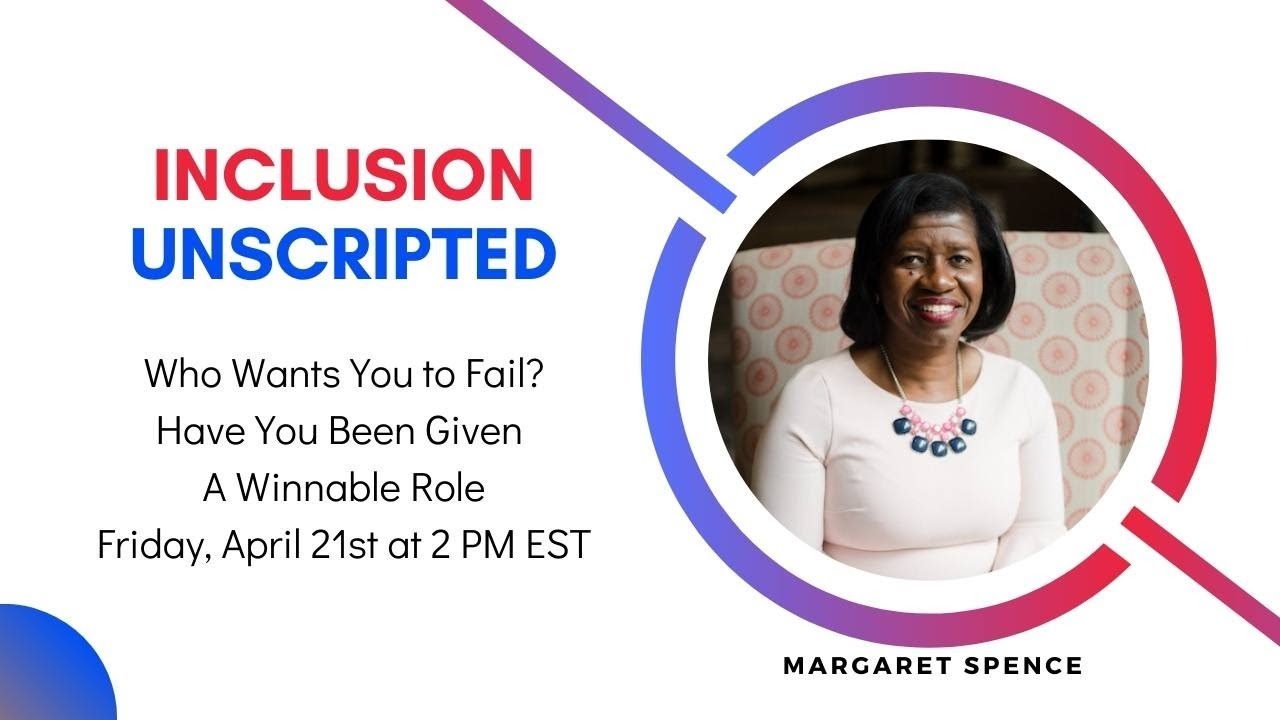
In this live episode of Inclusion Unscripted, host Margaret Spence examines why many diversity, equity, and inclusion (DEI) roles—and broader positions held by women, people of color, and HR professionals—are often set up to fail. She argues that these roles are frequently under‑funded, lack authority, and are designed without clear pathways to success, turning them into “cul‑de‑sacs.” Spence walks through five concrete contexts where failure is baked in: DEI leadership, women’s career ladders, HR executive tracks, leadership development programs for under‑represented talent, and minority hires (especially in sales). She then offers practical strategies for individuals to recognize unwinnable roles, ask the right success‑metric questions, set expiration dates, “fail fast,” and “network your knowledge” to build a reputation beyond a failing position. Throughout, she emphasizes the need for sponsors who hold space for success rather than merely defining success for others. The episode closes with a promotion of the Inclusion Learning Lab community for DEI professionals and a reminder of the podcast’s regular schedule.
Chapters
You're like a circle that floats around me, keeping me safe and sound. And when I fall, you tied a rope to me. You're blessing me every day. I was down with an illusion, like a sparrow with broken wings, but now I shine with your reflection on me. I'm getting back up on my Hi everyone, welcome to Inclusion Unscripted.
My name is Margaret Spence and thank you for joining me live today for Inclusion Unscripted. If this is your first time joining us, we are a weekly live podcast and we stream live to YouTube, LinkedIn, and Facebook, and sometimes Twitter. Inclusion Unscripted is here for one simple reason. We say what needs to be said about diversity and inclusion, equity and equality, women's leadership, how we empower our careers. We roll it all into one. But here's what I know. I'm not just here living diversity. I'm not here, just here being diverse. We are here every day to create diverse opportunities for people of color, for women, for everyone that is not currently in the majority in the workforce. So that is our, our key thing. Our key thing is we're not just talking about diversity and inclusion, we're living it. So my premise is Sometimes we operate so safe. We don't say what needs to be said, and we don't challenge the norms enough. We tend to, um, just accept, and we quietly say things among ourselves that we feel and we know to be true about the diversity and inclusion experience. This program is here to challenge that norm. To say to everyone, we could actually have these hard discussions and we could have them and be better for having those hard discussions. We could say what needs to be said. It doesn't have to be forceful, but we have to be able to say it and feel safe that we can speak our truth and that we can empower others to speak their truth and we can actually Instead of listening to what somebody says so you can respond to what they say, how about if we listen to understand what they're saying and, and increase our level of awareness about what someone is bringing to the table? So if you've joined us before, you know that Inclusion Unscripted is not scripted. I have a main topic that I talk about and I have a framework that I build, but everything that I talk through on this live podcast is from the heart, straight. It comes unfiltered. It comes to you clear as a bell. I don't want there to be any ambiguity about what I discuss. So today's topic is one that I feel is necessary. I took a couple weeks off from the podcast just to regroup, and I'm back feeling energized. And today's Discussion is about failure. Can we fail? Are we being set up for failure? Who wants us to fail? Today's discussion is going to talk about failure, failure in three contexts: failure around the mission of diversity and inclusion, failure around the process of being a diverse professional, failure around the ladders that we build to empower women and people of color, the entire process of inclusion through the lens of failure. See, everybody talks about being successful, but the reality, the reality is there's a lot of failure. And we don't always acknowledge failure. We don't always think failure is cute. Um, we also don't embrace the fact that we haven't been given roles that we can win. So let me say that again. The question for all of you on today's podcast is Have you been given a role that you can win, or have you been given a role that was designed and built on the foundation of failure? That's it for today. So let me introduce myself to all of you that's not joined me before live and don't know who I am, and you're seeing me for the first time. And really great, exciting news, our Inclusion Unscripted podcast is now on Apple. It's on— it's on up on iTunes. It is available on Spotify and Google Podcasts and everywhere that podcast is housed. We're on all of those places now, so I'm super psyched about that. Um, we have a ton of prior episodes in the can and we're loading those up as we go, but I'm super excited about that. So a little bit about my background. I have been in the HR insurance space for a little bit over 30 years, 36 years to be exact. I've been a consultant for 23 of those years, and I come to this with experience not only as a consultant but experience with my clients, observations that I, that I have. And so the truth that I bring to this program is not some imaginary truth. The truth that I bring to this program is the reality of what we see on the ground. When my team and I show up in an organization and we are working with that organization, we get real great lessons that we think everybody should learn. It's not that we think people are doing things wrong, it's just that we learn everyday lessons that I think um, need to be shared with a greater community. So let's talk about failure. Oh Lord, have mercy on us today. So we are going to talk about failing. Here's what I know: there are two types of roles that people take on. There are roles that were— was designed at— in its infancy, in the, in the process of conceiving the role, the job title, the job responsibilities, the process that the job is laid out on, that entire incubation of the role that you are in was founded on failure. The incubation, you know, imagine um, a child in a mother, a, a little tiny little embryo, and it's growing. And you think of that embryo as being grown in a fertile, happy zone where the mother is giving it nutrition and taking care of it. Great. But for most of us, the positions that we are in was never designed for success. The position was designed for failure. The position was built on the foundation of failure. And we take on these positions and we are in our mind feeling that we need to win, we need to be great, we need to show results, we need to be the best we can be in these roles. But the reality, the reality, the truth is the role was birthed in failure. You were never going to succeed. There was never a plan for you to succeed. There was always a plan for you to fail. The challenge for a lot of us is that we don't recognize that that is what we have walked into. And so we psychologically strain ourselves to meet unrealistic goals knowing that we have been, um, seeped and stewed in failure. And we don't know how to recognize it. We don't know how to recognize it. We don't know how to stop ourselves. We don't know how to come off the train because once we get on it we take on the role to such a degree that it is a personal aside, a personal failure for us if we fail in that role. And so we set out to prove the system wrong. We set out to prove that even though the role was birthed in failure, we can make it succeed. Because we are the secret sauce that the role needed to be successful. That's the truth. All of you, you— a lot of you are doing this. A lot of you are doing it. And, and the organizations you work for that build these positions seeped in failure are quite happy to have you running up and down all over the place trying to be successful. And just as you think you are successful, right, just as you think you are successful, right, then you realize, wait a minute, they moved the bar. The success is over there, it's not over here. And then we set out again to go into our mode of fixing the role, fixing the outcome, making it work, and then that is the cycle we live on. So I know if you're listening to this and it's— and if you're listening to the recording of this, you're probably going, what is she talking about? She is right. I am right. The question we have to ask ourselves is, have you been given a role that you can win in? Let me pause for a second and talk about diversity and inclusion. Just that subset, not HR, not talent management, not talent development, not any of the other business units that we could possibly work in. Let's just talk about that one role first. The role of diversity and inclusion leader was birthed and seeped in failure. It was designed to fail. Diversity and inclusion was built on the basis that it would fail at some point. But we are still running around trying to build success factors, recognizing that the role itself has been built on the premise of failure. And unless we rebuild the role, it will always fail. One of the things that we have said to organizations, when we recognize that the diversity and inclusion role is only going to sit in the HR department under the VP of HR or the CHRO or the director of HR, that role is not being designed for success because diversity and inclusion is not an HR problem. It is a business problem. So if it's not in the business unit and fully funded as a business unit, it is designed to fail. It is designed to do window dressing in the organization. And I've said this before, this is not new. I didn't come out with this. There's lots of studies on the fact that if the diversity inclusion role is not built properly, then it will be a failure. It's common knowledge. But here's where it gets even more technical. If the role has no power, it's gonna be a failure. If you can't make significant change and get other people to come onto the road of change, then nothing you do as a diversity and inclusion manager, director, leader is going to be helpful in the long run. So we have to then redefine our personal success process because instead of us getting caught up in the organization's success, we have to flip the switch and say, what can I do in this unwinnable, untenable spot to be at least a win within an organization? So that's one part. Let's talk about women for a second. All of us women out here, okay, we have been given roles that are dead end, cul-de-sac, and non-winnable, non-attainable, will never allow us to move up. We will always be stuck in that role. The role prepares us for nothing. It will never be a source of us gaining more, um, financial independence for our family. It will never be a source of where you are fully, fully presenting your skills and your abilities in that role. So basically, you have been put into a role that was designed for you to stay stuck and fail, or stay stuck and happy. Because oftentimes we know that the role is not nourishing us, it's not empowering us, it's not helping us move from point A to point B, but we stick with it because we have been given this job title and we are so caught up in the job title that we go, well, my— I'm the director of blah. So we're caught up in that window dressing, and we don't look underneath to say, have I been given a winnable role? Will this role prepare me for anything other than what I'm doing? And the challenge for women is that we stay in those positions for years before the light bulb goes off over our head and we realize, wait a minute, they put me in a dead-end role window dressing to say, hey, look over there, Margaret, she's our highest level woman. Look at her, she's great. There she is. But the role Margaret is in will never take her out of that role to anywhere else. That's number 2. Number 3, let's talk about HR. You HR folks, my peeps as I call you, right? HR can be a cul-de-sac role in an organization. How many VP or CHROs have ever become a CEO? I'm gonna let that one marinate for a second. How many HR directors, CHRO, and vice presidents have ever become a CEO of the organization? Not many. Another process where you will live in HR for your entire career. But if the goal is to move you as a woman, because the majority of, um, leaders in HR are women, um, while a lot of men, um, hold a CHRO role and, and fewer women hold the CHRO role than men, the shift is about 50/50, right? It's about 47% women, 47% men, okay, in the CHRO, VP of HR role. So if you're in that role and you've now done everything that you could possibly do for the HR role, and you're bored, and you're saying, I want to take on greater challenges, I want to move up the ladder, The, the company is totally fine on their website listing you as their highest level woman in the organization, as the CHRO or as the VP of HR, and you will be aligned with 25 other men, and there's our one lowly woman who is the CHRO of the company. Okay, so the question is, where do you go from the CHRO role where you headed? Where do you pivot from the CHR role— role to where, right? Or do you then say, I'm working for a smaller organization as a CHRO, I want to go work for a little bit bigger organization as a CHRO, and I want to go up to an even bigger organization as a CHRO? So basically what you're doing is climbing the CHRO tree, basically. But what would it take For you to say, I think I wanna be on the CHRO track and then switch over to the CEO track so that I could be seen as the CEO of this organization. What would that take? See, that's how we evaluate, have you been given a winnable role where you could win at something other than the job title that you've been handed? So that's that. So we've gone through 4 now. Let's go to the 5th one. The 5th one is these leadership development programs that are built for diverse people, that are built for women that are identified as our, quote, high potential, right? And we put them through these leadership development programs and we expect them to come out on the other side as leaders. The challenge with all of that is We've never fixed the department leaders that we're asking these women to go work for. We've never fixed the dysfunctional leaders that currently exist in the organization. And we spend a ton of time educating and empowering women to become leaders, but they are reporting to dysfunctional leaders. So basically they're being set up to fail. That's another whole part of this process, right? So we have to understand as people who are not in the majority— minority in most workplaces that we may be set up for failure. The role we may be given may have been birthed and designed for us to fail.
Really.
So how do we, how do we climb out of that box? How do we look at things differently? What does that look like? First off, if you have been given a role, any role, before you take the job— let me pause. We're in the middle of the Great Resignation, and a lot of you are making decisions to jump ship from the current companies you're working for to go to another company. Okay, so you're making this decision and the decision is based on, well, they didn't give me any opportunity here. I, my pay is not high enough here. I don't feel like I'm valued and wanted here, so I'm gonna switch over and I'm gonna go here. No problem with that. Perfect thing. But the question we have to ask ourselves is, is the new role a failure role or is it a success role? That's the question. Is the new role a failure role or a success role? Have we been, have we been given an opportunity to truly succeed and thrive in the new role, or are we really just setting ourselves up to go from one cul-de-sac to the next in the Great Resignation cycle where we're really just moving from point A to point B? We're not accomplishing anything. Because the reality is the role that we're taking was also conceived and birthed around failure. And they figure out how many people they can shove into that role and how many people will figure out that it's a failure role before they climb out of the basket and go somewhere else or try to get into another department. So that is the key. That is what we are talking about today, is have you been given a winnable role and who wants you to fail? All right, so let's talk about the who wants you to fail part of this before I give you the solutions. One of the assessments that I feel that we have to make, both as women, as people of color, as, as anyone that is not in a a leadership role that is fully vested in the financial outcome of the company. We have to ask ourselves, who wants us to fail? Who by design has decided that we should fail in the role we're in? If you are in diversity and inclusion, maybe the organization wants you to fail at what you're doing. Because they don't truly want DE&I. They're not fully committed to DE&I. So they would rather see you fail than empower you to succeed. And the way they show you that they want you to fail is understaffing, underbudgeting, underempowering the role you're in. And that applies to any role. You could be in accounting. And you're in a role within the accounting department that's underfunded, underutilized, underempowered, you're basically in a failure role. You could be in sales and you are not being fully empowered to sell to your full abilities, and you're not being given opportunity to sell at your full abilities. And so basically you're in a role because they put you in the role and you are Designed and destined to fail. Let's talk about minority hires. Let's go there, okay? Oftentimes, organizations hire minorities into roles that are designed to fail. Let me say that again. Oftentimes, organizations hire minority candidates into roles designed to fail. The leadership wants you to fail. The role itself was built around saying, we just need a diverse candidate in here. Let's figure out how we're gonna make this window dressing work. We're not gonna support this person. We're not gonna empower them. We're not gonna give them the tools and resources they need to be successful. We're just gonna say, I hired the Black candidate, I hired a Hispanic candidate, I hired an Asian candidate. There it is. I did it. And in 6 months when the candidate is gone, you get to say, oh yeah, the candidate left. Sorry. I'm so sorry you left. See, we tried, but you just weren't successful. You weren't built for this role. This role was never designed for you. You couldn't cut it here. And maybe we made a mistake. Maybe you don't say that part out loud, but you're thinking it. So the next minority candidate that comes along, you say, well, I don't think I can give this person an opportunity because remember when I gave the last one an opportunity, that didn't go too well. But the reality is you built the role, you built the process, you created the role and the opportunity for your minority candidates seeped in the fact that you wanted them to fail. Let me give you an example of how this works. Let's— let me give you a key example. Sales is a key example of where we set up minority candidates for failure. Let me give you a good runway. I do a lot of work in the insurance sector. I started my career in insurance. I do a ton of work within consulting within the insurance sector. Two salespeople show up at the table. One has a family history of having worked in insurance. Their grandfather started an insurance agency, the father ran it, the uncle ran it. It's rolled into their DNA. They have a long big Rolodex of friends and family who they can tap into to grow and groom their sales cycle. Minority man or woman shows up at the door. They don't have the Rolodex. They've never been exposed. They don't have the country club memberships. They have none of that. But we set them up by saying, we're gonna bring you in, and in 6 months you must be producing new sales very quickly, and here's some classes we're going to give you to be able to produce that new sales. The challenge is the sales process is a, is a process that requires some getting to know. It's, it's the process that requires you to feel comfortable with a person before you buy from them. So if I am, you know, without a Rolodex, without an ability to find a sales cycle for myself, very quickly, in 4 months or 5 months, I'm failing. I'm not meeting the sales requirement. I can't meet it because I don't— I didn't start off at the same place. As everyone else. So basically, um, because I didn't start off at the same place, I'm failing. The role was designed for you to fail. The way you were empowered in the role, you were designed to fail. So here's my sage advice to everyone today: learn how to fail. Fail faster. And when you fail fast, you figure it out, and then you decide, is this a role I want to stay in? Because the time we spend trying to be successful, we could also decide that the role is a failure and we need to get out of that role. That's it. We should be getting out of the role rather than trying to beat ourselves up to be a success in a role that was conceived in failure, i.e., the ENI. Okay. Or we take the flip side of the coin and we say, all right, this role was built and designed, conceived on failure. What are my key success that I'm gonna bring to this table that I'm going to know that when I walk away from this organization because I've had enough of the failure cycle, they will never forget me. They will always be impacted by the work that I've done. They will always remember that I was here. That can't be removed. So that's how we reframe failure into success. See, we have to decide what is our impact mission when we are in a role that is designed to fail. What is the impact? So it's not the result, it is the impact. Because we were never going to be able to meet the result that we've been asked to meet. So we have to say, how can I impact the organization, the role, the process better? How can I even change this role while I'm in it so that it becomes more impactful? That's another lens to look through. We also have to, have to realize that in every journey, in every journey, it doesn't matter what career journey you're on, there are two types of people that you will encounter: a person who wants you to succeed and a person who is holding space for your success. And I often say this when I speak at conferences and when I talk to people about their career. Let me give you the difference. The people who want you to be successful establish the parameters of your success. They basically say to you, Margaret Spence, in order for you to earn the gold star at the end, here's what success needs to look like. They're really not interested in your input. They're not interested in your view of success. They're not even going to ask you, um, what do you need to be successful? They're going to give you their definition of success, and it's up to you to move into that farm of their success. And when you move into that farm of their success, then they get to say, well, you didn't quite meet the success factors for this role. The people who are holding space for your success is a little bit different. The people who are holding space for your success come to you and say, Margaret, what do you need to be successful here? One of the questions that I want leaders to start asking employees, truly asking them, especially women, especially women of color, especially men of color, I want you to start asking the question, what do you need to be successful here?
Here?
What do you need to be successful in this role? What can we do to empower your success? What should success look like at the end of this? And the question we need to ask when we're looking to take on roles is, what is the measurement of success for me? And the question you should ask Your employer is, what is winnable about this role? What can I win in this role? Not only small wins, medium wins, large wins. What can I win? And listen to them try to tell you what you can win in the role. Don't ask, what can I be— how can I be successful in the role? The question is, what will I win in this role? Prize, but the winning, the winning keys. Am I going to get the key to the castle where I could put the key and open the door and I've got my winnings on the other side of the door? You also need to ask the question, what does it take to be successful in this role? That is a critical question when you are evaluating how you take on opportunities within an organization. The other question is, what caused the person who is not in this role now to fail? That's a question. What caused them to fail? What was the parameter of winning for them, and why did they fail? And, and you begin to listen because Oftentimes organizations don't even have the answer for that question, and the fact that they don't have the answer tells me that you are being set up to fail. You are being seeped in failure. You're being incubated in failure. You're being accelerated in failure. You're being engulfed in failure. See, we have to be willing to see when we are not set up for success. We have to see it, we have to understand it, we have to know it, we have to feel it. And we have to know within ourselves when our gut tells us, I can't win this, we need to say, yep, it's time to go. That's it. And we need to know when to walk away with our head held high to say, I did this, Girl Scout. Thing, but it didn't work. I didn't earn a badge, but it's okay. This is what I accomplished. The other thing that I want you all to know is something that I call networking your knowledge. So let me pop into that for a second, and I'm gonna probably do a, a podcast on this very subject in another week or two. When we network our knowledge, we basically eliminate the possibility of failure because people begin to say, okay, the role Margaret is in is destined for failure, but Margaret's knowledge is so expansive that we could see her outside of that role, right? We could see her outside of that particular role. And because we could see her outside of that role, we could empower her to leave that role behind and go somewhere else. One of the challenges when we have been put into failure roles is that we get typecasted with the failure. We get typecasted like Margaret is the best account manager in this particular role. We can't ever see her outside of that because we have no idea what her knowledge base is and she hasn't sold us on her knowledge base. So basically we put her in the cul-de-sac and she gets to stay there permanently because we don't know what she's capable of doing outside of the cul-de-sac that we put her in. And this is the truth. This is the stuff that HR doesn't necessarily want to tell you. They don't want to tell you that you're in a terminal cul-de-sac role and your knowledge will never be expanded out of that cul-de-sac role that's over here, and it will never be brought full center to where people could see you in another role. So basically, you'll find, especially for women and people of color, is that we will be stuck in roles for years, and the only option we have is to leave the organization to go to another organization so that we could clean the slate on our history. Right? So we could clean this, the slate on our history. So the only option, especially when you're in a terminal failure role, the only option you have oftentimes is to jump ship, take the, um, Great Resignation train and roll to another place where you can have a fresh start. And sometimes that's what you have to do. But what I'm saying to you is If we begin to understand the tenets of the role that we have been given, then we can operate a little bit differently within the tenets of those roles. We can operate a little bit differently. We can absolutely operate differently in those roles. We have to recognize that if we are not given something that we can win We could still build experience, and we can build, um, impact in the role that can pivot us to somewhere else. The question we have to ask ourselves is, can I adjust my lens to knowing that I will fail while I find success? That's a question. Can I adjust my lens to know that I'm going to fail in this role and that I can find success somewhere else or in another role in my organization, right? Here's another key point that I— when I made my show notes that I want to bring forward to you. No one can make you fail, even if the role is designed for failure. That's a key. No one can make you fail if the role is designed for failure. We have to learn how to succeed on our terms and put an expiration date on our success. What does that mean? In the last few minutes that I have of the podcast, let me tell you this of Inclusion Unscripted. We have to say, I'm gonna stay in this role for a year and my expiration date is 12 months from now. That's the date that I come off the shelf. I'm expired in this role and it's time for me now to figure out what skills I've gained in that 12 months so that I can exit the cul-de-sac failure role and find a role where I can thrive and succeed. We have to put an expiration date on the cul-de-sac that we are in. Because if we don't put an expiration date on the cul-de-sac, your organization is totally happy with you living in the role that was designed for failure. They're totally okay with you living in that role because that is the role that they've given you. And if they give you that role and they say, Margaret, you're in the failure role, but you're gonna get good at this failure role. Right? They're okay with you staying there for 10 years feeling like you're accomplishing something when the reality is you're not accomplishing anything. They don't mind giving you that. Okay, so we have to learn how to move beyond failure. We have to learn how to fail fast. In business, they say fail fast so you could see— could succeed even faster. I say to you, within your career, We need to learn how to fail quickly and move on to another role. Move on, gather our experience, network our experience and our knowledge so that we could be seen in the light of success. Because people don't hire potential failures, they hire success. But if you're in a role that is designed for failure, you will never be seen as someone who can be successful. And that is the key. We got to get this right. And so that's the reason why I brought this, this week to the Inclusion Unscripted table. So thank you for joining me. We are here every Friday at 2:00 PM unless I decide to take a Friday off, live on LinkedIn, Facebook, Twitter, and YouTube. And if you're joining me in the recording. We are on all the podcast platforms, including the iTunes platform for Apple. We're on Google, we're on Spotify, we're on Pandora, we're on all the, the, the, the podcast platforms. So join me again next week for Inclusion Unscripted. Also, this week is the official final launch of our Inclusion Learning Lab Community for Diversity and Inclusion Professionals. We are going to have a launch on Wednesday. I'm going to put out a live at probably 2:00 PM on Wednesday, and we're going to demo the platform and talk through the Inclusion Learning Lab Community for Diversity and Inclusion Leaders. Thank you again for joining me. Come back next Friday, 2:00 PM Eastern, and we will be here, um, waiting to talk about another hot topic, unscripted. Take care, everyone. Have a great—
Thank you, everyone.
Take care.








