E23: DEI Leader Burnout - From Out of Mind to Out of Sight to Silence
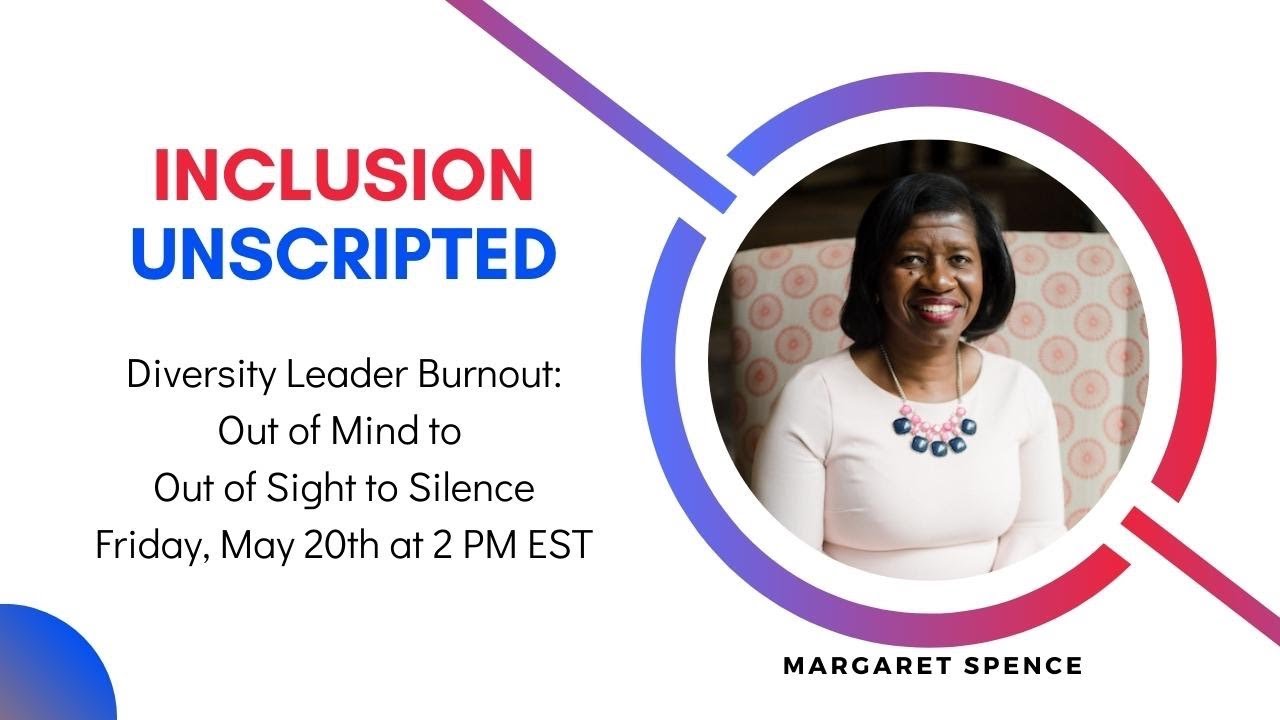
In this episode of Inclusion Unscripted, host Margaret Spence discusses the pervasive burnout experienced by diversity, equity, and inclusion (DE&I) leaders. She frames the conversation around recent racial violence and pandemic‑era trauma, noting how organizations often make superficial commitments that quickly fade. Spence outlines the systemic pressures that isolate DE&I leaders—being the sole champion, under‑resourced, and tasked with changing entrenched cultures—leading to a 67% turnover rate among DE&I managers. She introduces the Inclusion Learning Lab community as a peer‑support network designed to rebuild resilience. Central to the talk is a detailed walkthrough of the 12 (actually 13) stages of DE&I leader burnout, from the initial need to prove oneself through denial of stress, isolation, anger, futile attempts to change organizational values, and eventual depression and loss of identity. Throughout, she shares personal anecdotes, references recent incidents affecting Black, Asian, and Hispanic employees, and calls for organizations to prioritize the well‑being of DE&I leaders, emphasizing the need to “put the oxygen mask on ourselves” before trying to fix systemic inequities.
Chapters
Hi everyone, welcome to Inclusion Unscripted. I'm Margaret Spence and we are live today on Friday. And for those of you who are listening to the replay of the Inclusion Learn— the Inclusion Unscripted, um, podcast, um, thank you for joining us. So if this is the first time that you've joined the Inclusion Unscripted, uh, podcast, I want to just welcome you to this live unscripted event that I host almost every Friday. Some Fridays I'm away. I'm live on LinkedIn, YouTube, and Facebook simultaneously. So let me tell you a little bit about Inclusion Unscripted. We are sponsored by the Inclusion Learning Lab and We want every week to come to this forum to talk about hot topics, things that aren't normally talked about, or maybe they're not talked about enough. Inclusion Unscripted is here to not write a script about diversity and inclusion because for me, I'm living diversity and inclusion every day. I'm living being diverse, I'm living being inclusive. I'm living in a world that doesn't always welcome my inclusive self. Inclusion Unscripted is here to have these tough discussions and to talk through them with you and to support diversity and inclusion leaders who are out there doing this work every day. The work of inclusion is probably the hardest work that we'll ever do. I've been at this now, I think fully, 23+ years. And I didn't initially think that my first work was inclusion. I thought it was just advocating for disabled employees to stay in the workforce. Initially, that's what I thought. I thought, you know what, Margaret, you're working, you're taking your experience from managing workplace injuries, and you're coming to say to employers, you have to keep injured and disabled employees in the workforce. Because just because I have a disability doesn't mean I'm not able to do work. As my work transitioned to where we are today, I'm keenly focused on what it takes to be an effective diversity and inclusion leader. What does it take from the person sitting in that desk every day to do that role? What kind of support do we need to do the role of diversity, equity, inclusion, equality, belonging, thriving, acceptance? What is it that we need from ourselves to do that work? And out of that came the work I'm doing under the Inclusion Learning Lab and the work that I'm doing within organizations to build inclusive spaces. But then I sat back and I realized that diversity leaders are on an island by themselves. I've been in organizations where I'm the only one pushing the work, where it's often been, um, you're fighting the battle to build inclusion for everyone, to build equity and equality for everyone, but you're the only one totally committed to the mission of making that happen. You know, in 2020 we had the pandemic and then we had George Floyd's murder, and every organization made these resounding commitments. Deep down in my soul, I knew that those commitments weren't going to last. Those commitments were paper tigers. They were going to be plastered on the walls. They were going to be put out in nice canned press releases. CEOs would be given written statements to read. At their heart and at their core, they didn't really feel the message, they didn't feel the process. But those of us who are doing this work have committed to doing inclusion, to building diversity, to changing the space so that the people coming after us have a better experience. I think for every diversity leader out there who's doing this work, our commitment is not to the organization, but it is to the work that we are doing. The commitment is to find an organization in a place that they are and hope that our work impacts and shifts the way that organization works. Our goal— for most of us, our goal is to make an impact. Even when the work is hard, even when the organization doesn't support us, even when we feel that we are not fully aligned with the mission that the organization is trying to push out, we show up every day to do this work. The challenge for people doing the work of diversity and inclusion is there isn't a safe space for us to renew and rebuild our resilience to come back every day to do the work. That's one of the reasons why I launched the Inclusion Learning Lab Community, because I felt within the community we needed to have peer-to-peer opportunities to grow and learn together. We needed to have peer-to-peer opportunities to build a place for us to feel comfortable and to feel empowered in the work that we're doing. I went out and I said, what is it that diversity and inclusion leaders need? What do you need to make you more resilient in your role? Is it support? Is it more training? Is it a place that you can fail faster? Is it a place that you can build your own strength without being micromanaged or without the pressures being placed on you by the organization? What is it that we needed to create for you so that you could feel empowered and you could feel that you are— you've got the support, you've got the arms around you? And that came In that thought process came the Inclusion Learning Lab community for diversity leaders. But today on this episode of Inclusion Unscripted, I want to talk to you about diversity leader burnout. This has been a tough week for people of color, It's been a tough year for people of color. Our Asian brothers and sisters have been murdered in the streets, and organizations have been silent while that has happened to their AAPI community. We are in a month where we celebrate our AAPI employees but we haven't really supported them in the trauma that has been the experience of being Asian in America, in the hostility of racism. We haven't supported them effectively. Fast forward to our Hispanic brothers and sisters who are often grouped into the immigrant coming to take our job, category, the ones that are coming across the border for opportunity, we have grouped them into this place of they are bad people for wanting an opportunity for themselves and their children, even though we advertise that America is the land of opportunity and we will take your sick, your weak, your healthy, everyone can come. We sort of shut the door on that as a people. And then we fast forward to our Black employees and members of our society, and we have watched over the last 2+ years the brutality of being Black in America. It's not new, it's not unheard of, it's not different to what we've experienced. It's just now feeling more focused and revengeful. And I watched this week in silence, really. On Sunday morning when I woke up I was gripped. I couldn't really do anything. I felt that I was lost. I watched TV, I turned it off, I watched a little bit more TV, I turned it off. I started hearing stories about the people who were lost in Buffalo, and I sat back as a Black woman and thought to myself, is there a place in this country for me as a Black woman immigrant. I thought to myself, is there still a place in this country for me, um, 56 years after I arrived here? But then by Monday, I was gripped with fear to leave my house. My son came into town, I hung out with him for the day, we really didn't talk about Buffalo, the murder of innocent Black people, we really didn't talk about it because I don't know what we were going to say to each other honestly, and by Tuesday I had watched social media to see if there were going to be any significant announcements from companies to say racial justice is important to us, um, racism is something that we will not tolerate as a company, we will stand with our Black employees. I waited to hear the same thing after the tragic murder of the young Asian woman in New York a few weeks ago. And some companies put out things, but it was mainly their employees taking to social media to talk about what had happened, to talk about the pain that they were experiencing. And it was mainly the community that supported this woman that came forward. So now this week we are in our own trauma, we're not feeling psychologically safe. I had a couple calls yesterday with several people of color, and each time I asked, "How are you doing?" and I don't know that I wanted to hear the answer. I'm gonna be honest with you, because I knew how I was doing, I knew how I was feeling, I knew how vulnerable I felt in this moment, I knew how, um, traumatized I felt, and I didn't know if I could handle hearing somebody else's version of how traumatized they were. So I can understand organizations not wanting to deal with this Sunday evening I posted a thing on LinkedIn and I said, "Your Black employees will not be okay on Monday," and it got a few likes and shares. That wasn't my purpose of doing it. I just wanted to put it out there so that people understand that your Black employees aren't okay, your Asian employees aren't okay, many of your Hispanic employees aren't okay. So how do you have a diversity program when the people you're trying to serve aren't okay? Do we go to business as usual and pretend that these folks aren't okay? Do we fast forward and pretend that we are all okay? By Tuesday, I was in the pretending that I was okay by Tuesday. That's where I was. I had to, I had to get out of bed, I had to go to work, I had to go do the world that I live in. But for many of you, that step out the door was traumatic in and of itself. You know, I told, um, a lot of my cousins and family live back in Jamaica Many of them are U.S. citizens and they've decided that they can't live here. They can't live in this trauma. They'll take whatever they got in their own country, but they're not going to do this. And so I had a discussion with my cousin. I called her and I said, hey, let me— let's talk. And she says, what is going on in America? That was her opening line. And I said, well, what's going on in America has always been going on in America. I think what's going on now is that we're seeing it at a much more nuanced, hateful level, and it's being justified in every way. So within every organization right now, there are probably 4 sets of people who aren't okay. So let me go down the list for you. Black professionals aren't okay. Asian professionals aren't okay. Hispanic professionals aren't okay. Women are not okay. So the vast majority of who you are managing may not be okay, but the one person in your organization that is bearing the weight of all of this is your diversity leader, and your diversity leader is burning out. The light is on, the switch is turned to on, but your diversity leader is burning out. Exactly a year ago, I did a program on diversity leader burnout. It was one of our highest attended webinars, and people came and they talked about all the pain and hurt that they were feeling in the roles that they're in. They talked about the microaggression, microinvalidation, the micro, um, management of them doing the diversity and inclusion role. They talked about that. Our attendees talked about how they felt doing the DE&I role. I plan to do another one in June where I'm going to have another session with an open mic for diversity and inclusion leaders to just talk through what we are feeling, how we are navigating, what we are going through. Because I think it's important that we do this work, but I also think it's important that we support each other. What I've realized is that the reason there is a 67% turnover among diversity managers and leaders and chief diversity officers is because this is one of the most thankless, underappreciated, underfunded, underrecognized, underacknowledged position in most organizations. The diversity director, manager, leader, coordinator, whatever you want to give the title to, the person that you have said, "You're in charge of our diversity program." It's underappreciated. There are pressures put on the role, and the pressures put on the role is you've got to change our dysfunction junction that we have here. We can't hire people appropriately. We don't know how to source talent that is diverse effectively. Our managers don't know how to interview. Our managers eliminate based on their bias. Our leaky funnel to bring diverse candidates in the room is just leaking buckets of water every day. And when diverse people come into our organization, we want their skills, but we don't want their ambition. And it's okay because we're going to now warehouse them in the roles that we bring them into. And oh, by the way, diversity director, it's your job to go build this imaginary system so that our upper levels looks more diverse than it does right now. That's what you're telling your diverse leaders, your diversity directors to do. And I'm getting to the place where I almost think that we as Black people, Hispanic people, Asian people, Native American people shouldn't do this role. We should leave it to the majority to fix the problem that they created. I often think that that is what we need to do because I feel that we are, we are taking on a triple taxation. First, as people of color, second, of people who are marginalized, and third, as people who must now go out and fix the the mess that the organization and this society has created and this society continues to perpetuate. And we are the ones who are now being asked on top of our diversity, on top of our emotional wellbeing, on top of all of that, we're being asked to fix your dysfunctional leadership teams that don't really want diversity, but we're having to come out and give you the lens of diversity. I've often said, why are we doing this? Are we martyrs for our own selves? But I also know within me that we have to do this work because if we don't do the work, the blinders that exist in the organization will stay there. If we don't do the work, if we aren't the ones doing the work, then we will be the ones suffering through not having our population increased in your company. I don't know if that's the right word, but that's it. We will not be able to take a seat at the table because the table will never be designed for us if we leave it up to you to design it. But today what I'm really talking about and who I'm focused on is you, you, the folks doing the diversity inclusion work. I'm focused on you. I'm focused on your burnout because what I felt in my soul this week is that we are now out of mind. We are out of sight. And they have become silent. Let me say that again. What I've learned this week, this week, a week after the murder in Buffalo of innocent, innocent beautiful souls who have been contributors— an individual who hasn't contributed anything to this world felt that we were replacing him even though he had no place to be replaced. And he went out because he was indoctrinated, and his parents gave him the money to buy the gun. And we don't really talk about that because he didn't get the gun in a silo. He used somebody's credit card and somebody's money to buy that gun that he used to kill those innocent people. But we're not going to talk about that because when you talk about guns, people get ruffled. We're not going to talk about that. But he didn't get the gun in a silo. He got it from his parents' money because he doesn't have a job to pay for it. So somebody gave it to him, right? Let's get real about where we are. But in all of that pain that we have experienced on Saturday and Sunday and Monday and all the way now to Friday, all that pain that we've experienced, you as a diversity leader have had to be resilient. You've had to come back into the organization and refocus them on diversity and inclusion. But who is refocusing on you? Who's there to help you? See, I've written out the 12 steps and the 12 stages of DE&I leader burnout, and I'm gonna read them to you all in one, and then I'm gonna go through them one by one. So the first one is, I've got to prove myself. I have to prove myself as a DE&I leader. These are the steps towards burnout. See, we are burning ourselves out because we have the psychological trauma of being whatever nationality or race we are, and we have the double psychological trauma of getting an organization to embrace diversity and inclusion when they're not ready to do it, and they may never be ready to do it. So our goal is just to chip away at the brick and hope that as we chip away at the brick, the wall falls down and more people of color and women get to move through the ranks. That's, that's our goal. That's all we're doing. We're chipping away at the brick every day in the hopes that leaders will fully embrace diversity and inclusion. That they will fully embrace the process. But we of ourselves are questioning our way to burnout. Our first question is, I've got to prove myself. Our second question to ourselves is, if I work harder, it will get better. And if you're having these discussions, which is, I've got to prove myself first, No, you don't need to prove yourself. You need to execute the plan that they've given you, and you need to do it within the parameters of what you've been given, right? We're not proving ourselves. The organization is proving itself, not the other way around. So as we, as diversity leaders, take on this role, we have to be clear about the lane that we live in. That we occupy, what it is that we are really doing. So we go from, I've got to prove myself, to if I work harder, this will get better. No, it won't. Because if no one is embracing diversity and inclusion and you are working harder and harder and harder, all you're doing is wearing yourself out. So the question is, how do you work smarter? That's the question. How do you achieve goals and not burn yourself out? The third phase of diversity leader burnout is where you say, I don't need help. I don't need to tell the organization that I need help. I can keep going. I can continue to do this. It's okay, I got this. The reality is not only do you need more help, But you need budget, you need assistance, you need a team there. If you are running a diversity and inclusion department with one person for thousands of employees, how does that work? How do you get effective diversity and inclusion process and procedures if there's only one person in your DE&I department? How does that even work? Where, where do you invest? Where do you start investing if there's only one person in the department? The fourth phase of diversity leader burnout is, I hate these people. And you know you're thinking it. I hate these people because they're making it unsafe for me to be here. That's phase 4. I hate you now. See, I thought when I took this job that I was going to love this organization, but this morning I woke up and I realized that I hate you. Yep, because we can hate. See, it's not enough to say that the white supremacy that mowed down the folks in Buffalo is the only one allowed to hate. We as Black people can hate the system that you're— they're forcing us to live in. We can also, as diversity leaders, hate the system that we are being forced to correct. We can also hate the process that you're putting in place because you're phony when you put it in place. We can hate all of that because, see, our hate is not a vengeful hate. Our hate is a dislike of the process, and that's completely different to what we saw in Buffalo. What we saw in Buffalo was vengeance, right? It was hate of my space. It was hate of me. It was hate of the breath I breathe. There's a difference between I hate the system you created, but I still have to live in this system. There's a difference. The fifth phase of diversity leader burnout If I can change their values— that's what's going through our head— I can change their values, they will change, I'll show them the way. Because see, if we think that we can change them, they will change. The reality is they're not going to change. So how do we change so that we don't burn ourselves out trying to change them? There's a thing called the drama triangle where we're the victim, the persecutor, and the rescuer. I talk about this a lot in the things that I do. We cannot be the victim of diversity and inclusion. We can't be the persecutor of the people who don't want to change, and we can't rescue those who have no intent on changing what they're doing. What we have to do is sit above all of that and say realistically in this role, what can I do? So that others come into this organization feeling better? How do I make an impact so that they never forget my name, or they never forget the work, or they never forget the process that I created that will last long after I'm gone? That's the work. And that's the work rather than falling into the trap of burnout. The sixth phase is when you deny that you're stressed. That's the sixth phase. I'm stressed, I'm just a little overwhelmed, I'm not really completely stressed and falling apart. That's where we totally deny our own self in the process. We deny the stress of doing the work. And so instead of going back and saying, wait a second, this is deep for me, this is troublesome for me, I want to do something different, we instead deny our own emotional wellness. The seventh phase of burnout is when I get home, I just want to hibernate from everyone. The stress of work is just overtaking me, and all I can think about, all I can talk about, all I can exist within, every, every waking moment of me is talking about the workplace. I go home and I talk about them. I talk about what happened. I talk about the wall of resistance. I talk about all of the challenges I faced. And so my own world doesn't exist because all I do is talk about this, this, the, the, the total emotional vesting that I've done in their change and how much is traumatizing me. So all I can do is vent and talk it through. Then you move to the next phase, which is Phase 8, where we have zero tolerance for anyone or anything. Meaning instead of us doing the purpose work that we were meant to do, we're now doing the oppressive work where we're yelling and screaming, or we're being, um, pushed out of our solitude. We're being pushed out of our zen-ness. Because we're so angry with what's going on in the organization. And so we show up as the angry Black woman, the angry Hispanic woman, the angry woman, the angry person that's trying to push diversity through the organization. And then we move into, I can't take this personally because it's them, not me. See, it's a series of them but it's also a series of you. You have to begin to say to yourself, how am I impacting the organization if I'm not whole? How can I impact the organization if I'm not whole? If I'm living in the trauma of the work, how do I make an impact? Because all I'm living in is the trauma of the work. That's deep for us to think through. And then we say to ourselves in phase 10, why do I feel like my cup is empty? Even when I win, I feel like I've lost. That's when we're in phase 10 of diversity leader burnout. We are in phase 10 of it. We are burnt out. It is done. There's nothing left of us. We're just going through the motions now, and we're trying to make this all work. Phase 10. And by the time we get to Phase 11— and remember I said there's 12 stages of DE&I leader burnout— by the time we get to 11, we now are at this place where we feel that we are lost. I'm lost. Not the organization is lost. I've lost my identity. I don't even know why I'm in this role. See, many of you are going through these 12 phases that I'm laying out. You're going through it one by one by one by one. You're going through it, and so you forget why you took the job in the first place. And this is when most of you start boning up your resume. It's usually the 10-month mark, which is when the data shows that we get frustrated enough and we walk out the door. You've lost, you're losing daily. You really don't even care anymore. You're showing up because you can't do anything else at this point because you don't have another job, but you're working on finding another one. And you may decide that you never want to be in DE&I again. And for me, the work that I'm doing now is to salvage and save the DE&I directors who are in these roles so that you continue to do the work because we can we can give you a place to come to, to get thoughts, to exchange ideas, to talk through the trauma and to build the resilience you need to go back the next day and say, hey, I'm here, I'm ready to renew myself and do this work again. Because if we allow the organization to chop us down, then the work of diversity will get watered and watered and watered and watered down to the point where my grandchild who's now 5 months old will walk into an organization 21 years from now no different from what we're leaving right now. And so the mission for us is to stop that, but we have to put the oxygen mask on ourselves as diversity leaders. We have to put the oxygen mask on ourselves. So when we get to Phase 12, of the diversity leader burnout. Phase 12 of the diversity leader burnout: you're so depressed that you can't even get up to go into work. You hate the thought of the people you work for, the organization, the leaders, the leadership, the policy, the data. You hate it all, and you are ready to go. And you're ready to give up the work because it's just too hard. And in Phase 11 is when you hit— Phase 12 is where you hit the bottom for you as a diversity leader. But there is a Phase 13 where you become so depressed and so psychologically scarred that you cannot pick yourself up to keep going anywhere else. Even we've got to stop that from happening to you. Let me go through the 12 phases of diversity leader burnout again for you from the top. I gotta prove myself. No, you don't. If I work harder, it will get better. No, it won't. I don't need help. I can do this on my own. If I keep going, it'll get better. No, the organization needs to invest. In the diversity role. You cannot be the diversity leader of one for an organization of 8, 10, 15, 20,000 people or even 500 people. You need to have a team, so you can't do it alone. Phase 4: I hate these people because they're making it unsafe for me to be here. That's what's going through your head. Phase 5: I can change their values. They will change. I'll show them how to change. No, they won't change. We have to work higher than change. We have to work at reinstilling new thoughts and values in the organization. We can't change people. See, we run around trying to change people. We can't change the hate that went to Buffalo and killed those innocent people. What we can do is replace it with love, replace it with people who outnumber the hate. Within the organization, we have to outnumber the resistance, the people who don't want the change. We have to outnumber them to make the change happen. So when we leave those folks behind, they go, "Oh, maybe this is not a fertile ground for me." That's the work. But when we get to phase 5 of diversity leader burnout, Or phase 6, we say, I'm not stressed, I'm just a little overwhelmed. No, you're stressed out. Admit you're stressed out. At phase 7, when I get home, I want to hibernate from everyone. No, no, no, no, no. If when you get home all you can think about is the psychological trauma that you've encountered the day before, you're not well as a diversity leader. If you have zero tolerance for the process anymore, you're technically burnt out at that point. Because if we become intolerant to the process, then we cannot affect the change that's needed. We can't do it. And then you really move in phase 8 to, I can't take this personally because it's them, not me. I agree, you shouldn't take it personally. It is them, and you need to point that out. Boldly, it's you, it's not me. I'm not crazy. There's nothing about me that's insane. I may be traumatized, but I know when you are resisting change, when you say to me in the boldest way, we're not perfect but we're getting ready. That's what I know. Yeah, I had an organization say that. We're not perfect, but we're getting ready. Um, you got diverse people in your building already, so when are you going to be ready? You got diverse people sitting in the, in the walls of your organization, so when are you going to get ready? What are you being ready for? We're already there. We had to be perfect to get hired, but you get to be imperfect in your process of developing us. And taking our ambition to a higher level. It's the garbage of DE&I that we suffer through. But let's talk about Wells Fargo before I go. 4 weeks ago, I did a podcast called The NFL is Corporate America. I reshared it on LinkedIn. The NFL is corporate America, but Wells Fargo has proved my point that sham diversity interviews is the thing that is done, and you get to check the box. Yay, we interviewed Margaret, we just didn't hire her. Oh, we interviewed her multiple times for the promotion, we just didn't give it to her. See, the sham interviews, they come out eventually. The NFL sham interview. Corporate America has been doing sham interviews from day one. We've always done court, we've always done sham interviews. We invented sham interviews. We invented Margaret Spence, you're not quite ready for the role yet, here's a list of stuff you need to go do, and oh by the way, we'll figure out how we're going to help you do that, but right now we're not going to do that. And it's a sham interview, and I come back to the well and apply again thinking that something's going to change, when in fact what I should be doing is bolting up my resume and leaving. But that's a whole nother podcast episode, not this one. Let's talk back about the— and I burn out. Number 10: Why do I feel like my cup is empty? Even when I win, I feel like I've lost. And then you get to: I'm lost. I've lost my identity. I don't even know why I'm in this role. And then when you're fully, fully, fully flagged out. There's nothing left. You're so depressed that you can't even get up and go into the company. You don't want to be there. You don't want to be in their sight. You don't want to hear their voices. Their voices alone annoy you. The fact that they're asking you to another meeting makes you want to throw up. Yeah, that happens. That's how we burn ourselves out. We have to stop burning ourselves out, especially when organizations are resisting DE&I. We have to decide why we're there. We have to reevaluate our purpose for being there. We have to look again at us because it's not always them that causes us to burn out. It's not always them. Sometimes it's us. Sometimes we take on more than we are willing to acknowledge is too much, and we're not willing to open our, our mouth and use our voice to say, organization, this is not going to work the way you've laid it out. And so to combat burnout, we have to put the oxygen mask on ourselves first. What I've observed this week has been the most painful process out there. It's the most painful process. Organizations this week, on the backs of the trauma that occurred for the Asian community a few weeks ago and over this pandemic period, and the trauma that occurred from George Floyd's murder till now, organizations have gone into silence. You don't want to talk about it anymore. And unfortunately, we have to talk about it. We have to live it. We have to get up every day and come into your organization and do the work of diversity inclusion, even when we don't want to. So you've got to find a way to support your diversity inclusion leaders. You've got to find a way. And that's the reason why I created the Inclusion Learning Lab community, because this is a gap and it's a necessary gap that has to be filled. But for all of you doing the work, we have to take a place. We have to take a space where we refuel ourselves. Thank you, Dawn, for putting this note in, and I'm gonna share it. Thank you. I cannot— ah, as I breathe, um, what you've said is, I hope everyone finds some peace and rest if possible this weekend. As a non-minority D&I leader, I'm exhausted from the work. I'm empathetic to those of you carrying the extra stress of this work due to your own identity and performing this job. Thank you for your talk today. I want to thank you so much for coming to this talk today. And I almost feel that I missed on this, and thank you for this, because we also have our own blinders on. The work of diversity inclusion is hard, and we as diversity leaders are burnt out. And it doesn't matter what your race, gender, ethnicity, sexual orientation is, doesn't matter. If you're doing this work, it is beyond hard. It's beyond hard. And it's doubly hard if you're diverse and doing the work. And it's triply hard if you're a woman and doing the work. Because you see how women are being eliminated, overlooked, underserved within the organization. And we are nurturers by nature. And so we look at it and think, Wow. But I have to say, as I close, I want all of you, as Dawn said, to take a moment and reflect on the work we're doing. We have to find our own resilience to keep going, because if we give up, the society that doesn't want this gets to win. And that's my message today. We cannot allow the society that wants to pit us against each other, who wants to drive hate between us, who wants to kill us to prove a point. We cannot let that fragment of our society stop us from doing the work that we have to do in diversity inclusion to create equity, equality, belonging, and thriving for everyone in the workplace. Thank you all for joining us today live. Inclusion Unscripted. Join me again next Friday at 2:00 PM Eastern, live on LinkedIn, Facebook, and YouTube as we take on a challenge that we're dealing with within diversity and inclusion. Have a wonderful, wonderful weekend.
Keeping me safe and sound. And when I fall, you tied a rope to me. You're blessing me every day. I was down with an illusion, like a sparrow with broken wings, but now I shine with your reflection on me. I'm getting back up on my feet.
Take care everyone, have a wonderful weekend. See you next Friday, 2 PM Eastern, and you can watch, um, or listen to the replay on your favorite podcast app. We are streaming on all the networks, so look for Inclusion Unscripted, um, on your favorite podcast app and join me again next week. Take care. Hi.








