E24: How We Fail Diverse Candidates: A Micro View of Diversity Hiring
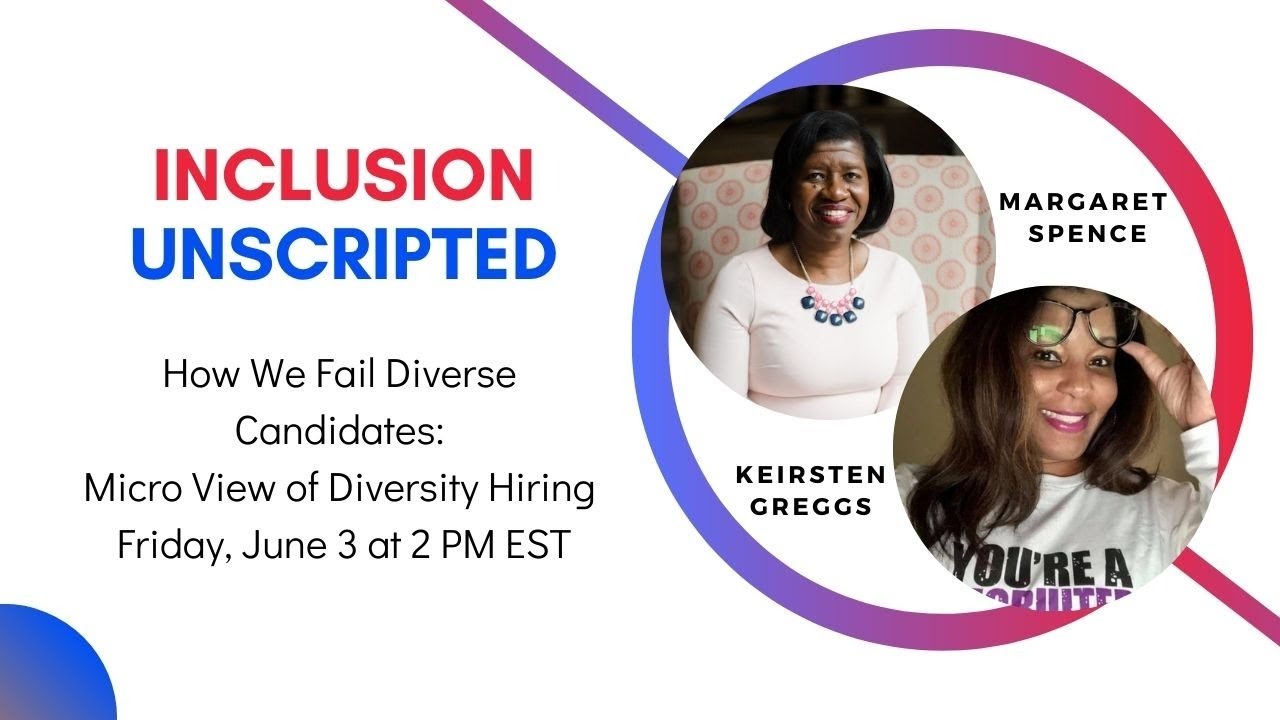
In this livestream episode of Inclusion Unscripted, host Margaret Spence welcomes guest Kirsten Greggs (Trap Recruiter) to dissect why organizations consistently fail diverse candidates throughout the talent acquisition process. The conversation opens with the common client question of how to increase diversity in the hiring pipeline, which Margaret flips by asking where the elimination points for Black and brown candidates lie. Kirsten explains that many firms use reactionary, once‑a‑year outreach (e.g., NSBE events, limited HBCU visits) and apply the same generic attraction and selection criteria to all candidates, ignoring systemic biases and the need for proactive, continuous sourcing. They discuss how bias seeps into interview stages—excessive interview rounds, “culture‑fit” judgments, and language or name‑based assumptions—often leading to over‑interviewing (up to 15 rounds) that disadvantages underrepresented talent. Both highlight the lack of long‑tail community partnerships, such as building relationships with high schools, local colleges, and historically Black institutions, to create pipelines before talent is needed. The episode also covers the limited power recruiters have in salary negotiations, the misconception that recruiters profit from hires, and the importance of advocating for candidates. Retention is identified as the missing counterpart to recruitment; without intentional retention strategies, diverse hires are the first to be cut during downturns. Remote work and geographic accessibility are examined, noting that hybrid mandates can exclude candidates who benefited from pandemic‑era flexibility. Finally, Margaret shares the emotional isolation DE&I professionals often feel and promotes the Inclusion Learning Lab community as a support network. The episode ends with practical take‑aways: stop using reactionary, siloed hiring practices; embed bias‑mitigation into every stage; build sustained community pipelines; align recruitment with retention; and empower diverse talent’s ambition.
Chapters
<LYRICS>You're like a circle that floats around me, keeping me safe and sound. And when I fall, you've tied a rope to me. You're blessing me every day. I was down with an illusion, like a sparrow with broken wings.</LYRICS> But now I shine with your reflection on me. I'm getting back up on my feet that you showed up.
Well, hello everyone, welcome to Inclusion Unscripted, where we're not just talking about diversity and inclusion, we're living it. We're living it because that's what we do. Inclusion Unscripted was built on the premise that we have to live more powerfully. We have to show up bolder. We have to say what needs to be said, and we have to create a safe space even when we're having tough conversations about ourselves. Um, hi, I'm Margaret Spence, and every Friday at 2 PM I'm here on LinkedIn Live. Um, today we are streaming on LinkedIn, YouTube, and Twitter. So for those of you who have not joined Inclusion Unscripted before, you know that I— if you don't know, I come to this without a script, with just a topic item, and we talk through the issues that I see out there in the world of diversity inclusion. For this month, we are going to focus on talent acquisition. How do we get diverse talent into the imaginary pipeline that organizations have, because I'm going to start there. Let's just go there. See, the one question that I get almost daily, right, from clients is, how do I get more diverse candidates? How do I get more diversity in my pipeline? How do I get diverse candidates hired? You know, we need a slate of people. And then the question I say to them is, where's your elimination point? Where is it that you start eliminating Black and brown people? And then there's generally this silence on the other end of the Zoom because they go, what do you mean? I say, you know, it shouldn't be so hard for me to get hired that you have to now come ask me how to get hired. It shouldn't be that, but here we are. So that's our topic for today. And that's really what we're going to focus on is how do we get diverse candidates hired? It is the thing that every organization is talking about. There is a talent shortage. A lot of you HR folks out there have coined this the Great Resignation. No, people didn't resign. They just hated you and they left. So let's be frank. Yeah, honest about it.
They just didn't like you and they left.
That's it.
They looked around and they thought, I'm out of here. It's been great, but you guys gave it a title and here we are. We've got this going on. That's where we are and that's what we're going to talk about. A couple of seconds about me. I'm the founder of the Inclusion Learning Lab and we have just launched a community for DE&I and talent leaders. Because here's what I know, and you can find out about the community at inclusionlearninglab.com/community. Inclusionlearninglab.com/community. One of the things that I know is the people who are doing diversity and inclusion are doing it in a silo all by themselves. They have no support, they have no one to circle around them, and oftentimes they're the only person in the organization doing the work of D&I. Because of that, they are in this space without adequate psychological and emotional support. The Inclusion Learning Lab community is there for that purpose. We're there to put our arms around the, those of you doing the work of DE&I. It doesn't matter what industry you're in, what organization you work for, whether you have a team of 100 or you're the only person doing the work. We're opening it up for all of the folks in the talent space who care about and who are doing the work of DE&I. So check out the Inclusion Learning Lab community. The last thing is every— the Third Wednesday, Third Wednesday is what it's called. We are going to be having an open forum for DE&I leaders. You can check out that information on our website. Third Wednesday, we will have an open forum. It's an hour. We'll pick a topic, we'll talk it through. It'll be open mic. It will not be recorded. It's a safe space. For us to talk about specific topics on a micro level. So now that I'm done with the infomercial and I'm done telling you all about that, everybody's able to see that I have a guest this week and I'm like super excited, oh my God, okay, um, calm down Margaret. So I have to tell you, my sister Kirsten Greggs, better known as Trap Recruiter, is joining me today. I have to tell you how we met because this is just too— so we actually met in person, which is so cute. Now, we, we met on, you know, on LinkedIn and Twitter. I mean, really Twitter, because then LinkedIn wasn't like the place where we could go all in about stuff. So we would go all in on the HR community on Twitter. So we started following each other on Twitter And then I spoke at the ERE conference in Washington, DC, and Kirsten was my introducer. She introduced my session and we sort of hung out and we've just been great. And every so often I pick up the phone and I text her and I say, hey, how are you doing? I may have forgotten about you for a while, but I see you on social media.
Yes.
Let me tell you about Kirsten. Founder and CEO of Trap Recruiter, a recruiting consulting and career coaching firm. With over 20 years of experience in talent acquisition, she's passionate about helping organizations implement creative recruiting strategies to attract, select, and retain historically excluded top talent. And that's major. She goes, um, she does this through full cycle recruiting, um, recruiting process optimization, facilitating workshops, hosting training sessions and webinars, helping job seekers find their voice in the hiring process. And we're going to talk about that for sure. And Kirsten was featured on a featured expert at ERE, which is where we connected in DC, in her site, Diversity Jobs, HireEasy, TalentView, TechTarget, BBC World News, BNC. I could go on and on and on.
Yeah, we don't need to do all that. Nobody cares.
People to know when you start talking, you're talking from place of authority.
Thank you. But yeah, no one cares about that.
Welcome to Inclusion Unscripted.
I'm so happy to be here. So you were just on my LinkedIn Live, Trap Chat Live. That was fun. And I'm glad that we have had the opportunity to connect work-wise again so soon. So thank you for having me. And I'm happy to be here to kick off your TA month.
Yes, my TA month. So we are all about talent acquisition. I'm actually right— I wrote a white paper on talent acquisition in a remote work environment. How do we create inclusion? So this should be good. My editor is editing it now and we're gonna spice it up.
Nice.
Go out.
So, so tell me from your lens, yes, what is the— what are the— what's the number one way? Let's just go there. What's the number one way that we fail diverse candidates in the talent acquisition process?
We treat them like they're not the underrepresented. We treat them like they're not marginalized. We apply the same strategies, we apply the same attraction and selection criteria without taking into account that we have biases that have been driving our hiring decisions, which is why our workforce isn't as diverse as it should be in the first place. Um, it's most diversity strategies, again, through my lens, and I've worked for some of the largest defense contractors, that are global, and, you know, there's a, there's a lot that goes into that, and there's a lot of excuses that are made as to why, you know, our workforce isn't as diverse as it, as it could be, you know, because they don't have security clearances. Well, why don't they have security clearances? And then, hmm, but that's a different conversation. So a lot of times we're very reactionary, uh, in our diversity hiring strategies, and we leave them for like a one time a year thing. So once a year we go to NSBE, once a year we go to Rose-Hulman, once a year we're at BAYA, which is also part of NSBE. You know, once a year we're, you know, we're on camp on different campuses than our preferred schools. Once a year we partner with a community organization because we got to pay what my old VP used to call pay at church because we got to pay at church because we made some faux pas. And so we said, oh, we're partnering with the XYZ organization and we're going to train up and provide them some resources for how to be into this industry or that industry. So we do a lot of things that are reactionary. We're not really committed. To diversity hiring until there's a problem, until someone says, why is your, for example, your Black population only 3% and you're a global company with 50,000 employees?
Right. The interesting thing that I often ask organizations is, what is the process to hire? A diverse candidate, right? What are the step-by-step-by-step process that you put in place to attract diverse candidates? We just did a review of 40 clients that we had, and we did this behind the scenes, not a part of anything. We just pulled their data and we sort of distilled it as one data set, right?
Okay.
And we looked at it and we started to figure out Where do they eliminate Black and brown candidates in their hiring process? Right? So a lot of clients, when we work with them, we'll ask them for their hiring funnel. Tell me about your hiring funnel. How do you get from point A to point B? Right? And then they'll— most of them have never ever considered the hiring funnel. And then all of a sudden they'll have to produce it because we ask for it. And we'll realize that there is a specific step where the Black and brown candidates get thrown out the door, right?
Okay.
And we'll serve that back to them and they'll say, but that's not possible, we need more diverse candidates. No, no, you had 7,000 Black and brown people apply, you only hired 18 of them. It's not about— it's not for the shortage of Black and brown people applying, right? So when you are out there trying to source candidates for an organization, what is your process where you say, they've asked me to give them a diverse slate? How are you finding this diverse slate that folks are asking for?
So I don't really like that approach, um, because I have been in situations where I will be asked where there is a number of people we need to interview. We're going to interview 6 people, 3 of them, 50% of them have to be diverse candidates. And that could mean woman, white woman, that could mean Black man, that could mean Black woman. You get double points for that. That could mean— that could mean someone who is neurodiverse, but it never does. We never think about that. We never think about persons with different abilities when we're thinking about our diversity pipeline. And one of the things that I try to drive home is that all these other things, like we want to hire this many veterans, we want to hire this many persons in the age group that's above that we're saying we're excluding. We want to hire this many people at the entry level. And I keep trying to tell people the diversity exists in each of those groups as well. But each time you're choosing the white version of that and not use it, and that counts as a diversity hire. So I don't really like the slate thing where it happens. You talked about getting through the funnel. But in my lens, they don't even get in the funnel. They don't even get to the funnel to even go through the process. Because when we are sourcing, when recruiters are sourcing, we're using again those same tools, those same methods. We're not going outside. So if you are a fisher, a fisher person, is that a word? If you like to fish, how about that? If you're fishing, you know, and you're like, oh, I hope I catch some catfish today because I really want to fry these up and, you know, put them between some white bread, make a sandwich. Uh, yeah, that's nice, but you're at a pond that don't have no catfish. How are you— how you gonna— how you gonna catch catfish, you know? Or, or you're, you're, you're you're continuing to source or you're continuing to focus your attraction efforts in places that are not diverse. So you're only getting the two Black students in the tech program from MIT, or— well, that's not a good example because they actually do have some diversity there. But you're only getting those two Black students from the Ivy League school. Who are even in that, that line or in that subject matter expertise. And you got— and you're only gonna pick one of them because there's only 4 positions to begin with, you know. So, so that's what I'm saying is that we can't keep saying that. And that's where you get that, oh well, there's no talent out there. You're not looking in the right places, right?
And it's not that there's no talent out there. I think I want people— there's a couple things I want them to stop saying. I want them to stop saying there's no talent out there. I want them to stop saying there's no qualified Black people because that's what they may not say it out of their mouth.
But yeah, that's what they mean.
And a lot of them say it. Well, we tried to find diverse candidates, but they really couldn't find anybody that was qualified. What's the definition of qualified? Because when you got hired, you weren't qualified, correct? Unless you came in the door. If this was your first job and you've been at the company 20 years, when you got there, you weren't qualified.
Correct.
Right. But now you're deciding that the candidate coming in the door needed to be qualified. So the question is, what do you say? Because I know it has to be difficult for you on the sourcing side.
Yes.
When you are constantly having to educate the populace, because here's an even thing, um, I'll say to our clients, you want diversity recruiting, let's say you're going to Pick a school. University of Chicago. I don't know, came out of the air, right? Not anything particular. So you, you California, you Chicago people don't get all bent out of shape. Or if you go to Stanford, right?
Okay.
Or you go to University of Texas or anywhere else, there are Black students on that campus that you are going to, but you don't go looking for them.
So not unless you're going there for, you know, the Black alumni, right?
Yeah, so you're not going there to say, well, where's the Black Students Association on this campus, this Ivy League campus that I'm a part of? Because there is a Black Student Association almost on every single campus across the US.
Yes.
Okay, so you're— even if you decide, well, I don't have a quote HBCU strategy, right? I'm gonna go and, um, I'm gonna go on to this campus. Okay, fine, go on to that campus, no problem. All right, now what? You've gone on to the campus, you're picking the same white students.
Of course they do. But, but we also have, you know, we have our folk— what we call our focus schools. And, you know, those are, those are the ones that we invest in, those are the ones that we hire the most people from. And the alumni that are there, the ones that go back, that, that are, that are engaged in doing that, they they are also very homogeneous too. So you're getting that. I don't know if you remember, but I did a post, one of my last ERE posts when I was still blogging for them, was about why you don't have Black candidates because you don't have Black recruiters. And that rubbed a lot of people the wrong way. But it is what it is. I am an attraction, and not just because I'm Kirsten, but because I'm level setting in a way. Like, people are going to feel— people who look like me are going to feel comfortable with me, the same as any other professional. And you mentioned HBCUs, but we're still— we're doing the same. And this is going back to my point that we're applying those same things. So when we have 4 Ivy League schools that we love to recruit from, you know, that's where we're getting all of our talent. We're doing the same thing to the HBCUs. We're only focusing on these two. And there's a million out there. I did not go to an HBCU, but I went to school in Richmond, which was surrounded by two. And I tell people all the time, Virginia State University has one of the best tech programs out there. Why aren't we there?
Right.
And of course, well, Howard, Hampton, Morehouse, Spelman, and FAMU. Yes, but they are awesome, and their alumni take care— like, wow. Yeah, yeah.
But, but here is the thing, even right here where I am in Florida, there's Edward Waters College, right? Okay, that There's Bethune-Cookman.
Yes, right. There's not going there.
Here, there's other schools here. So if you only go to the one school that you know in the state, then— and then you say, well, we, we have a relationship with them. It's not enough. It's not enough.
Build a new one. Yes, and build her— build, build a new one.
Right.
It's not, it's not hard. So yeah, like, my thing is, again, getting people into the funnel seems to be where I come in to the most, where I have the most trouble. And some of that is because of the types of positions that I recruit for. So when I, I work a lot in niche fields, um, like I did, uh, 18 months I rebuilt a global trade compliance practice for an organization who had some issues. We'll just say that. I'm not going to call them out. But yeah, I came back. I was only focused on hiring a certain person. And again, that field is not very diverse. People are historically excluded. So when you have positions that are written a certain way that requires experiential expertise in this field, there's only so many people. You know, I shout out to Torrin Ellis. You know, he had me assist him with some things he was doing within architecture firm, you know. And I was even surprised to know how how few licensed architects there were who— and not even that, but who were of color.
Right.
So what do you do with that? For certain things, you can't change your requirements because, yeah, you do need a license to do this. Yes, you do need to have certain credentials to do to do that. So it gets difficult. And I think for a lot of us, especially someone like me who has over 20 years of work experience in recruiting, even, is that I am now at a certain level where I'm interfacing with people like you. I'm interfacing with the lawyers, the doctors, the people, and I lose in my mind because I know people. I lose in my mind that that's such a small percentage of the population because they're in my ecosystem, right? And having to go outside, and then that becomes an issue because those same people are the ones that you reach out to. You start with your network, you start close inside of your network. And so that's why we're recycling all the same people, all the same. That's why all the same people are getting all the opportunities, because we know someone that knows someone that knows someone, you know. But there had to already be a— there had to already be a connection. And a lot of times those connections are exceptions. Not that they're exceptional, but that they are exceptions. Because, yeah, it is an exception that, you know, my— I could just look at my line sisters, you know, like how many are attorneys, uh, you know, like how many have master's degrees, uh, you know, like just— yeah, there's not that many.
Not many, right? You know, it, it's one of the things that we have been pushing, um, our clients, pushing them, pushing them, pushing them to invest in a long-tail, um, talent acquisition strategy. Okay, um, a lot of our clients are in the insurance industry, and the insurance industry, um, is not a sexy industry. It's not one that people want to run into, but it is one of the highest paid industries out there. Okay, you can walk into the insurance company in an insurance, um, an insurance job, and in a couple years be making six-figure plus. Right? Not 20 years, we're talking a couple years, okay? Most people, when they think about insurance, they think, oh, it's selling. There are thousands of positions. There are actuaries, there are, um, policy servicing, there's underwriting, there's risk management, there's, um, engineering, there's all of these positions, IT, and there's adjusters, there's policy, there's the sales side, HR, right? And HR, exactly. But because we don't create a long tail strategy— for example, your, um, your, um, architecture firm going to the high school.
Yes.
And start working in a historically Black community in the high school and start investing in the high school. Give the kids the opportunity, teach an AutoCAD class in that high school. Get kids engaged, give them laptops. This is a long-range strategy. It is not a— it's recruiting is not a strategy of we need talent, we can't find them, nobody's—
it's not plug and play. It is not plug and play. And, and, and that is, that is something that I, I fight every single day, you know. I'm like, you cannot expect to keep maintaining these same rigid structures. I came out of school with an undergraduate degree in sociology and international studies. That does not mean recruiter. You can train people to do things like real talk. You can figure it out. But when you are putting— there are so many roadblocks. Like you just said, go to your local high school. Well, yeah, when these blue these blue chip companies or these companies that are the most sought after are in locations that are not accessible to certain people, that becomes an issue. One thing that was great during the pandemic— well, it still is the pandemic, but one thing that was great at the beginning was the idea that people could work remotely. And again, I understand. That there are a lot of jobs that don't require people to— that people have to be on site. And I am one who has advocated to help us remember that everybody is not returning to the office. There are a lot of people who never left.
There's a whole segment that never left, that never left certain jobs.
But when we're thinking about those office jobs that people could have or those jobs people could do outside. It opened up because someone in Iowa or someone who is 50 miles away because it's more affordable, who doesn't want to drive 100 miles a day to get to work, they can do that job. But now that we are telling people, oh, you have to be No, no, no. We want you inside hybrid for these jobs that people have been doing for 2 years outside of the office. We have to think about that. And then again, accessibility is a big thing. Everybody like you wanted people to work from home and you want them to put in more hours and you want them to have their laptop on and you want them to do this. Well, guess what? That costs money. And guess what? That costs time. Everybody doesn't have the time, or everybody doesn't have the ability to move to a different side of their desk like I just did to come and talk to you. Like, they don't, right? So we have to think about that. And then we have our historical cultural biases that we're bringing in anyway. I say this all of the time. I've gotten to the point that now that I'm older, even though I'm still young for my age, I don't fight as much. I just repeat back what someone said so they can hear it, or I ask a question to cut like, so you're saying X, Y, and Z, correct? I'm hearing you correctly. And you'd be surprised the difference in how people are evaluating different candidates because of their biases. Someone with an MBA from Wharton. Okay. That person, I'm just going to keep it 100. It's you. Like, that person barely gets interviewed. They don't get asked hard questions, right?
Of course not. The rigors of the program is what is selling them. It is the mental model around what is acceptable, right? It's the mental model around culture fit. I'll get along with everybody here. Um, will they, will they like the manager? Will the manager like them? Will the team like them? Will they fit into our cookie-cutter culture that we have here? Well, no, they don't fit. But here's something that got me going a few months ago. I had a young lady that I was coaching, and she was interviewing for a pretty robust job. Okay, she had, I think, 15 interviews. And I'm— because I was coaching her through the interviews, I want to say 15 interviews is what she had totally, okay? And at the end of the 15 interviews, um, she met with every layer of this organization, every single layer of this organization. And at the end, they went with the internal candidate who had applied for the job. Oh, so what do you see? And I'm telling you, because I was coaching her, every time there was a call, um, she dialed me up and said, I have another interview with them, let's run the interview. I was running the interviews with her over and over and over again, and I would say, no, no, no, remember, this is what they're going to ask for, this is what they're going to do. This was my— what they— what they're going to do, right? In the end, and it was 60 probably 5, 6 days from the beginning of the process, from the I'm filling out the application and they called me, to from the into the ATS to the last thing was about 65 to 66 days. And in between, long time, there was 15+ interviews. So if you are coaching someone, because I know that you work with people, if you're coaching them I'll give you an example. I talk about my son all the time. My son is in tech, and I remember when he first went from working for startups as an independent contractor to deciding to take a corporate job, as he called it. I went corporate, Mom. Okay, great. He had a recruiter that took his resume and said, no, no, no, we're not doing this, and fixed it all up, made it look nice, and then walked him through what the interview was going to look like.
Yes.
Right. And then got him pumped up and ready for the interview. So if I'm a Black woman candidate coming to you for a job that may not quite fit the mold, what do you say to me?
I do the same thing that that recruiter did. I help you. I help and I, I tell you, I give you your control. Like, I tell you the things that you can and cannot control in the process. I tell you to not compromise your must-haves. Like, if something is making you uncomfortable, like, you don't have to subject yourself to that. You know, if you're in an interview and someone macroaggresses you, please let me know. Take note of that. Or end the interview. Like, that's up to you too. It's up to you when enough is enough. Like, enough is enough. And 17 interviews, like, or 15 interviews. Listen, 5 is too many. Like, that's a lot. Now, I don't know. Christina and I were interviewed for HR Brew. That Morning Brew part of—
yes.
So, and it was about the interview process, and I talked about how the number of interviews should be comparable to the job level. So if you're in a— if you're interviewing for a CEO or even for a C-suite position, prepare to go through multiple rounds of interviews. But if you are coming in as an analyst with a job that requires 2 years of experience, is very repetitive, anything like that, you don't need 4 or 5 interviews, 5 hours worth of interviews. No, you don't. It doesn't take that long. I promise you it doesn't. And one of the things I do is I do that upfront because I have to explain to people what that what that does, not just for the candidate experience, but what I like to call the recruiter experience. Because for every person that you're talking to, I am exponentially engaged with more people. So I'm engaged with the hiring manager, I'm engaged with the candidate, I'm engaged with the talent acquisition coordinator, you know, I'm engaged with, with HR, with my, like, all these people who have to, you know, who are weighing in on this process, and I have to make sure, especially when it comes to coordinating schedules, that all of these things work. And that's a lot, and that's just for one person. So for every one person, I could have 4 that are involved in this, and I need people to understand that. So please don't interview, like, and don't interview 11 people. Like, you don't need—
That was the other thing I was going to ask you. How many people for a job is too many people? It's like, how many, you know? All right, there was a time, and I'll go back and date myself, when, when I was out of college, um, it was a recession and there were PhDs applying for entry-level jobs because it was bad, right? We're talking in the '80s. Okay, fast forward to the '90s, we had the same thing back in '91, same thing went on in 2002. We had the same thing in 2000. After September 11th, we had the same thing happen. Then we fast forward to 2008 and we just went straight full-on global depression, right?
Yeah, you're right.
Now we're in pandemic land, right? Um, I— every morning I have a, um, a routine that I do, right? I turn on the TV to CNBC and I end at CNBC at night and I started CNBC. Not a plug for CNBC. Just what I do, right? And I do a start and end because I want to hear at the beginning of the, of the night, like 11 o'clock, the global markets open. I'm not a stock person. What I'm listening for is for, for to understand and hear what's going on out in the world and out in the economy, what these economists, these paid talking heads on economy, are saying. Because for me, it is an impact not only to my business but to the clients that I'm serving. And how I show up for them. And then in the mornings, I open with that 9 o'clock and I hear what's going on. So the buzz right now is, well, we're going to enter a recession, and you know recessions cause people to be terminated.
Yep, you got a lot of people that's being laid off, right?
And, and I have quietly seen under the shovel here, just quietly, uh, 5,000 people laid off, 3,000 people laid off. 2,000 people laid off. It's quietly happening, right? Quietly happening. Netflix, um, just let go— they bought a whole bunch of Black people, right? And this is, this is the thing that we also have to talk about when it comes to talent acquisition. Organizations will want to recruit Black people. You bring us in the door and we're the first ones cut, and we're the first ones out the door.
Yeah.
We're the first ones that you look around and say, who on the team should be eliminated? You know, one of the things— and this, um, I think it's tonight I'm actually speaking, or it's next week, um, we started this thing in 2008 called, um, HR in Transition. Because what we found was in 2008, the hardest pe— the first people who got let go in 2008 were the HR folks. HR got let go first. HR and recruiters. They were gone, out the door. And, and anybody that said, I'm an HR generalist, they were gone because they couldn't figure out what you did and what the generalist meant, and they got rid of you. If you were payroll, you stayed. If you were benefits, you stayed. If you were somebody important that we, we— you stayed. But if you were the generalist, I'm the jack of all trades, you were out the door. And I still see HR people making that mistake now because they think they're not that they aren't touchable. HR was the first folks terminated in the Great Recession. Then it came to the minorities and the women.
But where are we? But in corporate America, a lot of the— no, no, no. Where are your underrepresented talent? They're usually concentrated in certain groups. And when those groups are the ones that go first, they're the ones that go first.
Go first.
Yes. So, I mean, you look at HR. So we've all seen the studies, like, HR leadership is very heavily one thing. HR practitioners are heavily one thing. And there's a lot of Black people, Black women specifically, in HR functions. Right.
Right. And that's the first set of folks that— because, hey, we're not hiring, so we don't need you. That's why we got the ATS. We could just suck things out of there and they've got self-service benefits and we got the software that they can—
Oh, yeah. Now that did. So I remember I went through two self— when we were doing employee self-service, I went through two employee self-service things for a global company and that did adversely affect our HR people and to the point that people hated it, like, oh, we're outsourcing our HR. You just got a message from Aaron Dillard. Yeah, good to see you.
Good to see you. Thank you for joining us today. This has been a good conversation on, on talent acquisition. Really good conversation on talent acquisition. So, so, so tell me now, as we sort of wrap up, we've got about 4 or 5 minutes left. Tell me, tell me first off, from the employer lens, What do you want to see when it comes— again, restate for me how you think we fail diverse candidates. Let's say that one more time so everybody can hear that piece. And then tell me what you want to see happen going forward.
How we're failing diverse talent. We're not going where they are. We're not— we are not making our opportunities accessible in a balanced way, meaning we're, we're siloing them into certain career tracks and levels on that track. Okay, so there's that. There's no balance across, uh, the organization. We're also letting our biases control how we are evaluating them. Where we're injecting certain things. Like, I started slowing down my speech. I'm from South Jersey, as you know, and I promise you, if you saw me around my family, once I've been there for about an hour or so, you probably wouldn't be able to understand anything I said, or you would be like, is that the same person? There's that, like, they don't speak correctly. Their language is off. I get that a lot for folks for whom English is not their first language. People who are very highly educated, very whatever. And they're like, well, they missed a comma. The evaluation becomes a lot more stringent or they— or I get asked certain questions just based on someone's name. Well, we don't have money to, you know, to get them a visa. I'm sorry, what?
Did they ask you for a visa?
Correct. That's what I'm saying. Like, a lot of assumptions are made up front. And it used to be this way again when it was more— when it was, you know, people going to brick and mortar, like, 100%, like, certain locations, you know, we would be screening people out by their zip code. Like, this is too far away, you know. Well, they're not going to want to travel this far. Or they're like, don't make decisions for other people. Or, I don't have relocation for them. No, you have a relocation for this person, you don't have relocation for that person. So there, there's that. Um, what was your second question? I forgot.
The second question is, what do you want them to do? Because we, we, we need to do a part 2, and we'll do that in the a little bit because the part 2 is— I want to pick up on this the next time you and I get together where we talk about the salary negotiation income.
Okay.
And the difference between how recruiters navigate the salary and leave money on the table, or because we don't know how to—
we don't have as much power depending on the organization. I promise you, we don't have as much power as you think, as, as we're given. But because we are the liaison, because we're the person who brings and returns the information between the— like, we're the ones that are the midpoint of that negotiation. It makes it seem like we're in charge, but we don't a lot of times actually have the power to make that decision. I can advocate for people, and I explain that in a way that people see that. Like, I got an email Yesterday, actually, it was someone who came back and asked for more money. And I had already explained what I told them what I was going to do and what the possible outcomes were. And they said, okay, listen, here's what we talked about. Again, we ran down. Here's what we talked about. Here's what I asked for. Here is why. And they said, thank you. For championing this for me. And that kind of stuff, that makes me feel good. So I need people to understand because we get a bad rep, like recruiters are holding on to your money. No, we're not. Especially those of us who work in a corporate organization because we don't get paid for your hire. We're not compensated. We don't get a portion of your salary. And honestly, for the third-party recruiters who do get a portion of your salary, The more you make, the more they make. So, so please get that out of your head. Um, but yeah, I want us— so to answer your question, I want us to take a step back, to stop making excuses, and to stop applying old and short-term answers to our diversity, equity, inclusion, and belonging strategies. And also, I think what's missing is that we put recruiting at the forefront, but we also need to think about it in tandem. Is that the right word? You know, I don't know a lot of words on Fridays. In tandem with retention, because recruiting and retention go hand in hand. So we need to be thinking about once we get these people here, once we build up, you know, once our diversity pipeline is healthy and robust, and once we have talent, in our organizations, what are we doing to retain them?
Yep, and that is the kicker, and that is the truth. And it's not enough to just hire us. I said it a couple weeks ago, nope, you cannot ask for our skills and don't want our ambition. And that is the key. If you want our skills, you need to empower our ambition, which means that you put fuel and fire underneath our talent development. Yes, period. There's no— it's not negotiable. If you want our skills, you darn sure need to ask about our ambition. And if you don't ask about our ambition, then you probably shouldn't be hiring us. And for those of us who are Black professionals and brown professionals, Hispanic, Asian, Black folks out here who are— and Native American folks who are out here trying to get hired in these organizations. We need to do a better job of interviewing them and asking, once I get hired, what happens next?
And don't be afraid to, to go where— like, don't stay someplace where you're not wanted. Don't stay someplace where you're, where, where you're not growing and where you're not thriving. Um, don't, don't be like me and be sitting in the parking lot crying, um, you know, or, or having to make a phone call before you can even go in there carrying your Bible. Uh, church ladies throwing holy water on you on Sunday, spray you up to go back on Monday. Call on Jesus, Allah, Buddha, all of them, just Somebody help me, please, because these people— yes. So yeah, we gotta, we gotta know when to, to move on to.
Got it. Well, thank you so much. So before we close, tell us how to reach you. Um, if folks want to follow you on social media, tell us all the places we can find you.
Yes, I'm everywhere at Trap Recruiter, T-R-A-P-R-E-C-R-U-I-T-E-R. Horrible. I hope you spell better than I do. Yeah, everywhere @TrapRecruiter on LinkedIn. Even you can just type in Trap Recruiter or my name, Kirsten Greggs. I know Kirsten can be hard to spell, so Trap Recruiter is the easiest thing. I'm everywhere. I'm everywhere. Trap Recruiter.
Great. And for those of you who are watching, you can always visit us at inclusionlearninglab.com. And join our weekly program here Fridays at 2 PM. We're live on LinkedIn, YouTube, sometimes Facebook, sometimes Twitter. It depends. Today we are live on LinkedIn, YouTube, and Twitter. You can also listen to the recording on your favorite podcast app and download it and like it and share it and tell your friends. Now that I'm on— now that I'm on all the, um, all the podcast apps, please let your friends know that I am there and, and share this, this podcast episode with them. So as we go out the door, I want to thank you for showing up today. I want to thank you, Kirsten, for being here with me, and this was fun.
Yes, thank you.
Let's do it again soon. Yes. All right. Yeah.
You're like a circle that floats around me, keeping me me safe and sound. And when I fall, you tied a rope to me. You're blessing me every day. I was down with an illusion, like a sparrow with broken wings, but now I shine with your reflection on me. I'm getting back up on my feet. That you showed up was








