E26: Hiring Manager, Why Should I Trust You With My Career?
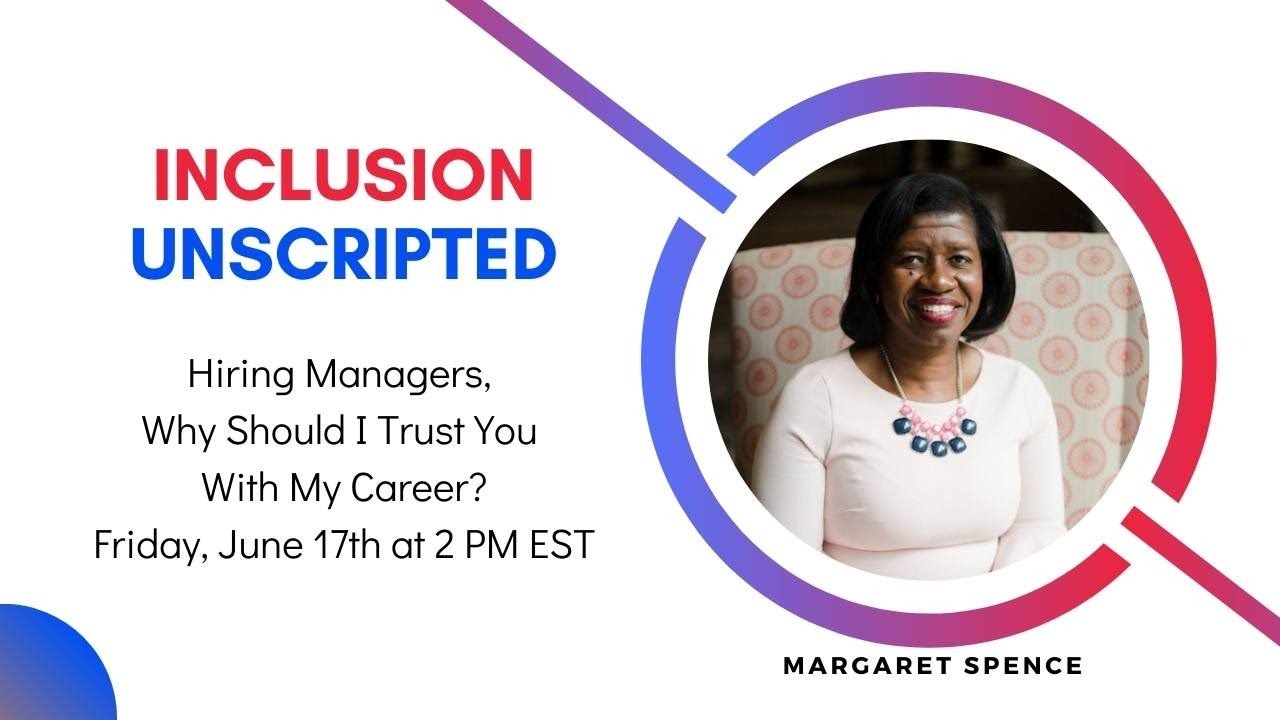
Margaret Spence, founder of the Inclusion Learning Lab, asks why diverse candidates should trust hiring managers with their careers. She cites 71% turnover among DE&I leaders and warns that ghosting, lack of feedback, and opaque hiring processes damage both candidates and organizations. Candidates should ask recruiters about prior diverse hires, growth pathways, and genuine commitment to success.
Chapters
<LYRICS>You're like a circle that floats around me, keeping me safe and sound. And when I fall, you've tied a rope to me. You're blessing me every day. I was down with an illusion, like a sparrow with broken wings. But now I shine with your reflection on me. I'm getting back up on my feet.</LYRICS> Hey everyone, how are you?
Welcome to Inclusion Unscripted, our live broadcast on LinkedIn, Facebook, and, um, today we are live on YouTube. We alternate between YouTube and Twitter. Welcome to Inclusion Unscripted. Happy Friday to you. Um, if you're joining the show live, welcome. If you are listening to the replay on one of the podcast apps, thank you for listening and downloading our episode.
For those of you who are joining for the first time, you've never attended an Inclusion Unscripted event, let me tell you what we do at Inclusion Unscripted.
We are unapologetically leaning into diversity and inclusion. We are here to create a safe space for those of you doing the work of diversity and inclusion for your organizations, doing it on a personal level. But here's what I know, and my motto for this Inclusion Unscripted is we're not just building diversity and inclusion, we're living it. We're living it every single day. I don't get to get up on any given day and decide that I'm not diverse. I get to live this, and I live this in a world that may at sometimes are ready for me and other times aren't ready. So what we try to do, our goal is to empower the diverse community to do a couple different things. We want our listeners to feel empowered to manage their careers. We want our listeners to be empowered to stay in your organization and do the work of DE&I. We want you to feel empowered empowered those of you who are not diverse, who are doing the work of diversity inclusion. We want you to feel empowered to co-create the world that we all want to see, which is a world where diversity is empowered. So that's what we do here at Inclusion Unscripted every Friday at 2:00 PM Eastern. But here's the tenets of Inclusion Unscripted. This is not a script. I don't write a show note and I follow a show note. We pick a topic, we focus in on the topic, I give you my real-world understanding of that topic. It's not always going to be pleasant and nice and cute and wonderful. It is going to be direct. It's going to address the issues that I see out there. So for the month of June, we have been focusing in on very specifically talent acquisition, but specifically diversity talent acquisition. Let me give you just a little bit about my background. I am the founder and CEO of the Inclusion Learning Lab. Within the Inclusion Learning Lab, we have a community for DE&I leaders and talent leaders. The community is there as a safe space to empower you to do the work. A lot of you can go out and get certifications in diversity and inclusion, but when you get back to your organization, the real work that occurs there requires support.
It is essential that we have support to do the work we're doing.
Here's the data point why the Inclusion Learning Lab community is essential. The average DE&I director spends 10 months in the role. On month 10, you're generally burnt out and ready to go. 71% is the turnover rate when it comes to DE&I. But here's the other number, which is the reason why we've done the Inclusion Learning Lab, is that less than 7% of current incoming DE&I leaders have ever done the role before. That is the reason why the learning lab occurs. Within the Learning Lab, we have microlearning. We have content designed specifically for you to be empowered in your role. We work on microlearning around ERGs, microlearning around strategy, around developing strategic initiatives, about creating runways. The community is open to individuals, organizations, and teams. So if you want to check out the Inclusion Learning Lab, it's inclusionlearninglab.com. Enough of the commercial for our Inclusion Learning Lab.
I want to talk to you today about your career, about talent acquisition.
Last week's episode was why you must question your career. If you didn't hear last week's episode, you can go back and listen to it. It is live on YouTube. If you go to my page, Margaret Spence, you will find the YouTube channel there. Um, so last week I did a complete breakdown on why you must question your career, and we had a lot of folks participating, and I had a lot of people send me things, direct message me, folks that watch the program while it was going on and others who watched it later on. So this week's episode is a little bit different. It is part 2 of last week's episode. This week's episode is geared to hiring managers, but it is also geared to those of you who are trying to be hired. It doesn't matter if you're in early career, if you're in mid-career, or you're in late career. If you are looking to change jobs, or you're looking for a new job or a new opportunity, or you are a recruiter or hiring manager, this episode is for you.
In this episode, we're gonna talk about the big topic that nobody wants to say, which is, why should I trust you with my career? So this week's episode is very specific. Why should I trust you with my career? What have you earned in your time as a hiring manager or a recruiter, or even an organizational leader that empowers you to have the trust that is necessary to manage someone's career. Here's what I know, and this is the key to what I know.
We underestimate the importance that we hold in people's lives when it comes to hiring them for a job.
We underestimate that in terms of how we hire people. We underestimate the amount of trust that they have to have in you to give you their career on a silver platter and say, here's my career, I trust you with my career, I trust you to empower me, I trust you to have my best interests at heart, I trust you to allow me to thrive, I trust you to take me from where I am to where I want to be. That is a level of trust that is being given to you as a hiring manager, as a recruiter, as someone who is representing a company who's going out there and asking people to come to your company to work. So the question is, why should any diverse person work for your organization? And the follow-on question is that— to that is, Why should any diverse person trust you with their career?
If you as an organization cannot answer those two specific questions, if you can't answer the question around why I should trust you with my career, you can't answer the question of why I should come to work for you as a diverse person.
You can't say to me, because I'm giving you a job and a paycheck. Because what I've learned over my lifetime, is a job and a paycheck doesn't mean that I feel fulfilled, doesn't mean that I feel I belong, doesn't make me feel that I'm being engaged. It doesn't help me feel that I'm a good person inside. Because if I join your team and you are a dysfunctional leader, and I join your team in the hopes that I'm going to be able to build my career, but you have never done the work on you and you've never built trust with an employee, and you've never actually learned how to empower anyone, I should really not trust you with my career. And that is the fact. Oftentimes, as individuals, we trust people with our pathway, with our purpose, with our process, with our possibilities. We trust them with that. But they have not earned the right to be trusted with your career. They have not earned the right to be trusted. And when we are out there going out, especially for early career folks, for people who are getting their first job, the first job out of college or high school, right, the first job entering the work— the world of work, and the person trusts you with their career. They trust you to say, you know what, I'm a lump of coal and I have the potential to be a diamond. If you polish this coal enough, I will become a diamond. Every diamond started out as a lump of coal. Every diamond started out there. So if I am early in my career and I'm coming to you as a hiring manager or as a recruiter, understanding the level of trust that, that individual is placing in your hands, and we discount the trust that they're giving you to empower their careers. We discount the trust. We take advantage of the trust. We don't treat the individual as the valued person that they are, and we don't treat the process of hiring people as a trusting process. You know, it's not a hiring funnel. You know, I'm getting ready to go to Dallas next week to speak at a conference, and I'm going to be talking about DE&I data. And what I've learned over the years is people look at data. Oh, I'm putting out DE&I data. We only hired 5 more minorities this year. We only hired 4 more women this year. We didn't meet our goal of hiring people. But here's the thing. Every number on your data set is an individual, a human being, a person. It's not a commodity. It's not relegated to a number thing. So when you take folks now through your hiring process and you say, we need 300 candidates in the hiring funnel to hire 100 people, you're actually dealing with 300 lives, 300 individual lives that you are impacting in a positive or a negative way. Right? And we don't take that into account. What we, what we, what we instead do is say, we need the numbers, we need the numbers. This is a people process. There's a reason why it's called human resources. There's a reason why it's called talent acquisition, because the talent is a human. The acquisition part is the process. Let me say that again. Talent acquisition is a two-part word, but the talent part of it is a human being. The acquisition part of it is your process. So if you're not bringing the human into the process, then you're doing me a disservice, and I should not trust you with my career, and I should not trust you to go through your hiring process. That's the entire summation of what we're talking about today. Oftentimes we view the hiring process as a transaction. The folks, all of you out there, um, who are doing talent acquisition and recruiting, it is not a transaction. I have super great friends who are recruiters, who are in talent, who are in the TA space, and they are amazing. And I know that they care about the process. I'm not talking to you guys, right? I'm not talking to those of you who are my friends, like Kirsten. I had her on 2 episodes ago, and she is in talent acquisition. But I know that for Kirsten, she cares. She cares about the people, the process, and the outcome. But I also know that there are many of you who the person being hired is just a score. It's a score on a belt. It's a notch on a belt. Basically, it's a score, right? You scored that talent. High five to me. I got that talent through the whole process.
I hired them.
Yay!
You deserve some badge of honor for doing that, but you took the humanness out of it. You took the humanness out of it. You aren't a human. I have a very good friend who tried to interview for a job, and the hiring manager ghosted her after they reached out to her for the position. Because here it is, there is no respect in the hiring process. You don't respect the process, you don't respect the people who've come into the process, and you don't respect them enough to say they've trusted me with their career opportunities and I should take this job more seriously. That's it. That is the, that is the happy part of this process. I don't even know how else to say this. That's what it is, right? So the question for all of you is, what are you going to do to create a trusting relationship within the hiring process?
If I come to your organization today, and let me give you an example, and this is a real example. You have 7,000 diverse people apply for jobs and you only hire 98 at the end, or 100 at the end, right?
Okay, so the other 6,000+ people, they had an experience with you that shapes their thought about the industry that you're in. It shapes their thought about you as a person.
It shapes their thought about your organization and your brand. They are now going to be able to shape and write a story about you.
They could tell their friends, don't apply there because I went through their hiring process and it was dysfunctional at best.
They didn't value me in the process. They didn't really engage with me. They didn't want to know who I was.
Right. But that is what we are dealing with.
Because we don't value the talent acquisition process enough, because we don't value it enough, because we don't invest the time in our own inner work around seeing possibilities and potential in the candidates that we hire or we want to hire, then people go through our funnels either feeling that they've been empowered, or they go through the funnel feeling that they've been taken this— they've been taken advantage of, that they were at a disadvantage. I was talking with somebody this week about a hiring funnel in an organization, and it wasn't the organization that I was talking to, it was a candidate who had gone through the hiring process.
So sometimes we will talk to people who are the candidate, because one of the things that I do on a limited basis is career coaching.
So I'll get someone who comes to me and says, I'm struggling to get hired in this particular industry, I'm struggling to figure out what I should do to get hired. Here's the experience that I've had trying to get hired by this company. And I will go, wow, at the end of the process. I'll go, oh my God, this is major. I don't even get this. I don't understand how and why they treated you this way as they were trying to empower you to be hired by them. The impression that we give people coming to work for us doesn't start when they come to work for us. It starts and it is formed when the recruiter has the first contact with the individual.
That's when it's formed. But here's what I have figured out.
If somebody applies to your organization 5 or 6 times and they're a diverse person or a woman and you never even acknowledge their application or that they applied, or they keep getting your canned rejection emails, One of the things that they begin to know within themselves is that you don't value them as a person. For all of you that want diverse hires, you want to have diverse people in your organization. You want to say, we've hired 20 diverse people or 100 diverse people, or we have a candidate slate of 5 or 6 diverse people in every slate that we put together.
You want that because that's your goal.
That's the thing you put on the wall that you're going and goal— your, your goal-setting numbers. We want to increase the number of diverse people that we hire, but the way you treat us in the hiring process leaves us psychologically scarred.
It does. I've had people that I've coached who had 30 interviews and never got the job, never even got a decline. I've had people that have gone through 5 or 6 layers of interviews who've never gotten the job, and they've gone through 5 or 6 layers of interviews. I've had other people who didn't ever— they, they want to work for this particular organization, they apply over and over and over again.
And they don't even get a response to their, um, to their resume.
And they will go into your applicant tracking system, they'll fill out everything that you want, they'll pay someone. I have folks that are paying people to do their resumes. They're paying them to do their resumes, keyword it, make sure it's wordsmithed correctly, right?
And they'll do all of that and they won't even get a job offer, right? They won't even get an interview. They won't even get a screening interview. They won't get a chance to even tell who they are. So let's go back up the funnel all the way.
The level of, um, disrespect within the hiring process has to be addressed. If you are in talent acquisition, if you are charged with recruiting talent, you're recruiting a human being to come to work for you, a living, breathing person, and you discount every single experience in your hiring funnel, then you really should not be hiring anyone.
One of the things that we recommend to organizations when we are working with them around diversity and inclusion, we will say to them, how many steps are in your hiring process from the time the you decide, okay, I want to hire X person from that point to the point where you make the job offer? How many steps are involved in that process? And then we will ask them, What was the candidate experience at each one of these levels? Did you survey a candidate who didn't get a job but went through the phone screening to see how they felt about the phone screening? Most organizations have never done that.
It's rich data, but we don't tap into it.
Did you, um, do a survey of an individual who interviewed with the hiring manager who didn't get hired? To see how they, they felt that experience was. Um, because that's your rich data. They may not answer the survey while they're going through the funnel, but they darn sure will answer the survey when you've made a decision about someone else. And it will be important for you to hear what that person has to say about the hiring process.
It's imperative that you listen and hear that.
But we don't do that granular work. The other thing that we ask organizations to do is map their elimination points.
At what point in the hiring funnel do women get eliminated?
At what point in the hiring funnel do Black people, Asian people, Hispanic people, Native American people get eliminated? At what point in the hiring funnel does someone make a decision not to pass someone's resume on to the person that's doing the final interview? And who gets to make that full decision? Is it one person? Is it a committee of people?
Is it 4 or 5 people? Is it only HR?
Is it only the recruiter who is making the decision to pass the candidate to the next level?
And do they always make the same decision?
That's, that's—
and when we ask people to start digging into their data set and we ask them to start really micro-evaluating their data set, what we find are trend lines that nobody actually evaluated. Because imagine your hiring funnel is a clear funnel, but imagine it as an iceberg.
There's what everybody sees at the top, and what everybody sees at the top is we need more diverse candidates, we need more women, we need more people to hire.
That's what everybody sees at the top.
What happens now as we go down the funnel is the fundamental things that often goes unchanged.
It's the stuff that do we don't want to uncover.
It's the stuff that we don't want to talk about. This hiring manager has never hired a woman. He hires the same looking kind of guy every time, or he puts one diverse person on his team, and once he's filled that one diverse person on his team, he's not hiring another diverse person, right? The data that is being, um, accumulated in your organization is the data that you have to use to tell a better story and make the changes that you need.
It's not up to the candidate, especially the Black and brown candidates, to fix your hiring issues. It's not our job to fix your hiring issues. It's up to you to fix your hiring issues, because if you don't fix your hiring issues, I honestly shouldn't trust you with my career.
I shouldn't trust you at all with my career.
And this is the fact. Now that I've talked to the hiring managers, I wanna talk to all of you who are job hunting, because a lot of you are job hunting. A lot of you are getting calls from recruiters, and you're responding to those calls from the recruiters, and you're going on these long-winded interviews for these positions that you think will be amazingly better than where you are right now. So let's talk to you for a second.
And it doesn't matter whether you are at the beginning of your career, the middle of your career, the end of your career, or you're ready to write a new chapter within your career.
These questions apply, and it doesn't matter where you are. When a recruiter picks up the phone and calls you for a job, the first thing that you have to do and ask yourself is, what do I want from this opportunity? And what about this opportunity is not available where I am right now.
Now, this doesn't apply to you early career people. This applies to people who are middle and, and end of their career. You're getting recruiters who are calling you. So the question for you is, what do I want, and what don't I have right now that I want to get from this new place that I'm going to? Because if we don't get clear about, um, that piece, then we end up jumping from the fire to the frying pan sitting on the fire.
That's the reality of what happens for us, especially for us diverse folks, because we don't tend to ask the powerful questions that, that is required in the interviewing of the recruiters who are reaching out to us to hire us.
We tend to be so frustrated in our current role that we don't do a necessarily do good enough due diligence to make informed decisions about the move we're thinking about making.
So at the very top of the funnel, when a recruiter reaches out to you, tell me the job that you're interviewing for, give me the job, and they give you this niceties and all the sales pitches around the job and you feel, wow, I think I want that job. This is where I want to go. Great. The next question you need to ask them is, have you ever hired a diverse candidate for this role?
If you are diverse, have you ever hired a woman in this role, or am I the first one? Am I the only one?
Do you have any diverse people on the team that I—
that you want me to talk about? Because if you're the only diverse person that they're thinking about going onto this team, it may be perfectly fine, but it could also be a trapdoor for dysfunction. We have to ask the question, what is your commitment to my success in the role? We don't often ask that question enough.
And one of the questions that I ask hiring managers is, what does it take to be successful here?
Because if they don't know the answer to what it takes to be successful here, then they can't answer the question, um, how will I be successful in your organization? Or what will I have to do to be successful here, right?
We've got to anticipate the questions, and we've got to do the hard work within the organization's infrastructure to be able to answer the hard questions.
And I'm giving you the hard questions that must be asked of any recruiter that picks up the phone and calls you for a job. The next one is, what are the growth opportunities here? Tell me about the journey of an individual who has been in this role, who got promoted. Where did they go?
How long were they in the role before they got the promotion? What was the path that they took?
Did they have to get certifications? How was the promotion process made? What was the decision? Because here's the deal, ladies and gentlemen, if you are a diverse person, you can enter an organization and end up in what I call the career cul-de-sac, meaning you're at the end of the road.
They've hired you in, they've given you a great job title, they gave you some money that was more than what you got right now, But that pathway goes nowhere.
They've never promoted anybody out of that role.
It's what I consider to be a terminal role. It's a terminal role.
You'll sit in it and die, or you'll sit in it till you get so frustrated and you will have not gained anything, and you will then move on to the next employer with a stagnant, um, flatline career. The other thing that you have to ask is, what are the development opportunities within this organization? How will you invest in me? Because organizations oftentimes say they want to invest in you, but they don't invest in you.
So if they say, oh, we have education, we have—
we give you education credits, that's not what I'm asking about. I'm not asking you to give me tuition reimbursement. What I'm asking about is, What certifications do you require me to take while I'm in this role? What stretch assignments have people typically gotten out of this role? What up-level development has happened from this role?
Why is this role even open?
Did somebody get promoted? Did they leave? What happened? Why this role is open? Why you need my skillset from the current frying pan that I'm sitting in to come to the frying pan that's sitting on top of the same stove? See, we have to identify all of that. We have to identify all of that, and we've got to ask really bold questions of organizations in order for us to move the needle on our own personal careers.
We must do that. We must do it. So, and the question that we have to ask ourselves when we are thinking about taking on a new opportunity is what is our endgame?
Meaning, what am I going to get from this position that I don't currently have right now?
Because oftentimes, because we're so upset with our current roles, we don't ask enough about how we're gonna be developed in the next role.
What is development going to look like in this role? How is that gonna work? Right?
We, we have to say to ourselves, okay, if I unhitch my cart from here and I hitch it over here, what's gonna be different? And the recruiter, the hiring manager, all of them need to be able to tell you that. They need to be able to articulate it. So if you are a hiring manager and you cannot articulate a clear vision for someone that connects them to the organization, that gets into their own personal heart space, that makes them connect and say, yes, this organization is one I wanna work for.
I wanna trust this organization with my career. Then we are doing a disservice.
If the, if the recruiter cannot connect with you as a candidate and enter your heart space where you feel, you know what, I can make it in this company, I could see myself making it here. Here's a misconception. We have to see Black people in executive leadership to want executive leadership. That's the biggest load of malarkey I've ever heard. Yes, we can't be it if we can't see it. But if I see a person anywhere in the ecosystem that is in my preview, that is in a role that I aspire to, I've already visually seen a Black woman, a white woman, a Hispanic woman, a Native American woman, a Latinx woman, an Asian woman in that role. I can visually see it outside of where I am.
What you have to help me do is make it a reality inside of your organization.
See, stop telling us that we can't be it if we can't see it. What you have to do is be willing to empower us so that we can be it in your organization and not saying to us, oh, you can't be it if you can't see it. See, it's about us trusting you with the ability to empower us. And if we can't trust you with our empowerment, we shouldn't trust you with our career. And if you're sitting in a role right now, let me speak to you because I'm not necessarily talking about that.
Next month, in the month of July, I'm going to do 5 episodes around talent development and career development very specifically. But right now, if you are sitting in a role and a recruiter has called you and you are not being developed in your current role, and that is the core frustration that you have, you need to hone in on this new role that you're being called for to make sure that you can develop yourself in this new role.
And I say to everybody, when you take on a new position, ask yourself, what do I need from this role? Do not go into an organization and put your head down and do the work and don't focus enough around what you need to be developed, what you need from a talent perspective to become a better person. The only job that every human being has in life is managing your own life. You're not here to manage anybody else's life. You're here to shepherd your children until they are able to manage their own life, and then you let those birds go and let them fly, right?
Some of us have a harder time doing that than others.
I've learned my kids are grown now. I'm good. Those birds have flown out the nest.
Right?
But for us, it is our job as adults to manage our purpose and process, our purpose and process, our career, our development. It is not the organization's job to develop you. It's the organization's job to give you the breadcrumbs that you can follow. It's up to you to go out and say, can I develop myself here?
What will they pay for to develop? What will they pour into me while I'm here? And how will that make me a better person?
And we cannot hand our careers off to people who will not support us.
So at the beginning, I said to hiring managers, why should I trust you with your— with my career? Why should anybody trust you with your—
with their career if as an organization you've never empowered people of color. We should not trust you.
And the mere fact that we shouldn't trust you means that we shouldn't be working for you.
That's the fact. If we can't trust you to develop us, to empower us, to make us better than we were when we got there— and this doesn't matter if you're Black, white, purple, green, orange, doesn't matter who you are. If you take a job and the company's not willing to invest in you, to develop you, and the average person sits in the same desk for 10 to 15, 20 years with no development, get out of there now. Because this job market is not going to exist forever. It's not. So the time to move is today.
It's not a week, a year, 10 years from now.
We need to take our own career by the horn. Your only job is managing yourself and managing your career path. It is nobody's job but yours to manage your career. It is nobody else's job except yours to manage it. And if you trust someone with your career and they're willing to take a poop on your trust, they then you should not trust them with your path and your future.
Your future depends on managing your career now.
So we're done today. I want to thank all of you for joining me for Inclusion Unscripted. If you're watching this live, thank you. There's a couple things I want to say before I go.
Once a month, the third Wednesday of every month, we do what's called Third Wednesday. It is an open forum for DE&I leaders and talent leaders. It's where we do a 30-minute presentation, and then we do 30 minutes of open discussion. It is not recorded. It's there as a support system for DE&I and talent leaders who are doing the work of inclusion. So that's the third Wednesday of every month. We just had one this week. It was amazing. The next one is the third week in July, third Wednesday in July. And we are going to focus on talent development next month. And they're scheduled every third Wednesday for the rest of the year. So that's one. The second thing is we're gonna do some demos on the Inclusion Learning Lab community, and I'd like to invite you to come to one of our demos. Visit our website, inclusionlearninglab.com, and then click on the community, our backslash community. And last, if you are watching this podcast, we are on all of the podcast apps, um, we are on all of the, um, podcast, um, syndication including Spotify, um, and Apple, um, Podcasts. Tell a friend, download the podcast, we appreciate your support. I think we have a couple hundred downloads now and we're working our way to try to get at least 1,000 downloads. So please go ahead and download the podcast.
Thank you all so much.
Next week we're going to wrap up the talent acquisition stuff, and I want to talk with people about creating a career roadmap for yourself. And how do you do that within an organization, whether they're developing you or they're not developing you? How do you create an incoming career map that you could say, I'm going from here to here to here to here? And this is the yellow brick road that I'm following. I leave all of you with one really great thing. Every one of you have a pen and a paper. The book that we are writing is blank. There's nothing in that book, nothing. We get every day an opportunity to write our story inside of our own book. It is our story. It's not the story that is created. Juneteenth is on Sun— on Sunday and Monday. It's up to us as Black professionals, people of color and women and the LGBTQ community, because we are in Pride Month. It's up to us to start writing our own chapters. It's up to us to take the pen away from people who want to write our destiny in their book.
It's up to us to write the destiny that we want.
Nobody gets to write our destiny. Nobody gets to write it. And we shouldn't trust them with our pen, and we darn sure shouldn't trust them with our paper, and we shouldn't trust them with the chapters that we're writing. So if you've allowed someone to take your chapter from you, now is a chance for you to turn the leaf, open the book, because we continue to write this book. As long as you have life you got up in the morning and you're breathing and you have life, you get to write a chapter, you get to write a verse, you get to write a line, you get to put a few words into this book of yours. My dad is 93 years old.
He's still writing his chapters, and I watch him every day navigate the chapters he's writing.
And he gets up every morning and he says, I'm still here and I'm gonna do this today. And so I've learned from his experience that it's my pen It's my book, it's my chapter, and I get to write it.
So that is what I want to leave you all with.
Don't trust people with your life. Don't trust them with your career. Don't trust them with your financial status. Don't trust them with empowering you so that you can empower your children and the next generation. Take the pen, take the paper, reclaim the chapters, and write your story the way you want to write So thank you again, all of you, for joining me live. And Leslie, thank you for joining live as well. I appreciate you for, for being here today, and I so appreciate all of you that listen live to Inclusion Unscripted.
Take care, everyone. I will see you all next Friday.
Yay! Have a good weekend and happy Juneteenth and happy Pride Month to all of you celebrating both.
You're like a circle that floats around me, keeping me safe and sound. And when I fall, you tied a rope to me. You're blessing me every day. I was down with an illusion, like a sparrow with broken wings, but now Shine with your reflection on me. I'm getting back up on my feet. That you showed up.
Take care everyone, see you next week.
Bye!








