E27: We Can Say No! The Art of Saying What You Feel
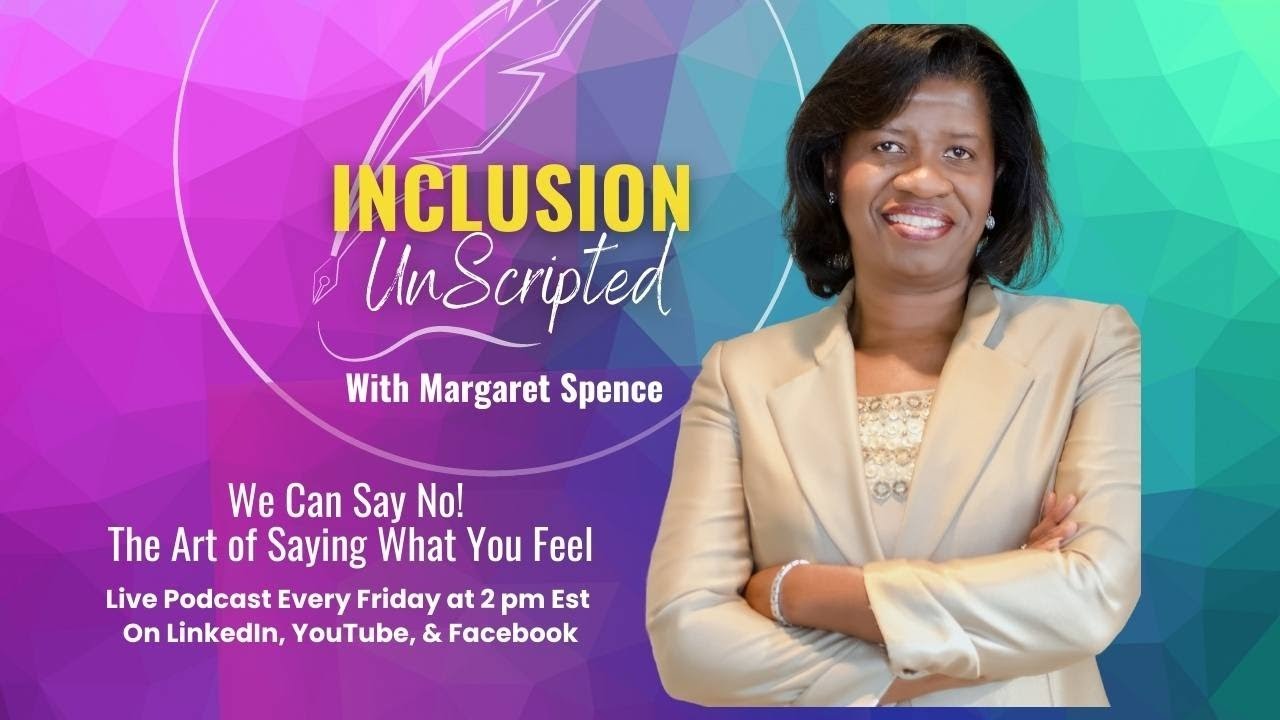
Margaret Spence explores why saying no is crucial for diverse professionals, especially women and people of color who often become "yes-doormats." She uses the oxygen-mask metaphor to explain self-care, connects over-commitment to stalled careers, and cites Greg McKeown's Essentialism on prioritization.
Chapters
Hello everyone, welcome to Inclusion Unscripted, live on Fridays at 2 PM Eastern. We are broadcasting live today on YouTube. Um, uh, LinkedIn and Facebook. And I am back! This is season 2 of Inclusion Unscripted. I've taken a few weeks off, I have rested, I've relaxed, I have renewed, um, and I'm back, back for Inclusion Unscripted Live. For those of you who have never joined me before, my name is Margaret Spence, and I am the founder of the Inclusion Learning Lab, and I am the host of Inclusion Unscripted. So let me tell you a little bit about Inclusion Unscripted unless you— if you've never joined us before. Inclusion Unscripted, we're not just talking about diversity and inclusion, We are living it. We're living diversity and inclusion every day. I don't get to get up in the morning and decide not to be diverse. That is just a part of who I am. But in this podcast, this live event, and for those of you who are listening to the recording after on the various podcast apps, we're on iTunes, we are on Spotify, we're on Pandora, We're on all of the, um, all of the apps for podcasting. For those of you who are joining us on the replay, Inclusion Unscripted is built around a premise, a premise that we have to live more powerfully, that we have to show up with more power, that we have to walk in the rooms that we are in with our full power in place. Inclusion Unscripted is where we are having honest discussions about diversity and inclusion. Most of them are personal to me. Um, occasionally I have guests. Uh, we actually have a live-in-studio person today, which is pretty amazing, and we bring to you unfiltered, unscripted conversations about diversity and inclusion. It is an essential piece of what we do. Every single person is diverse, but not everyone is inclusive. Not everyone includes everyone. Not everyone tries to bring inclusion as a core function of who they are. For me, inclusion is a core function of who I am. It's my goal to help you feel that you belong, to help you feel that you're a part of this podcast, to help you feel that you are a part of the Inclusion Learning Lab community. So before I start the show, and I told you I'm renewed, I'm like in this great place, right? I needed to take a break from the Inclusion Unscripted Live on Friday. So we've been gone for about 9 weeks. It didn't seem like it, but it's been about 9 weeks that we've been off the air. Just took the summer off. Took some time to reflect, took some time to just spend with myself and really develop and figure out what is the content we want to bring to this audience that joins us every Friday at 2:00 PM. Before I go into today's show, I'm going to do our infomercial. Our infomercial, really simple, quick infomercial. For those of you who don't know, I've launched the Inclusion Learning Lab Community. For DE&I leaders. I am super passionate about this community. I'm super empowered by the work that we're doing within the community. I am so happy to bring this to you. If you go to our website, inclusionlearninglab.com/community, you'll learn all about the Inclusion Learning Lab community. Within the community, we have a couple of great things that we offer DE&I leaders beyond the fact that you can join together with your cohort, with everyone else who's doing the work with you. We bring together articles and hot topics. We have open discussions, we have reading lists, we have monthly webinars, we have discussion groups every week, we have course cohorts. In fact, we are launching a new course called D, E, and I Data Storytelling. D, E, and I Data Storytelling. We're launching that course at the end of September. It is a 5-week cohort where we're going to really teach you how to use data to affect change in your organization. That will be a part of what is on the Inclusion Learning Lab community. We have a student cohort, we have peer groups, we have micro-learning labs. And we have research that we bring within the community and great articles that you can participate with and you can see as a part of the Inclusion Learning Lab community. So if you wanna learn how to join, go to inclusionlearninglab.com/community. Okay, so enough of that. Let's talk about why we're here today. What is the hot topic today? For the Inclusion Unscripted podcast. Today's hot topic is learning how to say no. For me, this was the pivotal couple of things that I had to do over the last few weeks. So today's, um, today's podcast episode is built on one thing: learning how to say no. We can receive no. All of us can receive no. We can get the no. We may receive no in such a deep way that it hurts us internally that we've received the no. But most of us, including me, I struggle with saying no. And so over the last 3 months or so, I have deliberately said no to people. And it's been empowering, it's been scary, it's been, um, yeah, it's been really interesting to say no to people that I care about, to people that I love, to people that I empower, to people that I work with, to people that I coach, uh, to people who want to be coached by me. I've literally told people no. And the reason why I had to say no to everyone is because there's a time when you are giving so much to everyone else that you forget that you need to take for yourself. So we oftentimes will give to everyone. We want to support every person. We want to make sure that everybody's okay. We want to be there for everyone all the time. But the reality is In order for us to be whole people, in order for us to show up as whole individuals, we have to say no. And we have to say no with conviction. We have to say no nicely, but we have to say no. And we have to put boundaries around ourselves that start with no, because if we don't do that for ourselves then people will, A, take advantage of us. B, they will overtax us and not realize that they're pulling from us, and we are emotionally drained trying to say yes to everything. And so we say yes to a lot of things that don't serve us as people, that don't serve us as diverse people, that don't serve us as women. And it's really easy for women to say, yes, I want to help you. Yes, I want to participate in that committee. Yes, I want to be a part of this. Yes, in order for me to build my career, I have to say yes to everything that opportunity that comes my way. But here's what I want to say to all of you in this back half of the year, this back half of the year. We've got 4 months left before 2022 is done. We have to learn how to say no for our own self-preservation. We have to speak our truth. And sometimes when we speak our truth to people, they don't always want to hear our truth, but we have to be willing to speak our truth. You know, it's difficult to say no But you know what, I like the analogy. When I'm on an airplane and I'm flying, which I'm back to doing again, which is so exciting— I, I just got back from Jamaica, um, a week ago actually. I took a week vacation for the first time in 3 years. I took a week and I just went and sat at the beach, celebrated my sister's 60th birthday with her and her family, and I sat at the beach doing nothing for a week. I didn't answer emails. I didn't respond to clients. I didn't worry about whether my inbox was overflowing or not. I didn't respond to pressing things that had come in because I needed that time to say no to everyone so that I could go out and renew myself. You cannot do the work unless you're willing to put the oxygen mask on your own face first. We have to put the oxygen mask on our own face. We have to put it on, recognize that we need oxygen first, and once we've gotten enough oxygen, then we can take it off and put it on somebody else's face. For many of you working in organizations, you have a negative reaction when you say no to anything that is asked of you. Oftentimes when you're working with a company and you're trying to aspire and grow your career, it's super hard to say no. You can't say no, and you say yes, and people recognize that you will say yes to everything, and so they pile everything on top of you. But we, especially people of color, because we could be viewed in the organization as the doormat yes. Let me expand on that a little bit, right? Um, you could be the doormat yes, meaning somebody comes to you and they ask you to do something, whether it's within your scope or outside of your scope, and they know that if they pass the buck to you or they pass down the work to you You will say yes because you are viewed in the organization as the doormat yes. The doormat yes. We're gonna give it to Margaret because if we give it to Margaret, she's gonna A, get it done, and she's not going to tell us no. And we get to wear her out so she takes that work home with her at night and she's doing it at 9, 10, 11 o'clock at night. Rather than spending time with her family, rather than spending time in her own renewal. She is our doormat yes. And because she is the doormat yes, everybody gives you the pylon and you're overwhelmed, you're tired, you're exhausted, but you're taking more on because you are the yes person. I'm talking to you. I'm talking to all of you who don't know how to stand up for yourself with a solid no. That's who I'm talking to. You know who you are. Your organization leader will say to you, Margaret Spence, there's a committee I think you should join. Go join that. And you don't say Mr. Boss or Miss Boss, I recognize that you want me to join this. However, I have 99 other things on my desk. How important is this particular thing? Is this something I can prioritize? Can I delay it? But because we live in a place of fear, if we say no, the fear of missing out, the fear of being rejected, the fear of the no being held against us stops us from saying no, and we say yes instead, to our own detriment. I'm guilty of doing that. I am 100% guilty of doing that. I could tell you that I will say yes. Somebody will call me and say, Margaret, can I get on your calendar for an hour just to talk about my career? And I'll say, sure. Because I want to help you to my own detriment. I could be eating dinner, but I'm talking to somebody about something at 6 o'clock at night. Or someone may call me and say, hey, I want you to work with me on a particular project. I want you to volunteer to work with me on this particular project. And I will look at it and say, boy, this is a great opportunity. I'm going to say yes to this. Why would I not say yes to this? It's a great opportunity. But then I get weeks into it, and now I'm tired, I'm exhausted, I feel like I'm being victimized. I'm now inside of the drama triangle where I'm feeling persecuted and prosecuted at the same time for being a part of what I had to say yes to. And instead of being able to give it my all, I feel like I'm a victim, so I can't give it my all because I said yes when I should have said no. You know, when I wrote my book back in 2018, um, Leadership Self-Transformation, I had an entire chapter on saying no. And I had to read my own book recently when I tell you that I took this time away from the podcast, from social media. I am always on LinkedIn, I'm always on Twitter, I'm always out there posting things every day. And those of you who follow me will realize for the last several weeks I have not been on LinkedIn, an occasional post here and there. I've not been really socially active, and I haven't done the podcast because I had to, as I said, learn how to say no, no, I can't do everything, I can't do it, I have to stop, I have to breathe. And so what I wrote here is a quote from Warren Buffett where he says, the difference between successful people and really successful people is the really successful people say no to almost everything. Let me read that again. And this is a quote from my book. It says, can you say no? Right here. This is a whole chapter in the book that I wrote. And in the opening line, the opening quote, Warren Buffett, is the quote that I used, and it said, the difference between successful people and really successful people is that really successful people say no to almost everything. That's the basis for today's episode— say no to everything that doesn't serve you. Let me read on through the chapter. The ability to say no is an art as much as a science. It's an art as much as a science. As you attempt to get into leadership, it's essential that you learn how to say no and mean it. See, sometimes we say no but we really don't mean it. We say no, kind of no, sort of no. No, we have to stand up for ourselves. Put the oxygen mask on our face first, right? So saying no is the art of prioritization. When you say no, you prioritize yourself over everyone else. When you don't let people use you as a doormat and you say no to them with your actions, with your speech, with your process, then you prioritize yourself first, because everybody is prioritizing themselves, even the organizations that you work for. The organization is prioritizing themselves, but it is essential if we want to give as much as we can that we prioritize ourselves too. So to keep going, in the book Existentialism by Greg McKeown, It gives an example of someone at work who feels the need to look at every opportunity. He says, looking at multiple opportunities is one thing, but agreeing to get involved in every activity defeats your personal mission and vision. So the question is, if you say yes to everything, how does that affect your personal vision for yourself and your personal mission to serve yourself. Sometimes we have to get selfish in order to advance, because if we are viewed as the yes doormat in the organization— the yes doormat meaning Margaret will always say yes, so we can dump on her every day, we could treat her badly and she won't push back. She won't use her voice to speak up for herself. She will be our yes doormat. You can't be that person. So on, as I continued in the paragraph I wrote, we often feel that if we say no, it will mean that we miss out on something important. The reality is you simply cannot agree to do everything. For everyone. When you dilute your attention by agreeing to do everything, you end up perfecting nothing. So here is the example. Many of you have not become subject matter experts in your organization as a Black person, as a diverse person, as a woman. You have not become a subject matter expert No one knows what you're good at, great at, because they give you so many tasks to do, and that dilutes your expertise. So let me say that again. Sometimes when we want to be promoted for higher roles, to move our career forward as diverse people, we end up being diluted in our experience because we haven't mastered, we haven't gotten the best of one thing that we're so good at that we could take that one thing and advance our career. We end up being good at a lot of things and nobody sees us as a leader of anything, and that occurs because we don't say no enough. We don't say no, we don't prioritize, and we don't give people our mission vision. So for example, if your boss is piling on all of the spreadsheets that you could do in your, in your sleep, then it's time to have the discussion with your boss to say, hey, I know you're giving me that and I constantly say yes to that work, but I'd like to have a little more of this so that I could stretch my experience level. But if we can't speak up for ourselves by saying and questioning what we're getting in terms of our experience, what we're getting in terms of work, and we don't know how to navigate no effectively, what we in essence do is build a career that cannot be duplicated or replicated anywhere else. We're stuck in the role that we're in. So let me, let me play this out a little bit more. Let's say you're the yes doormat in your organization. And I think I'm going to coin that word, yes doormat, right? If you're the yes doormat in your organization and you're the one that everybody comes to for everything, and oftentimes it's the women on the team, it's the young people on the team, it's the diverse people on the team that gets the pile on. Right? It's not necessarily deliberate, it's just the way that people have a mental model about how we operate in spaces. And so they have this mental model that Margaret will be the cleanup woman, that Margaret will do everything that everybody wants to be done. And so in that vein, you get the pile-on. But if you take a stop and you stop for a second right, take stock in your career and you say, let me build a resume, let me see what skills I've gained, you may realize that being the yes doormat means that you've gained no real skills that are marketable outside of the role you're currently in. And because you've gained no real skills that you can market outside of the role you're in, you're stuck in that role permanently and you cannot advance, whether you're in the current company or another one that you go to. Because you are the yes doormat, but you're not building competency and you're not building experience and you're not building up-level skills that's going to take your career to the next level. We have got to learn to say no, and we've got to learn to say no with conviction. So let me keep reading. It's essential that you learn how to prioritize and chart the direction so that others will want to follow you. If you're the yes person, no one is going to follow you because leaders must also say no. A leader is required to evaluate everything on the table. They're required to evaluate the good, the bad, the ugly, the not so good, and say yes to things that are productive and no to things that's not. It's called judgment. So if your judgment is to always say yes and you have no judgment to say no, who is going to make you a leader when they've never seen you demonstrate no? Who is going to make you a leader? What tribe are you going to lead? What group of people are you going to lead? What organizational business unit are you going to lead if no one has ever seen you demonstrate firmly the ability to make a decision and the ability to say no? How's that going to work? So I go on to say, if you are a leader and you say yes to everything, you will find that your mission is diluted. In a myriad of projects that are meaningless to your own personal growth. None of your projects get completed because you're so overwhelmed with trying to offer appropriate guidance to everyone by saying yes. This is critical. This is a critical, critical thing. So no is essential to developing our careers. It's essential to our own self-awareness. In order for you to be self-aware, aware of yourself, aware of what's going on inside of you when you say no— is it fear? When I said no to a lot of people over the last several weeks, and when I backed off of helping everyone and I decided that I was going to help no one for a period of time I was not going to respond to things. I was not going to be the immediate available. I wasn't going to be the one that rescued and gave advice and helped people. When I made that decision for myself, because I needed to put the oxygen mask on myself, I realized a couple things. I felt better. I was not stressed. I was relaxed. I felt good about the work I could do. I regained focus on what mattered to me. I doubled down on my own personal mission, my own personal vision. I doubled down on what was important for my survival. See, when you take the time to do the self-awareness of no. When you do that, when you take the time to do that, you accept that no is a core function of who we are, that anything that comes up when we say no is work that we need to do on ourselves. When I started saying no to people, I realized that there were things that I knew about myself and there were things that I didn't know about myself. What I knew about myself is I always want to help. I knew that, that was a given. What I didn't know about myself is that I could be comfortable not helping everyone because it's a personal mission of mine to make sure that I leave the world better than I found it. And that I impact people one at a time. So when someone reaches out to me, I want to impact them, I want to be there for them, I want to show that I care. And when I show that I care, it means that I give, but I give at my own detriment. So saying no was an empowered self-awareness for me. And so I'm sharing this on a personal level for all of you. This is a personal, personal level. As I said, Inclusion Unscripted, there is no script. It's— there's no script for this, no script. When I go through processes, I am really ready and prepared to do the work on myself so that I can help you and do the work with you. So here is self-awareness. It's what I know about myself. That's self-awareness part 1: what I know about myself. Self-awareness part 2 is what I know that I don't know. The stuff that's going on in the back of my head that I don't know. That's self-awareness part 2. Self-awareness part 3 is what I don't know that I don't know. It's the stuff that's way back there, sitting in the very, very back of my mind. That's self-awareness number 3. So for all of you that have listened to this program today, that have joined me live and will listen to the podcast um, when it is on the podcast apps. I want you to do some self-reflection. I want you to ask yourself some of the appreciative inquiry questions that I go and ask myself. What are you most proud of about what you do? What are you most proud of? What helps you say, wow, I'm so proud of that? What do you want as a person that you don't have right now, that you can't have because you're constantly saying yes to everything? And the other thing is, what can you start saying no to that won't horribly impact your life, that will make life a little bit easier for you if you said no to that particular thing? You know, I'm going to start a series called What's Your Possible. I've actually, um, I'm writing a new book called What's Your Possible. And what are the opportunities that we miss out on because we're so busy doing everything else for everyone else that we miss out on those opportunities for ourselves? What is that? What is that opportunity that we're missing because we can't say no, because we don't know how to say no, because we're afraid to say no, because we're fearful that if we say no, people will not accept us? What is that? What is that? Because that is at the core of what this is. What do we need to start saying no to? But what do we need to do in our core, in our middle, in our heart space that's going to make us brave enough to stand up for ourselves? Because if, if we as people of color don't learn how to stand up for ourselves effectively, we will be the yes doormats. If we as women don't learn how to stand up for ourselves effectively, we will be the yes doormat. If we as men don't learn to stand up for ourselves, we will be the yes doormat, and people will doormat us. And a doormat is pretty simple. You walk on it, you rub your feet on there, you scrub the dirt off, you leave the dirt in the doormat, and you walk away. So think of this: if you don't know how to say no, you will become and you will be the yes doormat in whatever relationship you're in, be it at work, be it at friendship, be it with your kids, be it with your, your spouse, be it with your significant other. We've got to learn in our relationships to say no. And we have to set boundaries when people expect us to say yes and we say no instead. That is the gist, that is the drift of what I wanted to talk about today. That is the absolute drift of what I wanted to talk about today. Say no for your own preservation. Say it for your own preservation. Okay, so we're back Fridays, every Friday now for the rest of the year. Season 2 of Inclusion Unscripted. We are going to be here on Friday at 2 o'clock. If you don't— if you're not able to join us, that's fine. Download your podcast app, tune into the podcast. Uh, we will be on all the podcast episodes. Inclusion Unscripted is brought to you by the Inclusion Learning Lab. As I shared with you all before, the Inclusion Learning Lab is a learning space for diversity and inclusion leaders. We have amazing content on Inclusion Learning Lab. If you want to learn more about Inclusion Learning Lab, go to our website inclusionlearninglab.com/community. You will find all kinds of information there about the learning lab community. We are here to empower and support diversity and inclusion leaders to do the work that you do effectively. Here's what I know, and here's something that I'm intensely passionate about. I know that for all of you doing the work of DE&I, you're doing it in a silo alone. You may not have the support you need within the organization and even outside of the organization. You have very few people that you can call and say, here is the struggle that I am having. Here are the issues that I have. Yes, they've hired me to do this job, but I'm struggling to do it and I need support. We are here to not only train you, we are here to empower you, and we are here to support you. So a couple things, you can join us on Third Wednesday. Go to the Inclusion Learning Lab website. On our events page is Third Wednesday. September 21st is our Third Wednesday at 1:00 PM. We are going to be talking about metrics and how you use metrics to write powerful stories to shift the people in your organization. That's enough of that. Thank you for joining me on Inclusion Unscripted. Season 2, I'm back. Happy to have you here. Um, can't wait to he— to, um, see you again next Friday. Uh, enjoy this long holiday weekend. Have a great weekend, everyone. Take care.
You've tied a rope to me, you're blessing me every day. I was down with an illusion like a sparrow with broken wings, but now I shine with your reflection on me. I'm getting back up on my feet, that you showed up was








