E28: Will You Rewrite Our Story?
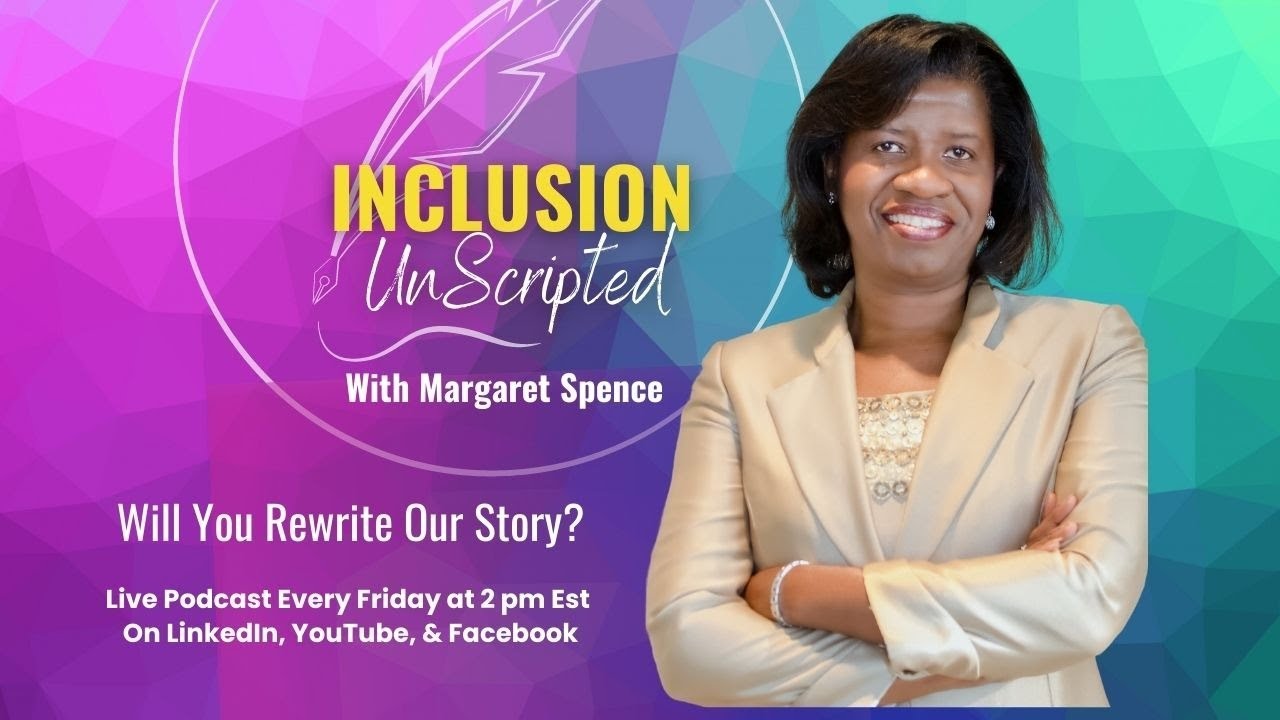
In this live episode of Inclusion Unscripted, host Margaret Spence challenges the diversity, equity, and inclusion (DEI) community to move beyond deficit‑based language and narratives. She distinguishes between "living" diversity—embodying inclusion daily—and merely "creating" diversity through superficial programs. Spence critiques the pervasive use of terms such as "marginalized," "underserved," and "underrepresented," arguing that these labels embed a story of pity and limitation that shapes hiring managers' mindsets and reinforces systemic bias. Through personal anecdotes as an immigrant daughter and a Black woman with natural hair, she illustrates how such language influences interview dynamics and career advancement. She proposes a rewrite of the DEI story: replace deficit framing with opportunity‑focused language, ask interviewers to consider what unique voice a candidate adds rather than what they must prove, and shift organizational narratives toward empowerment and possibility. The episode also promotes the Inclusion Learning Lab community, its resources, and invites listeners to engage, share the podcast, and become guests. The overarching call to action is for DEI practitioners, HR leaders, and talent teams to consciously change the words they use, thereby reshaping the stories they tell about diverse people and creating truly inclusive workplaces.
Chapters
Hello everyone and welcome to Inclusion Unscripted. We are live on Facebook, uh, LinkedIn, and YouTube. My name is Margaret Spence and I'm the host of Inclusion Unscripted. For all of you that are joining us for the first time this week, uh, welcome. For those of you who are listening to this as a post-recording on your favorite podcast app. Thank you for listening. So let me tell you a little bit about Inclusion Unscripted. Inclusion Unscripted is where we're not just talking about diversity, we're living it. There's a difference to just talking about diversity and thinking, well, you know, I'm creating diversity. There's a whole nother level to living diversity every day. And that's what we try to do with this live podcast every Friday at 2:00 PM. We try to say to all of you, you have to live diversity. You can't create diversity. You can't enable diversity. You have to live it. It has to be a part of who you are every single day. Living diversity versus trying to create diversity, because we are living beings that have already been created. We're already here. Inclusion Unscripted is built pretty simply. I say what needs to be said in a bold fashion about diversity, inclusion, equity, equality, belonging, and also women's leadership development, career management, and all the things that go into making us fully productive, passionate people about the work we do. There is no script. There's nothing that I write that is pre-scripted. I bring these episodes to you every Friday because of a simple passion, my passion to say we have to disrupt the way we manage diversity, the way we manage equity, equality, inclusion, belonging, the what we create for the next generation of great leaders who are among us right now. What do we are currently occupying the spaces want to leave for the next generation? Are we leaving them a world that's better, a more inclusive, creating more belonging, more opportunity, all of that?
So that's the foundation and basis for this show.
And as you see, every week I bring to you what I am feeling. What I feel in the pulse out there. This is a live program, unscripted, unedited.
We don't take out any of the stuff that I say every week.
It's raw, presented to you. My entire goal of doing Inclusion Unscripted is to give voice to what isn't being said in our ethers, give voice to things that we're thinking in our mind but we're too afraid to say. Give voice to disruption within the diversity and inclusion space. There's a lot of us out here doing this work, and I want to commend you today. For every person who is doing the work of diversity, equity, inclusion, talent development, talent acquisition, HR, I commend all of you for the work that you're doing. We have to take credit for the work that we do to create opportunity for everyone. And we have to take credit for the work that we're doing to create spaces that are more inclusive so that everyone can thrive, so that everyone can thrive in our work environments, in the world that we're a part of, in the communities that we are building, the communities that we're raising our children in, the communities that we are part of. Inclusion is always our message. This episode and all episodes are brought to you by the Inclusion Learning Lab. We are an online learning community for diversity and inclusion. We create safe spaces to learn, to fail, to empower, to grow. If you haven't visited our website, I'd love to invite you to do so. It's inclusionlearninglab/community. But you can just visit inclusionlearninglab.com. We have a weekly newsletter that we put out at the Inclusion Learning Lab. You can sign up for it on our website. Tell a friend about us. Tell a friend about the work that we're doing to create community for diversity leaders. Tell someone about this podcast that we are on every Friday live. We are on YouTube this week, um, LinkedIn, Facebook, and sometimes we occasionally broadcast to Twitter. So having said all of that, you didn't come to hear all of that today. You came to hear the topic, and the topic for today is, will we— you rewrite our story? Let me say that again. Will you rewrite our story? So why am I talking about rewriting a story? Why is this important? I'm gonna lay out for all of you my pet peeve, the things that are driving me the most crazy about diversity and inclusion, the, the thing that is getting under my ever nerve, okay, the thing that's driving me crazy.
So here's, here's the deal.
Before you can create opportunity for me as a woman of color, what is the story that you are telling yourself about me when you look at me with my natural hair, with my yellow shirt today?
For those of you who are listening to the post-recording, I have on a bright yellow shirt.
And I'm in my natural hair. And if you haven't seen— if you want to see the video, you can always go to YouTube and watch it. It's on my Margaret Spence channel at YouTube. So when you want to talk about empowering Margaret in your workforce, in your community, what is the story that you are telling yourself about me?
What is that story?
Is there a narrative about Margaret that I don't even hear? The narrative that is built in your head, the narrative that is supported by the work that you think you're doing to empower me.
What is that story?
What is the story that you have in your head about Black people, about Hispanic people, about Asian people, about Native people, about LGBTQ people? What is the story that you have in your head that you have written, completely written in your head about me as a person? And then let's couch that in, what is the story that you've written in your head? And then what is the shape of the empowerment that you think you're giving to me based on the story that you've written in your head?
Because here's what I know.
The story and the narrative of diversity is written in a negative. I tell organizations that I work with every day, when I go into an organization and I'm working with them to build effective and powerful action-oriented DE&I programs, I say to them, We cannot build diversity and inclusion from a place of negative.
I have to ask you a simple question.
When you're at your best, most inclusive self, who do you want to become? Because it's essential that we have the aspiration of who we want to become as an organization.
But when we peel the onion and our eyes are watering, As we peel this onion of inclusion, that is where the story goes off the rails a little bit.
That's where the story that you've built about me goes off the rails. Here's the thing. The narrative of diversity and inclusion, and I'm calling it all out for all of you who are doing the work of DE&I, for all of you who are participating in the work of DE&I, for all of you who are leading teams and quote, creating inclusion, this is for you.
For all of you that are hiring diverse people and women, this is for you too.
The narrative of diversity is written the following way: pity poor Margaret needs an opportunity, and pity poor Margaret needs me to help her get the job. Pity poor Margaret needs to be empowered. Pity poor Margaret needs my help so that she could see who she could become.
Pity poor Margaret needs you, Mr.
or Miss HR person, talent leader, talent development person, talent acquisition person, organization leader, CEO, president, founder of the company.
All of us little minions need you so that we can realize our dreams.
That's the couching of diversity and inclusion. That is the story that is told about diversity and inclusion. Let me bracket this a little bit for you, because a lot of you may think, what is she talking about? Let me give you the words that are used in diversity and inclusion.
Marginalized. We're helping marginalized people, right? We're helping marginalized people. So if I'm marginalized, if what you're hearing from me is a marginalized person, how do you ever see me as someone who has potential, possibility, purpose How do you see me if the first word that you think about when you think about hiring a diverse person is we are helping a marginalized person come into our workforce?
See, the days of marginalization existed when my parents were young.
It existed when I was young. I'm almost 60 years old, so in my lifetime the word marginalization meant that I was marginalized from the process. Today, in today's workforce, if you are still using the word marginalized individuals that we're trying to hire, you're doing a disservice to the fact that you're hiring college-educated people who have gone to college, who have done the work, who have done what was asked of them. They have taken the steps for empowerment, but even the steps for empowerment is still couched in marginalization. You don't see me as an empowered person because I went to Howard University, or I went to Florida A&M, or I went to the University of Georgia, or I went to Stanford or Princeton or Harvard or any other school. You don't see that. You're still seeing this marginalized person who's presenting a resume to you to be hired. Let me give you the other word that we use, the other one that is a pet peeve of mine: underserved. Underserved people. So if I'm underserved, how do I become overserved? Or how do I get— just get served, period? See, back in the day, in the '60s, in the '50s, in the '40s, and the '30s, these words were built to describe us, but they are still being used now to oppress us in the process of trying to advance ourselves. So you get to underserved— nice happy word that is on everybody's website. There isn't an organization website that doesn't have underserved, that doesn't have marginalized. Some of the big think tanks and consulting firms are still using the word marginalized. Do I still want in 2022 to be described as marginalized and underserved? Is that the story that I want in your head when you're attempting to empower me? Is that the story that I want you to have about me? Is that the story that a woman wants you to have, is that she's marginalized and underserved? The next word that is just a pet peeve of mine— I don't even know where to hit this one— underrepresented. Why don't you say we don't hire enough people and stop saying underrepresented? Because then you get to sit in the underrepresented category. You get to put me in the underrepresented category, so I have to prove representation when I'm underrepresented. I have to prove that I should be served because I'm underserved. I have to prove that I belong above the margin because I'm marginalized. These words matter. These words matter when it comes to talking about the story of people of color and women. And to some degree, we have to, we have to recognize that the words we are using to talk about people of color paints a story in our head.
So here is how marginalized plays out in the brain of a manager who's interviewing a Black or Hispanic or Asian or LGBTQ person during an interview. Okay.
Hi, Margaret, how are you? Great.
Thank you for the interview. Fabulous. So tell me, what makes you qualified for the role that I'm interviewing you for? Because that's this question that's going on in his head or her head. That's the question, that's the question I'm having to overcome because you have said I'm marginalized.
So the question that is in the head of the person who's acquiring this talent, that person's head is thinking, okay, Margaret is marginalized, yep, What makes her—
what would make her eligible to be above the margin? That is what is going on in the person's head.
When you guys, HR humans, you humans that handle HR consulting firms, big ones, I could name you all, I could go to your every single website, every single one of you, I could go to your website right now and on the website, the very top margin says, "Underserved. We build diversity and inclusion for underserved people," or, "We help organizations create opportunity for underserved people." Who the heck is an underserved person? My humanity doesn't make me underserved. The fact that I'm alive doesn't make me underserved. It makes you underserved, for not seeing me for my potential and my purpose. It doesn't make me underserved because you won't open the door and let me in. I am not an underserved person. I am not a marginalized person. I am not underrepresented. That is not the truth. Black and brown people make up 40% of the planet right now, or 40% of the U.S. If you add us up, we are the majority globally. But because we have been told so long and fragmented and, and, and, um, broken apart, we each fight and strive and claw for our spot. But if you add it all up, Hispanic, Black, um, Native people are the majority in the world. From a population standpoint. But because we have been given these labels that build a story about us, you get to call us marginalized, you get to call us unrepresented, you get to call us underserved. Then you get to say to us, after you've hired us and put us into your dysfunctional companies and leadership teams, that we are underappreciated. We have a lot of Black and brown people here who are underappreciated, right? Or we have a lot of Black and brown people and women here who are underdeveloped, right? So you're constantly putting us under the carpet, under the ground, under the dirt, under anything. We get to be under So the story of these words get built. I spoke to a group a couple months ago and I said to them, how would it sound—
typically what happens is when you're going out to interview someone that is diverse, a leader says, I'm going to interview a diverse person.
When you say, I'm going out to interview a diverse person, What that means is technically in your brain, what it says is this person has to prove to me that they belong on my team.
This person must prove to me that they are worthy of this opportunity I'm giving them. That's what it says. How would it sound if a leader said I'm going out to interview an individual who I think is extremely qualified so that they can be a diverse person on my team and help us create more inclusion. Now I'm not proving my spot, I'm not proving my worthiness, I'm not proving my ability to 'fit into your culture.' What I am instead saying is, 'What would adding Margaret do to our team? What voice would Margaret bring to the team?
What representation do we not have right now that Margaret could add to the team?' See, there's a lens.
It's a different story. But if we tell our managers and our leaders that we're going after marginalized people and we're going to go find these marginalized people out in the ethers, then that is what they expect.
In their brain, I am already having to prove my worth and my worthiness. I have to prove that I'm eligible to be in this space.
I have to prove that who I am is not enough.
I have to then say, okay, Margaret, you need to be more. You need to be exceptional. You need to be the only option that gets knocked down the door. And so your leaders and your people who are hiring folks run around trying to find this needle in the haystack person and they, and they refuse to hire the slate of very qualified people that you present to them. See, this is what happens when we couch things in underserved, marginalized, underrepresented.
Poor pitiful you is what you're saying to me.
You're so pitiful that we have to give you an opportunity.
You're so pitiful that we have to create a space for you because you're underserved, and we're gonna figure out how we're gonna bring you to the dining table. And instead of giving you a full meal, we're gonna give you the potatoes. And so that's the story that gets written inside of your leader's head. That's what the story that gets written about me as a person. That's the story that shows up for me.
That is the story that shows up for me, you know.
And yes, inigo, words matter, and they have a strong impact on us.
But some of these words are so ingrained in our psyche, they're so ingrained in a part of our psyche that we don't know how to unpack them and create different words that allow us to tell a different story. You know, when I wrote this, my question was, how will you rewrite the D&I story to build a different narrative? And that is the question.
How will you rewrite the story to build a different narrative about your diverse people?
What will that look like for me? What is the story? Let me give you my story.
Let me tell you my story in a nutshell. I am a, I am a daughter of immigrants. I am an immigrant.
I am an immigrant who came to the United States because my mother wanted to give me an opportunity. She decided that— she made that decision when I was just a year old. And she came here to— so that I would be empowered to be who I could be, because that was the foundation of the American dream. That was the foundation of the American dream, that I could be anything I want to be. Yet when I got here and I started pushing forward and I started asking for opportunity, I became marginalized. See, I'm not marginalized as a person. No one in your organization is marginalized. Marginalization happens to us. We are not marginalized. There is a difference. Then I realized that corporate America was never going to serve me.
I was never going to be underserved.
Corporate America was not going to serve me. And in that process, I started my own company so that I could represent myself rather than be couched in your vision of me being underrepresented. See, I'm rewriting the story for you. See, and when I worked in my organizations before I started my company, I recognized that in order to be appreciated for the work I was doing I needed to do that work for myself because appreciation for my work starts with me.
It doesn't start with you appreciating me. See, that's my story.
That's how I write the story. And when I realized within the corporate space that I was never going to be developed, I took the opportunity to develop myself. So I'm not waiting for you to decide that I'm underdeveloped, right? That's rewriting the story. But if you never know my core story, who I am, what I went through to go to college, what I went through to be where I am, then you get to treat me as a marginalized person. Every person in your company has a story. For all of you that are working with data around diversity and inclusion, we're actually building a course called DE&I Data Storytelling. We are working to build that course because here's what I know. The data that you're looking at to say I'm underserved and marginalized and underrepresented, that data that you're looking at is a person with a story with a life, with an experience, with a goal, with an ambition, with a vision, with a purpose, with a possibility. That person has all of that wrapped into them. But because we don't get to see that, we couch everything in— we've hired a marginalized, underserved person in our company, and you get to put the blinders on. And on one side it's marginalized, on the other side it's underserved. And so when you look in my eyes, you don't see my possibility, you don't see my purpose, you don't see my vision, you don't see my desires, you don't see where I want to go, you don't see how I want to be empowered, you don't see how I want to be developed, because you don't care. All you see is I served a marginalized, underserved person, and the rest of the story gets written between these two sandwiches. This is what happens to us. This is why we are not seen and moved. This is why we sit in an underappreciated role, and our leaders can't see us because they only saw us originally as marginalized and underserved, and they are still viewing us as marginalized and underserved. And they cannot rewrite the story because nothing that we do creates a different narrative for them. That's it right there. You know, we are often wedded to our story because of the words we use to describe our people. It leaves us stuck in the same description of who we are. We are unable to look through a new lens, to see people through a new lens, a new focus, a new ability. So as I wrap up today, I want to challenge all of you who are doing the work of DE&I.
I want to challenge you, all of you who are doing the work of DE&I.
I want you to stop using the word marginalized. I want you to stop using the word underserved and underrepresented. I want you to call this what it is. You're not giving opportunity. What is the opportunity zone that we are asking for? But we are not marginalized people. We exist in a system that marginalizes us, but we as people, as human beings, are not marginalized. I was born with my potential. I was born with the God-given potential to be anything I want to be. I was born with that innate spirit within myself. It is you who come in now and snuff out that fire in me every day by pushing me down into marginalization, pushing me down into underservice, pushing me down into underrepresentation, pushing me down so I'm underappreciated, and pushing me down so I'm underdeveloped. That is not where I started. When you, when, when you have a brand new baby— my grandson is 9 months old on Monday, and he is a world of wonder. Every time I see him, his curiosity is there. He is curious about climbing the steps yesterday. That was his thing. He was curious about going up the steps, right? And in his little 8-month-plus self, he was climbing up the steps because he knew that he didn't have any guardrails on him. He didn't have anybody saying, you can't really do that, even though his dad was yelling, don't go up the stairs. Right? That's when you look at a baby, when the baby's born into this world, nobody looks at the baby and says, well, you're a marginalized baby. No, I may not have every single thing that I need or I should have, but I have life, and life gives me opportunity and possibility and potential. We as people who are managing other people need to understand that if we don't rewrite the story of these other people, if we don't rewrite these words that we are using to describe us, then we are not serving ourselves and we are not serving the communities we're trying to uplift. See, it's uplifting, it's not underserving. It's upleveling. It's not underrepresenting. It's developing, not underdeveloping or underdeveloped. It's not underserved. It's how can I serve you better? It's how can I serve you better as an employee in this company? It is tell me your proudest moment in life and how can I make you extremely proud for working for us? It is what gives you a sense of pride in yourself, and how can I empower that more? It is how do I help you feel that you are living to your full potential, that you are living on purpose? It is how And what can I do so that your contribution is elevated? It's what can I do to create what's possible for you. That's what this is. This is not underserved, underrepresented, poor Black woman needing your handout, your crumbs, your potatoes when you eat the meat. That is not what this is. I am sick and tired of hearing that we are underserved, underrepresented, marginalized. All of you large corporations who are doing DE&I consulting, remove the words from your website and start talking about us in a positive light. You're helping organization see what's possible. You're helping them see what's possible. That's what you're doing by giving opportunity, not by determining whether I'm marginalized and I need a spot.
HR folks, I'm talking to you.
People who are poor don't have less vision than people who are rich. People who are poor have the same vision, they just don't have the same opportunity. People who are poor and are struggling to put food on their table want opportunity. They don't want to know that you think they're marginalized.
They want you to figure out a way that you're going to create opportunity for them.
That's what they want. That is what they want. A young Hispanic woman or man coming out of a college who doesn't have a Rolodex like their, their white counterparts. They want to know that when they show up at your door without the Rolodex, that you're going to give them an opportunity. Not that you're going to think they're marginalized because they scratched and they clawed to get in front of you so that you could interview them. They went through the river that you created for them so that they could be served by you, not continue to be viewed as underserved. So I want you to rewrite our story. You know, there's a lot of people out there now wanting to say slavery didn't exist, um, you know, uh, discrimination didn't exist. None of that. You want to scrub the books, scrub the history, don't talk about the history. That is your issue.
We are living our history every day.
We're living it. We live diversity. We don't create diversity. People who are diverse don't create diversity. We are diversity. We are living diversity. We have no option but to live diversity. That's why I started Inclusion Unscripted, because we are not creating diversity, we are living it. We are living it. And if we're living diversity Every single person in this planet is diverse. We are all living diversity. The question is, are we living opportunity for everyone? Are we creating inclusion for everyone? Are we building the table so everyone can sit at it? That's the question. That's the question. That is the question. Don't tell me again. And all of you who are out there hiring people to come and work with you for DE&I, if they are starting with marginalization as their first word, get rid of them. Retune them. Help them understand that people are not marginalized, Systems marginalize people, but people have a God-given innate purpose and possibility.
It doesn't matter how bad you are as a person, you have a possibility to be better.
You have a possibility to be better if we find forgiveness in our heart spaces, people could be better.
If we find opportunity in our heart spaces, people can become who they were meant to be.
Yes, thank you. You can't sit at the table because the powers make it non-inclusive, but that does not mean that I don't— that I I'm not eligible to sit at the table. See, when you say I'm marginalized, you basically say I'm not even eligible to sit at the table. I have to earn the spot to sit at the table, but if you're giving me opportunity, then you set the table, you scoot a seat over, and you say, Margaret, pull up and sit down. That's inclusion. That is inclusion.
We've got to stop letting people define us and write the narrative of who we should be. We have to stop that. So as I wrap up, I want to ask all of you doing the work of DE&I a simple question: will you rewrite our story that you have in your head about us? Will you remove the words that make us less than and find words that make us more than, that give us opportunity and spaces to grow, spaces to become, spaces to be what's possible for us? Think of it this way: The time we spend excluding people, if we spent that time including them, think of the world that we would be creating. The time we spend on exclusionary activity and downright racism and downright exclusionary bad behavior, if we focused our energy on creating opportunity zones, so that everybody sits at the table equally, what a beautiful world we would be living in. I challenge all of you to rewrite our story. You don't get to have the pen, the paper, and the chapters. Rewrite our story. Thank you for joining me today on Inclusion Unscripted. We are live every Friday at 2 PM Eastern. On Facebook, LinkedIn, and YouTube. You can also listen to us on your favorite podcast app. Inclusion Unscripted, we are able to be downloaded. Tell a friend about the podcast. We welcome the opportunity, um, to share the views that I have, and we also are looking for guests. So if you think of somebody who would be great as a guest on this Inclusion Unscripted Live, please send me an email. Pretty easy, you can reach out to me on LinkedIn or mspence@inclusionlearninglab.com. Thank you again for all of you that joined us live. Thank you for the comments we got out there. Anthony, thank you for putting this out there. Thank you all for listening to Inclusion Unscripted. I'm Margaret Spence. Join me next week at 2 PM Eastern live. Take care, have a wonderful week.
You're blessing me every day. I was down with an illusion like a sparrow with broken wings, but now I shine with your reflection on me. I'm getting back up on my feet. That you showed up—
Take care, everyone.








