E31: The Power of Equity – Distilling Equity Into Talent Strategies
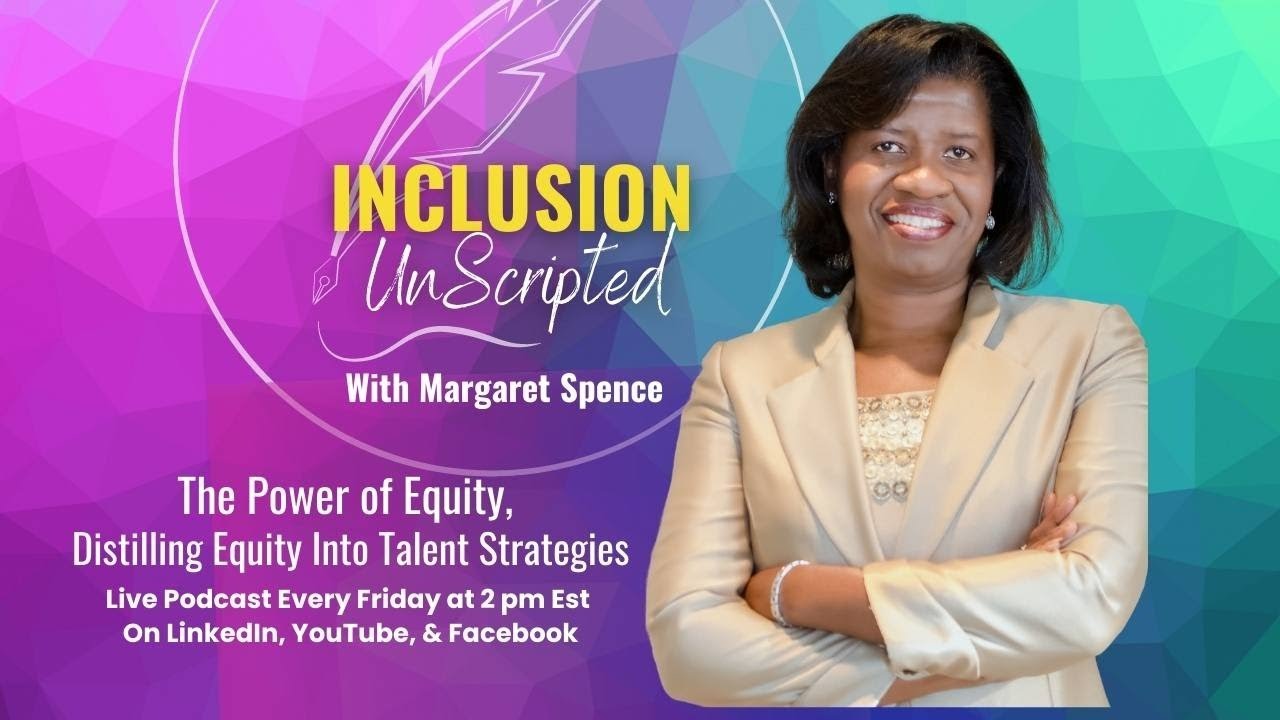
In this live episode of Inclusion Unscripted, host Margaret Spence, joined by her partner Inigo, unpacks the concept of equity within talent management and HR. They begin by distinguishing equity from diversity, inclusion, belonging, and equality, emphasizing that equity is an individual‑focused, fairness‑and‑justice lens that requires systematic assessment of disparities in opportunity, outcomes, representation, and compensation. The conversation moves through concrete talent‑acquisition scenarios—recruiting from HBCUs, entry‑level hiring, bait‑and‑switch job offers, and salary negotiations—to illustrate how equity can be eroded by low offers, opaque pay structures, and mismatched job titles. They discuss the ripple effects of pay inequity, such as quiet quitting, reduced engagement, and long‑term wealth gaps, especially for women of color. Margaret shares personal coaching anecdotes about salary surveys, negotiation tactics, and the hidden levers of compensation (bonuses, stock options, residual commissions). The episode also highlights the importance of development equity (tuition reimbursement, certification funding) and how organizations often shift the financial burden onto employees. Throughout, they call on HR leaders, CHROs, and board members to make equity a strategic priority, to be transparent about compensation, and to embed equity discussions into DE&I work. The session ends with a reminder of upcoming “Third Wednesday” discussions on equity and employee resource groups, and a personal note about surviving Hurricane Ian.
Chapters
<LYRICS>You're like a circle that floats around me, keeping me safe and sound. And when I fall, you've tied a rope to me. You're blessing me every day. I was down with an illusion, like a sparrow with broken wings. But now I shine with your reflection on me. I'm getting back up on my feet.</LYRICS> Hi everyone, welcome to Inclusion Unscripted.
My name is Margaret Spence and I'm your host on this live event. Um, I want to thank all of you who are joining me live today. For anyone that's not been a part of Inclusion Unscripted before, I'd love to tell you a little bit about who we are, what we do. Um, Inclusion Unscripted, we are not just talking about diversity and inclusion, we're living it. Every single day. I don't get to just be talking about diversity and inclusion. I'm living that. That's a part of who I am. Inclusion Unscripted is built on the premise that we have to live more powerfully. We have to show up in the rooms where we get access, and we need to show up powerfully. And we need to walk into those rooms with our confidence clear and our messaging on point. We have to show up bolder We have to say what needs to be said, and we have to create a safe space to have tough conversations, even with ourselves, even with our own community of people. We have to say what needs to be said. Um, having said all of that, let me introduce myself. My name is Margaret Spence, and I am here on Fridays at 2 PM. This is season 2 for us, I'm here to basically lend my voice to the inclusion space. I do a lot of work in the diversity and inclusion community, starting with working with disabled employees all the way to now working full spectrum D&I. What I've learned over time is silence is not golden. We have to add our voice and be in the arena saying what needs to be said. Inclusion Unscripted is sponsored by the Inclusion Learning Lab, inclusionlearninglab.com. We are an online platform where D&I leaders can be supported in the work of inclusion within organization. We have a platform built for talent management, talent leaders around diversity and inclusion. We are the largest community built exclusively for diversity and inclusion and those who are managing diversity within their organization. So if you haven't heard about Inclusion Learning Lab, go visit our website. It's inclusionlearninglab.com. We have lots of great information there. And if you have not learned about our community, the Inclusion Learning Lab community, inclusionlearninglab.com/community. We also host an amazing program, which is a follow-up to our live Friday broadcast, called Third Wednesday. So the third Wednesday of every month, we have an open forum for discussions around D&I. And we pick a topic and then we run with that topic. The topic for October is employee resource groups. How are they? Do they— are they effective? Are they delivering what we need from an employee resource standpoint? And so I'd ask you to join us third Wednesday, 1:00 PM Eastern time. We always post the link on LinkedIn and Facebook and also on our company page, the Inclusion Learning Lab. Having said all of that, last week I did a show on equity and I talked at length about equity and I talked about how equity shows up in the workplace. Over this last week, I've gotten so many emails, so many inbox, so much direct messages, especially on LinkedIn, about equity, about the process of equity, about why equity is important, about why we are afraid to talk about equity. And so this week's program is part 2 of last week's program. Last week's program will be up on our podcast app, um, probably next week it will show up there. But if you want to see it You can go to YouTube and search Margaret Spence, Margaret Spence on YouTube, and it is listed there on our YouTube channel because this is a live recording. So you can actually watch last week's program on YouTube because it is posted there. If you follow me on Facebook on my Margaret Spence CEO page, the video is also on Facebook and it is also on LinkedIn from last week. And if you go onto my Margaret Spence page, you'll find it, or the Inclusion Learning Lab page. So equity is one of those things that we have so much anxiety around equity. I didn't think there was so much anxiety about equity. And last night I was talking with Inigo. He's one of my partners in the work that we do, and we both work together with the client work. And I was on a call with him last night and he said, I understand equity. It's the wall where the people are at and there's one higher, one lower.
And it's my ability to climb up on the box and be able to see over the wall like everybody else.
Equity is not that.
Equity is very different.
Equity has some specific pillars that I think we need to really unpack. And in the conversation with Inigo last night, I decided, you know what, he and I were going to do a program on purpose, which we pushed to next week. And this week we're actually going to talk about equity. So let me unpack equity a little bit because I don't think that we are comfortable with the word equity. I don't think that organizations are comfortable with the word equity. I don't think executives executives are comfortable with the word equity, and I don't think boards and CEO and C-suite level individuals are comfortable with the word equity. So we're going to start with the word equity.
I think that's the only place to start.
And then as I navigate through this, I'm going to bring in some appreciative inquiry points because I'm a big AI practitioner. I believe in AI. I think that Appreciative inquiry is a part of the work that we do in DE&I. If we're not doing appreciative inquiry work, we miss an opportunity to be effective, even more effective at a more granular level. I'm going to circle this around a little bit. Most of the time when you think about equity, when somebody says equity, the first thing that comes to mind is a normal narrative. The narrative is something like organizations must make diversity not a nice to have, but a key advantage in your organization's core mission corporate and social responsibility. It's the right thing to do. That's generally what happens when you say equity and diversity, because most people equate inclusion, belonging, thriving, justice, all the other things that we want to put into the DE&I space. But it's diversity, equity, inclusion, equality, belonging, justice, however you want to call it. You want to give it the Jedi terminology, um, there's a lot of you out there using Jedi, and I don't think that any of you truly, especially non-diverse people who are using the Jedi, understand the justice piece of Jedi. I think we throw it out there because we want justice, and we don't get what justice looks like for a person of color. But I'm not—
that's not the topic for today.
I'm going to stick a pin in that because I'm going to come back to the justice discussion. Today we're talking about equity again, and as I said, if you missed last week's program, I'd suggest that you go on to YouTube until it gets onto the podcast app and listen to last week's program on equity. So the definition of equity gets skewed often. In some people's mind, If I, as a person of color, say I want equity and I want to have equity, there isn't a clear way to define equity in an organization. There isn't a clear messaging on equity. If you think about equity, the definition that I found, the most salient definition of this is the following. Equity is fairness and justice achieved through systematically assessing disparities in opportunities, outcome, representation, and we redress the disparity through targeted actions. That is the definition of equity, right? So let's unpack the definition a little bit. The definition says fairness and justice achieved through systematically addressing disparities in opportunity. So let's talk about equity in terms of opportunity through the opportunity lens first. Let me give you equity from a talent acquisition space because we are, we're HR folks, we are talent folks, we are dealing in the talent space. I could talk about equity in housing and other things. That's not where I live. I live in equity in talent, in the ability to be hired, developed, groomed, and promoted in an organization. That's where I talk about equity. So equity and the disparities around equity starts with opportunities. So let me give you an equity lens from opportunity. Many of you want to run diversity hiring programs, and many of you are running diversity hiring programs, and you're going out to the HBCUs, the Latinx programs, the Asian API programs. You're going out there and you're attempting to recruit and bring folks into your organization. Fabulous. You're giving opportunity, but is the opportunity that you're giving built on equity, or is the opportunity built on filling the quota number or the number of individuals or making your overall numbers look better from a diversity standpoint? What is the story behind the story? When you make the decision to go out to an HBCU, or to an AAPI program or Latinx program, and you decided— or a Native American program— and you wanted to go out there and recruit that demographic into your organization. When you made that discussion and when you, you had those lens put together, where did equity come into that discussion? I guarantee you that 80% of you never had the equity discussion. And I would almost say 90%, because what you're doing basically is hiring for your entry-level roles, your beginning roles. A lot of you are doing college campus recruiting and you're bringing people into the college campus position. Um, I've coached enough young folks over these years, especially when my sons were younger and I was coaching their friends coming out of high school and college. I did a ton of coaching there. What I found is the way that we treat young people coming into the workforce for the first time and their first job is often the most dismal experience that that young person has coming into an organization. We don't consider the equity of developing that young person effectively. We, at the beginning, we create these benchmarks of who we want to hire, and we will lay out these very specific benchmarks. We want them to have a college degree, we want them to have this, we want them to have that, we want them to have the other.
Great.
And the person comes in the door, they're coming into an entry-level role. Many of you do not have a development plan for this young person coming in the door. You know, as a parent, I used to take a lot of things for granted. I'd say to my kids, hey, um, write a check to so-and-so, and they go, okay. And I could hear the wheels running at the other end going, what does that look like?
And then I realized that I had not actually told them.
I told them how to write a check, but I never actually pulled the checkbook out, tore out the page rolled it out, put in the spots in the right places, and said, this is how you pay another human being for rent, for this, for that, for the other. And so the first time they leave home, there's an assumption that you've touched every base with this person that you've raised, and you've given them all the skills and tools. The reality is they're not prepared.
So a lot of our young folks come out of college unprepared. For work because college has taught them the, the fundamental things of learning.
So they come into the work environment, and a lot of you old hands— and I'm going to call you all old hands because I don't know what else to call you right now—
seasoned veterans in this, in the workforce, these young folks come in and they're met with hostility.
They're met with, this is how we did it, this is how we do it, why are you asking that question, let me show you how to do it.
And let me hoard information.
Let me not give you enough information so that I don't feel threatened by you being here.
When you evaluate equity on the basis of opportunity, you look at the opportunity landscape that you're creating for the individual, not the entire class of people, but the individual. Equity is not about a class of people, Equity is about my individuality in equity.
When we talk about equity, and for all of you that are questioning and trying to figure this out, let me explain.
Diversity is about the whole group.
Inclusion is about the whole group.
Belonging is about your feeling, how you feel in that workspace. Um, equality is about the whole group.
When it comes to equity, it's only about you.
Period.
It's not about the group.
I'm not concerned with the group.
I'm concerned with me, Margaret Spence, one person. When it comes to equity, I'm figuring out for myself, where is my equity stake in this organization? What is this organization doing for me personally? One of the reasons why we're so, like, caught up in this Great Resignation, which is sort of lifted and gone off somewhere. I think that word sort of flew the coop at this point. Now we're talking about quiet quitting. Well, everybody is quiet quitting your organization.
There's not a person that works for you that's not quiet quitting.
Because if I don't feel that I have equity in the organization, I'm quietly quitting. I'm quietly not giving my 100%. If I feel that I'm being underpaid, If I feel that I can't pay my bills, if I feel that I can't survive, that is where equity comes into my mind. What is the organization investing in me every day for me to show up? And so do I show up with 100% of me, or do I show up with a quarter of me, or a fourth, or a third, or a 1/16 of myself in certain days?
That's how equity shows up. Equity is pay, meaning equitable pay.
The first lever that gets pushed across when it comes to equity is pay equity.
Um, as I said last week, um, Black Women's Pay Equity Day occurred like last week. It took us a whole year to get there.
That is the first lever of equity.
Equity is pay. It's a singular process. It's not how you pay the whole group, it's how you pay me as a person.
It's how you decide when I got hired that my paycheck should look a particular way. I was coaching a young gentleman, one of my, my son's friends. He had worked at a hotel, um, he had been there 5 years while he was going to college. He was a staff accountant at that hotel. Um, so he graduates with his degree in accounting, and now he's ready to leave that role, and he's going on to another role. And so I coached him, I helped him do his resume, I got him all ready for stuff, I, you know, interviewed him and got him ready for the interview and everything.
So he interviewed with a company here locally in Florida, and he got offered the job. So when he called me with the job offer, I said to him, okay, what is the salary they offered you?
And he said $42,000.
So of course the HR in me jumped into gear. I went into my salary survey data that I was paying for, and I looked up the salary survey for that zip code, for that job, for that description that he had, and the base starting salary was supposed to be $60,000.
They offered him $42,000. And so I said to this wonderful young gentleman, I said, you need to go back and negotiate with them because this is your first test as a, um, new entrant into the big old job market, right?
So you've gotten an opportunity for a job, and now I'm going to test you on how you integrate the core fundamental thing, which is negotiation. So he went back to this recruiter and he said to her, hey, I, um, you offered me $42,000, but I think the base salary for this position should be $60,000.
And the recruiter said, the job offer is $42,000, we're not paying you $60,000. State, um, take it or leave it. And he says, well, I need at least $55,000 because you're asking me to move from South Florida to Central Florida, and I'm gonna have to get a new apartment. I'm living with my parents now. I got to put a deposit down, yada yada. And the recruiter said, $42,000 is the salary. I've got 5 other people I can make an offer to for this job.
Real thing, real thing happened before the pandemic. This happened Real, real, real thing before y'all started calling it the Great Resignation. And so I said to this young gentleman, don't take the job, because once you go into the organization on a low salary, your 5% is based on the low salary. And I had already looked at this organization and realized that they were paying, um, people with less experience than him $55,000 to $60,000, but they were paying him $42,000 with 4, almost 5 years. He was just about the end of 5 years as a staff accountant and a bachelor's degree for a staff accountant role.
Fast forward, let me show you, let me talk through the rest of equity for new entrants into the workforce. My niece, um, graduated from Florida A&M University Go Rattlers! And she was working for a law firm and she wanted to work for a bigger law firm, so she saw a job posted and she applied for the job. And when she applied for the job, the person says, oh my gosh, you're great, because she through college for 4 years had worked at a law firm part-time.
And so she had 2 solid years of experience as a Clerk, paralegal.
And when she went in to apply for the job, um, with her college degree—
and both of these individuals are African-American, right?
Um, she went in to apply with her college degree, and the recruiter did what I call bait and switch.
She applied for a paralegal role that had a job requirement of 2 years and all the skills she had, because again, she had an HR person in her corner. So we took the job, I took her resume.
It took her experience. I lined it up.
I, I helped her interview. I told her what to say when she got there, and she had it straight. The recruiter said to her, hey, um, guess what? We have another job that's a little bit of a less job. It's our intake clerk job, and that's where we think you'd fit best. So that became a bait and switch situation.
See, we're still talking about equity in terms of opportunity. Right, for all of you out there who are going out to recruit people, we're talking about equity on the basis of opportunity. Let me read the definition of equity again.
Equity is fairness and justice achieved through systematically assessing disparities in opportunity, outcome, representation, and redressing those disparities through targeted action. That's equity, right?
And as I said, if you join me—
just joining me, you will have heard me say that equity is a solo process. Diversity is about my entire people, all the Black people is in diversity.
Inclusion is about all the people in your various categories of checkboxes that you want to check. Belonging is about me. Do I feel like I belong on your team?
Okay, can I thrive?
That's really also about me.
But when it comes to equity, here's the thing with equity. Equity is only about me. It's about how you treat me, how you offer me opportunities, what outcome I'm going to get, how I'm represented in the workforce, how I am paid, and how you create targeted actions to build my equity stake in the organization. That's equity.
See, so I'm unpacking it really slow, and I may do 3 shows on this at the rate that I'm going, because I think everybody needs to understand equity, and we need to understand it clear.
So this young niece of mine with her 4-year college degree in legal studies and her 4 years of experience as a paralegal part-time, was now told, we have an opportunity for a paralegal, but you are now going to be our intake clerk, which paid her less money. But because she was young and bright-eyed and bushy-tailed, she thought that was the place for her to be.
So she took the job against my advice because I told her not to take it.
So when we're handing out equitable opportunities Does everyone arrive at the equity table the same way when it comes to opportunities?
Because here's the thing, equity starts in the recruiting process when it comes to talent.
Equity starts in the recruiting process. It doesn't start when you hire me, it starts when you are recruiting me, because within recruiting there is inequity. Right? And that's the word. You're not gonna ever give me equity because of where you are placing me and how you are undervaluing me and how you are demeaning my existence and my contribution. See, equity is the thread that drives through diversity, but equity is the single thing that will stop us from having a generational wealth, which seems to be the word we're throwing around now, right? But it's going to stop us from being sustainable, especially as women. If a woman walks in the door and she's paid less than a man, her equity stake in the organization is already diminished. It is already diminished. But somehow in our head, we don't want to talk about equity. So I'm gonna make it a point because October is National Diversity Month. So rather than talk about how diverse we need to be, I'm going to spend the entire month talking about what equity means to a woman of color. Okay, so my niece took this low-paying job and she sat in it for a year, and it took her a year to figure out that her Aunt Margaret was right.
She needed to quit that low-paying underserved job because the requirement for the intake clerk was not a bachelor's degree, it was high school.
So if you're gonna do equity, and I come to the table with a level of equity— every person comes to the table of the hiring process with a level of equity. Your own personal equity is your knowledge, your skills, the stuff you've developed over time. That's your equity. That's your personal equity. We have to learn to invest in our own equity to build our personal equity, but the organization must then take my personal equity and pour into that cup and say, here is the development equity that I'm putting into Margaret Spence. See, a lot of managers feel if I develop I develop my team, they're going to leave. They don't think that if I develop my team, I'm building equity in that person, and the equity of goodwill is going to allow them to stay here a little bit longer. See, equity has a ton of different connotations. It starts with how you hire me and how you pay me. HR has gotten in its head that people want to work for you prior to the pandemic. Let me redress that. HR had it in their head because somebody ran these surveys that said salary was not the most important thing to your employees. That is the biggest load of horse pucky crap that I have ever heard in life. If I cannot pay my bills, I cannot be focused on your work. Let me give you the example.
That I don't think organizations are looking at. Let me explain quiet quitting to all of you who want to use that new terminology. I use a lot of freelancers on Upwork. I go on to Upwork and I hire a ton of freelancers to do work for me.
It's one of the ways that I have special projects.
I'll have client projects and I'll pop on to Upwork and I will do um, hire 5 or 6 freelancers. Every single person that I've hired in the last 5 months has had a full-time job.
They've all had a full-time job that they're working, and they're on there getting gigs and other jobs because A, they may not be making enough money, B, they may not be emotionally challenged with the current work that they're doing, or C, they might just feel that they need to have a backup plan just in case your plan devours them financially. So we talk about quiet quitting.
Equity pay is the beginning and the foundation of equity for me as a woman of color.
If you underpay me at the door, then you get to give me a 5% raise on nothing. You get to give me a, a new job at the lowest base salary. You get to never put me in a position where I'm getting stock options, and you never put me in a position where I'm getting a share of the profit, right? So when it comes to equity, I'm walking equity for all of you because I think it's necessary for us to walk equity. And if you're doing D&I and you've never said the word equity out of your mouth, then you need to go start reading up on equity, period. You need to start reading up on equity. You need to start asking your organization hard questions. What does equity look like here is the question.
If I am a successful person in this organization, what does equity look like for me?
Because equity is personal. It is a single lever, right?
People did the Great Resignation because John Brown around the corner offered them a little bit more money, and it—
they offered them a little less stress, and they offered them a little less toxic managers, and they offered them more opportunity, and they offered them career guidance. All of that is equity. Equity is my being hired as a, as a brand new young person with no experience whatsoever, and you saying to me, Margaret, here are 5 certifications you need to take in the next 12 months. These certifications will prepare you to take on the following assignments.
It's not even a promotion.
It is the assignment. So if the organization pays for me to go take those classes, that is equity. Let me give you another stake in equity. All of you that have college reimbursement plans or tuition reimbursement plans or paying for certification exams, right? Great. But here's how you shift the burden to me. You make me find the money for the course, put it on my paycheck, put it on my credit card, take it out of my paycheck, take it out of my savings. You shift the burden completely to me, and then I have to wait for you to reimburse me for the course that is necessary to do the job that you hired me for. That's another equity when it comes to outcomes. See, as I—
let me read this again.
Equity is fairness and justice achieved through systematically assessing disparities in opportunities, outcomes, and representation, and redressing the disparities through targeted action. So if you have a tuition reimbursement program and I'm a low-wage worker and you're making my development a part of my development plan. So you've got a development plan that your organization has put together, and you've said to this young person who is already struggling, you've got to take this type of things to get ahead. I remember my managers telling me that I need to get certifications, right?
I remember when I was an adjuster, it was you needed to become a certified workers' comp claims adjuster.
Great. But to take the course was not only my time but my money.
I remember when I was doing the risk manager program, my manager said, you need to become—
you need to get this certification. She didn't pay for it. I had to pay for it out of my pocket. I had two kids, and I'm trying to put shoes on my kids' feet, and I'm worrying about, oh wait, I got to get this certification in order to be eligible for the job, and then you give me a development plan and you tell me that I have to do it in a year, but at the same time my equity stake was already in the crappers because you aren't paying me enough money. You put me in a crap role, um, you don't give me the development I need, and then when you say I need to be developed, you turn around and say you got to pay for it out of your own pocket. That's how equity looks. That's not diversity, that's not inclusion, that's not equality, that is equity. That's how equity looks. That is how equity looks, right? That is how equity looks.
Equity looks very much different from diversity, and we don't address it enough.
We're afraid of it. And here's the thing, D&I folks, Equity is not reparations. Equity is not, I want the CEO seat. Equity is not that. Equity is about me. Am I paid enough? Am I developed enough? Do I have opportunities? Am I going to have the same outcome based on the investment you've made in me? When you give me training It's an investment in me that is building my own personal equity. When you, um, when you give me an opportunity to demonstrate my skill, you're giving me an opportunity to have equity. When you put me in a room that I'm not normally in, it's not inclusion. You're allowing me to develop my equity chops within the organization. You're allowing people to see me and say, wait, we've invested a lot of time and energy in Margaret. Wait, she's great. Most of you do not understand the equity part. And thank you, Pauline, for saying this.
Yes, especially helping new people coming into the workforce understand the range and room for negotiation. And the market value and their own personal value. Every single one of you has a personal level of equity that you bring to the table.
My personal equity is my 38 years of experience. Nobody could take that equity away from me. But when I come to the organization and you undervalue it by salary, you undervalue it by job title, you undervalue it by position, you are now taking away my equity. So let me, let me give you how this, how this looks. If I am a woman, if I am a woman and I come to your organization, right, and you hire me and you give me the wrong job title, right? So I have the wrong job title. Equity is so granular, as it says, it's assessing systematically assessing disparities and opportunity. You give me the wrong job title as a woman, right? I don't have the—
the— I'm doing a, let's say, a consultant role, right?
But I have a thing as a, um, a lead.
A lead.
I am a, um, an HR lead versus an HR business partner. If I ever decide to leave this company and go somewhere else, They're going to say, well, we were really looking for somebody who had HR business partner experience, because they're going to look at my job title and they're going to look at my experience and they're going to look at everything and they're going to say, well, you don't have the right job title. That is now a— basically, you have blown up my equity in the position and the role that I've been in. You've blown it up. You've dismantled my position because you gave me the wrong job title, and you deliberately sabotaged me and my ability to grow because people don't grow from the job title you gave me. The— that job title is a cul-de-sac position, right? It's a cul-de-sac position. And if it's a cul-de-sac position, then, hmm, I'm not gonna grow from there, right? So I'm constantly coaching people to say, okay, you've got to take a gap job. You have to take a job that's going to clean up your experience and give you the right job title so you could go on to where you need to go. This is critical in 2022. As we are ending this year, I want to hear folks doing D&I start talking about equity. I want to hear it in meetings with leaders. I want to hear it as you're setting your strategy.
What is the equity position for people in this organization?
It's not people of color, it's individuals.
What is the equity stake for individuals in this organization? How does a young person navigate this organization?
What is the equity stake for them? How does a senior level person who's been in a role for 5 years, how do they navigate equity? What is it that we need to pour into that person to take them to the next level or to even make them better at the current role they're in? We can no longer continue to ask for diversity Right? We cannot continue to ask for diversity. We have got to ask for equity with diversity. We must have equity opportunities, as it says, equitable outcomes and equitable representation and equitable pay with targeted actions to build my equity along my employment continuum. We are no longer going to just ask for diversity. All of you who are doing this work, stop asking for just diversity, stop asking for just inclusion, stop getting into this alphabet soup of belonging and thriving and blah, blah, blah, because none of that affects a woman like me who needs equity. When I am 65 years old, the fact that I didn't get equity when I was 30 will impact me then because I will have spent the entire 40-plus years of my work life being underpaid, underdeveloped, underserved, under-outcomed, if that's a word, right? And I will be given less opportunity because of the, the way that I started in the workforce. We have got to start asking for equity. And, and I'm gonna say it again because I think a lot of you think that equity— when you say equity and it's uncomfortable for you, it means that you want to demand a seat at the cap table where the money is being divided. We have got to get to that table, but we don't get to that table unless we start talking about equity. I'll give you a bigger example. I was coaching a woman who was in a very senior level role in an organization, and she did not realize that her counterparts were not only getting a bonus, but they were getting long-term stock options, and they were also getting on top of that a quarterly distribution of dividends. So she had the same job title, division president, as all the other people, but because the salary process was not made clear to her as a woman— and she was not a Black woman, she was a white woman because it wasn't made clear to her. She did not know for the 10 years she sat in the role that she did not get the correct compensation, and the organization was not going to go back and give it to her because basically she had signed an employment agreement and compensation package, and she didn't know that she should be negotiating other things. And so is it pay disparity? Is it paid discrimination? Yes. But guess what? If you logically get this thing laid out to you and you think it's the right thing and you sign off on it, who am I? When we hide equity, pay equity in roles, when we hide that information the person is losing out immediately. Let me tell you this as I close this out.
Let me tell you a story.
For many years in the HR space, I worked over in the workers' comp space, and I would go out and get vendors for organizations.
I would go out and I would source vendors from my, my client companies. And when I sourced the vendors, I would be giving contracts to, to vendor companies at huge dollars amount, millions of dollars, okay? And I did not know that my counterparts were getting residual commission from those types of placements, disclosed residual commission.
So if I brought a vendor, let's say a software vendor, to a company, and the software vendor came to the company, and the company spent $10 million. Fabulous.
My counterparts who did that same thing were getting a 2 or 3% residual commission for life, as long as the company stayed with that vendor.
I didn't know that. Call me stupid, but I did not know, because for me as a consultant, I wanted transparency. I wanted to make sure that I didn't mix one thing with the other, and I wanted to be true to form. But there's a difference between true to form and disclosed compensation. My counterparts, my big counterparts, disclosed the compensation they were getting. I didn't even know that existed. I find out quite by accident because one of the counterparts called me one day and said, well, I see you're on this account, um, we want to know what kind of compensation you're getting so we know what to negotiate on what we're doing.
And I'm going—
I'm, I'm in shock, and I couldn't even say it because it was too freaking embarrassing to say it, right? So it's not that we don't, um, know that these things happen.
We know, but we don't know when that lever is being switched on and off.
We don't know what compensation we should ask for. We don't know how to ask for the compensation. But those of you who are CHROs and head of HRs and vice president of HR, you all know the compensation levers for pay equity. You know them. You've just chosen to keep the rest of us in the dark.
And you want to say that you're a champion for DE&I. You cannot be a champion for DE&I when you're not addressing equity for people of color, for women, for young people, for people who just don't get access to the information.
Equity is going to change things for diverse people, and if we don't get equity, if we don't start demanding equity, nothing is going to change for us as diverse people and also as women. Because they will give us the job title, they will underpay us, and they will not bring us to equity.
And this is the truth. Thank you, Pauline, for putting this information, and thank you guys for watching live today. We will continue this discussion around equity. I will come back to this over and over again over season 2 of Inclusion Unscripted. This is the conversation. We're going to do a third Wednesday on equity. I want to invite folks to come to the Third Wednesday event to really have an open mic conversation around equity. Yes, and Natalie, I agree, we get what we negotiate, not what we deserve. But if we don't even know what's out there and we're not aware, we don't even know where to start negotiating. That's how equity comes into play. Equity needs to be a focus beyond race. There is the accountability. Yes. Thank you, Christopher. There is the accountability for equity starting with the chief HR officer, vice president, vice president of HR, and the chief operating officer for every organization. And if you're doing ESG and you are running a board, your board needs to be concerned about how you are creating equity, not only for the employees in the organization, but for the vendors and contractors that you hire outside of the organization. Equity is a broad thing, and I'm gonna keep beating this drum. We have to beat this drum about equity because it's important to me as a woman, it's important to me as a person of color, it's important to me because I have young folks in my midst. It's important to the next generation coming into this crappy workforce that they understand equity and they understand how to ask for it. So thank you guys for joining me this week. I am in Florida, for all of you that don't know that. Um, we survived Hurricane Ian. My yard was flooded. Um, we have survived Hurricane Ian. I still have one child that has no power, but we are making it and we are going to be okay, and Florida is going to rebound from Hurricane Ian. And I thank all of you who posted to my LinkedIn about the hurricane I thank all of you who reached out to me by phone to see if I was okay. I thank all of you who continue to support the Inclusion Unscripted Live. Thank you again. See you next Friday when I'm going to talk a little bit about— we're going to do a program on purpose, but I also want to talk about employee resource groups and how employee resource groups either create opportunity for us as people of color or they don't. And that's going to be the, um, the process for next week. So thank you again for being here with me today. Take care and have a wonderful week next week.
Thank you all.
Have a great week. Take care.








