E34: The Four Seasons of Your Career: Nothing Stays The Same Forever
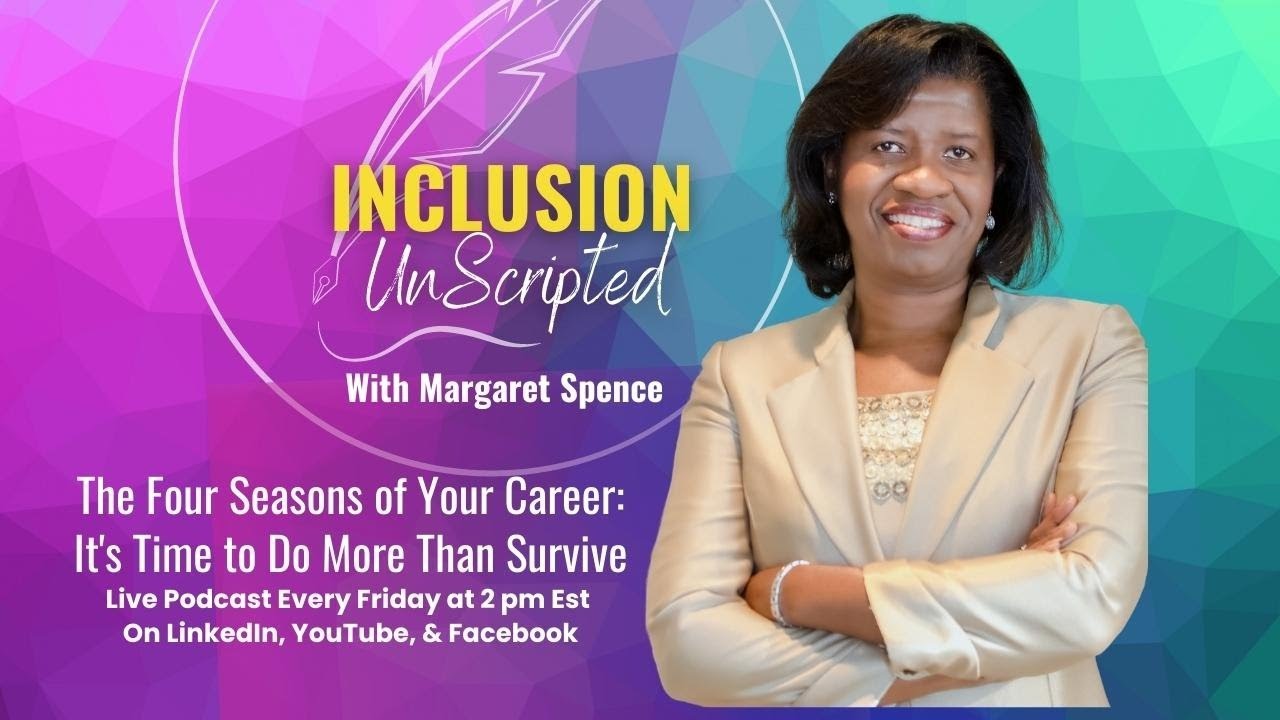
In this episode of Inclusion Unscripted, host and Inclusion Learning Lab founder Margaret Spence frames career development as a cycle of four seasons—winter, spring, summer, and fall—to help listeners identify where they are in their professional journey and how to move toward greater fulfillment. She opens with a brief overview of the Inclusion Learning Lab community, its Third Wednesday open‑forum series, and the newly launched DE&I Data Storytelling cohort. Spence then walks through each career season, describing the emotional and practical characteristics of winter (malaise, loneliness, feeling stuck), spring (hope and expectation without tangible growth), summer (visible growth, abundance, but also distraction and a need for protection), and fall (celebration of achievements mixed with fixation on failures). Throughout, she critiques “quiet quitting,” highlights the importance of compassionate leadership and psychological safety, and stresses that organizations often forget the humanity of their employees. She calls on women of color and other under‑represented groups to recognize their current season, collectively push for equitable leadership, and actively seek tools—like the DE&I Data Storytelling course—to tell more human‑centered DEI narratives. The episode ends with a call to action: assess your career season, shift mindsets, and engage with Inclusion Unscripted’s community and resources.
Chapters
Hi everyone, welcome to Inclusion Unscripted. We are back again this Friday for an amazing show on the season that we are in with our career. That's what we're going to talk about today. So welcome to Inclusion Unscripted, where we're not just talking about diversity and inclusion, we're living it every single solid day. Inclusion Unscripted is built on the premise that we have to live more powerfully. All of us have to live in a much more powerful space, and we have to show up bolder. We have to show up with our full selves. We need to ask for what we want. We need to be clear about where we want to go, and we need to create a safe space to have tough conversations about diversity, equity, equality, inclusion, women's leadership, our place in society, where we want to go, all of that. If you've never joined me before, my name is Margaret Spence. I'm the founder of the Inclusion Learning Lab. And the host of Inclusion Unscripted. We have actually been doing this for a year. I can't even believe that we are 12 months into Inclusion Unscripted. We have recorded, I want to say, 40 episodes, taking away the weeks that I took time off from doing this live event on LinkedIn Facebook, um, Instagram, uh, sometimes on, um, always on LinkedIn, um, and YouTube. So it's been a year. I, I feel like I need to celebrate. We've, we've had about, I don't know, 500, 600 downloads of the podcast because we turn these episodes into podcast episodes, and we have garnered a bunch of folks that listen on Friday from their computer who aren't able to come on and put comments in. But I appreciate you for showing up on Friday for the Inclusion Unscripted live podcast. So to tell you a tiny bit about myself, I have been in the HR space for a long time. I've been a consultant for over 20 years. I am really focused around women's leadership development, totally focused on next generation leaders. Intensely focused on diversity and inclusion in our next pipeline. Because if we create another generation that doesn't see opportunities to advance in our organizations, we're doing a disservice to them. But today we are going to talk about something that is near and dear to me. I got up today and I felt a little tired. I felt like I was exhausted. The Inclusion Learning Lab has been an engine that could and an engine that would and an engine that's going. For all of you that don't know about the Inclusion Learning Lab, please visit our website inclusionlearninglab.com. We have a community that is built for diversity and inclusion leaders to support you in your role, to support HR, talent, talent acquisition, talent development, ERG leaders, organizations, and community groups that are trying to foster diversity and inclusion, equity and equality in their communities, in their work environment. The Inclusion Learning Lab has a bunch of different things. We, we do Third Wednesday, which is our online open forum for DEI. We just had one last week and we're going to have it this week and we're going to have one next week. The open forum is where we come together and we talk about topics that maybe you need to brainstorm something with someone else, with a group of cohorts. It's a safe space where we bring forward diversity and inclusion initiatives. We talk through our processes. This week's event that you all missed, but you got to join us next third Wednesday, We talked about ERGs and how do we make them more strategic? How do we plot the ERG process into 2023 so that our ERGs are more strategic? So that was our Wednesday's event. So you missed it, go to Inclusion Learning Lab, sign up for our newsletter. You'll get a, a notification when we have events. But the big thing that is coming out of the Inclusion Learning Lab this week, The big thing is we have launched our new course. It is called DE&I Data Storytelling, and it starts on November 15th, is our first cohort. We have launched it, we've got registrations. We have a small class that we're launching with. We're only going to open it up to 10 cohort members. It is a 5-week cohort. Here's what I know. Diversity and inclusion data It's not like business data where you say our sales trajectory is here or there. DE&I data elicits either people who say, I don't want to do anything with this, or I'm going to do something, but I'm not going to do it the way that it needs to be. Diversity and inclusion needs better storytellers. We have got to have better storytellers telling the diversity and inclusion story. Diversity inclusion is not just numbers. It's people, it's people's lives, and people's lives depend on us telling the DE&I data story more powerfully with resolve, with and taking our organization on a journey using the DE&I data. So I want you to join the DE&I data storytelling course. It is on our website. If you go to inclusionlearninglab.com, and you do click on the learning link, you will find the information for the DE&I Data Storytelling cohort. So enough of that. Let's talk about why we're here today. Today we are talking about the seasons of your career. And so even though I feel a little like I think I'm in winter right now, right? I said to a very good friend, one of my mentees that I love so much this, this past week. She asked me, how am I doing? And I— my answer was, I'm between winter and spring. And she said, wow, what does that mean? See, winter is a time when things sort of— leaves fall off, it gets cold, nothing is happening, the bears go into hibernation. Um, you know, Paksatwani Phil, the, the, um, groundhog, dips into the ground and we hope to pull him out in a couple of months, probably in February or March, and we'll say it's the end of winter. Here's what I know, here's what I know: every single one of you is in a season in your career. You are existing in a season. And we have to figure out what season we're in with our careers. We've got to figure it out pretty specifically because the seasons that you are in, the place that you are from a season standpoint, the place that you are from a season standpoint is affecting how you view and navigate your career. We are less than 8 weeks away from the end of the year. A lot of you are going to go out and do vision boards. Many of you are gonna make, um, great plans for 2023. You're gonna sit down and make these amazing resolutions around where you think you should be next year. But the challenge right now is the season you're in right now is going to affect how you go into 2023, the season you're in right now. So let's talk through the personal seasons of our life. The season of winter can be lonely. The season of winter can be sad. The season of winter can be heartbreaking. The season of winter can cause us to get the flu and get sick. The season of winter is where we hibernate within ourselves. Many of you are hibernating within your career. We'll come back to that in a second, okay? The next season is spring, and when spring comes forward, we have a lot of hope, we have a lot of new beginnings. We have a lot of opportunities. We begin to see things in this new light. We see the trees getting leaves again, and the seasonal change is coming to an end. All the sloshing that we do in the snow is gone, and we're ready to renew and start again. Some of you, your career is in the summer, and in the summer you have signs of growth. You've got a little flicker of growth. Maybe there's a new leaf that comes out on the tree. Maybe there's a new, um, bud that shows up. Or maybe if it's an apple tree, it's bearing an apple, it's bearing fruit. But in the summer, sometimes we need protection from the sun. We need protection from the elements. Um, sometimes in the summer we get distracted with where we should be going. We get distracted with the nuances of summer, the renewal of being able to go outside, being able to join with our friends, being able to, um, go do things that we couldn't do during the winter. And then we fall into the season of fall, which is where we sort of celebrate our successes and our achievements, and we say, wow, we've made it almost through the year. And we really in fall can focus on our failures. We can focus deeply on how we have failed, how we failed ourselves, how we failed our families, how we failed our community, how we failed the vision board that we did in January, how we failed to accomplish the goals that we wanted to accomplish. English. And so within your career, you have the season of winter, the season of spring, the season of summer, and the season of fall. But here's the deal: while the atmosphere and the environment around us will change every season, some of you get stuck in the season that you're in. Many of you are stuck in the career season of winter. You think you've accomplished some stuff. You're not sure that this is what you want. You're, you're a little bit sad. You're showing up to work a little bit disheartened. You're having a lot of heartbreak around the work you're doing, around the people you're working with, about the organization you're connected to, and you are making yourself sick internally because you hate what you're doing. But here's the real thing: you hate the fact that you haven't asked for what you want. And now you're heading into the season of winter. It's the end of the year, and you've looked back on this year and you've said to yourself, what the eff? What have I accomplished? I haven't accomplished a damn thing. That I wanted to accomplish when the year started. My organization promised me a lot of things. They promised me a promotion. They promised me leadership development. They promised me that I was going to move ahead. They promised me the sky, the moon, the stars, and they delivered zero. A dark night. And many of you have fallen into this ambiguity I don't really have a defined role. I don't really know what I should be doing. I think what I'm doing is right, but I'm too afraid to ask if I'm on the right track or not. And so we sit in our season of discontentment, which is our season of winter for our careers. A few of you are living in spring, eternal spring, where you think there's hope, where you think there's opportunity, where you think there's new beginnings, where you think that the tree that you've attached yourself to is going to flourish and grow for you. But you still haven't asked for what you want, you still haven't focused on what you need, and you darn sure haven't asked your leaders, your organization, to invest, to do an equity investment in your development. So that's the season of spring. A whole nother set of you are living in summer, and summer is where you dress nicely, you find the prettiest clothes You show up in the most happiest state because you get to just exist. And so in summer, you have a need to be protected, but you haven't asked for protection. You have a need for abundance, but you're distracted by the shiny objects that get thrown in front of you. You've asked for growth, but they haven't watered your tree. So you can't grow. See, so you're living in the season of summer but in a sadness state around your own career and your growth and your movement and your trajectory. And so you're sitting in these places where your summer is really a negative, your period of growth, your your opportunity to thrive is not being fueled, but you're happy because you got a paycheck. And that's a good thing, don't get me wrong, having a paycheck is a good thing. But having a paycheck where you're sick and sad and upset and feel like you're dying on the vine is not an acceptable sacrifice for your own self-good. It's not an acceptable sacrifice. We have to do more than thrive. So, so here's the thing, and, and this is, this is a little personal. So I want to tell you all about this t-shirt I'm wearing. The t-shirt says— I got this t-shirt from one of my co-workers. It says diversity is sweet. Um, and it's, it's a beautiful shirt. It's got ice cream cones on it. So if you're wondering why I have on the ice cream cone shirt today, um, for those of you who are listening to this episode after the fact, you can go on to YouTube and watch under Inclusion Unscripted, you can watch the video of me in my ice cream shirt. Um, so here's what I know: if we don't address what is going on inside of us as, as people, as the humanity that we are, then we are going to die on these vines that we're trying to create.
In—
some of you are sitting in the season of fall. You've got success and achievement, but you've had darn more failures in the organizations you work for then you've had success. And just before you're ready to walk out the door, just before you're ready to make a different decision about your life in the season of fall, when your career is in the season of fall, just before you're ready to make that decision, something gets thrown at you. It gives you a new spark, a new resilience, where you think, this is exactly where I need to be. And then you basically say, okay, I'm good, and you forget about the seasons of your needs. So here's a little personal thing, as I was starting to say a little bit ago, little personal thing. We could all choose to be happy, or we could choose to be content. We could choose to thrive or we could choose to be intensely happy. We could choose— we could choose to 10x our growth, or we could choose to struggle through the, through the menagerie of our work environment. We could choose to be uplifted by the people that we work for and our leaders, or we can choose to show up every day um, as it's called now, quiet quitting. See, this quiet quitting thing is garbage. People have been quiet quitting. Um, this giving it a name sounds cute, I'll give you that. Give quiet quitting a name. However, when you, when you start evaluating people based on an analogy, quiet quitting, then you miss an opportunity to say Why aren't we engaging Margaret in her own career? Why aren't we offering her tools so she doesn't quiet quit on us? Why aren't we opening the door so that she sees the opportunities here? How do we move Margaret from the season of winter where she's sad and heartbroken and lonely and sick to a season of hope, the season of spring where she's got hope and she sees new beginnings here and she sees opportunities here? Or how do we move Margaret to the season of summer where she sees growth and she sees potential and she sees abundance and she's not distracted by the fact that we're not developing her? And how do I take Margaret into the season of fall where she's celebrating her success and achievement and not focusing on her failures so she thinks she needs to quietly quit our organization? That's the seasons. But we are so caught up in the analogy, in the wording, in the terms, that we forget the humanity of our organizations. Organizations have forgotten their humanity. Today I watched as Twitter email terminated They, they fired people by email, and somebody who narcissistically leads this group thinks that that's okay for our humanity. And because they've set the tone, the humanity that we have disappears. How do we forget the humanity in human resources? How do we forget the humanity in diversity? How do we forget the humanity in inclusion? How do we forget the humanity in equity and equality? How do we forget the humanity in ourselves as people? How do we forget that? How do we move this needle to the point where we've forgotten our own humanity? And how did you, as an individual working in an organization, forget to fuel your humanness and your own humanity within that organization? And how and why do you allow these organizations to zap you of your humanity, stomp on your humanness, take you to the season of discontent? And then when they're done with you there, they fire you. You're done. Goodbye. Because here's what I know: they were never ready for you. The organization was never ready for you. And for those of us who are diverse, who are leading diversity and inclusion, we have to know the seasons we're in within the organizations that we work in. Because if it's summer outside and inside of us we are in the season of winter, we need to reevaluate the work we're doing. If you're in an organization and it's summer and spring outside and you're feeling like you're in the season of winter where you're sad and heartbroken and lonely and just sick of being there every day, then we have to evaluate our own humanity because the organization is not going to serve our humanity. The organization is not going to serve our humanity. We have to evaluate our humanity as people who show up every day to do these jobs. We have to evaluate the human feeling that we need every day. And if the organization is not providing it to us, then we have to figure out how and where we get the empowerment that we need within our own humanity to show up with more resilience and more power. But we cannot continue to sit in these god-awful seasons, the season of— especially the season of winter, where we are sad and lonely and heartbroken working for these organizations. And, and here's the part that gets to me, that, that gets to me in the most, I don't know, heartfelt way, is when an organization says to an individual I see your potential. I see that you are a great contributor. But oh, by the way, I don't want the world to know you're here. I want to hoard you as the talent. I want to hide you in the corner, and I want to make sure that you're not empowered because you're my secret weapon. You see, this happens on teams. Where you, you want to advance, you want a promotion, you want to grow in the organization, but your leader says, no, Margaret Spence, growth is bad, I need you here. And so your leader sabotages you, which pushes you into the season of sadness. But you show up every day thinking that this organization is going to change, or this leader is going to change and suddenly see your potential, and suddenly they see that you deserve hope and opportunity. See, it's not gonna happen if your leaders, if your organization is not fueling you now, if they're not recognizing where you are in your career, if they're not recognizing that the organization may be in the season of summer because everybody thinks there's opportunity and growth but you're still sitting in the season of winter where you're sad and heartbroken. If the organization can't see that, then you have a problem. You have a problem. Here's something that people do so, um, routinely. They'll say, Margaret, how are you doing? And you say, fine. And they go, okay. You're fine. It's good, Margaret Spence. Okay, we don't need to ask her anything else because I'm afraid if I ask her what season she's in, she might tell me and I'll have to do something with it. We have to recognize as leaders that there is a level of compassion that is required within leadership. There is a level of compassion that must be exhibited within leadership. I'm reading an amazing book called Compassionate Leadership, and it basically says that we have to have a level of compassion for our people. We have to have this level of compassion for our people. It, it actually says leaders are the single biggest contributors to the employee experience. Well, we've already known that. But if your leaders can't see that you're depressed in your role and they can't see that you're not well in that role and they don't care about your wellness or your psychological safety, and they don't care that, that you don't see opportunity and growth in the organization, that you feel that you've been left behind, then what exactly are you doing working there? Do we continue after all of what we went through during COVID Do we continue to put our own well-being behind instead of in front? Do we do that? Do we ask our organizations to lead with compassion, to lead with a sense of humanity? Do we ask our leaders to say that every person on your team is a human being and every person on your team could be experiencing something in their season of life? And how do we move the bar for everybody in our organization? How do we help people feel that they can grow here, that they can thrive here. How do we help them do that? And if you're living through the seasons, if you are living through the seasons of, of discontent in your career, what should you do? What should you do? So let's, let's talk about some solutions. As I said, if you're joining us a little bit late, let me go over the seasons again with you. The seasons of your career, there are 4 of them, just like the regular seasons. There's the season of winter, which is what I call malice or malaise. It's the season where you're sad in your career, you're heartbroken, you're lonely, you're sick. You just feel that you're not at the right place. You just are struggling to get from point A to point B. That's the season of winter. We have to figure out where we are in the seasonal process because yes, we are entering winter right now, but that doesn't mean that your career needs to enter winter. Your career could stay in spring if you're happy, if you're connected, if you feel that the organization is fueling you, your career can stay in spring. See, this is the thing. This is the nuance thread that I want you guys to hear now. See, when you're going through the seasons with your career, it's hard to shake off a season of winter and take on a season of spring if the organization itself doesn't shift, or if your mindset doesn't shift as well. Your mindset has to shift. You have to move from, from being just here to passion and purpose. What's my passion? What's my purpose? If you are in the season of spring but you're not seeing signs of growth, which would occur in the season of summer, then you have to evaluate. My career is sitting in spring. I have hope. I have hope that I'm gonna get opportunity. I have hope that there's going to be a new beginning. I have hope that I'm going to get a promotion. I have hope that if I show up every day and I put my head down, things are going to happen. But the reality is, unless you see signs of growth where your career is actually in the season of summer, you're wasting your time. And many of you sit in this season of spring in your career, and I will talk to you, I'll have sessions, and people will say, but I see opportunity here, I see that I'm going to grow in this organization, I see that I'm going to advance and move forward, I see where I'm going to go. The challenge is you've been sitting in the same desk for 5, 6, 7, 8, 9, 10, 12, 15 years, and the season of summer which is where growth occurs, has never occurred, has never happened for you. But you sit in this vacuum of spring in your career where you think there's hope, there's going to be a new beginning, there's going to be opportunity, there's going to be growth, there's going to be stuff that occurs for you, but you never move out of that because you'll have your annual review coming up I'm sure, and it'll say Margaret is high potential, she'd be a great leader, she is one— the one we want to see as our next generation of leaders. But they told you that 19 times and you're still buying the hope and the hope for opportunity, and you haven't moved off of the hope for opportunity. And guess what? Your organization is totally happy that you are sitting in the season of spring, even though everybody else around you is in the season of summer. They're growing, they're abundant, they're moving, and you are still sitting in the hope. You're still sitting in hope. So do you move off of hope, or do you digress now and go back to winter where you have sadness and loneliness and so on? Or do you sit where you probably are sitting right now, looking at the end of the year through the rearview mirror in your car as you're driving home? You're in the rearview mirror looking and going, in the rearview mirror, I had a lot of things I wanted to do this year. In the rearview mirror, none of them occurred. In the rearview mirror, I didn't get my promotion. In the rearview mirror, my boss promised me a lot of stuff In this rearview mirror, my boss said that I was great, but here's the thing: nothing has ever occurred for me in the last 11 months. For 11 months, you've sat in the season of spring hoping that there would be an eternal spring of hope, but the eternal spring of hope didn't come. It didn't happen. There was no eternal spring of hope. But you're still sitting there waiting. Why are you sitting there waiting? Why are you sitting there waiting? What prompted you to sit there and wait? What was that? See, we have to recognize in our career where we are. Are we in the season of winter in distress? Are we in the season of spring where we're hoping for hope? Hope is going to spring eternity out of this dying and dead career we have. Are we in fall where we are now ending October, looking at the end of the year going, what did I achieve? And darn it, I failed. I failed to get everything that I had on this vision board. See, we have to bring our careers to a season of summer where there's growth, where the organization protects and grooms us, protects and grows us, protects and invests in us, where we are abundant, but we don't get distracted by shiny objects that show up that take us off our game. See, ladies and gentlemen, it's essential that you understand your seasons of discontentment with where you are. We're gonna do a series of these, um, Inclusion Unscripted episodes as we go into the end of the year from the rearview mirror. We're gonna look from the rearview mirror for the next 6 or so episodes What is life looking like for you in the rearview mirror? And how do you, as a powerful person, individual, start looking through the windshield and see where you're going? How do you stop looking through the rearview mirror of everything that didn't happen for you and create your growth, create your abundance, create your opportunity through the windshield, not through the rearview mirror. For all of you that are diverse who listen to Inclusion Unscripted, it's essential that we understand as people of color and as women of color— as women of color, we pretend a lot. We pretend that we're okay. We pretend that we don't want what we want. We pretend that everything is good because if we put on our pretty makeup, if we make our hair look amazing, if we put on fancy clothes, we think that we are okay. And as women of color, we spend an awful lot of time underneath dying on the inside because we cannot get what we want. We've been disappointed so much with what we need, and we stopped asking for what it's going to take to build our humanity. And so it's essential that women— broad category women, broad category diverse women— understand the seasons we're in, and we are able to spot our seasons and effectively navigate ourselves out of the winter and the spring and the fall of our careers and put ourselves in the summer where we are growing, where we are being protected in the organization, we're being protected in our family structure, and where we are able to have abundance and grow and groom ourselves for the next level that we want. And we as women have to get to the place where we understand that they will never actually just give it to us. We are always going to be in this fight. So we could choose as women to fight individually, or we could choose as women to come together and have the fight as women, because the men out there are quite comfortable leading the organizations, leading the teams, and getting the equity share of the organization, and leaving us as the largest population without any equity, without any movement, without any ability to become intensely financially secure. So as I wrap up this Inclusion Unscripted, I asked the question, what season is your career in? Are you constantly living in the season of winter? Are you constantly expecting difference or expecting growth or having hope in the season of spring? Are you always in the season of fall where you evaluate your achievements but you're so focused on your failures that you're not looking through the windshield to see where you could go next? Or are you living in the season of summer where you have signs of growth, where you are growing, where you are being protected and developed within the organization, where you see abundance, but you're so much in your comfort zone that you're distracted from what's going on around you? See, this is the discussion that we need to have with ourselves. It is the power of the seasons that we go through that create the opportunities for us in the future. Ladies and gentlemen, figure out the season you're in, evaluate it quickly, and be willing to move out of that season to where you want to be. I thank you all for joining us on Inclusion Unscripted this Friday. It was amazing. If you have any questions, reach out to us on the inclusionlearninglab.com website. As I said, and it's scrolling across the bottom of the screen, we have a new course, uh, DE&I Data Storytelling. It starts in a couple weeks and we have several cohorts scheduled into 2023. Um, and just reach out on LinkedIn, on Facebook, and on YouTube. If you like this episode of Inclusion Unscripted, please download it from the podcast apps, share it with a friend, tell them about it. And if you think there's somebody that I should interview on Inclusion Unscripted, send me a direct message on LinkedIn. Um, it's Margaret Spence on LinkedIn, and I will be happy to talk to that person, invite them onto the Inclusion Unscripted podcast. So here we go. I'll see you all next week. Have an amazing weekend. And remember, we're not just building diversity and inclusion, we're living it. Take care.
You're like a circle that floats around me. Keeping me safe and sound. And when I fall, you've tied a rope to me. You're blessing me every day. I was down with an illusion, like a sparrow with broken wings, but now I shine with your reflection on me. I'm getting back up on my feet.
Take care, everyone. See you next week.








