E45: Ageism Is Real: The Power Voices of Women Over 40
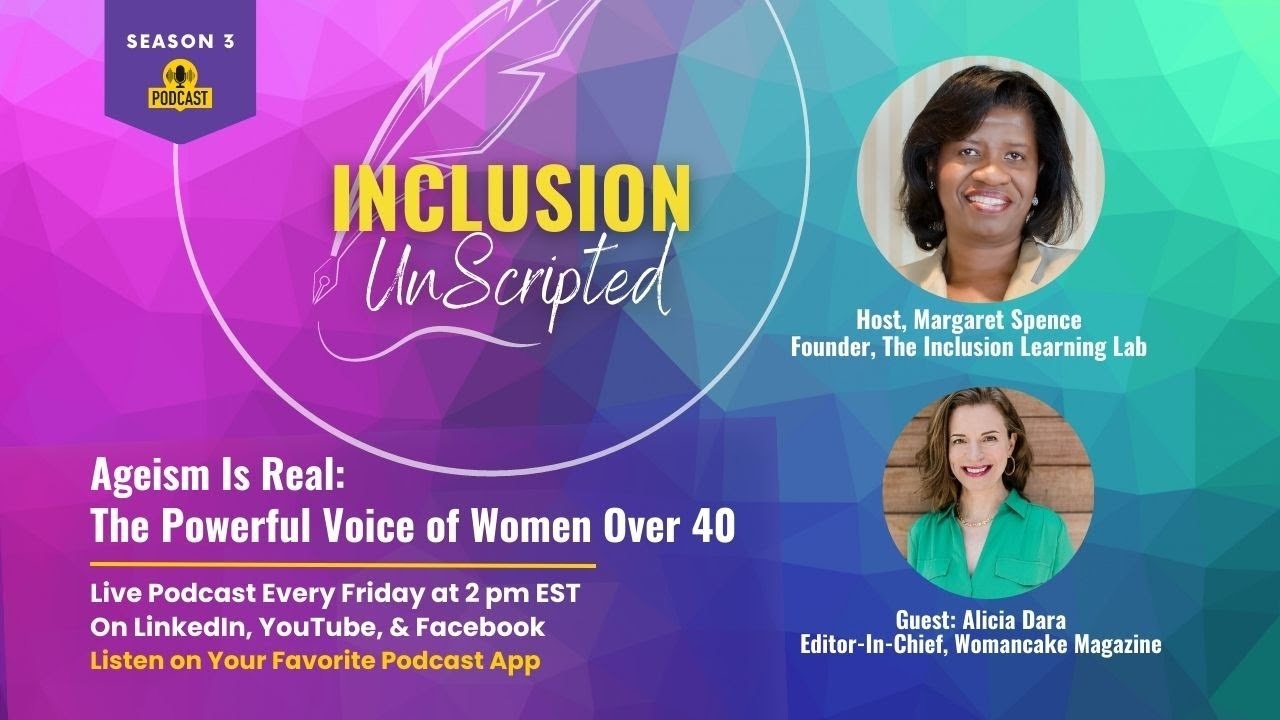
In this live Inclusion Unscripted episode, host Margaret Spence and guest Alicia Dara discuss the pervasive issue of ageism, especially as it affects women over 40 in the workplace. The conversation opens with a reference to public criticism of Halle Berry’s nude photo, illustrating how older women are judged for their bodies and age. Margaret shares personal reflections on turning 60 and the rapid passage of her 50s, framing the episode as a call to examine how organizations often overlook or marginalize mid‑life women. Alicia introduces her "Power Voice for Career Women" coaching method, emphasizing speech, presentation, presence, and advocacy as tools to counter sexism. Both speakers highlight the need for inter‑generational mentoring, robust employee resource groups (ERGs), and formal/informal mentorship that flows both up and down the hierarchy to surface the value of experienced women. They critique current succession‑planning practices that ignore older talent, noting a brain‑drain risk and the lack of post‑retirement engagement. Margaret cites informal research showing that when women CEOs step down, they are rarely succeeded by other women, reinforcing a leadership pipeline gap. Alicia explains the purpose and vision of Woman Cake Magazine—a free, bite‑size publication for women 40+ that aims to shift cultural narratives, celebrate the "queen" phase of life, and eventually evolve into a media company collaborating with other women‑focused outlets. The dialogue also explores psychological barriers that keep women from championing each other, urging a move from competition to collaboration. Throughout, the hosts intersperse audience prompts, personal anecdotes, and calls to action, directing listeners to sign up for Woman Cake, join the Inclusion Learning Lab community, and attend upcoming webinars on ERGs and treating one’s career like a business.
Chapters
You're like a circle that floats around me, keeping me safe and sound. And when I fall, you tied a rope to me. You're blessing me every day. I was down with an illusion, like a sparrow with broken wings. But now I shine with your reflection on me.
Hi everyone, welcome to Inclusion Unscripted. Thank you for joining us today. As you know, we are live every Friday at 2 PM on Facebook, LinkedIn, and YouTube. So thank you today for showing up for this program. We're going to talk about ageism and how women navigate ageism, and this broadcast is actually timely I think it was yesterday or the day before, Halle Berry posted a picture of herself, uh, nude. I think she was fully nude, and she had a lot of criticism from people about her age, about the fact that she shouldn't have shown up that way, about the fact that she, um, should not be doing that, she should go off to the pasture and wait for her grandchildren to arrive. Like, that's a thing. But in the workplace, when we work every day, oftentimes we forget about the multi-generational workforce that we're a part of. We build programs targeting younger women in the workplace, and we don't always establish ourselves as a workplace friendly for every woman. And I was having a discussion a couple days ago with one of our clients, and one of the individuals on the program we were doing said, my husband's older, I'm younger, and he's going to retire. And I often feel that maybe the workforce thinks that I should go off into a pasture somewhere and I should end my career maybe when he ends his career. And that's the thought that I get from my friends and family. Well, why would you want to keep working if he's not working anymore? So I think ageism is real, and ageism is a thing that we have to talk about. And I am so honored today to have a guest on, um, who has launched a magazine called Woman Cake Magazine, and she's focusing and targeting women over 40. You know, we get in this 30 under 30, 20 under 20 and so on and so forth. What about 40 over 40, 50 over 50? And here's the interesting lens that I bring to this. I turned 60 this year, and this is a new milestone. And the time between 50 and 60 went like a snap. I don't even know where those 10 years went. But I look now at my own life and my own career, and I say to myself, where am I going from here? What is my next chapter? But how do I as a woman keep my power as I navigate through from point A to point B? If this is the first time you're joining us, my name is Margaret Spence. I'm the founder of the Inclusion Learning Lab, where we help organizations build inclusive workspaces by training their DE&I and leaders how to effectively navigate talent challenges and build a more inclusive world for everyone. So thank you for joining us, and I want to introduce our guest today. I am so excited to have you here. I'm so excited to have you here, Alicia Dara, and she is coming to us from a beautiful place, um, that I'm gonna go to one day. I've never been to Northeast, the Northeast part of the United States.
Oh, the Northwest, the Northwest.
Yes, Northwest.
Yeah.
I've never been to the Northwest part of the United States. And my bad, um, I've done Northeast, never done Northwest, so it's on my bucket list of places to go. But that's neither here nor there. Let me introduce our guest. She's a national— nationally recognized speech and presentation coach based in Seattle. She's helped thousands of people, including CEOs, global VPs, executive directors, political candidates, break through blocks, find their power voice, and put it to work. Her signature method is Power Voice for Career Women, and we need that, which helps women strengthen their voice, clarify their message, push back against workplace sexism.
Corporate—
her corporate clients include Microsoft, Amazon, Columbia Bank. She's got a long list, um, Amazon, Facebook, the Seattle Trade Commission. But one of the biggest things that intrigued me, why I wanted you here today, was— and I have to tell everybody how we met. Um, I— we were introduced by a mutual friend, and I was interviewed for Woman Cake Magazine. And on that interview, I said, oh my God, you've got to come on the podcast. So thank you.
Welcome.
My pleasure, Margaret. Thank you for having me. I was just editing, putting the finishing touches on your Woman Cake interview, which launches on Wednesday. It is fantastic, and everybody should go into the chat. I put in the link for Woman Cake. It is free to sign up, so everybody should go and do that.
Yes, yes. So Woman Cake Magazine. So let's start there. Tell me why you entered the space of launching a magazine for women over 40. Tell me that.
Thank you for giving me the opportunity to talk about this. So this year I'm going to be 50. I have spent my whole career, pretty much my whole career, working to strengthen women's voices. And I've been asking myself, okay, how can I take it to the next level? And I know you and I spoke about this in your interview a little bit, that there is a— after a woman reaches a certain age, and culturally we can't really agree on what that is, but, but let's just say generally it's over 40. Once, once a woman reaches the age of 40 there is yet another force of oppression that can fall on her, which is that of ageism. And I think you and I, Margaret, are perhaps a little bit shielded in our profession from the true effects of ageism because everybody expects coaches and consultants to be wise. And in fact, there's a hilarious meme about this in the coaching industry that I find so funny. It was a single-line tweet a couple of years ago, and it was just one line, and the line was, the 23-year-old life coach? Like, who's, you know, who's gonna— so I think for us, it actually behooves us as we, as we age, we actually do receive perhaps even more respect. So we're maybe like a little bit shielded from, from ageism the way that many of our peers are. But regardless of that fact, I know you see this and I see this too. I see that hammer coming down on women and I just can't stand it. It is so ridiculous because women get to this point in our lives and it's a time of mastery, right? It is a time when we know more, we are more alive and embodied in our skills, knowledge, and wisdom than we ever have been. And so I wanted to create a venue where women can be seen and heard, older women can be seen and heard and respected in that way. And I just, I, I really want to change, to help to change culture. And that's what I'm doing with Woman Cake. Everything we publish is 1.5K words or less. So we call it Woman Cake and we serve slices of wisdom. So they come into your inbox and you get to eat that delicious slice and get some strength in your day.
Yeah. Wow. So in your role prior to launching the magazine, I know that you were working with women and you were working with them around finding their voice. One of the biggest challenges I see right now, and I did a show last week on the concept, the construct of empowerment, right? The construct of empowerment, which in my view, it was you've, you've given a woman her power. She walked in the door with her power, and then you slowly take it away, right? You disempower this woman over time. You disempower her, you disempower her, and then you create these programs that you're now going to redevelop this woman and give her back her power, and you're going to empower her. And I think that is such a— I don't even know, it's a dysfunctional concept when it comes to a woman's voice. So what do you see as the biggest barrier to women using their voice?
Well, okay, so you brought up something I think that is very important, and, and I don't think this gets talked about enough in our culture, but it's really important to remember, and you nailed it so beautifully, that the systems themselves themselves are not designed by women for women to succeed. They're not set up for us to succeed. So it's a little bit, it's a little bit tricky to kind of, to kind of like tease these things apart. But I think one of the things that women can remember is that we are actually stronger together. So especially in corporate America, corporate America is a very, very sexist environment among other kinds of forces of oppression. Corporate America is a very traditionally and historically a very sexist environment. And part of the way that sexist environments thrive is by keeping women separate, by separating them and siloing them and turning them into competition, really vicious competition for each other. So whenever I work with groups of women, you know, the larger part of my message is women together can change the weather. We have to come together. We are so much stronger together than we are individually. So I think of finding your power voice as being Really, it's 3 basic things. It's your speech and presentation skills and all your professional communication, which includes things like texts and emails. It is a really powerful presence that you bring wherever you go. And it's also really just advocacy for the women around you so that everybody is supporting everybody else's voice. This is a very, very complex issue involving all different kinds of social conditioning, all different kinds of things from the political landscape, cultural messaging we receive. You know, women's lives are— women's inner lives are extraordinarily complex. And the way that we come into these spaces, the way— what we bring into these spaces is extraordinarily complex. And that, as I see it, is not something to be frightened of, but something to really embrace and understand that together, when we work together, we're so much stronger. So this is all just to say that working on our own voice is really important. Working together and recognizing the kind of group change we can have, the effect we can have, is even better.
Yeah, I agree with you. And I think one of the, one of the challenges that I see is that as women, we don't think together. We don't think about the fact that it doesn't matter what race a woman is, she has the same innate needs across every single subset of who we are. If we divide down women into the, the pieces of the pie, pieces of the cake, right? But we don't tend to come together, um, to really fundamentally understand that we all want the same thing.
Yeah, yeah.
And how do you, how do you think with your platform, how can you use your platform as a way to expand this or explain this, or how would you infuse that into what you're doing?
I mean, I think again, it's a question of really recognizing commonalities and recognizing what common interests are to build coalition among women. We don't have to move in lockstep. Certainly your needs as a woman of color are going to be different than mine, typically much greater than mine. And your understanding of the world, the way you move around in the world is going to be very different from the way that I do. But regardless of that fact, there are commonalities, especially in these environments that are looking to just hold women back as a kind of gender, as a, as a raceless category. They just want to really like hold us back, you know. So again, I mean, I think it's recognizing what commonalities are and the fact that we stand to gain so much if we work together. I don't know that there is a simple answer to this question. I think it is a process of trust. So much of what I do when I, what I'm hired by companies to do typically is not just to empower women, which is an overused term, but not just to empower women by offering really, really impactful speech and presentation skills, but also really team building. I do what's called gender-based caucusing. So, so it's really about, you know, team building among women. When women are together in spaces where they feel safe, there is so much more freedom to speak, to connect, to relate to each other. And so that's a lot of what I'm there to do is to remind women to listen to each other and to seek those commonalities, not to diminish the other things because the other things are incredibly important. And again, ultimately, we want to work together as a coalition to push back on all the racism, all the transphobia, all the homophobia, all the other things. But together, as we push back on sexism, that is a very powerful force.
Absolutely. And I agree with you. I think that when we look at all the issues that we have as a woman in the workplace, when we take them in a broad lens, right? Whether it's opportunity for advancement, whether it's gaining skills that we need, whether it's our leader seeing our possibilities and our purpose and understanding how to move us through. Us not getting caught in, oh, she has the most experience here, let's just keep her in the role because she's the most experienced. Why would we want to try to find someone else to do this? Right.
Which is very common. I see this all the time, this thing you're talking about, right?
So how do you, um, how do we in, in a specific way learn the skill of advocacy? Because I, I'll give you an example of what happened. I was doing a presentation. I was asked to do a presentation for an employee resource group of women, right? And they had an employee resource group, and they asked me to come in to talk about women's career and how you should take the path And it's one of the most impactful presentations that ended up happening. A woman raised her hand and she said, "I've been with this organization for 23 years, and for 23 years no one here ever asked me about my career goals or what I want. And now they're coming in and they're building these new career goal things." for women who are much younger, and they are forgetting completely that there's those of us who have sat here for 20 years. And I don't know if the leaders in the room heard her at a deep level.
I did.
It's a— it's a thing that I— it never left me since I heard it.
Yeah.
So I think when it comes to ageism and us connecting the dot together. How do we do that?
OK, well, I can tell you something. So in my career, I've been in over 200 workplaces. And I've observed career women working and moving around in their natural habitat and relating to one another. This thing you're describing, I think, is actually epidemic. And I think my generation, Generation X, is definitely starting to feel it too. I have noticed something very interesting, Margaret. And I'm wondering if you've seen this too. I have noticed that when it comes to advocacy for other women, companies that don't have a formal or even informal mentoring program have very little advocacy going on between women. And I started to sort of notice this about 10 years ago or so. And I, and I've learned since then in working with women who are part of these mentoring programs, both formal and informal, that really good mentoring actually runs both ways. So you and I as older women may be thinking about mentoring down, but there's also a kind of mentoring up. And when it comes to that, that woman that you described, part of what's missing there in her, I believe, in her personal work paradigm where she is now is a sense of value, right? So she doesn't have people who can recognize her value and hold that space for her, that container for her. But I believe, just based on what I've seen, that really good mentoring programs— ERGs are important— and really good mentoring programs can help create awareness of this value. Because who's doing the mentoring down? It's the older women, right, who have all the skills, all the knowledge, all the wisdom, expertise. So really good programs— what I have seen is that certainly the older women will, you know, mentor the younger women. And as you and I spoke about in your wonderful Woman Cake interview, which is coming out next week, we can, we can help younger women understand that there really is no career ladder. It's really about a series of strategic strategic moves. But also the younger women start to notice and to speak up for the older women and say, hey, you know, so-and-so is incredible and she really should get that promotion. There's a, there's a culture there of valuing wisdom that I think is important. And that woman, to me, her story says she's not, she's not in that culture right now. And that's, that's, that's on the company. The company needs to work on that.
And you have a, you have a, you made such a fabulous point about valuing wisdom, right? You know, often right now a lot of organizations are looking at succession planning, right? And they're looking at an aging workforce, and they're looking at a workforce that is going to walk out the door in the next 5 to 7 years. But as we do this brain drain of people walking out the door, there, there's always going to be this gap for the folks coming in the door. Okay. And I don't know that organizations evaluate how do we use our older employees, our long-term employees, how do we use our post-retirement employees, even if they don't— even if they want to go to the beach of Florida and live here on the beach. How do we engage them back even for a couple hours a month and saying run a webinar for us. Yes, do something to bring it back. And I think as, as women, we have to really recognize the importance, as you said, of on-level mentoring, even mentoring across and on the same level you're on.
Yes, yes, I agree. I was just having this conversation with a client yesterday morning. She is now going to be, I believe, very soon she's going to be 59. She's been in her industry, she's in the financial industry, and she's been in the industry for more than 25 years. She and her husband just started to create their kind of vision for their off-ramp for retirement. And I asked her, hey, do you, do you have any kind of plan for, you know, succession? Do you, do you want to continue to contribute in your industry? Do you want to, you know, keep giving? Do you have any, any, anything like that you want to share? And she just went completely blank. She said, you know, it never occurred to me. It never occurred to me. She goes, yeah, that makes complete sense. I have an enormous amount of, you know, understanding of these things. I know this industry inside and out. I can predict trends. I really should, I should think about that. So she was talking, we were sort of brainstorming a little bit about that very thing that you said, which was, could you just do a little webinar once per quarter and just talk about what you're seeing, kind of a broad overview, and then like really like go really deep on a couple of things. And it really cheered her up. I think it really, as we're talking about, I think it really gave her kind of a sense, a deeper sense of her own value. I think that's wonderful. And I think companies should take the time to invest in that. It's really a shame to lose all of that extraordinary— it's not just wisdom, it's power too, you know, to lose all of that. It's not a good strategy for companies.
Yeah, yeah, I agree with you. I agree it's not a good strategy and it doesn't create continuity. And it doesn't give an organization the dual lens that it needs from a whole process. What is this dual lens that I need in terms of serving the women in my organization, maintaining continuity, valuing them, expressing that value, showing the value, and so on? But here's the informal research that I've been doing. And I want to bring this to you as a thought here, okay? I've been tracking, um, over probably the last 20 years or so the women that become Fortune 500 CEOs, and then eventually I started tracking women that have become political leaders around the world. And the trend that I have seen is whenever a woman becomes a leader and she decides to step away, there's never a woman to replace her.
Wow. Oh wow.
I have not seen, except for one, it happened once with Xerox when Indran, um, when, um, I can't remember her name now, when, um, she was probably the first African-American woman who became CEO.
Oh, I know, I know who you mean. Yeah, yeah, yeah.
And so and I'm remiss for not remembering her name. But when a woman— she, she was replacing a woman, and then when she left, she was replaced by a bunch of men, right? And I've looked at the Australian Prime Minister, or New Zealand Prime Minister, yeah, left. She is being replaced by a man.
Yeah.
I've looked at the meltdown that occurred in the UK with the woman Prime Minister, right? And out the door she went. Well, even if you think before that Margaret Thatcher came along, and then there were how many multitudes of men that came after Margaret Thatcher.
Oh yeah, although she— we have to say Thatcher didn't exactly give women in politics a good name. Exactly.
Women in politics didn't get a high mark from her. There was not a check mark. Yeah, right.
But yes, I see your point.
She even opened the door to say, well, a woman can be a powerful Prime Minister Angela Merkel, for example, in Germany. Yes, yes, she was a powerhouse of a woman.
Ellen Johnson Sirleaf is the one I'm thinking of also in Africa. Ellen Johnson Sirleaf in Liberia, I think.
Yeah, yeah. So we have all these examples of women becoming high-level leaders and they age out. Yeah, they're now 40, 50, 60, and they decide, I'm gonna go out the door. Yeah, right, in Illinois, Pepsi, right? And right, right, um, they go out the door.
Sherry Lansing, I think, also comes to mind too. Sherry Lansing at Paramount, I think she was. She's— yeah, yeah, yeah.
So what is it that's missing from us as women that comes back to the community, come back to the mentorship that you talked about? It circles back to all of that. Okay, what are we missing about it, about supporting, about getting somewhere and bringing another woman? What are we missing about that?
So I— first of all, it hit me like a ton of bricks what you just said, and I, and I see the reality of it, and it's, it's a, it's an interesting, uh, very compelling phenomenon. I mean, off the top of my head, I, I think rather than asking what's missing in women, it's important to ask what's missing in the culture and in the world and in these societies and communities that we live in. I mean, again, we're talking about, you know, the concept of women leading a nation is still really pretty new in terms of like, I don't know, the latter, maybe the early half of the 20th century. I'm thinking of Indira, Indira Gandhi. I mean, it's really— it's still sort of culturally new. We don't have enough examples. I mean, I don't know, I don't know, Margaret. It's really—
so I was referring to Ursula Burns. Yeah, yes, yes, right, right. She replaced a woman when she came into the role, right?
Yes.
But then she was replaced by, I don't know, 5 or 6 men. They divided the company up into little—
yeah, yeah, oh yeah, yeah, yeah, gave all these men the company.
Yeah. But do you think— let me rephrase this. Do you think women over 40, even with our wisdom, are given roles that we can win at?
Well, typically no. I mean, I think the answer is no. I mean, that's a huge part of the flaw in the systems as they're designed now. I think, especially in the wake of everything that happened in 2020, there were so many social justice movements that started to happen. And in the wake of the MeToo movement, What I noticed, I don't know about you, but what I noticed was a lot of women, and many of them were women of color, were being stuck at the top of organizations that were failing. They were already failing and they were being told, fix it, go in there and fix it. You want the opportunity, fix it. But all of those systems were already failing, or there was rot that was exposed from the inside. And once the woman gets in there and looks at the books, she's like, oh my goodness, there's no way we can save this in its current iteration. You know, right? So I think we have plenty of examples of, of that, um, that have just happened very recently. But I also think that there is something about— okay, I can't put my finger on this, but it's something I've been thinking about lately. There's something about, about leadership. We, we have kind of like cultural expectations of leadership that are deeply intertwined with patriarchal values. And with sort of a patriarchal kind of outlook on things. And I think here the important thing to remember is that we, all of us, all of us do, women do too, internalize these systems. They become part of our kind of like inner architecture. And unconsciously, I don't mean to imply, I mean, I think of myself as like a dedicated intersectional progressive feminist, but I know that I have, you know, just like everyone else, internalized systems that constantly need to be reviewed and worked on, you know. But so, but so if we think of it at the level of the individual, so we think of each each of us as women in positions of leadership, we each have these, this kind of, let's call it unfinished business. But then we look at the macrocosm, the larger level, and we can see that these systems and organizations and nations have them too. So I think it's a, it's a work that maybe needs to be done on both levels, you know. But that said, I mean, again, the more that we— things like mentoring, things like, like your, like you, your organizations do are extraordinary. You're two incredible organizations, which we talk about in your Woman Cake interview as well.
Yeah.
All of these things ultimately are working toward the same goal, which is to make women more visible, to give them actual tools, not to talk about empowerment, but to give them actual tools to do what they do and then to set them up for success. And the more women feel like they're being supported in these systems, the more they feel like they can change them. And that's what we really need.
Got it. Absolutely. And I wholeheartedly agree with you. In that lens. I wholeheartedly believe, believe in what you're saying. What I've— my— one of my observations is this: I think women are scared to bring another woman along for fear that this woman might not be as perfect as they are, or may look at them a little bit less— like, if I bring her and she fails, and I fail, or if I bring her along why would I want to do that? And then there's this also, this, this triangulation of feeling threatened by a woman, another woman entering the space.
Yep.
And feeling threatened by another woman entering the space. And, you know, I often say to, to people that I'm not competing with anyone. The only person I'm competing with is myself.
Yep.
There's enough business work processes out there in the world for everyone. There is no need for us to butt heads and compete.
Yeah.
And try to play these psychological games with each other.
Yes.
You know.
Yes.
And so, um, as we go through our process here, I want to ask you a little bit about more about Woman Cake and, and your long-term vision for Woman Cake. What's this big vision? Tell me, if you look back 5 years from today, what, what do you want Woman Cake to I'm so glad you asked because I'm working on my strategic vision right now, today.
Okay, well, so I had a guest on my show recently, excuse me, on my show, that I interviewed recently for the magazine named Cindy Gallop, who is the legendary 63-year-old sex tech founder of a company called Make Love Not Porn, which she will be the first to tell you is a social sex website And there's a lot to know about that. And it's very compelling and you can sort of, maybe your listeners can look that up. But Cindy came on the show and she did something extraordinary that I've never seen any woman do in my life, which is that she came for the interview and I was asking her more or less the same question that you just asked me. And she said, well, I'm paraphrasing. It was something like, I want to make sexuality healthy and strong. And loving, and I want to make a shit ton of money doing it. And she was so real. She owned it so much. Yeah, she said, and she said, Alicia, the reason I say that is because women are socially conditioned to say, oh no, money isn't important to me. And since that interview, I've been asking myself, what is my, you know, what's my take on that? And so I've been doing a lot of interviews about Woman Cake in the months since we launched, and I'm getting this question a lot. I'm giving you a long answer.
Thank you for being—
no, no, this is good.
This is good.
So I guess my original answer that I really had planned to give in my capacity as editor-in-chief and the founder of the magazine is to say that I really do want to change culture. But I'm also very interested, sure, in making a hell of a lot of money because I want to be able to turn the magazine into a media company. That's where we can really start to change culture. So what I call the first leap to hyperspace— I'm Generation X, so you'll have to forgive my Star Wars reference— but for me, the leap to hyperspace, the moment that the Millennium Falcon jumps to hyperspace and all the stars go streaming by, is when we hit 10,000 subscribers.
Subscribers.
We are not there yet. We are still in the hundreds. We still need to get up into the thousands as of today. Uh, so the more people come and sign up— it's free to sign up— that would help us a lot. So once we get there, that'll be a major milestone. But 5 years from now, what I would like Woman Cake to be is an active media company that collaborates with other women's kind of media companies. So I'm thinking here of Reese Witherspoon's Hello Sunshine, I'm thinking of Mindy Kaling's production company. I'm thinking of— oh God, I mean, there's just so many. I have such a long list. But to do collaborations that create, again, that create media that is by and for women who were over age 40. And I don't just mean women in their 40s because I'm— as of this year, I'm no longer in my 40s. I mean, you know, women who are much older as well. But to keep really recognizing— can I just be totally real with you, Margaret? I think I can.
Yes, absolutely. I—
there's this thing that keeps coming to mind over and over and over for me. Um, sorry about the siren. When I think about, um, what is supposed to be traditionally and historically the three stages of a woman's life, which are maiden, mother, and crone. But I don't know about you, crone doesn't feel like me. So I have decided, I have decided that any woman who makes it to age 50 is a queen. So it's maiden, mother, queen. That's where I am. So I want, I want to create a culture where women look forward to midlife. We look forward to menopause. We look forward to like coming into this time of power and saying, wow, this is a big transformation. This is the most powerful, essential version of me that I can now bring to the world. And I want the culture to celebrate that. I want the culture to say, welcome, queen. Welcome, welcome. You'll love it here.
Well, wow, that's, that's huge. And that we don't— I'll give you a funny, funny joke. Um, there's 5 of us in my family who are all turning 60 within 12 months, right? And we're all born at the same time.
Are you all sisters?
We're all cousins, right? We're all cousins. Yeah, it's— we— I, I'm an only child, so I don't have brothers and sisters, but we— I have a family of girl cousins. Right? And so all of us were born, and we have one girl cousin that's much older than all of us, and we have one that's— she actually turned 70 this year.
Oh wow.
Turned 70. And then we have one that's in her 60s and so on, and then, and then the rest of us are turning 60 now. So we're all in this arc, and there are several of us that are struggling with 60, and there's others like me that's going, yes, let's go! You know, I don't want to be 40, I don't want to be 30, I don't want to be 20, I don't want any of that again. I want here forward. Right. And I'm going forward. I'm writing this new chapter. Yes. And, and writing this new chapter stronger. And so for women in the workplace, what I want to say and what I want to hope that they— that everyone gets from our talk today is your age doesn't define you at all. And there's so much opportunity and possibilities that go beyond where we think the gate opens and closes for us.
Yes.
And we have to force organizations to end the sexist culture.
Yes.
To empower and move women, not just give them these courses.
Yes.
But to say, you have a voice here, your voice can be heard.
Yes.
This is what your voice looks like, this is how it sounds, but this is how we listen to your voice, this is how we accept your voice, this is how we respect your voice, this is how we move based on your voice. Yes, right.
Yes.
And this is the impact that your voice can have for us across the board.
I love that.
For me, that is the— that's the essence of what the work that you and I are doing.
Yes, yes.
It's this hard work around I have a voice, let me use it.
Yeah.
And I want you to hear it.
Yes. Yep. I completely agree 100%. And I'll add one little thing, which is really about the issue of visibility. I have a lot of clients who get closer and closer to 50, and they start to feel like, maybe I'll just kind of self-select out of, you know, the workplace stuff and various things and this, that, the other. And I'm like, please don't do that. Please don't do that. You know, if you have the energy, if you have the strength, please, please do the opposite. Please show up. Please push forward. Make yourself hyper-visible. Make yourself hyper-visible. I think in a lot of these spaces older women need to really get used to advocating for our value. And unfortunately, that, that's, that's still the case. Ultimately, I think you and I, like you said, are working to help create cultures where older women are inherently viewed as valuable. But until we get to that time, I think it's important for older women to show up in spaces and advocate for our value and get used to articulating what our value actually is. That's a lot of what I do with clients, really, is I help them learn to articulate their skills, knowledge, wisdom, and expertise in a way that has maximum impact so they can go where they want to go.
Yeah, great, great. So one thing that you want to tell us about you, or about anything that you think would impact your current space that you—
oh, my current space that I occupy. Please go and sign up for Woman Cake Magazine. I put it in the chat. It is womancake.com. It is free to sign up. Margaret Spence's interview is coming out next week on Wednesday. I am so excited. You gave us a wonderful interview. And already the staff that I've shared it with just loves it. So I can't wait for that. Please sign up for Woman Cake. That's what I'd like to say.
Okay. A link to Woman Cake from our website.
Thank you.
Episode will go live later today.
Wonderful.
And I want to thank you for being here today to tackling this subject around ageism, tackling the subject around women finding their voice and recognizing that there is no boundaries that we have. And we all share the same thing equally. Yes, all of us do.
Yes.
Yeah, beautiful.
Thank you for having me. It's my pleasure, Margaret.
Thank you, thank you, thank you. And for all of you who are joining us, thank you for this great conversation. We're going to continue talking about ageism because I think it's necessary. I think it's a necessary conversation that has to continue, and I think One of the, the program we're going to do next week is on treating your career like a business. And I think if you treat your career like a business, you understand the various phases that you go through in a business and the various phases that your career will go through if you treat it like a business and not like, oh well, the employer is responsible for my next steps. So thank you all for joining us. Remember inclusionlearninglab.com. You can join our community. We're here every Friday at 2:00 PM Eastern on LinkedIn, Facebook, and YouTube. And you can sign up for our newsletter at Inclusion Learning Lab. We have webinars every week and our upcoming webinars on ERGs. Thank you again for joining us and don't forget to sign up for Woman Cake Magazine. Thank you all. Give me one second as we end our show today. Take care. See you all next time. Friday.
Thanks, Margaret.
Bye, everyone.
You're like a circle that floats around me, keeping me safe and sound. And when I fall, you tied a rope to me. You're blessing me every day. I was down with an illusion, like a sparrow with broken wings. But now shine with your reflection on me.
Take care, everyone.








